The New Office Suite: Harry Stebbings (20VC) and Christopher Pedregal (Granola) at CVAI London
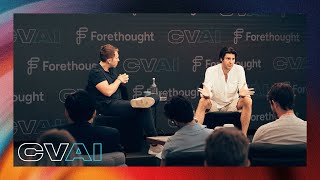
Harry Stebbings interviews Granola CEO Christopher Pedregal on how AI interfaces will change work. Prompting gets replaced by examples, voice becomes the main input, and whoever controls user context across services wins. The legal questions around data access and privacy are still unsolved.
Chapters
This is brought to you by Forethought Building AI agents for every customer moment without further ado, Harry Stebbings is the only investor I trusted to do an interview. You know, sometimes they can be too safe, but very excited to have Harry and the CEO of Granola on stage.
I love that. The only investor he trusted enough. And when he says that. I'm going to start with a story of how I met Chris very briefly, which is my partner thought he was fantastic and that we should invest. I think he was probably one of the first investors that you met at Pre Seed. I met him on a Sunday night and I heard him tell the story of like, yeah, AI and notes. That's kind of it. And we had a nice chat, but that was kind of it. And I called my partner up and I said, lovely, dude.
Fuck.
We've got to set up a Just Giving page for this one. It's the only way he's going to raise money.
Fuck. He actually told me this for the first time five minutes ago.
I thought it was a bit rude, but you took it quite well.
Yeah, listen, I'm sorry of a Just Giving page. If you want to give Granola money, we would appreciate it.
Listen, I want to start actually on something that you said before when we were chatting. You said, hey, I think prompting is going to go away almost entirely. Yeah, that's quite a controversial statement given it's pretty much all that we tend to do today. Why will prompting go away?
Yeah, so I think you need to separate it in two things. We're still going to give AI instructions on what we want it to do, but right now, prompting is a very, very low bandwidth way of giving it instructions. So it's fine to say, write me an email, but if you write a prompt like write me an email, casual tone, quick sign off, don't use EM dashes. That's a really bad way to instruct an AI. So I think examples are going to replace prompting for 99% of use cases out there. Because if you can just give it five great examples of how you want to do it, AI does an amazing job at inferring the structure, tone and goals from those examples into whatever you're trying to do.
One way to get more data into prompts is actually to have voice. Obviously, voice has tonality, it has different volumes. You can actually get more context from voice. How do you think about the future of voice in terms of human input?
Yeah, I think right now one of the main issues with AI is just how slow it is to get information in and out and telling it what you want to do. We're so much faster at speaking than we are at typing. So I think the main or one of increasingly common way of interacting with AI is going to be you speak to it and then you read the output. So voice in, text out. Because we're way faster at reading than we are to listening to spoken voice. So I think that's the way things are going. You still want all the context, you still want all the examples in there. Because saying okay, please write me an email, no EM dashes make it short. Casual tone is still not a good experience. So as long as it kind of understands who you are and then you can use your voice to just direct it to what you want, that feels right to me.
If we have speech as that kind of primary user input, what does that mean in terms of how you create product? Does that change the importance of ui?
I mean, I think UI is not going away. We'll see that. We'll see what Jony I've and Sam Altman are cooking up.
Right. But what do you think they're cooking up? Will it have a screen?
That's the whole question. That's my job, I think. I think you, after 10 years of.
Being wasted.
And setting up, just giving pages.
Yeah.
You're not going to get rid of a screen entirely. Whether it's on that device, I don't know. I think probably not on that device. But to be able to actually do the things you want to do, you'll need to look at a screen at some point. Whether it's when you get home, whether you're in the car, you might still have a phone on you. I presume it'll be a context gathering device that is voice native focus both on your instructions but also getting general.
Context is simple, always better in making great product. People love the granola product. We speak about the kind of rising prominence of voice where obviously UI becomes maybe a little bit diminished. How do you think about simple always being better?
So I don't think simple. Basically it kind of comes down to like how much of an expert or power user you are. Right. Like if you're gonna, if you're editing a feature film, you don't want it to do it. With a UI that has two buttons. Right. You want to have a lot of fine grained control and you'll spend a lot of time getting really good at that. I think the problem with products is that people assume that people are power users a lot more than they are. And are willing to learn new paradigms, new UIs, new ways of doing things much more than they are. So I think the 8020 is that you can get away with a product that only has two buttons. Not only do you get away with it, people will love you for it most of the time. But obviously they're going to be power users that need the more advanced stuff.
When we think about kind of more advanced users, a lot of the time they want more integrations, they want more access to their existing data. We're entering this, as you wisely said before, kind of this kind of context wars. How do you think about this context wars? We've obviously seen Slack have their lockdown. How do you think about this and what happens in the next two to three years?
Yeah, so I think basically we've all realized that AI's usefulness is limited by how much it knows about you.
Right?
So like the AI that's going to be most useful is the AI that knows you best. And I actually think the models we have today are super smart. The problem is that they don't know who the heck you are and how you do things and what's going on in your life. So I think context is king. And right now that context is split across all sorts of companies. Right. And I think you're talking about Slack putting up like limiting access to its content. I think no one knows exactly how it's gonna shake out and I think a lot of companies are gonna get scared. So I think we're gonna see a lot of reactionary, like limiting of data over time. It's all customer data and customers are going to do what they want with it. So I think they'll be the go through this middle age period and then there'll be the enlightenment on the other side. But over the next couple years, I do think people are going to limit access to their data into context. And I think what you'll see is you'll see a lot of companies trying to go lower level. So instead of going through an API, Slack can stop its API. But if you have access to the pixels on my computer, you can look at all the Slack data. So if you're a desktop app and you have accessibility settings turned on, you can look at all the pixels on the computer or if you're a browser. So for example, D from the browser company can look at all the content on all your websites. Right. And then it becomes a legal question rather than like a technological limiting question.
What happens in that world when it becomes a legal question on Accessibility of user data on screen?
Yeah, I don't know. I'm not a lawyer. I think we've seen norms change pretty quickly.
It's like a complete wobble. I mean, I just fucked up.
Yeah. Okay, so are you guys familiar with dia, right? Chrome. And it has chat on the side. So, okay, the question there becomes, if you open up a website in your browser and you select all, you copy and you paste that into ChatGPT, is that okay? Right. And then what if your browser just does that for you, Is that okay? Like, who's liable? Is it you? Is it the browser company? I think the norms here are going to. Are going to change quickly. That said, we might not even have seen the legal backlash to AI yet. So I don't know if we're just like pre, you know, all the copyright suits and whatnot coming to bear, or if we're just at the beginning of this new phase where new norms are going to have to be established and rethought.
We have two different kind of ends of the spectrum. We have HubSpot, who are kind of very progressive in terms of their thinking. Early partners with OpenAI, very forward thinking with Dharmash in a lot of ways. And then you have kind of Salesforce and Slack, who are kind of locking down, and they seem to be kind of two opposing ends of the spectrum. Do you think one will win where the other will lose?
I think we're going to end up in a more open place. As in, do you think the strategy is better to be open or locked down now?
Yeah. I mean, do you think Salesforce will be punished? Slack will face declining user numbers, bluntly suffer at the hands of being a closed garden.
I think they will. I think it's all a question of time frame. Right. I think there's a question of how quickly does OpenAI try to eat the world versus, you know, how quickly can other products adapt to the new world? I think that's kind of the race.
Right.
Because if so, I think it all boils down to, is there one general UI that you use to do all your work? Like, do you go to ChatGPT and you do everything through that, or do you have a bunch of verticalized UIs that are specialized at that and better at it? And I think the jury's out. Obviously, at Granola, we think we're going to have specialized UIs for important use cases. But I think that's really what this is about.
My favorite quote is, will the incumbent gain innovation before the innovator or the startup Gains distribution. How do you think about that today? If you think about an OpenAI's ability to do what you do in some respects and have distribution versus your ability to move fast, be very nimble, innovate.
Yeah, I think my, my view here is that we are in, you know, when the iPhone came out and you had like the beer drinking apps and the lighter apps, like, I still think we're in that stage of AI, which might sound ridiculous because whatever chatbot has 500 million users and is clearly useful, but I really think that is the case. I don't think AI is that useful. I think it's today and I think it's mostly masquerading as useful, but you end up spending a lot of time like rewriting or redoing it. Another way to put that is it's going to be so much more useful in one to two years and I think we have yet to see truly AI native interfaces and products come out. And I think that's the whole question. I think it's not about the products that exist today. Those are still like the caveman days now. It's like who can get to the truly AI native experiences and whoever builds those first and who gets distribution on that. That's my view. And I think we're all, everybody in the industry is pre that right now.
What do you think we do today that we will look back on in five years time and go, gosh, I can't believe we did that.
I think prompting the way we prompt today is going to seem completely ridiculous. Or the fact that right now you ask, you ask an LLM to write something for you and then the way you change it is by giving it another prompt, asking it to change it. Like you don't go in, you can't go in and edit the thing it just wrote. That's going to seem fricking bananas. Right? I think how is there any LLM out there that you use that lets you edit the thing it just generated? Which one? Sure. Okay. Yeah, yeah. For code. But if you look at natural language stuff, it seems like, yeah.
Will we have more or less engineers in 5 years time?
Define an engineer, I guess.
Don't be like Jordan Peterson.
No, I mean, I'm serious.
Right.
Are people going to be writing less code? Yes. Right. Are more people going to be building things? Yes. So computer science graduates. I don't know that one's hard.
Do you think AI helps 1x engineers be 10x better or does it help 10x be 100x better?
Oh, wow. You're good at these questions.
I've done 3,000 shows.
What do I think? I think today it definitely lets you can go from 0 to 1. So people who couldn't build stuff before can now build things. And that's incredible. I think if you're learning how to program now, it's a tricky time because you don't actually need to learn a lot of the foundations. But then down the line when you need to fix stuff, you don't have those foundations, so that's tricky. I don't think the 10x makes. Well, I don't know. I don't have a smart answer to that.
Don't worry. It's very rare though that for me I mostly interview VCs so they never give that as the answer. I want to do a quick fire round, so I basically, I'm going to just papa you with questions. Okay, hit me with your immediate thoughts. What do you think of Zuck buying scale?
I have so many questions about that. Like I'd love to know what. Like I'd love to know all the details. I can't. I can't draw that picture from the outside.
Do you think that Daniel and Nat Deal will go through with them joining as well?
I don't know.
Do you think Windsurf will go through?
I don't know.
When will you start taking people's money?
I don't know.
This is a very productive quick firearm. Which AI startup that is less well known do you like or respect the most?
That's a good question.
Mine would be captions. The speed with which they interact with.
Them captions is incredible. Captions is incredible. And I don't hear that much about them, but yeah, it's hard. I feel like we hear the same few names all the time and then there's tons of startups out there and it's really hard to break through because there are so many AI startups. Yeah, nothing good.
What would you do if you were Sam Altman today?
What would I do if I were Sam Altman?
To be fair, Paul Chris had no context on any of these.
I mean, I think he's doing a lot. I think there's a tough tension between consumer and work use cases. Right. And I think there's probably a bunch of. I'm sure they're working on this. I mean there's some articles about this, but product surface area for productivity that they, if they, if they build that, then all of a sudden all the incredible models they have will make that much more useful. So I think you'd go after a lot of like Google Docs type use cases and if you, if you can do that in an AI native way, I think that'd be quite powerful.
Final one for you. Five years time. Talk to us about what the granola product looks like in five years.
Yeah, I think if we do our job right, you'll be doing a lot of work inside of Granola. Well beyond meetings.
Won't be on meetings.
Beyond meetings, Yeah. I think if we do our job right, most of this room should be doing most of their work in granola. I think that's the world we're going in. I think in the past the product categories have always been determined by the format of the content. So you'd use Excel for spreadsheets or you'd use Google Docs for a doc. And I think in the future it'll transition from document types to workflows. So it's about the end to end workflow, if that makes sense. And then everyone's going to go after can compete after the same workflows. So you need to have the right context around those.
Listen, Chris, thank you so much for agreeing to do this with me. After the just giving comment at the beginning, it was setting a low bar for that one, but thank you so much, dude. This has been a pleasure to do.
All right, thank you.
More from Christopher
How to Build a Product that Hits PMF on Day 1 | Granola, Christopher Pedregal