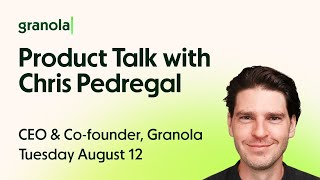
How to Build a Product that Hits PMF on Day 1 | Granola, Christopher Pedregal
Christopher Pedregal, CEO of Granola, achieved product-market fit on launch day by obsessing over user research and discarding half the product before shipping. He counts only users with meetings longer than five minutes to avoid self-deception, and builds products with a "soul"—coherent design rooted in shared values.
Chapters
We had product market fit. We had it on day 1 of launch. I think the first lesson is like talking to users is the lifeblood of building product. This happens all the time. You're building something, you're like, this is great. And then you put it in front of users and then they don't understand it. For example, there's this amazing video on YouTube, a product designer doing a user test and you see the user grab the square and put it into the square hole. The designer's like, yes. And then you see the user grab the circle and put it in the square hole. And the user's like, what? And then you just see like basically completely misunderstanding the product that in front of them. If it takes a month to, to get feedback on it, it's almost not worth doing because the thinking you had when you made the original decisions, you don't even remember. So I think the short cycle there is super important. What I don't believe is that you should talk to users and then just do whatever they ask you to do, right? Because users are going to say a whole lot of things and sometimes they'll contradict. Sometimes what users think they want and what they actually want or what they actually need are different. I think if you just make a prioritized list of user needs and build those. That doesn't work very well. Hi, I'm Christopher Pedregal. I'm the co-founder and CEO of Granola. Granola is an AI notepad for meetings. Uh, think of it like Apple Notes, except it will listen in the background, and when your meeting ends, it'll take whatever crappy or raw notes you've written and flesh 'em out into great notes. We launched Granola a year and a half ago. We were 4 people at the time. We're now 35 people. We raised our Series B at a $250 million valuation and we're growing super quickly. I really love building tools that let people do things. This idea of, oh, if I make this product great and people use it, it means they get value out of it and their lives are perhaps a little bit better as a result. That's something that I've always found really motivating. I was born in '86 and Google, like the search engine, launched in '98. So I was 12 years old when Google launched. I was just fascinated. I lived in a small town in the middle of the woods in upstate New York. So the internet was like this window onto the world. I kind of looked at California and Silicon Valley and Stanford and Google and all those companies. I looked at them as like, you know, up on an altar. How do they do this? So when I went to university, I kind of studied, I want to understand how do computers work? How does the internet work? How do you build things for the internet? So I studied computer science. Like there's these very key moments that happened to me in college where I was like, oh, interesting. That, that speaks to me. And like one, I was, um, in a security class and I learned that, hey, cryptography is basically magic, but most, almost all security vulnerabilities come from people doing the wrong thing or systems not being designed in a way that makes sense to people. And I was like, oh, interesting. Even something as technical as security, the human interaction element is huge. And then later in my journey, I discovered this field called human computer interaction. And it's basically the study of how do people use technology and how do you design technology for people? Like if you want to build a really, really fantastic product, you really, really need to understand your user in that moment. This is something I talk about a lot internally at Granola, that Granola as a product, the product should feel like it has soul. When we interact with a product, like if I pick up this mug and I hold it and I interact with it. It's a little bit like interacting with a person. What I mean by building a product with soul is that that whole product should feel coherent, consistent, like it's coming from the same place. It's coming from the same set of values. And I think it's very easy to tell if a product has that, and it's very hard to build. The reason it's hard to build is because the bigger, the more complex a product gets, the more people are involved in the making of the product. And when lots of people are involved in making it, they're all going to have different values, different viewpoints for different ideas. If they're not aligned in a very deep way, every screen of the app is going to feel very different. You know, there's that, that famous thing, which is if you look at a product and you can tell the organizational structure of the company that built it by the design of the product, and that's really, really bad. Take your, your best friend, imagine your best friend, right? You can kind of imagine what your best friend is going to do in most circumstances. If you make fun of them or you make a joke or you praise them, you're kind of going to know if they're going to be graceful or blush or make fun of you back or start crying. You kind of understand what they stand for, what they like, what their values are. We build these mental pictures of people. If you start talking to your best friend and all of a sudden they start acting like your principal, you know, or your boss, it's like you don't really know what to do with that. And we do the same thing with products. What I mean is like a product with soul is the exact opposite. It's not about the company structure. It's coming from a much deeper place in terms of, of values and personality.
I'm Taylor Rotwell, the founder and CEO of Laravel. Our mission is to help developers build, deploy, and monitor applications consistently and beautifully. Starting projects is great, but more importantly, you need to ship them. Great ideas mean nothing until they ship. That's exactly why I built Laravel. To bring your entire journey from idea to production into one seamless flow. It's more than a PHP framework. It's a complete connected ecosystem built for speed and confidence. We provide elegant opinionated solutions for everything your modern web app needs. And you can deploy in under a minute with Laravel Cloud, straight from Git, zero config needed. Laravel now powers nearly 600,000 live websites, helping developers worldwide ship their ideas fast. Build with elegance, deploy with confidence, monitor with precision. Stop configuring, start shipping. Visit laravel.com today.
My whole philosophy is that there's an explore and exploit. I think a huge advantage for us when we started building Granola is that we didn't launch it for a year. And what that meant is that during that year, as we were exploring things and trying new things, we had a lot more freedom to change the product drastically. I'd say for the first 9 months, 10 months, we were mostly adding things, adding new features, trying to improve them, adding new, like, screens, what have you. And then at one point, we kind of realized, okay, here's the thing that's going to be most important, most useful to users. And we went and we cut about 50% of what we had built. That would have been really hard to do if we had been launched and we had lots of users. Like, it'd be very hard for us today, in one fell swoop, cut half of the product. I think our users would really yell at us. That's a big part of the, the way we build. So for any product that you're building, first you have to go through this explore phase where you're figuring out what's the shape of the solution. And there you want to try as many different things as possible. And once you kind of know what the shape is, then you go into a different mode we call it exploit internally, where you just polish, right? You take the rough shape and you polish, polish, polish, polish. And here's where the details matter. But you need to make sure you're polishing the right shape. Because if you're polishing the wrong shape, then all of that is throwing. The question is kind of like, do we hit something that's valuable and now it's time to polish? Or do we, should we still be looking for a new shape? Right? The answer is like, it is really hard to know if you have the right shape of a product. It's really hard. When we launched Granola, I didn't think we had it. At that point, I was like, I think this is good enough where we'll learn more by giving it to more people. That's why we decided to launch when we did, because we said like, are we going to learn faster by continuing to do this? Are we going to learn faster by launching it and getting feedback from lots of users? And up until that point, it was really clear to me that we would learn faster by just onboarding 2, 3 people every day and getting feedback. And at some point, once we started doing that and we started hearing the same things over, and over and we kind of understood those users. We said, okay, now let's give it to lots of people because maybe there are people who want to use it for use case we've never thought of. And the fact is we had product market fit on day one and we didn't realize it. And one of my biggest mistakes was not noticing it. It took me 6 months to realize that we had product market fit. We had it on day one of launch. The first lesson is like, it is really hard to know when you have it. I heard this story that the Facebook team, they had this other idea, which is kind of like Dropbox for music, some kind of file sharing thing. And they worked on it, I think for the first 6 months or 9 months after they launched Facebook. Because they were like, oh, I don't know if there's a there there, you know, we might want to work on this other thing more. And that's Facebook, right? That's like the generational company of the decade. And they still didn't know necessarily if they were onto something huge. So what I got wrong, I think a lot of early founders get wrong. A lot of people will sit down and say, I'm going to build a product. Here's the pain point I'm going to solve. I wanna build a great solution and it's all about, can I execute on that? Have you ever played those video games where you land on a new level and there's like a little map in the corner and it's all gray and then you need to kind of go and walk around and then the map kind of unblurs. But when you start off, basically you have no idea of what the terrain around you looks like. I think that's the right metaphor. The right solution is unknowable until you go out and you try it and it gets contact with the world. You can't sit and design the perfect thing. You need to like put stuff out there, probe the system and see how the system probes back. I very much believe that talking to users is the lifeblood of building product. I think if you're not constantly talking to users, not constantly getting feedback, you're just not going to build something really good. You need to systematize your ability to talk to users. If the activation energy for you to go and talk to your user is high, then you're just not going to do it very often. And if you can lower that activation energy necessary to go talk to a user, and if you can do that for your whole company, great things are going to happen. So this was 2013. I started edtech company, an AI tutor for high school kids called Socratic in New York City. And I, uh, I ran that for 5 years and then Google acquired that company. It was really hard for us to actually go and talk to high school students. I remember we'd know that there are a few colleges and a few high schools around our office in New York, and I would sometimes go after school and be like, hey, do you want to answer some questions? And it felt super creepy. Eventually, it took us a while to get there, but we figured out this system where on every Tuesday and Thursday, we would have, I think it was like 5 to 8 high school students come into the Socratic office. And spend the afternoon. We didn't have anything to talk to them about. That's fine. They would just sit there, do their homework and leave, and they would get paid for it. And they were super happy. But if we were working on a new feature or if we were working on messaging or whatever it was, they would be there and we could show them whatever we were doing. And the moment we had that, our ability to improve our product and make it better sped up dramatically. A big difference at Granola versus Socratic is that, um, we can talk to users remotely, like over Zoom. And that actually makes a lot of sense because our product's meant to be used during meetings, right? So we'll do a lot of video calls with, with users. So we, we usually have standing user interviews 4 days a week that anybody at the company can join and whoever's working on stuff can ask for information. So that's something that I've taken away from the Socratic experience and have kind of carried with me since. The second thing is, in my opinion, like the secret with user interviews is you don't need to hear the same thing from 10 people. If I put a prototype in front of you, and you say, this button's super confusing, and I look at it and I'm like, oh, I totally understand why you're confused. I don't need 10 other people to tell me that. I should go and I should change that button immediately so that next time I show it to somebody, I learn what the next problem is. And I think this is something that especially in big companies, that's unheard of. It's very easy to delude yourself. Be very, very skeptical and critical and honest about if what you've built is actually something people want and they're actually gonna use. Use. So like in a user interview, never ever ask someone if they would use something. Or you can ask it, but then completely ignore the answer. If you're putting them in front of a prototype, ask them like, what would you do next? And then if they say something, say, is that true? Or like, don't you think you'd be tired? Or, you know, like really probe on it from a negative perspective, because that'll, I think, get you to the reality faster. That's just human nature. In a user interview, you're going to try to say nice things. So I categorically ignore all positive things that people say. And use really conservative metrics of engagement. Internally, when we say a user, it's only a user who's done at least one meeting, new meeting on this day, and that meeting has to have over 5 minutes of transcription. Otherwise, we don't count you as a user. So if you used Granola yesterday, we don't count you as a user today. If you open up Granola and looked at 10 meetings, but you didn't do a new meeting, we don't count you as a user. And we basically, from the get-go, we've always had very conservative metrics for what's activity so that we kind of, we don't kid ourselves. It's so, so easy to come up with excuses or say like, oh, you know, it's actually because of this other thing that we're going to fix. It'll be fine. Like the product's actually good enough. What I don't believe is that you should talk to users and then just do whatever they ask you to do. Because users are going to say a whole lot of things and sometimes they'll contradict. Sometimes what users think they want and what they actually want or what they actually need are different. So my philosophy is to talk to users so you can really get their context. You can hold that in your brain, but then use your intuition and your vision of what the product should do. So from the get-go, I think we've always known that we wanted Granola to be a very simple, minimal design product where it feels nice to spend time in. It's not distracting. It's not vying for your attention. That's been rooted on what we wanted in a product, right? Because we use Granola and we've always wanted to use Granola. But as we try to build that out, we have hundreds and hundreds of users kind of in our heads that we can kind of close our eyes and be like, oh, what would Nancy think of this? We can kind of visualize the response pretty well. And I think that's super important. I think if you just make a prioritized list of user needs and build those, that doesn't work very well. Like whenever we've done that, users never ended up using those features very much. Like this happens all the time where you're building something, you're like, this is great. And then you put it in front of users and then they don't understand it. They hate it. They don't get it. There's this. Amazing video on YouTube, a product designer doing a user test, and you see the user grab the square and put it into the square hole. The designer's like, yes. And then you see the user grab the circle and put it in the square hole. And the user's like, what? And then you just see, like, basically completely misunderstanding the product in front of them. I think the only way you can build an intuition is by putting stuff in front of people and getting feedback on it quickly. If it takes a month to get feedback on it, it's almost not worth doing because The thinking you had when you made the original decisions, you don't even remember. So I think the short cycle there is super important. When we started building Granola, we took a very, very iterative approach. Like we built the bare minimum thing and then we tried to get people to use it and see all the reasons why it didn't work. And then we tried to fix those and then we tried to change it. And I think your intuitions do get better, but you can never stop doing it. That's the other thing. It's like the intuitions get better and then you stop talking to users and And your confidence level still stays high. So you're like, oh, I understand users. I know what I can, what I need to build. And then when you start user testing again, you realize you're totally off-piste. And I think two different paths you can take when you're building products on top of AI. You can build a product that will basically replace the human, or you can try to build a product that's going to augment or enhance what the human does. That's basically where we're going with Granola. So we're starting with meaning notes. We're going to help you with all the work you do. After a meeting, whether that is writing follow-up emails, whether that's drafting a memo. We're going to help you prepare for your previous meetings. We're going to help you do analysis across all your meetings. We're going to help you do more and more and more and hopefully make, make your life a little bit better every day.
More from Christopher

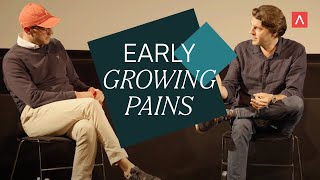


The New Office Suite: Harry Stebbings (20VC) and Christopher Pedregal (Granola) at CVAI London