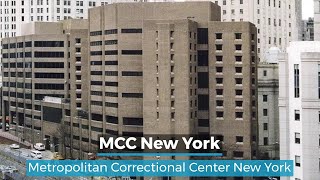
Chris Zoukas describes MCC New York, a 12-story federal detention facility in Manhattan holding 609 detainees awaiting trial. The facility has minimal drug treatment, only a 40-hour education class and a non-residential 9-month program. Notable incidents include housing El Chapo and Jeffrey Epstein's suicide in 2019.
Chapters
Hello, my name is Chris Zoukas, and I'm the Managing Director of the Zoukas Consulting Group, a federal prison consultancy specializing in prison preparation, resolution of in-prison matters, and reentry success. Today I want to talk about Metropolitan Correctional Center New York, which is also known as MCC New York, and I have also seen it referenced as MCC Manhattan. The technical name is Metropolitan Correctional Center New York for MCC New York is a federal prison in New York that houses primarily pretrial detainees. These are federal criminal defendants who have been charged but not yet convicted of federal crimes. The facility also houses a smaller number of sentenced inmates, some of which are awaiting final designation to the facility where they'll serve their time. There's also a small work cadre of inmates who remain there to help with prison operations. So MCC New York houses both male and female detainees and prisoners, obviously in different areas of the facility. It is an administrative security prison, which means that it houses detainees and inmates of all security levels. So they have different wings in which— or different wings and floors in which the inmates reside based based on their security level, um, and also along their sentenced or non-sentenced status. It currently houses 609 male and female inmates. It is part of the Bureau of Prisons Northeast Region. It is located within the Southern District of New York, the federal district for SDNY. So most detainees who are there are pending trial in the Southern District of New York. Specifically the U.S. District Court. It is a medical care level 2 facility and also a mental health care level 2 facility. This means that detainees and/or inmates at the facility, um, they can have some medical problems that require periodic physician review and care, but not anything incredibly serious. So for example, it's fairly typical at a medical care level 2 facility for healthy inmates inmates suffering from mild conditions like Type 1 and Type 2 diabetes, high blood pressure, and other conditions that can be maintained through physician contact on a, let's call it, a semi-regular basis. So they need to see a physician once every 6 months or so. So MCC New York was opened in 1975. It's 12 stories tall. It has held a number of high-profile detainees throughout the years. For example, Gambino crime family bosses John Gotti and Jackie D'Amico. It has also held numerous terrorists. It held El Chapo. One of the more kind of unfortunate incidents at the institution was actually Jeffrey Epstein's suicide, where he had hung him. I believe he was, he had hung himself. But there are a number of other incidents at the facility as well. For example, I believe it was in 2019 that the various social support agencies came in, bring in food. I think really what they're focused on was that the conditions were so bad because the power was out for such a long time at the facility facility. Now you had like the Salvation Army and other organizations were actually coming in and were bringing blankets and jackets and clothing for the inmates. Um, that was probably the one of the more notable recent incidents at the facility. Um, so inmate housing. So inmates are housed in one of 10 housing units. Um, 2 of the housing units each have 20-person dormitories while the other 8 consist of 2-person cells. In addition, there's also a special housing unit, which, you know, call it what you want to call it, but it's solitary confinement. That's where inmates who are in protective custody, inmates who have been in trouble at the facility and are being housed pending investigation, or who are placed there because of disciplinary segregation reasons. Inmates do have access to health services, psychology services, at the facility. There is no residential drug abuse treatment program, but the facility does offer the drug education class and the non-residential drug abuse treatment program. So your drug education class is the 40-hour, uh, it's just a, a basic class that all inmates who have a history of substance abuse are required to take. The non-resident— non-residential, uh, Drug Abuse Treatment Program is a 9-month-long program that goes through kind of the, the knowledge component of the drug treatment for the BOP. So this is a non-residential, and it does not offer the year off the sentence that the RDAP program does. Inmates at the facility do have access to a leisure library and a law library. Um, there's no UNICOR at the facility. There is a commissary at the facility, so inmates who— inmates and detainees who receive funds or who work at the facility, such as the work cadre inmates, are able to spend their money on things such as radios, MP3 players, various food items, various clothing items, and the like. Visitation at the facility, so Visitation is held between 8:00 AM and 2:30 PM, except on federal holidays in which visitation is held, or also held between 8:00 AM and 2:30 PM. This is based on the inmate's assigned housing unit. So right now, visitation is on Mondays for 9 South and the SHU. For B and A units, it's also held at the same time. On our website, you can, prisonerresource.com, you can find the actual visitation policies, which we repost every time the Bureau of Prisons changes the visitation policies. Note that due to COVID, there are differing regulations, and this seems to be a fluid, an influx situation. So be aware that the status of visitation can change rather quickly. Like I said, I think it's about it. If you're looking for additional information on MCC New York, that is Metropolitan Correctional Center New York, please go to prisonerresource.com/federal-prisons. Again, that is prisonerresource.com/federal-prisons. There you can read our profile, our comprehensive profile on MCC New York, which includes all the basic information such as where is it located, of how do you write an inmate there, what are the programs available, what are the housing units and the housing structures like. Um, one thing that we're particularly proud of is that we've managed to obtain the visitation policies for the institution. So that would be the visitation supplement specific to MCC New York. Also up on MCC New York's page, we also have the legal visitation policies for attorneys. Additionally, we have the admission orientation, admission and orientation handbook for inmates who are either sentenced there or detainees at the facility. We include the PREA audit report. So that's the Prison Rape Elimination Act annual audit report. And this is a report, it's honestly, it's not as helpful as it could be, but it does detail the most recent PREA audit findings which goes into, you know, what are the areas of concern at the facility, what are the number of actual reported sexual assault instances or accusations, along with how many were substantiated and other quite interesting background there. We do have a Spanish visitation regulation section up as well. So if you speak Spanish and read Spanish, you'll be able to see that in your native language. And finally, we have the MCC New York Commissary List, so you can see what inmates at the facility can currently buy, what it costs, and how it works. Thank you very much for your time. I appreciate it. Again, my name is Chris Zookas, and I'm the Managing Director of the Zookas Consulting Group. If you have any questions about any federal prison matters, please feel free to reach out. Our website again is prisonerresource.com. That's prisonerresource.com. You can also call us at 843-620-1100. Again, that is 843-620-1100. And we're available via email at info@prisonerresource.com. Again, that is info@prisonerresource.com. Thank you for your time.