Maximum protection. Maximum margins. Minimum effort.
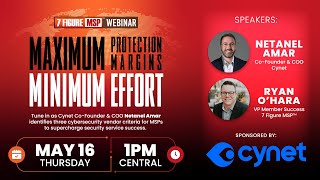
Nathaniel Amar from Signit and Ryan O'Hara from Seven Figure MSP argue that MSPs should consolidate on all-in-one security platforms instead of piecing together best-of-breed tools. Signit claims 100% visibility in MITRE evaluations and keeps false positives below 3%, with centralized logging, automation, and 24/7 monitoring built in.
Good afternoon, everyone. We're getting ready for this webinar. We're going to do, like a little bit of a live green room here for probably the next three to five minutes. Give everybody a chance to get in the room. So please stay tuned if. If you want, introduce yourself in the chat. Tell us where you're coming and watching in from. Where are you coming from, Nathaniel?
I'm actually in a small town right next to Jerusalem, the holy city. Yeah.
So what time is it there?
It's actually 9pm our time.
Not too bad, not too bad.
I'm in the future. It's actually a very good time slot to have the east and the west coast people as well joining us.
Yep, yep. Perfect. Yeah. So you're. You're about seven hours ahead of me.
Yep.
Right. We've got Texas, we've got Toronto. I love Toronto. Southern California, New Jersey, A little bit of everything so far. And for those of you guys just rolling in, we're gonna give it probably a couple of minutes here, give everybody a chance to get in the room before we get things kicked off. So we're just doing a little bit of live green room time here with Nathaniel and myself and all of you. Oh, we've got Alaska. That's one we don't see every day. I think Alaska is what, like, 10, depending on where in Alaska. Four or five hours behind me. The other direction. I feel like we need music for these green room sessions.
Anything in mind?
I've got plenty. I just don't have any of it queued up. Think about that next time.
Guns and Roses, November Rain.
I don't have that in my record collection, but that would be a good one.
Took you back to the 90s?
Yeah, that's. That's my. That's my era. That was when I was in high school, so a lot of the music behind me comes from that. Around then.
Music is forever.
Mm. All right, we'll give it another minute or two and then we'll get things rolling. You give us a little sneak preview of what we're talking about today.
Yeah, actually, we are going to talk about how to do things differently in cyber security, which is a very complicated area. And we will see how we can have the maximum protection, keeping the maximum margin possible with having really having the minimum effort on the maintenance, implementation and operation side.
I think another cool way of taking a look at this too, if we're able to kind of navigate it that way, is one of the struggles I've talked to MSPS about lately is some of the ones who are newer to the cybersecurity space and getting into it, kind of struggling with how to get spun up with a cybersecurity stack quickly. I think some of them go down a few too many rabbit holes, get a little bit too in the weeds trying to make everything perfect. When in reality partnering with a company like yours who can pick up most of that slack and do all of that stuff for them, as opposed to them taking potentially years to become experts in all of this stuff, is a really good solution.
No, definitely. Actually this is one part of the reason that we actually founded Senate as a company. We actually saw that in the market, but this is something that we are seeing worldwide. We are seeing these type of challenges within MSPS and the actual end customer that have the thirst for the managed service provider to rescue them from this horrible situation. And we will talk about it. Those rabbit holes that you mentioned, you can definitely skip those. We have enough scars of mistakes that we've done in the security world and I think that we can learn from that and we can do things better for the future.
Sounds good. Well, let's get rolling into it. So thank you for joining us. My name is Ryan o'. Hara. I am the Vice President of Member services for Seven Figure MSP and today I'm joined by Nathaniel Amar from Sign In. We're going to go through maximum protection, maximum margins and minimum effort. So Nathaniel, if you want to do a little introduction of yourself and your company and then just let me know and I'll get that your, your deck up and we'll start going through this.
Absolutely. Thank you very much, Ryan. So if we can have the slides ready and first things first, thank you and your team, Ryan for inviting me to present during today's session and and of course for everyone in the audience, I'm very grateful for this opportunity to speak with you. My experience in cybersecurity actually spent from number of different leadership positions playing both defense and offensive hats in cybersecurity. My background is hacking and I took this type of expertise into the defensive world being chief Information Security Officer for the board of Universities within in Israel and having the National Institute for Testing and Evaluation, which is I think the equivalent for SAT in the States, the organization that runs the SAT in the States. And after that I become the Chief Technology Officer within secos, which is an information security consulting group within Israel. And then I took the leadership of the biggest offensive security company came out of Israel, which is baacseq. This by the way, a company founded by my Partner Eyal. He founded this company when he was 16. So you can guess, you can guess how much better of a hacker he was comparing to me.
Yeah. Starting a company like that, he probably got into a little bit of trouble.
I think One of the VPs of Gartner called him security boy wonder during this time. Yeah. And after what we saw in the market, we actually founded Signit together. So this is my experience. Michael, next slide please. And actually this will lead me directly to how we started and where the vision came from. So imagine that you have both the offensive security mindset and you know how to protect the organization because you're actually seeing all the cracks. You know exactly how to navigate within the organization. And we are seeing something very weird in the market. I will share with you some of our experience in there. We used to have a cyber attack simulation. It's like a very sexy type of penetration testing. Becoming a real live hacker nation state type of expertise, going to Global 2000 companies, companies that invested huge amount of money, huge amount of time, and they took the best people in cybersecurity possible in order to build their security posture to defend the organization. And we used to have 100% success rate within less than 48 hours to own this organization and to navigate and to do whatever we want below the radar within this organization. And we understood that something is broken with cybersecurity the way that we are protecting our businesses. Because if this is the case for Global 2000 companies, if they are not able to really defend themselves with all the money, all the people and all the technology, the best of the technology in there, that something is not working properly. We actually saw organization investing in increasingly complex multi platform type of security. I want to have the best type of security control to cover my emails. I want to have the best security controls for my endpoints. I need to actually defend my expanding attack surface. I'm using more and more SaaS applications, my users are working remotely. The challenges are growing. And we saw that actually very early. And we also saw that using the glasses of the offensive security and this is where everything started for us. We saw it's very hard to buy, implement and maintain those type of different solutions into one place. And that created cracks for advertisers to exploit. That means that we actually built in our security posture in a way that, that helps the attacker to navigate between those different security controls, stay under the radar and still getting their things or their malicious activity getting into this organization. And these type of challenges actually inspired us. So we designed siement Comparing to all the other alternatives in the market from the ground up to solve these specific problems and to empower even the leanest theme for security operations group because we used to have. We are having huge amount of organization as our customers that have maybe, I don't know between hundreds of assets to 350,000 assets within one organization. I think this is our biggest and they still have a lean security team and our product designed exactly to have those type of organizations. Next slide please Michael. And basically what we try to do is to achieve everything from the ground up to have a wall to wall solution for any type of organization. But in the automation in mind with the visibility in heart and the ability to reduce time to know that something wrong is happening, time to act upon anything malicious that you are finding and the ability to reduce time to resolve. We will touch that later in those slides. And I believe that those goals that we put to ourselves in our vision actually took us by surprise. But we are seeing huge adoption by MSPs. We will touch that a bit later. What we saw during those time is that once you are changing the mindset of having the all in one approach. I want to really protect the organization. Wall to wall protection into each size of organization is one. You need to achieve 100% visibility and you need to achieve 100% ability to react. And this is something that got tested by Mitre and they are very, very happy by the results. We'll talk about that later. But we also want it to be cost effective because you cannot protect a $1 million business with a 2 million dollar security control budget. It makes no sense. And we are actually. I will tell you a secret Ryan. We already already lost to the malicious side. The attackers are using so many different techniques that causing us to spend more and more money and it's actually too much already. And we are seeing the market going into consolidation. But it needs to be cost effective solution. I need to protect the businesses in a reasonable way and a reasonable amount of money. The second thing or the third thing actually is the ability to be simple. We lost it. We lost the simplicity within cybersecurity. I think more than 15 years ago. We are building more and more technology up upon the other. We need more and more people to operate stuff. We are flooded with different alerts, right? It's not something that you can operate. And if you focus in on the small and medium enterprises or even very big enterprises with a small security team, you will find these challenges something that really bothers you. Next slide please, Michael. All right. So this is what happened in the producers. We started going with direct approach. We went into the market and we told every company that we faced, this is what we have to offer. We have the all in one type of capabilities. We ranked top three in Mitre, which is the toughest type of evaluation currently in the market. We are very happy with what we have. Come on and join us and we actually had a very good success. We have around, I think up to 1,000 direct customers approximately. But the nice thing about it is that within a very short period of time we started to get knocks on the doors from managed service provider. And this is a very, very interesting things to understand because the managed security service provider and the managed service provider market is growing amazingly. And if we look at the numbers within a few slides as well, we will see that there's a reason for that. And the reason is that those companies looking for consolidation actually aren't able to find the capabilities within their own teams and budget to face the current challenges, the cybersecurity challenges in the world. Next slide please. Michael and Nathaniel.
I would argue that they probably shouldn't in most cases. I think some companies try and do it themselves, themselves when they're going to be way better positioned to partner with a company such as yours that does this every day and specializes in it, as opposed to trying to spin something up from scratch.
This is completely accurate and I will take it a bit further. Further than that. Imagine that you have a lack of around 4 million security expert worldwide at the moment. You find it very hard to hire the people to operate the security controls that you already have. And of course you have those personnel trained, knowledgeable and having all the ability to act upon any type of tool which you don't have so many inside the organization. Imagine that you need to have the budget, if you're a small or medium enterprise, you need to have the budget of the Fortune 500 type of companies in order to reasonably defend yourself. This is not something that is going to work. And this is why customers are choosing MSPS over and over again. And we talked about around 1,000 direct customers. But what happened is that only during the last two or three years we got so many managed service providers, more than 200 of them, and each and every one of those can actually have hundreds or thousands of end customers behind them. So we're actually today serving huge amount of customers behind the MSPs and we are seeing this demand growing and growing and it makes perfect sense. And this is something that makes us very proud to have all those MSPs choosing us because it makes sense, because it works. This is something that we are definitely going to move forward with. Next slide please. All right, so based on this experience, let me share with you the lesson learned. Right, so one, the demand for cybersecurity services is something that is growing. But we have seen many MSPs that are actually intimidated by the effort needed, the expense in order to get in to start to launch the offering of the many service by their own. We are seeing that the security. Sorry for that.
I guess I think the other thing too, Nathaniel, not only are they scared and not think that they can get that stuff, stuff spun up properly, I think that they have a lot of resistance to the fact that they think that they can't sell it either.
I completely agree with you. And the reason that they cannot sell it is that because they cannot compete in a, in a, in a good way, they cannot offer what the customers are looking for and they're not getting fast enough into the market competing with others that are already there. And this is something that we are going to, to change and I'm going to scare you here for a bit, but we are going to specifically talking about what is stopping everyone from offering a security service. Next slide please, Michael. So the early steps actually seems discouraged. No worries, I'm not going to read every word on this chart. But basically we are seeing that the traditional mindset is to start with researching what is available in the market. What type of product do I have, what type of vendor, what is the best, what am I looking for, what type of customer, what is my ideal customer profile and what is the best security control that I can provide to him. This is the first step. This is already intimidating. This is huge amount of work and time needed just to do this first step. Second, let's assume that magically we were able to find the top 5, 10, 15 security controls that they need. Now I need to evaluate each vendor to see what is relevant to my needs. More than that, it's not about having the best technology, it's about having the best technology to meet the pain points of my customers. So it's even more challenging than that. Let's assume that we skip that challenge as well. And let's say that we also able to compare our requirements and we are able to iron out the deployment and configuration and we are testing the qa, making sure that everything is within a reasonable quality level and then I was able to train my team, etc. Etc. This is not a process that can have let's say a solid business that go out into the market having a good offering. This is something really intimidating. But I really believe that we can change it. Next slide please. Thank you. So what we are seeing here, it's actually less than 5% of the security vendors we currently have in the market. I think the most accurate number according to Cybersecurity magazine is around it's over 3600.
Wow.
Security vendors currently in the market or claiming to be a cyber security vendor, many of them actually focusing on protecting specific aspect. I'm going to focus on protecting your SaaS application. I'm going to protect your mobile devices. I'm going to protect the ability for your employee to connect remotely from home or from JFK or hot or whatever into your most sensitive location using vpn, et cetera, et cetera. There is no ability at the moment for MSPs for end customers to really understand within this huge noise what to do, what to choose and what is the best solution for them. So do you guys have time to vet them all to test even 1% out of those? There's no way something here is broken. There is the cybersecurity paradox here is that we still think that having the best of breed approach, spending more money, no one have an unlimited budget hiring people that are not really available to us and buying more and more security solution will make my organization be more protected or my service providing a merit service provided to the end customers will do this trick. It's not working and how do I know it? Number of successful security attack every year is growing exponentially. I will give you one number to remember. $6 trillion. This is the cost of cyber damages last year during 2023. I will give you one additional thing to additional number to know. This is double the amount of climate change damages. This is only the cyber security damages last year. This is crazy number we cannot have the same approach in order to solve the future problem which is going to be to get bigger and bigger with AI and everything else with the same approach. We need to do something differently and this is why we are here. So we build some criteria in order to let's say three keys criteria. That is going to be during our presentation. And the first thing that you need to know is that we need to solve this cast and we need to know what is the first criteria to distinguish distinguish between an effective and ineffective cyber security tool. And let's ask for the first question Next slide please. Michael is the solution is an all in one solution. So back in the days we used to think that all in one is equal equivalent to a mediocre type of tool. I mean you cannot be a very good submarine and an airplane, right? You need to choose. It's either this or that. In cyber security it's different because if you are built from the ground up, with the knowledge of visibility needed, the knowledge of how to react and how attackers actually works within the organization, you can build a wall to wall solution to cover most of your needs within one solution. And this is very different, I would say in a positive way. It's different from having a dedicated solutions try to integrate between them, trying to make different technologies fix one with the other, or having the, let's say the big vendors are actually buying companies and build them into one offering. It's still different technology behind the scene. I'm familiar with one big vendor that actually bought six different companies, five of them of my close friends, and try to orchestrate all of them into one offering. They have a very cool name for it. It's still not working well after three years because having those things really integrated with each other, it's not working so well, unfortunately. So when we are asking if the solution is all in one, it's our ability to handle. Next slide please. The increasing amount of cyber attacks and the variety of them and we are seeing those increasing in volume and in sophistication. So we are seeing ransomwares not growing by numbers, but growing by the amount of money they want. Once they are getting into your organization. We are seeing more and more backups being encrypted, getting the organization on their knees, trying to get business work together. You are seeing more and more botnets, you're seeing credentials, you're seeing vulnerability exploitation across huge amount of devices and you are seeing your attack surface growing because you're using more SaaS applications. People are working hybridly now. Since COVID people are not working from the office anymore, nine to five, five days a week, it's, it's not happening. People are connecting from everywhere. We have seen employees having their laptops on their kids lap, using to watch YouTube or whatever, clicking on whatever. We don't know even what. We have a big challenge and we need to make sure our solution can meet those different type of threats in one consolidated way. Next slide please. And this is why we are seeing more and more, and this is actually very cool numbers, more and more security vendor, more and more security provider and more and more end customer going into consolidation. Because we understand today that having different parts, that each of them are moving in different direction for buying them, managing them, fine tune them, and trying to chase this type of activity over and over again is not working again. How do we know it? The amount of successful cybersecurity is going year over year. So we have seen that actually the reason for those consolidation, 65% of them. Gartner says that it's actually reducing the risk. It's improving our posture just by having the all in one type of approach, the consolidated, the consolidation type of approach, in addition to cutting the cost, which we used to thought it's the main type of, let's say, the main reason behind going into. Into consolidation. Next slide please.
Michael and Nathaniel, like, just to kind of summarize that a little bit too, I think like one of the big reasons that consolidation is so critical and can reduce costs and make you more secure is the all in one solution still has the various layers and the various pieces. It's just all managed in one place. So what you're getting is instead of having all of those pieces, all with different vendors, all over the place, you have them all in one place, easier to manage for one. But the important thing to me is you are getting all of that telemetry being looked at by the same company. So you've got a lot more visibility. It's kind of to go back to your submarine analogy. Instead of looking out a bunch of different portholes and only having each person be able to see what's right in front of them and you are able to see everything around the entire submarine and be able to tell much better, is, is this really a risk or is this something that's, you know, a false positive or, you know, just an employee who's working on their vacation in the middle of the night versus somebody hacking into them?
Definitely, Ryan, you got it nailed. This is exactly, exactly the core of the, of this topic. And I will elaborate. There's two very important things in cybersecurity when you're going into the defense type of operation. One, visibility. I need to know what's going on, where things are happening, what type of activities, who am I protecting? I want to know everything about the users, about the assets, about the files, about the network, everything that I need to use in order to have my business processes run, you know, business as usual. I need to protect them in a way that it will provide me the context, not only the visibility. So I need to see wall to wall, but I need to understand what I'm seeing because otherwise it will be huge lake of data, which is meaningless. To me, I cannot do anything without it. Because we have built everything in a way that we will analyze for example the files behavior with the machine's behavior. That means the endpoints, servers, mobile devices, etc. We'll analyze all the files behavior will connect and protect your security posture. Even with your SaaS applications, more and more organization are not limited to the perimeter anymore. The perimeter is dead, the user becomes the new perimeter. Right? Because you're using Monday, you're using Salesforce, you're using Zoom, you're using whatever type of SaaS applications and those security posture needs to be protected. The configuration changes within SaaS application is not something that people are even getting their mindset within because they are flooded with alerts elsewhere and they are focusing on different things. So once you have the very good visibility and you can cover everything around you and you will have the context because you have such a good visibility, you can actually put the automation in place. And we will talk briefly about it within a few more slides. But to get into the point, when you're trying to manage complex security tech, stack of siloed type of solution, you know, one endpoint security with one network, behavioral analysis of user behavioral analysis, etc. It's exhausting. But more than that, once you have an incident, where do you start? You need to call the IT guy. Give me the active directory logs, what's going on with the firewall, Give me the information from there. What is the attack scope, where it started, what things are happening, you are clueless, it's exhausting. And you cannot move forward in an efficient way once having an incident with multiple security controls because you are not able to manage them or even to get them into the situation where it's providing you a reasonable security level. Next slide please. Michael. And this is what it actually the big mindset change that we are doing. We are unifying a full suite of security capabilities into one, except of having different type of security controls that we cost. We talked about it a lot, the time, the complexity, the budget that is not really existent, the skills. We don't want to move on with this journey because we know it's not efficient, it will not work well. Let me take you into our ui. Next slide please. Michael, this is how things looks like when you will start the morning and you will get into your seat 8am, 9am if there is an incident, it can be 4am at Saturday, right? We don't really know when she hits the fan. You need to start with one dashboard, one. I want to see that Everything checked. I want to make sure that my email is protected. I want to see that my SAS and cloud workload is protected. They want to make sure that my endpoint covered. I want to make sure that all my automation that I invested in are running smoothly for me. I don't want to do manual work which I don't have the time to do. Instead of that I will use this console and this is something our MSPS really like because they have the multi tenancy and they can manage huge amount of customers within one headcount which is very profitable and it helps them complete better. You can actually offer to your end customer a better price because you can manage multiple accounts under one headcount which is very very good. Next slide please. Michael Perfect. Once we have this visibility, once we have this one ui, you want to make sure you can connect to everything which is important to you. The integration must be native because when you want to integrate into your SaaS application, for example in order to gain visibility, you also want to connect to your firewalls, for example to your active directory, to your other security controls in order to do two activities. One, enrich the data. For example, the automation can take information for my Fortinet firewall and get it ingested within silent but it also can provide the ability to act on my behalf. Dear Fortinet Firewall, Palo Alto firewall, checkpoint, firewall, whatever it is, block this traffic, create a specific security rule. You can do whatever you want. Once you have a native integration with a simple UI in UX you can actually have this type of automation and integration having a wider coverage of protection but also reducing the time taking us in order to have those activities within a very fast manner within an incident response. Next slide please. All right now sorry I think I have a short delay here. So when we are talking about all those benefits and we are talking about the all in one security capabilities then we have the centralized log management which is the SIEM solution that we must have for regulation and for all the logs retention and stuff like that. And when we have the security automation and orchestration built in as a core within the product and when we are covering the users and email and endpoints and network and all the other stuff that we talked about briefly and we also have additional layer of 24. 7 this is actually allowing the MSPs to maximize their profit by the ability to provide a full bridge protection capabilities with one solution. You don't need to go and to buy more and more product and try to have those type of security posture having Your customers secure in a non efficient way. Next slide please. Perfect. This is something I really like. We put some signed testimonials. So here we have Dean from Wally Computer Associates, great partner of us. You're going to peles get more value. What else do I need, right? I mean this is the kind of business that we are here for. We want to make sure that our end customer will have the best protection possible. We saw the micro result, we are happy with that. I will actually share some more information about it in a few minutes. But more than that, you can get into the market very fast, you are going to pay reasonable price for the software and you can provide more and more value to your customer and more and more profit to you. So what's holding us from taking that forward? Next slide please. Just to recap this criteria number one so security challenge wise, we can actually detect and prevent, we can scale, we can have the higher margin possible for the msps and we really believe that consolidation, having the all in one cyber security solution as a mindset, this is something that is going to change dramatically the way that we are consuming security. And this is why we are experiencing so much success with MSPs worldwide and having their end customers super happy. Next slide please Michael. We can talk about the second criteria, automation. Now this is something very important. The autonomous vision is something that it's not exist only in cyber security. It exists in cars, it for a long years now in airplanes, aircraft, etc. You have the autopilot right? The pilot today can take off, can fly and can land automatically, completely owned by the aircraft capability, can do everything automatically. The pilot is there just to make sure that everything goes smoothly and there is some problem that needs to be handled. But the automation is there. It's going to change our life. We are seeing more and more people driving, keeping the lane with autonomous car, making sure they will avoid incident, et cetera. This is exactly what we want to achieve within cyber security and the ability to reach there is within automation. Next slide please Michael. And this is where we are getting actually into the what's in it for me? So when you're using automation you can actually reduce the time, the time to know that something wrong happens, the time to act upon a malicious activity and the time to resolve which will get you back to business as usual. It currently take up to 207 days on average to detect a breach. Just to know that something bad happens. This is not a good place to be. Next slide please Michael. Time is money. When you have automation in place, you can actually on the bottom line on the cost of the data breach, it can be reduced by millions of dollars. So if you will have no automation at all, it will cost you more than $5 million. If you will have a limited type of operation of automation in place, it will cost you around $4 million. And it's actually more less than $3 million today. If you have a really good automation in place, why you detected very fast, you resolve very fast. This will reduce the business impact, right? If you can prevent this is best. No one wants to know about a ransomware that encrypt everything 10 minutes ago. I don't want to detect that. I want this type of event to be blocked, completely blocked. Zero business impact to my organization. But if I got into the detection phase, I want to make sure that I can reduce the time dramatically upon all those different criteria. Next slide please. And this is where I think the main differentiator between the security service providers can actually offer and use to their customer. Automation can help us at night operation, can help us during weekend. Automation can help us when our employees are sick and they can help us when I need fast and accurate instant response. I need to make sure I will have minimize the minimal effect on the client business operation while having an incident. And we saw it in real life. We saw hospital delaying operations. We saw hotels not able to get guests into the rooms. We saw retailers, stores are not operable because some ransomware attack or anything else. Time is money. We need to make sure we can get the fast recovery possible. And we have the way to do that. Let me share with you some number next slide please. Check out this number. This is a real life number. We are very proud of that. 90% less manual handling, 50 times more faster results. The automation within silent it's actually built upon playbooks that designed to replace what a human being, an expert human being will do. Once facing an alert, he will triage, he will deploy, he will create the policy, he will mitigate, he will investigate on your behalf. He will get all the findings. He will enrich the information from other security controls and then we'll get the remediation for you in an automated way. This is crucial. This is one of the biggest feedbacks that we are getting from MSPs of why choosing Signit upon anything else in the market. Because of that you can compete better, you can make sure your customers are happy and when things really go sideways, you have the best ability to recover and to get into resolution within minutes. We are not talking about 207 days just to know that you are breached. We are talking about minutes to recovery. This is what we can do with the automation. Next slide please. And this is something very cool. You know we are competing with huge amount of security vendors. We were talking about 300, sorry, 3,600 different security vendors in the market today for the first time, for the first time, when you're using automation, when you have the ability to protect almost everything which is crucial within the end customer organization, you have the best result possible. For the first time ever signed delivered both 100% invisibility, 100% in analytic coverage with zero configuration changes. And this is something very important to learn. When vendors are going into the evaluation, they are, let's say, focused 100% on security. They don't care about anything operational. They don't care if the agent on the machine will consume 90% CPU usage. They don't care if the machine is not able to work or to serve any user doing his job because it needs to protect when signed. Take out of the box configuration with no configuration changes and reach for the first time within the MITRE evaluation, 100% in both categories. This is something that we are really proud of and this is for us the stamp that our vision works and this is the things that we need to do across the security market, the cyber security market, across all vendor possible to make sure that we are changing the mindset and we are going forward with things that are actually working, not necessarily doing the same things over and over again, which is not really working in order to protect our organization. Next slide please. I see that we are very limited on time. I will go a bit faster than that. Basically when we are talking about automation, it will lower your cost, it will reduce the time, it will make sure your customer is really protected and having the minimal business impact possible upon an incident. And it will help you actually in real time having the best result for security and the ability to recover within one dashboard, one employee at a time, serving different hundreds of different customers. Next slide please. Another testimonial. This is something again very nice. This is I think one of Latin America partners of Sinet that year over year going almost 300%. This is something that we are really proud of, this is working and the ability for us to see that it's working is not only by growing 300% is to make sure this 300% growth that represents happy end customers on the other side. It's something that's actually going to change the market. Next slide please. I think that we talked about it enough. Let's move forward with the time so we'll have time for Q and A. And let's talk about the scale. The scale is important. I think the technology is the crucial part. We must have the best technology possible. But on top of the technology we must have the right human expertise to monitor, to operate and to make sure the technology will provide the best capabilities. Next slide. When we are talking about, and we talked about it before, when we are talking about lack of security experts, we are Talking about almost 4 million people during last year. Next slide please. We are talking about understaffed teams worldwide for the companies that we are serving. So even the ability to prevent, to troubleshoot, to fine tune is not there. The people are focusing on trying to triage 1000 alerts per hour from huge amount of different security controls. Next slide please. And they are still the weakest link. We are talking about that by next year we will have lack of talent or human failure will be responsible for other half of significant cybersecurity incident. By the way, this is also causing for human errors that we are seeing like in the past, big breaches that we saw within Nvidia, Microsoft and the other. It came from human mistakes. This is something we must avoid and we must get improved in order to get things in a more secure way. Next slide. Perfect. This is where the money is. When we are talking about SMBs looking for security services, you can see the numbers. This is billions of dollars, right? If you look at 2022, we are talking about 25, almost $26 billion. When we are talking about four, four years from now, 2028, we are actually doubling the market, tripling the market within additional six years. This is what the money, this is what the needs. We have seen the pain points within the managed service providers and we want to be the technology that will serve those MSPs in order to provide the best solution with the best profit and the best charging but also the best protection capabilities to our market. Next slide please. This is where the Sinet expert can get inside. When silent offers the technology. It also also provide the 24, 7 managed detection and response capabilities to our MSPs. And we are not talking about regular SOC analysts. We are talking about reverse engineers, traffic researchers and malware analysts. Those guys are really state of the art person that can help you hold your hand within incident response, make sure that they can triage, they can take false positive and reduce it for you. They can make sure that you will have the best knowledge and ability to act upon a specific Incident and they will be there for you 365 days a year. 24 by 7 ready for you with our in house security operations center.
Nathaniel, we actually had a question related to that. If we want to hit on that now real quick. I think you probably hit most of it but Harry is asking what is signet? What does signet MDR actually mean? Will you respond to an event to stop a malicious process that your soar automation can't didn't do, isolate an infected device, et cetera.
These type of questions came from real life. Right. When we are talking about the MDR and why is it needed upon the automation is because automation is never perfect. Technology is never perfect. There's no silver bullet. Right. Especially not in cyber security. And when we are talking about the MDR service it actually goes within a few different directions. One alert fatigue. The MDR is going to reduce the amount of false positive that you have. It's going to actually reduce the amount of alert that you are going to see anyway. Signed. Have we haven't talked about it before? Less than 3% false positive alert. This is the best, the best percentage within the entire MITRE evaluation companies that participated. The average over there is around 20%. Right. So we are very happy with that. So one, reducing the false positive value. Second, we are talking about the ability to get deep dive manually where we have an inconclusive type of finding. Instead of you doing it yourself, sign it, MDR will do it for you. And the third thing, make sure that you will have the best expertise within an incident response with people that really can get into the details they can understand if this is a targeted attack, if this is something super sophisticated, if this attack scope is not something that is dedicated for a specific person or a specific asset within the organization, you will have the answers, you will have the expertise and you will have the best technology at your hand in order to make sure you will have the best result.
And I think that kind of answers O. Jones's question. Do you provide incident response services if one of our clients has an incident?
So we are not providing an IL services let's say as a direct approach to our customers. We are definitely augmenting the MSP's personnel with our expertise. So it will be some kind I would say of a white label for you. So if you will be facing the customer and they will need an incident response capabilities we are definitely going to join this effort and to assist you. And this is all included within our offering. All right. I think, I think we can skip the other testimonials and I think we can, we can go directly to the, to the questions if we have some additional. But basically.
All right, so then we've got another one from Harry. Can you produce automated compliance or monthly event and real time security security posture reporting.
So yes, by the way what you will able to see and you can by the way scan this barcode in order to get the one on one demo. You can see how Signit actually get for an example from the SSTM all the SaaS application security getting all the relevant regulation listed for you and to see where you need to fix. If you need to meet HIPAA or PCI or anything else it will be listed for you. You can get it, you can get a report out of that and you can actually reduce the time to meet the regulation and compliance easily. And it's also highly supported within the, within the platform.
Okay. And then considering the trend of Israeli based company acquisitions, I'm concerned you will get bought out. I definitely want to get your opinion on this. My, my thought on this. Right now Israeli US like a lot of companies are getting acquired at this point. It's just the nature of the business. You know, short of the really big companies and even them, even they're getting bought out by private equity. Ultimately if somebody comes to you like your business, your MSP and wants to offer you $100 million, you're probably going to take it. So I don't think we can make decisions based on the possibility of companies getting acquired because there's just no way of predicting that. I see just as big of a trend of US based companies getting acquired left and right. I think if anything it comes down to keeping your options as open as possible based on the terms that you negotiate with your vendors and vetting those vendors for quality and whatnot. But I don't personally think this is something that you can really base a lot of your vendor decisions on because I think anybody's open to be acquired at some point for the right price.
I completely agree with you. You cannot tell the future opportunities are coming each ways. But it's not about Israeli or US based company. Our actually headquarters are actually located in Boston. But when we are talking about consolidation it's not only for technology, it's also within the market. If we have at the moment more than 3,000 different security vendors, we shouldn't have so much. Right. It makes no sense. Good offering and some big companies can, can get good technology at their hand and have it consolidated within the other offering. It can make Sense. But our desire is to really change the market is to make sure that we can grow with our partners, not necessarily with an MNA type of.
Yeah, I mean, honestly, like evaluating vendors, I'm more apt to go with the one that I think might have a chance of being acquired than the one that might go the other direction and go out of business.
So it's a good company. I completely agree with you on that.
All right. And then Harry would like to know, can you touch on your licensing model and MSRP costs?
Yes, absolutely. So basically we should do it one on one because the varieties change. The amount that we are charging is actually an annual price per asset and it depends on the amount of assets that you want to cover. Some MSPs are going, you know, lend an expense spend starting with X amount of licenses and then growth, of course that while growing, the price per asset will be reduced.
And then. Not a question, but we'll give you some props here too. We've got a testimonial in the group four years in. Very happy and happy to recommend Signet from Victor.
So thank you very much Victor. I'm really happy to hear that. And please never forget to put provide to provide us feedback and to let us know how you can influence our roadmap to make sure that we will keep improving and provide the best technology for you and your customers.
Awesome. That's all the questions I have in the queue actually. No, I'm sorry, I got one more that just came in. Are there any minimum amount of endpoints?
Oh, I'm not really sure about that. I think it's several hundred or several thousands. We need to ask the commercial guys this questions but I really recommend to go Oscar with the one on one demo so we can have a discussion about your business, what you're trying to service and maybe we can offer you the best suite and package to to assist you getting into the market and to grow your business. We have a very good experience with that and we are seeing that especially in North America. We are experiencing very good growth and this growth together, it's actually a win win situation. This is all perfect.
Any. Any parting words for our viewers or like what? I also like to ask, you know, if they take away one thing from this talk, what would that one thing be?
I think that we are like to give people too. I think that we are smarter than doing the same thing over and over again. Especially when we know it's not working well and we should have the courage to test different mindsets. But we have to test it. You have to kick the tires, right? I will share with you something that usually vendor will not tell you. When I met one of the biggest organizations in the world, it's actually located in the US I met the CISO of an organization that have around 5,000 security experts reporting to him. Very big organization. And he asked me one question. What is the best security tool created in the last decade? This is a tough question. I had no answer for that. And he started to laugh in the meeting and I looked at him and he said, it's PowerPoint. All you vendors came with a fancy PowerPoint. Showing me all your magic and all your stuff, promising that everything will work smoothly. It's not the case, we should promise less. We need to kick the tire more. We need to check the technology, we need to check the service. We need to make sure that we have a good personnel and a good mindset. Goodwill behind behind the technology. And once we have all those checkboxes checked, we can have a very solid good business because we will provide the best value to the customer.
Sounds good. Well, hey, Nathaniel, it's been a pleasure. So look forward to seeing you again here soon. Thank you to our viewers and come join us again next time. Hopefully you enjoyed the conversation and we'll see you again soon. Thanks a lot, everybody.
Thank you very much, Ryan. Bye bye.
More from Chris

The future of MSPs will be about who can lead through automation. DM us to learn more! 🔥



What the right outreach can do for your funnel. Learn more with Leads Mastery! 🔥



CONFIDENCE is a learnable skill. Master it at the Stage Mastery Challenge, 10/7 to 10/9 🔥

Take it from the MSPs who’ve actually done it. Stage Mastery Sales & Speaking Intensive, 10/7-10/9


Build the talk that fills your calendar on Stage Mastery Sales & Speaking Intensive 🔥
