Breaking Bad Habits
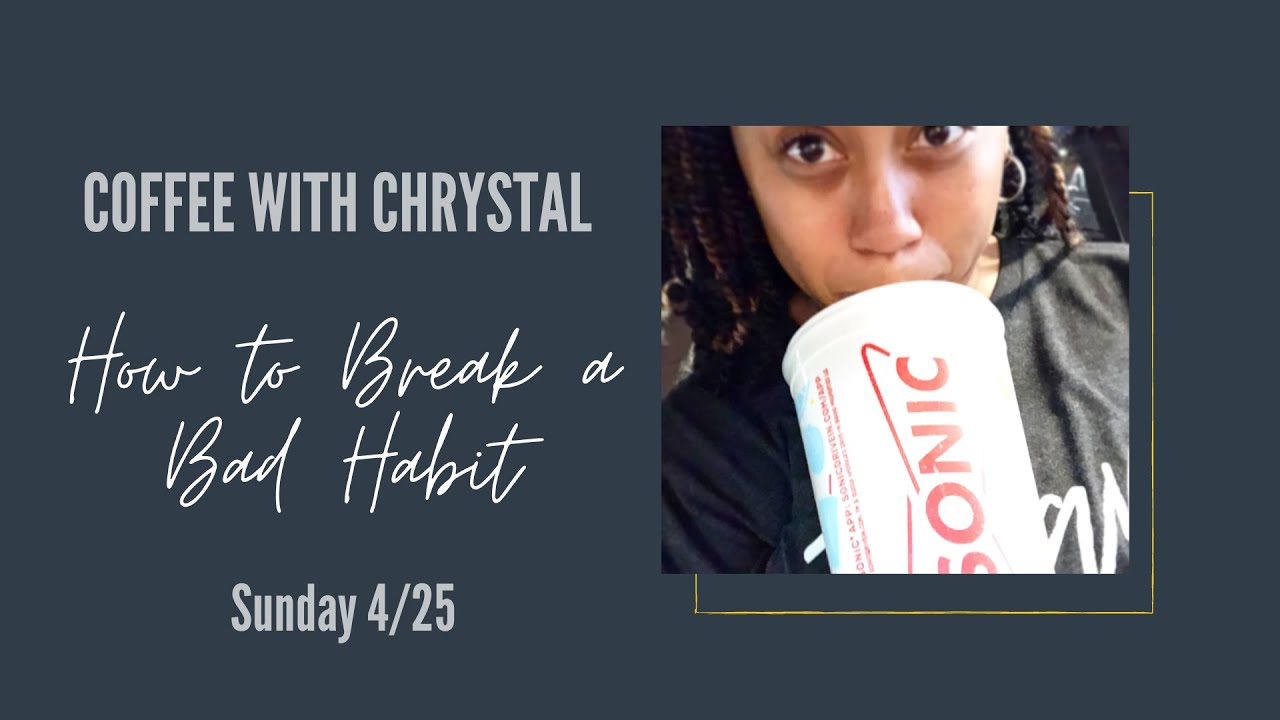
Chrystal Hurst breaks down five strategies for ditching bad habits: track progress with a 90-day calendar, start small, celebrate wins, replace the habit with something healthier, and change your environment. She cites research showing habits form over 21 to 66 days and uses examples like swapping Sonic ice-tea for lemon water.
Chapters
Have you ever tried to break a bad habit? Well, I have time and time again, and today I want to talk about some practical ways that you can set yourself up for success. Let's talk about how to break a bad habit. And in advance, I want to ask you if this YouTube video, or if you're watching on Facebook, if it's helpful to you, be sure and share the video so that somebody else that you know can see it. I also want to let you know that if you are not yet subscribed to my YouTube channel, or if you have not liked my Facebook page and you just happen to see this video, make sure that you are following me on Facebook or that you're subscribed to the YouTube channel so that anytime I go live or share content, you'll be notified. So why am I the person to talk about breaking a bad habit? Well, simply because I have a lot of them to break. Ha! Let me tell you something. I recently was on a juice fast. So I had a little bit of a problem because I bought a 3-day fast and didn't realize that I was going out of town. So I only got to do 2 days and I froze day 3, and I'll have to pick up day 3 this week sometime. But let me tell you why I did it. I did it because I wanted to cleanse my palate, y'all. I was just going off the rails when I'm living a high stress life, which often I'm— I do. I have to really be careful about how much stress is in my life. The first thing on my list to go, the first thing I stopped thinking about, the first thing that it becomes really easy for me not to pay any attention to is what I'm eating, y'all. I am an emotional stress life eater. And so when I'm stressed or when I'm really busy, thinking about my food is the first thing I stop doing. And so I slide back into bad habits that I have with food, not drinking enough water, not eating enough vegetables, waiting until I'm too hungry to eat. And so that's one bad habit I have in my life. I have others, but I'm not going to make this episode about all the things I do are bad habits. What I do want to tell you is that I've had enough in my life to understand some, some principles about breaking bad habits that can be helpful to you and to me. Okay, um, if you have a bad habit, all a habit is is something that you have taught yourself to do on automatic. That's all it is. It's something you have taught yourself to do on automatic, which means it's easier for you to do than to do something else. So the reason why something is a bad habit is because it's something that is easier for you to do that's not good for you, but it's easy for you to do anyway. So in order to break the bad habit, you have to create a new pathway. You have to forge a new path. You have to teach your body, teach your brain, teach the core of you how to do something else with a little, uh, less effort than maybe you do it right now. Um, it's not that hard to develop another habit to replace the bad habit, but you do have to be intentional about it. It does take intentional, uh, activity. It takes focus. And so I wanted to give you some practical ways. Now, again, getting back to my green juice cleanse situation, y'all, as soon as I drink about a day's worth of those juices, number one, my— by the second day, I have a lot of energy. I'm not bloated. I'm not full. I'm not drugged down by all the extra carbs. Like I actually start to feel different. And the thing that I may have been doing knee-jerk, you know, grabbing a cookie or, you know, grabbing some French fries. I mean, can I just tell the truth and keep it real? The reality is those things don't even, I don't necessarily even want them. There's been a change of palate, which sets me up for a new version of success in that habit. But I have to keep it going because as soon as I feel stressed again, what am I going to do? Go back to the thing that's easy. And food, y'all, it's just the— it's just the— it just is what it is in my life. It just, it just is what it is. And let me tell you, I've been vegan for 6 weeks, and then that was over. I lost 25— no, 28 pounds. That went really fast. Um, and it wasn't, wasn't hard. I just had to think a lot. So I know how to lose weight. I know what to eat. I know about the keto and all the things. And this is not the episode for the diet recommendations, but it is an example from my life. So don't email me with your diet recommendations. I don't want them. The thing is though, I have learned a thing or two about breaking bad habits and what it is to fall back into those habits. And I want to share those with you. Art Markman, who was on an episode of the podcast, we'll put a link below, a wonderful professor at the University of Austin, professor of psychology. And he said, if you don't keep track of what you're doing, you won't notice your improvement. If you don't keep track of what you're doing, you won't notice your improvement. So I want you to know that you have to keep track. Paying attention means you have to keep track. Now, this is super simple. Uh, Jerry Seinfeld wanted to build a habit of creating a joke every day. So he got a basic wall calendar, like the kind you can just get from a dollar at the dollar store or from Walmart or whatever. And every day he made up a joke. And he would take a pen and make a mark across the day on the calendar. And his goal was not to break the chain. He said, I don't want to break the chain. So in order to break the habit of making up jokes whenever he felt like it and waiting until he was motivated, he decided to pay attention to how often he was creating a habit. He wanted to get in the habit of, of creating jokes, so he decided to keep track. So somewhere, some kind of way, you need to be keeping track. You could be journaling a journal notebook. You could be keeping track on your, on your phone. You could be putting sticky notes on the wall because you're going to get to 31 days and you're going to label those sticky notes. And every day that you accomplish your goal, you take a sticky note off the wall. I mean, it really could be anything as tactile, as written, as computer-generated or digital as you want it to be. But the most important thing is that you are keeping track. One of the things that we have done, um, for, um, one of the products that I have created is a planner. It's a 90-day planner. And inside of this planner, with this last rendition that we had, we actually created a habit tracker because we realize that often in getting to your goals, uh, working on your habits is something that you want to do. Um, I know that if you are already in the Inner Circle that you, uh, have had the opportunity to get this. If you are at the coaching level or above. But if you haven't, we would love to give you a copy of this. And so there's a link below in the show notes on YouTube, if you're watching there, for you to grab the habit tracker, print it out, and then use it. But honestly, you don't have to even use my habit tracker. You see what it is? It's just a list of numbers. Mine happens to be over a 90-day period. You may have heard that it takes 21 days to form a new habit. I've actually heard that it takes more like 33. And then I read a book called "Habit" by Charles Duhigg that says it actually takes 66. I feel like we could put one more 6 at the end of that and say the reason why we have to work on our habits is because bad habits are from the devil. But anyway, um, 66— it, it takes a long time to retrain your brain. So the thing is, is you don't want to start too big because retraining your brain then will be too hard. It takes a lot of energy to create new pathways in your brain. Think about it. If you wanted to dig a trench in in your backyard that already has grass growing over it. It's gonna take energy. Now, once the trench is there, anytime it rains, it'll catch water. It'll easily catch water, but you have to dig it first. So habits are like that trench. It will easily catch whatever falls into your life. So if you don't have the trench in the right place, then you have to dig it. And the way that you dig it slowly but surely, because you don't wanna do all that work in one day by yourself, you do it one shovel at a time. And you keep track of what you're doing. Okay, then as you keep track of what you're doing, you, you need to celebrate your progress. You need to celebrate and to say, this week was a good week. Out of 7 days, I did it 5. This month was a good month. Out of 31 days, I did it 29. This 90 days, this quarter was a good quarter. Out of 90 days, I did it 72. You want to pat yourself on the back because every effort towards making a new habit is a, is an effort worth celebrating. But know that if you don't keep track, it won't be a part of your focus. And the problem with habit is that you can have a bad habit and do it every day of your life without paying attention. So the antidote to that is to pay attention. The second tip for replacing a bad habit is to replace the habit with a good one. Okay. I love sweet tea. And I had gotten into this habit of stopping by Sonic fast food restaurant that many of you will be familiar with, particularly in the States, if you're watching. And y'all, Sonic ice is amazing. It's amazing. And then if you put a Coke on that or some sweet tea, it just is popping, locking. It's awesome. Okay, but anyway, see, this is what happens when I start thinking about food. I start singing. Stop singing, Chrystal Hurst. Stop singing about food. But when I would do that, I decided that I, I had a habit of going to Sonic. It was like everything in me was like, you're passing Sonic, girl. You're passing Sonic. Now I could have just passed it.. But instead of just passing it, I decided to replace the habit. So I pull in the Sonic, I would get my Route 44 cup of ice with lemon water, because I actually like water and I like water with lemon in it. So I got my satisfaction of the ice, I got my stop by Sonic, I didn't have to change the whole habit, I just changed what I did when I got there. Replacing your bad habit with a good one is a great thing to do. So that way you're not necessarily having to change your path exactly, but you may be putting something better in the path you already have. It gives you a way to do the old thing a new way. This can happen by changing your environment, okay? Replacing a bad habit with a good one means getting rid of the Oreo Thins— am I telling on myself about Oreo Thins? I might be— and replacing that with a snack that's easy to grab, okay? So, you know, the package of Oreo Thins, you just peel back the You peel back the layer, you peel back the layer, and then you just grab a couple of cookies and nobody knows. I used to hide my Oreo Thins from my kids and the Pop-Tarts. Anyway, um, so what you can do is— I like hummus, so a great way to replace that is to get rid of the Oreo Thins but replace it with something else I like. So carrots and hummus work really well. It's easy to grab, my kids don't fight me for it, and I can snack on it on the go. Same thing, raw almonds, unsalted raw cashews. I love those. Can't have too many of them because of the fat, but that's a great habit because it's a snack on the go. So when I would be, uh, running around and need to grab something quick, replacing the things that I kept on hand that were not great for me with things that are good for me, fruit and vegetables and nuts, um, those are helpful. So what can you do to change your environment and to introduce something new into your environment that doesn't take you too far off of your path, but it gives you something else on the path that will help. Another good way to replace a habit with a good one is to come out of the dark. There are many habits we have that we don't want other people to know that we have. So another way to replace the bad habit of doing what you do in the dark is to put yourself in the light, which means accountability. This is why Weight Watchers worked. You can go to Weight Watchers and every week somebody's gonna look at the scale and go, what did you do this week? I see you. And that's why I didn't like Weight Watchers, because every week I just felt seen. I was like, I can't do it. Now I will do myself Weight Watchers. I'll get on the scale, I'll write it down, I'll log into MyFitnessPal, I'll do all these things to pay attention to myself. But I struggle with failure. Like, it's a, it's a, it's an Enneagram 3 complex situation. I struggle with people knowing that I failed. I don't like people to know that I screwed up. It is what it is. But replacing it with accountability in some way, shape, or form, that is healthy. That is healthy, right? I'm not saying Weight Watchers is bad. I'm just saying it messed with my mind. I want you to remember this. You have to cultivate good habits. Habits keep you on track and they keep you from having to make a million hard decisions every day. I actually was at an event recently where we had a Q&A and one of the girls in the audience said, How can I achieve balance in my life? And I said, well, you'll never achieve balance in your life. You— balance is something that you're always going after. And life changes, your kids change, your, your job changes, your finances change, the economy changes, everything changes. So you're always just kind of, you know, it's like riding a bike. You're always balancing. You're just reacting to the terrain that's underneath your feet and paying attention to the terrain. But here's the thing about habits. They give you routines and rhythms that mean that the hard things in your life take less energy. Okay? Right now, I do not make up my bed. I'm not in the habit of making up my bed. I've decided that's not a hill I want to die on in this season. But I have had that habit before. Let me tell you something. The first day or two, it was like, ugh, you know, it just took forever. I was rushing to get out the door. You know, it just seemed like it was this habit I was working on and it just took a little bit longer, right? But then after a few days of doing it, it started to become a part of my rhythm. So no longer was it a habit that was hard for me. It was a rhythm or routine that gave me the joy of getting back into a made bed at the end of the day. It's the same thing with preparing food, because food is my effervescent example of developing habits. If you get in the habit of meal prepping for the week, the first few times you do it, it's going to take you a long time. You're going to think, oh my gosh, I cannot do this every week. I got stuff I need to do on a Sunday. But after a while, if you get into the rhythm of meal prepping or meal planning— I meal plan for my family every week, I've done it for years, um, and I need to do it separately for me so I can eat some rabbit food a little bit while I'm feeding them all the good stuff. But the thing is, is in getting in the habit of doing that, the first few times it will feel like a stretch, but then you get into a rhythm and a routine, and then that rhythm and routine makes it easy for you to move forward in life the way you want to do it. So replacing your bad habit with a good one is a way to also move the needle forward. You can force a habit because you can do what you don't feel like doing, okay? You can force the habit. You don't have to be a product of what you feel like doing today. And here's the good thing about developing habits: as you choose to develop them, they become things that you feel like doing. But you start with the end in mind. You don't start from a feeling, you start from You start from the thing, the fact, the fact of what you need to do to have the life that you want to live. Okay. I have a habit every morning, a routine every morning of starting a load of laundry. I started that habit, that rhythm, that routine, because I hated doing laundry all day on Saturday mornings. And so by putting the laundry in every day, can take it out, we can get it folded before the kids finish breakfast, or, you know, I mean, or at least before we get started with schoolwork for the day and it's out the way. I've trained my boys to do the same thing. They start a load of laundry every morning. It's a part of their routine. So we don't have big laundry days on Saturday because I decided that's not how I wanted to live my weekend. So I developed the routine. Now it's like, it's not even hard. It's not even something I have to think about. I get up in the morning, we put a load of laundry in the washing machine. So whatever you want to do in your life, initially you may not feel like it, but later the freedom that routines and rhythms give you are life-changing. So let me give you another example. I have a friend who wanted to stop smoking, right? So instead of just starting to say, I'm not gonna smoke anymore, she realized that she had these rhythms and routines that led her to that bad habit that made it easier for her. She would always get her pack of cigarettes when she, um, when she had loose change in her car. She said, I only get a pack of cigarettes when I have loose change. So she got rid of loose change. She quit keeping loose change. Like, if she would go to the store go to the restaurant, she would say, "Keep the change." If she would go to, you know, anywhere, she would give away her change. She would give it to the homeless person on the side of the road. She would get rid of her change. Because she changed the rhythm, she altered it, she replaced it with something else, an empty cup holder, that made it harder for her to get her cigarettes. She said, "The battle for me getting off my cigarettes started with me no longer keeping my change." It can be really that simple. If you have a habit of hitting snooze, Okay, that is a habit in the morning. Then you want to replace that habit by replacing your environment or the proximity of your phone or your alarm clock. Put that thing on the other side of the room. Then you will have to get up and you can get up and get back in the bed, but it'll be a lot harder once you've gotten out from under those nice, neat covers to do what you used to do, which was have your phone in the bed next to you by your ear, just tapping it with your finger a million times before you got up. Dr. Oz, I was watching a show of his a long time ago where he was talking to somebody about, her bad habit of snacking before she went to bed. She said, "It could be cookies, it could be ice cream, it could be chips. It's just a part of my routine. The kids go to bed, I'm finally grateful to be by myself and I start snacking." So he said, "You've gotta break up your rhythm. You've gotta break up your pathway." So he suggested, he said, "What is something that you do to signal to your body that you're ready to go to bed?" She said, "Well, I always brush my teeth before I go to bed." He said, "As soon as your kids go to sleep, brush your teeth." Because that taste in your mouth will signal to your mind and to your body that it's over. Now you can sit there and eat something else, but that will break up the path. You're gonna replace your normal pattern with a different pattern, okay? So changing your environment or replacing your bad habit with a good one is super simple. These little things that you can do to shift the narrative in your head, okay? That is disrupting the pattern. That's the third point. So the first one is to keep track. The second one is to replace your habit with a good one. And then the third one is to disrupt a pattern. My friend Christy Clover says, habits can be changed if we understand how they work. Changing any habit just requires a little determination and a little hard work, a little bit every day for a while. Here's the thing too. I don't want you to work on a million habits at once. Start small. Many of us fail at our habit changes because we change them too much all at once. We're trying to change 8 habits at a time. A long time ago we did a Fat Demon Challenge. Maybe we'll do it again sometime soon. And the first week all you do is up your water intake. That's it. Focus on that one thing. I've had so many people tell me that in 28 days of working on changing their diet, if they focus on one thing at a time, they're way more successful than starting the big diet change on Monday. Sometimes you just need a little sip of something-something to get you going in the right direction. The fourth, I want you to journal and reflect on your thoughts and ideas. Now, this is different than keeping track. Journaling actually says what led to the downfall. When you break, when you break off, you break, get off track, and you know that you were doing okay and then you fell off the wagon, what led to that? You need to pay attention to your life, not just to say I did it or I didn't do it. This takes tracking a step further and says Why did I do it? Why was I successful? Why did I not make it as much as I wanted to make it, or as long as I wanted to make it? What is getting in my way? What are the challenges? How can I better arrange my life to support my new direction? You want to journal and keep your why in mind. Many of us remember that YoPlay commercial where this girl goes in front of her bathing suit, you know, and she's looking at it every day, eating that YoPlay, because she was constantly saying, let me keep my why in front of me. Let me focus on the reason why I'm doing this. And then at the end, she comes in and she takes the bathing suit off, and apparently she's off to the beach to enjoy her summer having lost weight eating Yoplait. So you want to post your why, pay attention to your why, constantly have that in front of you. You want to pay attention to how you feel as you maneuver through the change in the process. You want to make sure that you're paying attention to your cue, your routine, and your reward. Most of our habits, if not all, Charles Duhigg says, have a cue, a routine, and a reward. In the example where the lady was eating chips or sweets every night, the cue was her kids go to bed, her routine was she got chips or ice cream, her reward was enjoying all the warm fuzzies that come with that dopamine hit that you get from eating sugar and salt that you shouldn't be eating at 10 o'clock at night. You want to shift that and say, okay, what is a new cue for me? What is the signal? So when he changed her habit to brushing her teeth, that was a different cue. The cue for brushing her teeth was it's time to go to bed, and the reward was eating something else. She changed the cue. It's like, it's like Pavlov's dogs if you've studied psychology, or it's like the psychology of hamsters and rats. I mean, like, they put them in a maze and literally if you do the same thing over and over, you'll form a pathway. Then they, they know how to go through it without the cues. You have to change what reminds you that it's time to do something. You have to change what you do when you get that reminder. And then you have to change what the reward is. And the Yo Play Lady, that's what she was doing. The cue was, it's time to eat, I'm hungry. The routine was, if I'm hungry, I'm gonna not eat the cookie, I'm gonna eat the Yo Play. And the reward was going to look at her bathing suit. Those 3 things. And Charles Duhigg's book is a great book, but, um, you don't have to read that to make the changes, y'all. It's really simple. One small change at a time. That podcast that I was telling you about, it's episode 262. So you can just go to chrystalhurtz.com/262. It's Winning with Habits. I want you to, um, celebrate you while you're working on the progress. Don't wait until you get to the end. Celebrate you as you go. And remember this, and here's your 5th tip. Every day is day one. So every morning when you get up, you get to celebrate that today's a new day. And imagine that every day you're starting fresh. Because this is what happens, right? When we start our diets on Monday, we have a mindset that, oh my goodness, this is a fresh start day. This is a fresh start day. Yay! And so we get all geeked and excited. If you open up your day every day, you open up your eyes and you embrace your day with, this is a new day to start this habit, then every day is your start, which means every day you can be successful. Okay? So leave margin in your life for reflection because Why you had the bad habit will teach you just as much as what you learn from developing a new habit. You can break bad habits. They don't have to be horrible habits, but if you want to just replace not the best habits with better habits, these things can work for you too. And people who have great habits, they win, y'all. They win because they are no longer using a bunch of energy to do the things they ought to do every day with their life. Those things are on routine, they're on automatic, which means that you have that energy reserved for the things that you actually need to put your brain on today. I don't want to think about every time I have a meal what I'm supposed to eat. So if I meal plan, that means I could roll through the kitchen, grab what is on dock for today, and keep on trucking, you know, or use that time instead of using all the time for fixing food. I can eat, and then while I'm eating, converse with my kids or talk to my husband or read a book. I get to use that energy a different way. So when you put the energy into building habits, one habit at a time, you are going to put the energy in as a deposit that will reap great returns on the rest of your life, because later and over time, you'll have that energy for what you actually want to do with your time. George Washington Carver said, 99% of all failures come from people who have the habit of making excuses. I don't want you to have the habit of making excuses. I want you to have the habit of doing the right thing the right way at the right time. And then reserving the energy of not having to think about all the right things for the new things that you need to do today. So I would love for you to pick a habit. Tell me in the comments right now, what habit do you need to eliminate? What habit has been bugging you? It's something that you know you need to change. You know you do it knee-jerk and you know you need to quit doing it. You just know it's— it may not even be like that life-altering, but if you could just move the needle in this, you would free up energy for something else. What habit do you need to eliminate? And I'd also love for you to tell me which of the tips today resonated most with you. Now, because I want to make sure you comment, tell me about your bad habit and/or tell me about which tip resonated more with you. I'd like to do a giveaway. My dad's name is Dr. Tony Evans, and he recently wrote a book called Kingdom Men Rising. This is the book right here, right here. I'm gonna make sure you can see it. There we go. Kingdom Men Rising. And I know that many of us who, uh, who are girls who watch this have men in our lives— sons, brothers, husbands, fathers— who might want that. And I'd love to give one of those away. From those of you who comment below, we'll choose someone to receive this book because I would love to share it with you. And if you had not heard of it before, I would love for you to consider going to pick that up. Barnes Noble, Amazon, everybody has it. Y'all, my habit this week is gonna be what I started last week. I'm gonna continue that this week. It's just more fruits and vegetables and water. Keeping it simple. See, thought I had tea or coffee in here, didn't you? Just keeping it simple. And if you would like to join me for these recordings live every week, simply go to ChrystalEvansHurst.com/ Inner Circle, where I go live every Monday morning, share a little bit of foolery and fun, and then I dive into a teaching for this week. If you'd like to join me live for that teaching, to be a part of the live studio audience, consider joining the Inner Circle today. So don't forget to subscribe on YouTube, don't forget to like the Facebook, and then I will see you right here again next week.










