Clear Your Head #alittleQC
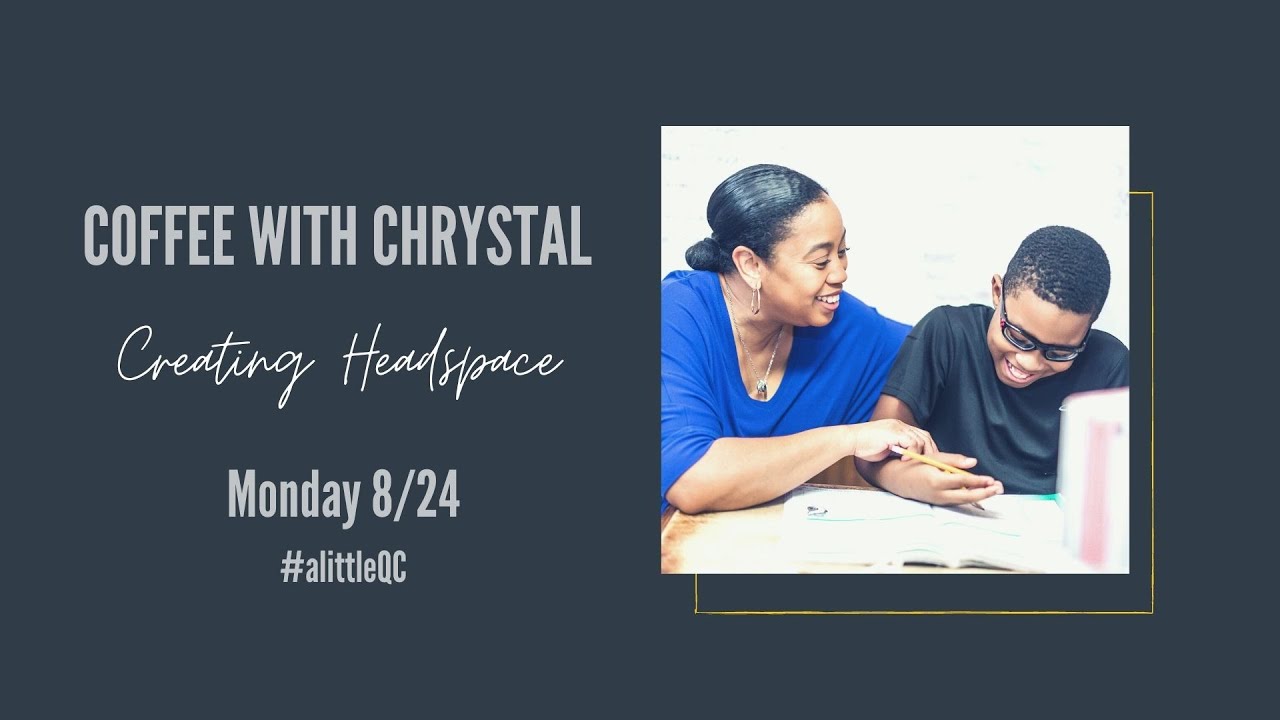
Chrystal Hurst talks about making mental and physical space as school and work restart. She offers three ways to reclaim headspace: purge outdated habits and items, set real limits including rest, and clear your life so you can receive what comes next.
Chapters
Good morning! Good morning, everybody! It is Monday. And if I'm not mistaken, it is— I don't know what's going on with my life and why I can't seem to get it together. How about that? I was gonna say it's the last Monday in August, but it's not. Next Monday is the last Monday in August. So we've almost made it to the end of August. And I know that many of you have already started new things. Many of you have already started new things. As we were waiting for the music to come to an end and the countdown to close, I was attentive to the comments. And so I see you watching from Singapore, and I see you, um, watching from Alabama and from Florida and New Hampshire, Mississippi. I see you. But I also know that some of you said today's the first day of personal development for you as a teacher, or today is the first day of virtual school. And I see you saying that you're in pain. I see that. So we are all heading back into something that's supposed to look like normal, except it's totally not going to. It's totally not going to. Um, I see some of you saying you can't hear me. Is that any better? Are you able to hear me okay now? Just checking and making sure. I do have a mic that I'll bring a little closer. Okay, so yes, Letia, many prayers for homeschooling parents and teachers and people whose kids are going to be asking them a million questions all day. Somebody said, this is my last first day of homeschooling for my senior. I'm in all the feels. Y'all, we are in a a new space. Um, somebody said, why am I not on YouTube? But I am on YouTube. Am I not on Facebook? I should be. Y'all are making me worry that I did something wrong this morning because I don't see any comments from Facebook. Hmm, somebody said, oh, we still have the door background. Okay, let's see. I'm fine on YouTube. Okay, well, I don't know. Hmm. I'm on YouTube. I should be everywhere. Facebook is on. Okay, well, let's keep going. Let's keep going. All right, so, hmm, always something technical to worry about, y'all. Okay, so here's the deal. I am I am with you here. My kids are starting back to school slowly. We always start back slowly. We— check something, y'all. I don't know if that's gonna help any. We start a few subjects at a time and we roll in, and by the first week after Labor Day, that's when we are full steam. So we kind of 3R it until then. They have to read, they have to do something with arithmetic, math, they have to do some writing somewhere, and then they do have some co-op classes that have started, only a couple. My older two are doing dual credit that starts this week. And then, um, you know, the next week or two, then we'll be full steam ahead. But we go slowly. Um, we go slowly. And that's really for me because I can't get my act together in time to do everything, to launch everything at the same time. So, um, uh, I want you to know that rhythm is changing for all of us. Um, even if your kids are not in school or you're not a teacher, The world has this way of working on that rhythm, on the school year calendar rhythm, and there's this swell of energy. If you're in Texas, then we had the sale weekend a couple of weekends ago where everything related to school, school supplies, school products, um, paper and backpacks and all those things went on sale. So if you went to Costco or Walmart or Target during that time, the stores were busy. And you were probably wondering why is this the case. It's because we're getting ready to go back to school, which means that the energy level is shifting and that the things that we have on our plate are shifting. Because even if you don't have people in school, the people that work with you do, the people that go to church with you do, and that energy, that shift in scheduling changes the way we interact with each other because we all have more on our plates. So that said, um, I just want you to know that there's a shift, and with that shift comes new territory that we're navigating with our heads. And so what I wanted to talk to you about, uh, a little bit this morning is, um, creating headspace, creating headspace, um, when there are things that are shifting in your life you need to understand the importance of creating headspace, having headroom, so that you're not constantly bumping, um, bumping up against every boundary that you have in your life. That is not a good way to live. It is not a good way to operate. Um, when you leave yourself headspace, when you create headspace, you are giving yourself a gift of having enough room to negotiate the extra things that come with this season. If you don't leave yourself enough headspace in a new car, then if you get a tall hairstyle, you will be bumping your head against the top of the ceiling and the roof in your car every time you get in. And even if that hairstyle is negotiable, if you like to get it off of the back of your neck during the hot summer months, you wanna take those long braids or that long ponytail and lift it up and wrap it up. If that thing is too tall, you will be bumping up against the headspace. So you want to make sure that you always have enough headspace. If you have ever studied and crammed yourself full to prepare for a test, you know that going in full to overflowing is not the best way. Overflowing means that things are slipping out, they're slipping up. You can't keep track of all the information that you've absorbed because it actually didn't sink in. It just stayed on the surface. And started running over. You need to leave a little bit of headspace, a little breathing room to take a break after heavy studying before you go take that test, to take a nap. If you push yourself to the limit, um, educationally, that is not beneficial. Um, we all know this to be true, and then we know that if we go slower with our studies, then that means that we have a little better absorption. That's what we would tell our kids. You have to understand need to create headspace. I've talked about this before, but in my shower I use this thing called Aqua Notes. It is a waterproof pad with a waterproof pencil, and both of them suction to the wall of the shower. And someone introduced this to me, and I loved it because I mentioned one day that some of my best ideas come while I'm in the shower. And so I was losing ideas or scrambling out of the shower trying not to forget them, and I'd be repeating them over and over again. And then someone said, you need Aqua Notes so that when you're in the shower you can write down those thoughts. Well, here's the deal. Um, the reason why I have an overflow of thoughts while in the shower is because there is headspace, there is room, because there's a lot of things that cannot or will not take my attention away from what I'm currently doing. And so my brain has room to run. You've heard the saying that says the gift of childhood, or the work of childhood, is play, that there should be boredom. Boredom is a gift. And when you give your children room to be bored, when you give yourself room to be bored, you're giving yourself a gift, because innovation often comes from the room to have ideation. And ideation often comes from the room, to not have anything else crowding up your thought life. Your brain is free to do extraterrestrial, extraordinary creative work when you don't stuff it to the limit. And so creating headspace is something that we all need to do. We all need to do. And I know it's tough, Ani Tyler, because you said, what is your advice? I'm starting my master's program today and I am my mom's full-time caregiver. I realize that some of us are going back to work at the same time our children are going back to school, that we are maybe having to go back into work physically at the same time we're trying to get our kids to work virtually, and there's a lot of mismatch going on right now. And so I want you to know that I understand that it's tough, but I do think that no matter what circumstance you are in, you can create headspace. I'll give you an example. When I would go to work a few years ago, I would work downtown, and the drive was my time to detox, okay? It was my time to listen, yes, to the radio, but often to listen to silence. It was my time to listen to music, but sometimes it was my time to learn, to listen to podcasts to feel like I was growing personally and developmentally. I would listen to the radio, the news radio on the way into work because I remember going to school with my dad when my dad would take me to school and he would always listen in Dallas to News 1080 KRLD to stay informed and aware of what was happening. And so I thought a car time is good for me to decompress. It's good for me to learn. It's good for me to grow. It doesn't have to be wasted time. It can also be time for me to connect. And so once a cell phone in the car was a thing regularly, it would be my time to talk to friends. But that was where I created my space. It was 30 minutes, and on a bad day, 45, but that was space for me. And I tried not to, um, waste it. I tried to pay attention to what my body and what my mind needed and give myself that room. Um, I would try to get to work a little early, put my Bible out on my desk at work, work because there was room there, quiet there, that I didn't necessarily have at home trying to get my daughter up, get her to school, get to work on time, and sometimes to beat the traffic. Instead of having my devotions at home, I would have my devotions at work. So you work all these different ways to fit it in. There was a book that I have, it's called A Mom Like Me, and she's a homeschool mom of 8 kids, and I read it, and one of the things she said that was non-negotiable was going for a walk. Her husband would walk in the door every evening and she would walk out and she would go for her evening, early evening walk. And she did that because she was like, I have to create the headspace. I have to create the room for me to give myself what I need. And I realized it's not that simple for many of us. We have to figure it out and do some hard calculations to define where our headspace headspace is. But what I want to teach you this morning in practical ways is the importance of headspace and ways you can do that. Okay. I looked at Monique last week and I said, listen, I just feel the need to not just be inspirational, motivational, but ridiculously practical this time. And so we talked a little bit about where I wanted to go. And, um, and that's where I'm going to go today. Um, always, I'm always in a pulling up my notes here so that I don't forget to tell you about the thing that I really need to tell you about. Don't forget, I have a book coming out September 1st about prayer, 28-day, 28-day prayer journey. You can grab it anywhere books are sold. And if you're looking for information about the book, you're like, do I— is this really for me? Then check it out by going to chrystalevanshurst.com/pray. If you are not on my mailing list, there are some things that are coming up in the next week that I will be emailing my email list about only. How do you get on my email list? Just go to chrystalevanshurst.com, right underneath my picture, drop your name and your email in that box. Okay, make sure you are on my email list because there are some things that I only tell my email list about. Okay, all right, so let me jump into this. Um, oh, and beware that if you missed it, there was a podcast podcast that came out last week. It's awesome about— well, I won't tell you, okay? But be on the email list and you'll know anytime a podcast comes out. Got some more stuff about prayer this week. It's really cool. Okay, here's what happens if you don't create headspace. Hey, Jessica Peavy! Here's what happens if you do not create headspace, okay? You will have decision fatigue. Your brain has a limit. You have limits. And let me tell you, I don't like to hear that. I like to go until I can't go anymore. And I'm a fairly high capacity person. So it's trouble for me when I realize— I usually don't notice that I'm butting up against a limit until I start misfiring. And I can usually see that clearly in other high capacity people. Capacity people. They are doing all the things that they always do, but they don't realize that they're misfiring. They don't see the short circuit. I see the short circuit in me when I have to make decisions and then I just cannot make a decision. Um, I just, I can't seem to bring it down to the end result. I'm running around in circles and it's simple decisions too. I don't want to think about what's for dinner. I don't want to think about, um, um, you know, which plan do I want to choose on DirecTV if we're ever gonna get DirecTV. By the way, we're trying YouTube TV, we'll see. But the point is, is I start misfiring decisions. So that's me, decision fatigue. I'm not sure to stay or go, I second-guess my decisions, and I do that a little bit anyway because I'm a little bit of a perfectionist. But it's not a matter of the inability to land the plane. It's just the inability to think it through. I realize that I'm short-circuiting. That's one thing. If you do not create headspace, then you will realize that you are constantly running on empty. Okay, running on empty. Have you ever gone to the grocery store and seen that you needed some soup and seen that there are 5 trillion, 192 million, 397 thousand 23 types of soup. Okay. When you are, when you have no headspace, that is overwhelming to you. When you are, when you have no headspace, every time you go to the grocery store, you're rushing. You don't have any time to get your basic needs met, any time to think through what you're going to eat and prepare for that. You just are grabbing on the go what you feel like eating tonight or driving through whoever's drive-through is open and appeals to you that night. There are too many things that your hands are in, and removing one— your hand from any one of those things may cause one domino to fall that goes all the way, all the way to the end. Uh, no, Jodi, I'm not a 9 at all. So, um, decision fatigue. You're limited on time. You don't have time for the things that really are important, that are basic, that are important. And in the season where you're needing to find new rhythms, it's tough. It's already tough, but it's tougher than tough. And y'all, right now, COVID-19, um, uh, school, new work schedules, things getting into new rhythms— this is a tough scenario. It's a tough scenario. And the new rhythms that we are being required or asked to make are hard. And it takes energy to find new rhythms. It takes energy to do things different because most of your life You live on automatic. That's what your body wants to do— settle into something you don't have to think about. And as soon as you have to think, you lose headspace. And if you're already living at the limits, you don't have the headspace needed to create new rhythms. Okay, so this is why creating headspace and clearing your head may be difficult, or that's what— the way you know that, that the difficulty of your headspace is, is a problem, okay, that you need more of it. All right, my brother, when we did the Sister Circle retreat back in, back in old 2019, he was there, my family was there, and he gave the illustration of clearing the table. If you are at a nice restaurant and it's time for them to serve you your course your main course, and let's say you had an appetizer or a salad or a soup or bread. What they will do before they bring your main course is clear the table because you don't have room for all the plates of your bread and your soup and your salad and your appetizer and your entrée. But you didn't come to the restaurant for bread. You came, if you were hungry, for a main meal. You came for dinner, and that plate is going to be larger than the other plates. And so a good waiter will clear the table so you have room for the main thing. If you don't clear the table, if you don't clear your head, if you don't make creative space for your thinking, then you are going to be in trouble because you are not going to be able to have the main thing be the main thing. Um, you're going to be busy with all the things that that, that are good, that are nice, but that are keeping you from receiving the main thing. Does that make sense? I hope it does. So the reality is we all need to create headspace. Um, I have in my new home, I have a dining room and I have a kitchen, and I've always had a dining room in my home and a kitchen. I've always put my piano in the dining room because I don't really use a dining room. But here's the thing, And when you have kids homeschooling at the kitchen table, that means every time it's time to eat a meal, you have to clear the table and then you have to eat, right? So I thought in this new house, I'm gonna use the dining room. I had another area where I could put my piano. I said, I'm gonna use the dining room. I'm gonna put a table there. Um, but we're gonna do school in the dining room so that there's room always at the kitchen table to eat. And do you know what's happened? We've migrated back to the kitchen table. There's a dining room there. I haven't yet put the chairs there. And so the kids have migrated towards the kitchen table and it's okay. It's just that every time we need to eat a meal, we have to do the work of clearing the table so that we can eat. It would be so much easier if we just were operating in a different space so that the space for nutrition was always available. It's a little extra work when you don't always have an open space. You could do it, but it just just requires a little more energy. Y'all, I'm still trying to clear out school books. One of the reasons why I'm still here in front of this closet door is because I keep coming back to the old house, moving slowly, because I'm trying to not bring things with me into the new space that I don't need, that I'm finished with, that someone else can use. I'm trying to make room for the new by getting rid of the old, and it's tough. And creating headspace in your life is tough. It requires some tough decisions. It requires you looking at this and saying, I know I'm always trying to leave room for it, but really, really, do I need this in here? You have to make difficult decisions to create space in your life for the good new thing that God wants to do in your life. So here's how you do it. 3 things I want to tell y'all, cuz I'm a preacher's kid and we always talk in threes, to try to do as much as we can alliteration. Purge as you pursue the new thing that's in front of you. Purge as you pursue the new thing that's in front of you. Everything from your old self or your old life will not fit in the new space in your new life. And if you bring it all with you— and you can— you are cheating yourself out of what's supposed to fill some of that new headspace. Okay, it's up to you. It's up to you to create the space. And in order for you to create the space for where God is taking you, this new season of COVID-19 and school with your kids, this new season of going back to work, of things getting a little bit more intense, this new season of dealing with the health challenges, this new season in your marriage of being committed to studying in the Bible, whatever it is, you're going to have to purge something that was in your old life to make room for your new life. This could be seasonal, but this could also be developmentally, right? This could be that who I was back then is not who I want to be, and this new fall season is renewing in you the desire to build into the you you want to be. Well, that means you're going to have to purge some of your old habits to make room for the new habits. Okay, everything cannot fit. It can't. If you want to grow and develop, there are some things that you used to do that you can no longer do. When it was time for me to run a marathon, I had to purge my habit of staying up late and being a night owl, and I had to learn how to be an early morning person. I was not that naturally, but if I was going to make room for the new thing which was training for the marathon, I had to start waking up. Okay. If you want that new job, you're going to have to create the headspace to figure out what it is at that next level that your employer wants of you. And even though you've been doing an okay job where you are, if you want to exemplify that you are capable and ready for new responsibility, new expectations to meet new levels of, of of productivity, then you're gonna have to make room. You're gonna have to sit with your current boss or look at your new boss and say, listen, I want that job. The next time this level job comes up, I want that. What do I need to do more of to show you that I'm ready and desirous of that new position? And then you're gonna have to figure out that all those conversations at the water cooler are not for you. Do you want to have less chaos in your brain? That means you're gonna need to watch read Marie Kondo's book or watch some HGTV or follow some organizing people on Instagram or on Pinterest and say, if I'm gonna be less of a slob, I'm gonna have to organize my space because I'm wasting too much time every other day trying to find my keys. You want to be somebody new? Then you're gonna have to purge some of the old. Somebody said, not the water cooler. Okay, everything that you've been will not fit the person you want to be. Decluttering brings clarity. And as hard as it is for me to look at some of these schoolbooks and say, honey, you haven't used that 12 years, give it up, give it up, in order for you to make room for for something new, you're going to have to get rid of something old. Decluttering is not just about stuff. It is about your heart. It is about your mind. It is about your time. And it's tough. It's tough to let go of old things. I understand. But what if your release of the old is creating room for the new. Okay, and I want to encourage you to get help for that. Sometimes when I'm decluttering, I need backup. I need a friend to come be with me on the phone, kind of talk to me, talk to me through, girl, I just don't want to let this go, why can't I let this go, you know, is this— it's time for me to let this go. But let me just tell you something, if you do not do this, if you don't make the hard decisions to release. And think about this: some of the things that you are unwilling to release would be a blessing for somebody else to have, but they don't get to have it if you don't release it. Your cluttered space— mental space, heart space, physical space— is a distraction. It is a distraction. I was watching a gal named Miss Freddy on Instagram. I've actually talked to her, consulted with her about getting my photos organized, and she was showing a huge thick photo album, huge thick photo album that, that her mother-in-law had given to her. And her mother-in-law said, you have to help me make this smaller, like it's so big. It's a photo album she put together when she was a teenager She said, "Nobody's going to look at this. It's too heavy. I can't even lift it anymore. But I stuffed everything from this family summer into this." And Miss Freddie said, "There are great memories here, but nobody's ever going to look at it if it's too heavy to pick up." So what she did is she laid it down. She took pictures of it with her scanner. And she scanned in all the pages. So it ended up being a book that was this thick instead of this thick. Thick and this heavy instead of this heavy. And her mother-in-law was delighted, and so whenever— so was everyone else, because now they actually looked at the book. What is weighing you down? What is weighing you down? How can you lighten the load? How can you lighten the load. And sometimes it's tough, I understand that. And I understand that you're the only one, but you need to talk to some people in your life. And seriously, if you, if you look for the answer, I believe you will find it. The Bible says, seek and you will find. Sometimes we don't get the answer because we're not actually looking for it. And the things that have been weighing us down are also pacifiers. They are comfort. They are like warm blankets we don't want to give away. But what if that warm blanket is keeping you stuck in the bed and life is waiting for you outside of the doors? Take the blanket, fold it up, and lay it down. The more you have to carry, the slower you will move. And the more time it will cost you. And the most precious thing you have is time. The reason why this move is taking me so long is because there's too much stuff. Purge as you pursue what's in front of you. So I'm still moving in, we're still— we're living there, but I got to keep coming back here where all my stuff is to keep cleaning things out, to, you know, stick with all my equipment. But my goal is August 31st is the last day. I'll do my last live from here and then that'll be it. That's my deadline. It's crazy. Okay, here's number 2: practice acknowledging and setting your limits. Okay, it is actually an affront to God for you not to acknowledge that you have limits. You have limits. You are a human being, which means that you are not unlimited. You are not unlimited. And when you don't acknowledge your limits, you are doing yourself a disservice, and you are doing what all humans sometimes get in trouble for and that's thinking we are God, that we do get to decide, that we do get to, um, go further than what our time and our limitations will allow us to. We forget that we will run out of time. It is a, an honor. It is humbling, and it is respectful of who God created you to be, to say, I actually have limits, to set boundaries, to acknowledge Sabbath rest. Um, to say there's one day a week where I'm not doing all this stuff. I'm gonna get off my computer, I'm gonna rest, I'm gonna do my laundry, I'm gonna intentionally move slower, I am gonna sleep in on occasion, I am gonna make room to study the Bible, I am going to do nothing, I am going to pick up a hobby. I know it's tough, but in some ways you have to slow down enough for one day a week, one afternoon a week. I remember when my dad would come home from church on Sundays, Sunday afternoons. And, uh, we weren't tired, but he was, and the whole house took a nap. Sunday afternoon naps were the worst. And then we would get up and go back to church because in my mind I'm like, it's time to keep— we should keep going, we should keep going. It's a Sunday afternoon, there's nothing going on, we don't have any school. Nope, house nap, whole family nap was Mandatory. And I'm so grateful for that. I'm grateful for the relaxation of a Sunday afternoon, of learning that it's okay to do nothing. And I want to tell you that you need to practice doing nothing, even if you don't nap, resting, nothing time, Sabbath, one day a week, or spread out even during the week. But I would encourage you to look for at least one day or one part of one day a week or certain time where you just shut it down. You just shut it down. Because what if you will not hear the full voice of God in your life, if you will not receive confirmation, affirmation, direction without the room to receive it? What if the seed that is planted on Sunday mornings or Saturday nights or whatever— you're going to church now virtually— what if those seeds that are planted need time to germinate, room to be watered space to grow. And what if the fact that you get up and Sunday afternoons is your day to do all the things to catch up, what if that is actually choking out the life of the seed that was planted? Sabbath is a way of thinking and it's a way of life. It's not about not getting things done. It's about germinating the seeds that are being planted so that you can be more productive on the days you are actively pursuing your work. My mom— I was just talking to somebody else the other day about something that she didn't want to do, and we were, you know, trying to decide, is this something that we should do? It's ministry related. And the person said to me— and I said, well, I said to I said, listen, I know why my mom didn't want to do this thing. She didn't want to do it because she knew she would have to manage it and she wanted to protect her time. She knew that that was not where she needed to put her time. And she, she was acknowledging her own limitations. And this person said, I believe that that's one of the reasons why your mom was so great at so many things is because there were so many more things. She said, it's not my lane. That's where I draw the line. I live with that. Lived with limits. And I agree with that. I agree she lived with them and said many times to many things that people ask her to do, this is not my lane, this is not my lane, or this is not my season. And I refuse to be sucked into things that are not my season, that are not my lane, when what I need to be doing is creating headspace for the things that are my lane, that are my season, that God is going to ask me about. And then I want him to be able to say well done. And he won't say well done if I'm always stuffing this thing that he's asked me to do into a corner. So what does this mean? This means that you go to bed. This means that you get good sleep. This means that you can't be on social media all day. This means that you do have to limit work so you have time for fun. This means that you do— that you— your walk after work or before work is non-negotiable. This This does mean that you take a lunch or at least make time to make a healthy lunch. This does mean that your kids have some time where they cannot ask you questions, where they have to respect that this is not their time. There is time for you and your spouse. This is time for you to decompose from your workday. When I come in the door, I tell my children— because they have all the questions— and I look at them and say, "I just walked in the door." And I smile. And I know you have all the questions. Give me a minute, please. And sometimes you have to teach yourself how to create headspace, but sometimes you have to teach the people that you love how to create headspace too, for them and for you. You are not at your best if you have not been getting adequate rest. That's another reason why you might be short-circuiting. So you want to purge as you pursue what's in front of you. Literally get rid of the things you don't need. Get rid of the things that, that can bless somebody else. Get rid of the things that you have no longer a use for, or that you cannot, cannot, uh, possibly use in your lifetime. Cuz let me tell you, if you don't do that— what else my mother did? My mother purged over the last 5 years of her life. She was actively purging, which means that it was a gift to us when it was time for her to go home to be with Jesus, that we did not have to do that. If people have to purge on your behalf, it is way more painful for them than it will ever be for you, because you know what is and is not important. They do not know. And I hear about so many people who have to purge after they've lost a loved one, and it is tough because they're trying to figure out where things are, where things go, years and years of stuff collected that were never given away, and now they have the burden of having the garage sale or the estate sale. If people have to create headspace for you, it's double the work for them. It's double the work for them. You are a gift to yourself and a gift to other people to set your limits. You can't use everything that's in your house, and you can't use more than 24 hours in a day. You have limits. And if you can't get to it today, it doesn't mean you can't get to it later. It means that this may not be the season. Purge as you pursue what's in front of you. Practice, acknowledge, and set your limits. You can't use every stinking single homeschool curriculum out there. You can't do everything that everybody has ever done, and you'll stress yourself and your kids out. If you're trying to do it, do everything. How do I know? Then prepare your hands to receive. Clear the table. So right now we are working at the same table we are doing school at, which is the same table we are doing food at, which means we have to clean the table multiple times a day so that we can all eat, right? But it's not just about clearing the table, it's about cleaning the table. And I tell my children how to know if the table is clean. I said, you gotta get down like so to make sure that the light is hitting the table where you can actually see where there are still crumbs or see where there's something sticky. You gotta be able to look at the table good. Don't just give me this cursory wipe down where you miss some spots. You need to look at the table like so, so you can see where the water, where the wet rag didn't touch all ends of that table. Because I'm not just interested in you clearing the junk off, I actually need for it to be a smooth, smooth, non-crummy, non-sticky spot where I can put my laptop, and until you've actually cleaned it all the way off, I can't work there. Preparation is a full-blown positioning. It's not halfway done, it's not sideways done. It's something that you want to put your whole heart into. You actively creating headspace in your life is going to mean that you're going to have to look at it from different angles and make sure that you didn't just take one thing off, but there are more things that need to be cleaned. You're gonna have to put energy into seeing, did I actually do this fully? That means you're gonna have to have some conversations with your spouse. Hey, how's my headspace? You're gonna have to have some conversations with your coworker. You know, how's my headspace? Am I, am I being productive? Am I— do I have the bandwidth to rise to the challenge? Are you looking for more from me? Am I not giving you something that you need? You're gonna have to look at God and in your relationship with God say, is there something that I am not doing in my life? Am I doing exactly what you want me to do? Am I leaving something on the table? And I want to look at it from all these different angles to see relationally, spiritually, emotionally, physically, how am I actually doing? If you find yourself like emotionally eating or binging on something, yes, you need to figure out, is it an emotional space that's an issue, a physical space? Is it headspace? Are you stressed and eating? And the way that you were trying create more space in your life is by not thinking about what you eat next. You're just trying to get through the next meal and stop the craving. Or is it that you need headspace in order to create enough room to think about what you put in your mouth? Because it is so true, you are what you eat. And I want you to know that this message is for me just as much as it is for you. Changing your habits, preparing your hands to receive, training your hands to do something different. It will be so much easier when I get these kids gets into the habit of schooling somewhere different. Either that, or I train them fully in making sure that the table is clean, because I'm not doing it. I have 3 kids. So they are either fully cleaning that table, we're going to continue to school there, or we're not going to eat at that table and we're going to keep it clean and find the other table that we work in, or maybe we sit in the living room. I don't like that then because everybody's sitting around on devices and I like to be able to walk easily into a room and see everything that they have going on their laptop. Cause distraction city is the name of the game when they're on those laptops. Virtual schooling tip. But the point is, I want to be ready that the table is clean for whatever I want to serve. And I want to be ready. I want my table to be ready for whatever God wants to serve up in my life. And if I'm too close on the headspace that I'm supposed to be living with, I'll miss it. I will totally miss it. Because I won't have room to receive it. The Bible talks about giving in Luke— given, it will be given back to you, pressed down, shaken together, and running over. Do you want to know why this principle of shaken together and pressed down is important? Is because as you get things poured in, you have to keep making room in order for there to be room made as you receive. You have to press down, shake it together, and figure out how can we create more space in here, or else you will miss the thing that allows you to run over. You can't receive more if you haven't created the space. You have to live with expectation that if I create room, then that gives God room to do something new in me. You have to create headspace for your time with Jesus. You have to create headspace for that workout. You have to create headspace and margin for the meal prep. You've got to create headspace and margin for the time with your spouse. You have to create headspace and margin for the time with your kids so that when the unexpected comes, and trust me, the unexpected will come, you have room to navigate, to receive, to nurture, and to be blessed and to be a blessing. Headspace. If you ever find yourself saying, "Ooh, I just have to think about that later," you don't have enough headspace. If you find yourself saying, "Ooh, oh my gosh, I'm just so stressed out right now, it's just too much," you don't have enough headspace. Now I realize that there are some times where things happen in life that we cannot control. I know we can't control them. You can't always control the sickness. You can't control the financial devastation. You can't control the unexpected journey with your children in school. But I'm saying when you are adding to your life and not actively making room for new rhythms and new routines so that there can be less that you have to think about so that you're creating more headspace. And if you, if you need to dial it back, the first thing is to dial back something, something easy, to see if it makes a difference. Because some— you don't have to do the whole thing. You don't have to go in hard, you know. You don't have to go in a Hoarders episode. Just do one thing. See if, if I fast from something, does it make a difference? Let me give you an example. One of the reasons you fast is for getting spiritual answers. You're trying to get something spiritual that you cannot get. Without the sacrifice of the spiritual, right? But sometimes, y'all, like, fasting is a practice healthy people practice that don't know Jesus, okay? If you fast, you are giving your body a chance to catch up. And some people say that when they fast for 24 hours, all of a sudden their brain is clear. You want to know why? Because your brain got a chance to stop giving away blood to your digestive system, and all of your brain is now going to your head. And now it's like, oh my gosh, It's crazy. I can think. But you don't know that until you fast. I would encourage you to take at least 24 hours and get off of social media, at least, maybe 72, maybe a week, and see what happens when I make room. Like, something that's not hard. You may not be able to change what you're doing with your kids' school. You may not be able to change where you work. You not might not be able to change the caregiver situation. What happens? If I make a little room just for a 15-minute walk, because I know that's something I need to do. What happens if I stop cooking my family a gourmet meal every night? They'll live. They'll live with some Hungry Jack flake potatoes. What happens if I don't make this from, from scratch? What happens? What happens if I fast from something that I feel like I have to do, or this is the way I've always done it, but it's actually not needful? What happens if I put it on the back burner? Try something that will give you a little bit of headspace and see if when it's pressed down, shaken together, if you don't have room for a little more to run over, to be an overflow instead of a lack. Yes, Nikki, you said this is so good, especially during the pandemic, because all of our spiritual and natural habits have gotten off. Mine too. And then on top of that, I'm in the middle of a move. And on top of that, there's a whole other bunch of things that I can't even tell you about right now that are totally throwing my whole situation to the wind. So I'm giving you this message because I need this message. Creating headspace requires you to purge as you pursue what's in front of you, to practice and acknowledge and set limits on your time, to prepare your hands to receive. Clear the table, make room. You won't regret it. Nikki said, um, well, nope, Janet said, I wish my mom would have purged before she left us years of saving no one needs or can use. This is the biggest hurdle she left for her children. I'm purging as a gift for my children. Let me tell you something, when you have room, when you have headspace, you are able to be a gift And then you don't have to feel as bad when somebody needs to talk to you, when somebody needs you to be available, when somebody needs you to show up, when there's a need that you wish you had time to meet. And y'all, listen, don't, don't feel bad if you are like overflowing to the limit. It's alright, you're still breathing, you get to do it. And Janet, you get to teach your children, this is how to do it, this is how to do it. And then somebody's gonna come into your life, you're gonna say, I loved my mother my mother, this is one thing I wish that I wouldn't have had to do after she was gone. So this is what I did. You're learning how to purge, which means you can teach somebody else. Like Maya Angelou said, those who learn then teach. This is the gift that keeps on giving. When you create headspace, you have learned to do something that most people don't know how to do. And when you learn to do it then you can show someone else. And that's what our circles are all about. The circles that we have with the kids' moms that are in our class, or the circles that we have with the ladies that we walk with, or the sister circles that we have with the women who, uh, who go to our church or in our small group. Once we learn something and we say, listen, girl, I love Jesus, but let me tell you what Jesus has been teaching me. He's been convicting me that I don't have room. Room because I'm full. Full. Yes, Sharon. COVID, school, kids, work, church, house, people, killings, Black Lives Matter, political drama, all of the things. Take a deep breath, cuz here's what I need you to know: if you stop breathing tonight, all of those things will continue without you. So you might as well create headspace today for only the things that you can do and the things that are most important. And those other things can wait. They can wait. If nothing else today, I want you to find 5 minutes. 5 minutes. Yes, to take a deep breath. I want you to set 5 minutes, set a timer somewhere, and just Breathe deeply. And if 5 minutes is too long, do 60 seconds. You will be so surprised to notice what happens in your body when you stop to breathe. Your systems relax. Go for 5, at least do 1. You'll feel it. You will feel it. And then I need you to find one thing in your life that you can purge today. One area in your life, somewhere in your week this week where you need to set a limit. You don't have to go to every birthday party and every birthday shower, every drive-by. Y'all, these drive-bys are gonna kill us, aren't they? Clear the table so you have room to hold something new. You don't have to, and you can't, hold on to everything. Clutter— physical, emotional, mental— causes chaos. If you want to move forward with clarity, you have to be willing to let some things go. Some of y'all say, how do I know when God is speaking to me? He's not gonna He's not going to yell. So unless you create the headspace, you won't hear, you won't know, you won't receive. Hey, Rebecca Bender, I cannot wait for my people to get to hear about you. Okay. Yes, Angela, got that diffuser going, eucalyptus and lavender. Jay said, I didn't know I needed this. And most of us don't. I hear you. Shawna, she said, I have said no to everything, but I still don't have headspace. And you got to figure that out. You know how to find me, your inner circle. Send me a message or sign up to be on the next sister session so we can talk about that now. All right, y'all. Okay, have a great day. I'm gonna keep it short today because I got kids who need to get on to their next thing. All right, y'all, go to chrystalevanshurst.com/pray. I see your questions. Yes, you can still pre-order. Do it soon, goes away soon. After the pre-orders are over, so are the goodies. All right, y'all, take care. Have a great day, and remember, there has never been nor will there ever be someone just like you. So if you're not you, no one else can be. Make room to be you.










