How to Leave a Legacy
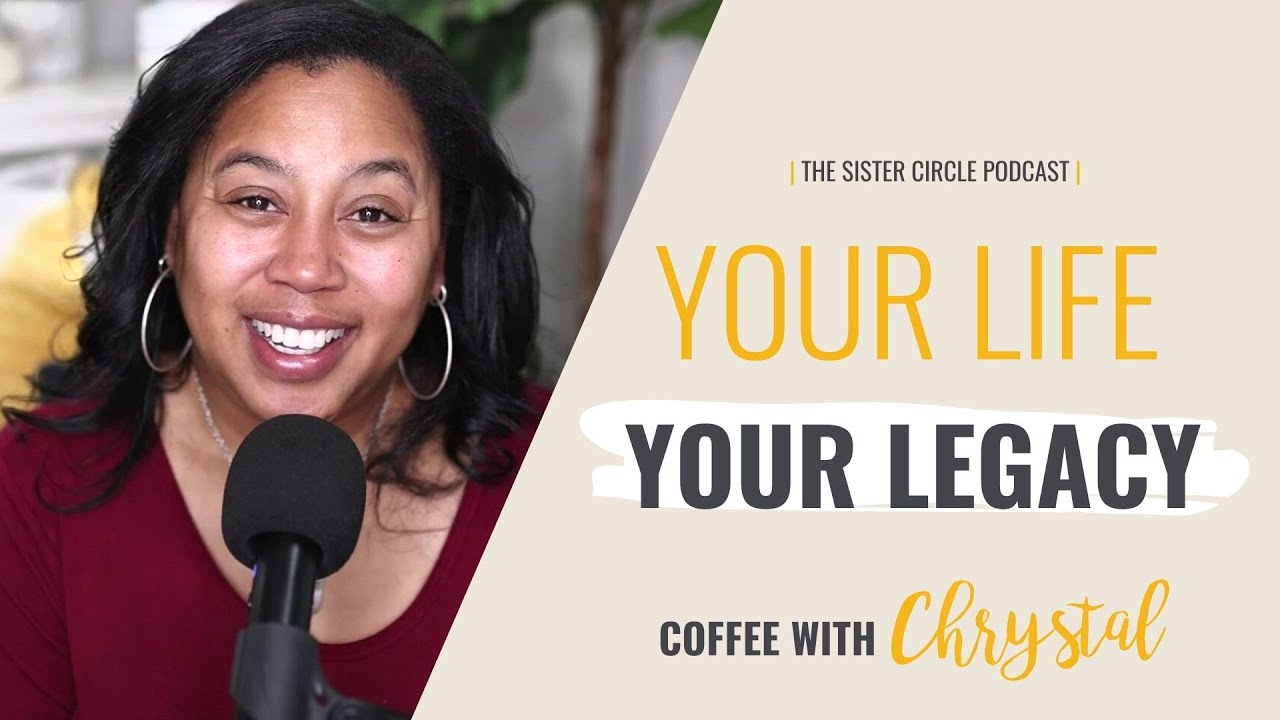
In this solo episode of "Coffee with Chrystal" from the Sister Circle Podcast, Chrystal Evans Hurst reflects on what it means to leave a legacy. She frames legacy around three pillars—memories, resources, and identity—illustrated through personal family stories about her grandfather’s piano, her grandmother’s cast‑iron skillet and Scrabble set, and the process of sorting heirlooms from a storage unit. Chrystal urges listeners to be intentional about creating memorable moments with loved ones, to steward financial and material assets so they can benefit future generations, and to recognize and share the relationships, knowledge, and faith that shape who they are. She weaves a faith‑based perspective throughout, citing biblical principles, the “50% rule” of giving, and the importance of keeping the faith. The episode ends with a call to action: live each day with legacy in mind, deliberately crafting memories, giving resources, and affirming one’s identity as a child of God and a steward of family heritage.
Chapters
Have you ever wondered what it takes to actually live your life so that you leave a legacy? Well, let's get into that today. Hello, my name is Chrystal Evans Hurst, and thanks so much for joining me for another episode of Coffee with Chrystal. This is one type of episode that you get when you listen to the Sister Circle Podcast. Every week the Sister Circle Podcast is released, and there's one solo episode and then one episode where I interview a friend, a sister, or sometimes a brother on the podcast, and you're watching the video version of the solo episode. If you want to be notified anytime I go live or anytime I share a video like this one, then make sure you are subscribed to my YouTube channel or that you are following me on Facebook. And if you're interested in listening to the audio version of this, then you can listen to it on whatever podcast player is your fancy— Apple Podcasts, Google Google Podcasts, Stitcher, or Spotify. I'm happy to be in your life today to encourage you, and I hope this word, this content, does just that. So you might be new here, but the likelihood is that you've probably been around, and if not been around me, someone in my family— my sister Priscilla, my brother Anthony, my brother Jonathan, my dad Dr. Tony Evans. And if you've been around, you know that in the last few years we've lost a long list of family members, um, some totally unexpected like my cousin Winter, some that we just that didn't see coming in this season, like my mother, and some that had been with us for a really long time, like my grandfather. He was 90 when he passed. But it doesn't matter when someone leaves you, it's usually always too soon. And the thing that you realize when someone leaves you is you realize with a, a really clear level of sight the legacy that they've left you. You can know that someone has left you a legacy when they're living, but it's when they're gone that their legacy shines through, through those you love and even through you. Just like a beam of light. And for me, it has been quite eye-opening to become so joyfully and painfully aware of the legacy that we've been left by those who have gone on before us. My grandfather, who I'll show you a picture of him. This is him in 2017. We went, this was one of the family members that passed away to bury my uncle. And we went there. This is him sitting at his piano. He was a master musician, led worship at his church, um, recorded, played with bands. I mean, loved, loved the piano, led worship at his church every Sunday. And, um, that piano, because of legacy— when we went, when he passed and we went to his house to move things out of the house that we thought should be a part of the legacy he leaves in terms of things That piano now sits at a place that we frequent often. It sits in a little alcove, and anybody that passes it, because it's in a place where my dad does ministry, hears, "This is 2 Daddy's piano." It's not about the piano though, now is it? It's about the memories that we made singing around the piano with him. It is about the times that we remember with him facing the way he's facing right now, having a conversation. He's facing the stairwell in his home. Someone would be on the stairs, someone would be sitting on the floor, someone would be sitting, um, or standing in the doorway, and we'd be talking about the good old days. Don't you remember when? Don't you remember how? Don't you remember who? It's not about the piano, it's about what the piano represents, right? When you think about what happens to the people you love and to the places that you've been when you leave The question is, will you leave a legacy? And your legacy will always primarily be based in memory, not the things, the things attached to memory, but it's about the taste that you've left in someone's mouth because you were here. Whether that be your spouse or your children or your siblings, your cousins, your small group at church, your neighborhood, the people you worked with. Let there be no mistake, you will leave a taste in people's mouths. People that you are barely acquainted with, or people that you know very well, you will leave a taste. You will leave memories. The only question that we really have to ask is, what is the memory that you will leave? And will you be intentional about leaving it? We have the gift of music in our home because my mother was a singer. She played the piano too. So coming Coming from her and my grandmother who played and coming from my grandfather who played, our home was always filled with music. It's not about the piano. It's not even about the sing-alongs. It's about the memory of the tune in our home. My granddaughter came over one day recently and she played the piano in my home. My husband gave me the gift of a piano when we got married 'cause he knew that I said I'd always wanted one. And one night as I was making dinner and I heard the piano playing, I thought, this is the sound of home, my home. Because what do I remember when I would sit down to practice the piano as a little girl? The smell of dinner cooking in the kitchen while I practiced the same line, treble clef only, over and over and over again. The memory, the sights and the smells and the sounds of home, the conversations that you have with those who you work with, the friends that you choose to show up and celebrate. It's not about the things, it's about who you were when the things were present and the taste that you left, the sights and smells and the sounds of you in the lives of others. So I want you to think about the memories that you have. In fact, I would love for you after watching this to take a moment and think about the moments in your life with friends or family, with neighbors, with community, with coworkers that make you smile. And then the question that you need to ask yourself is, what am I doing intentionally to continually create moments like that? Because if you remember it with a smile, the likelihood is that someone else does too. Or will if you choose to continue creating the memories. This is why we invited my daughter, my son-in-love, to come over for, um, a slumber party during the winter storm. The reason why we asked them to come and bunk with us is simply because I knew that that would create a memory. A memory of the fireplace, the memory of roasting marshmallows, a memory of hanging out and just eating until we couldn't eat anymore, a of staying up late and watching movies. And we did that. This is what I hope my grandchildren will say: we did that at Chrissy's house. Do you remember that time we stayed at Chrissy's house? Memories don't have to be major or big or expensive. I remember going to my grandmother's house during the summertime, and y'all, going to my grandmother's house during the summertime was a bunch of nothing. When I tell you nothing, I mean nothing. We watched cartoons, we ate, uh, grilled cheese, and we drank, you know it, hot tea. And so did we go to do anything phenomenal that cost a million dollars? No. But do I remember the moment spent on her leather Sofa when the sweat was hot underneath my back thigh? I sure do. Do I remember the smell of her clean kitchen? Because her kitchen was always clean. Do I remember the accent thick on her tongue and the beads that hung down? Because that's what homes in the '70s did. 100%. So it's not about fancy, inexpensive. It's not about ridiculously creative. It's about, as my mother would say, the overflow of you. It's the overflow of you. So I want to encourage you to be intentional about making memories with the people that really matter to you. Keep it simple. Don't go into debt. Don't feel stressed. Just show up and be consistent in that. And people, the people that really matter, will remember you. But memories often are tied to things. And so, as I mentioned to you, my grandfather passed a couple of years ago, and We all went down there, of course, for the funeral, and we went in my grandparents' home that they lived in for over 60 years, and we all went around the home looking for the things that were valuable. We did move the piano to Dallas, but we moved a lot of other things that had to be wrapped and shipped, but we tried to identify what was really important. So finally this weekend I went to the storage because now I'm in a home where I can actually put some things in in it. I went and got my grandmother's dining room set and, um, put it in here. And I may keep it, I may go ahead and give it to my daughter for her new home, but I'm so glad it'll stay in our family. But when my daughter came to meet me at the storage unit, y'all, it's now virtually empty. Grandfather clock that will go to my sister, mostly boxes left. We're almost done. When my daughter walked into the storage She took a deep breath and she said, "Oh, now I want to cry." I said, "Because you're remembering to Mama and to Daddy?" Which is what I called my grandparents or great-grandparents. She said, "No, because you live a whole life and this is what it's reduced to, a 10 by 10 or a 12 by 12 foot space. Everything that was valuable to you in boxes. Things. We know it's not about the things. We know that it's about the memory of the things, and it's about the memory of those things first. So I actually wanted to show you a couple of things that I got out of storage. 20 years ago, I asked my grandmother in her kitchen, "Tu mama, when you pass away, Can I have your cast iron skillet? And she said, are you serious? And look what I now have in my hand, along with a little something I took off of her shelf because she loves Scrabble. And this says, if y'all can see it, Queen spelled in Scrabble letters. I have this whole set. It's a set of 3. 20 years ago, when she passed away, I said, oh no, I can't ask my grandfather for the skillets. That's horrible. He's still living. What am I gonna do? I said, I hope I still get to get the skillets because I don't know that anybody else knows that I ask, ask her for them. And she said yes. And when he passed, my first thought was, I gotta go get her skillets. Now y'all, I can buy myself a cast iron skillet. I can buy one. It's not about the skillet. It's not about the thing. It's about my memory of her standing in the kitchen on a hot Baltimore summer's day, because we always went to visit her during the summer, frying chicken. With her housecoat on over her slip from church, still with her pantyhose on because that's how you did it. Back door open, screen door, with a breeze flowing through from the back to the front. It's not about the skillet. It's about her being the queen of her home and using the skillet as a tool to create the memories, the sights, and the sounds, and the smell. That I remember to this day. Of course, there are other things that we were able to bring here. I have her Scrabble table because she loved Scrabble. Um, I have a set of Christmas dishes and china. There was another set of china that Priscilla didn't want, no one else wanted, and so my daughter never got a set of china. I said, it's a complete set of china. Do you like it? She said, I love it. So she'll take it with her into her new home. And it's not about the things. It's about the fact that there was a woman who created memories and legacy and happened to use things to do it. So yes, I want to ask you, what memories are you making? But I also want to ask you, what resources are you leaving? Because things can pass down from generation to generation and can give the generation after you in your family, or you can give a generation adjacent to you something that they now don't have to work 20 years to get on their own. Yes, things are assets and money. Stop spending your money so that the generation after actually has a head jump start on life. Just because you can buy a bigger house, does that mean that you should? Or should you actually pay off the house that you have so you can will that to your children and they can have a head start on their lives. Sure, you can spend all of your money traveling all over the world, and there's nothing wrong with that, but maybe you measure out what you do because someone else could use those resources to get a college education without going into debt. Think about that for just a second. I'll never forget that I heard Pastor Morris from Gateway say that he and his wife have a 50% rule. They try to live 50% of what they make on that alone, and the other 50% give it away. Why? Because you can't take it with you anyway. And so rather than upscaling their life to do what they could do, they do what they should do and give a lot of it away. So what resources are you accumulating to pass on? Not for you to spend, but to share. What money do you set aside so that when you meet someone who has a need, you can just hand them a $100 bill? Bruce Wilkerson talked to us in that— in our church about that at one point. He said, I always keep a $100 bill in my wallet and I ask the Lord, who am I supposed to give this $100 to today? And he goes out looking for the person he's supposed to bless. It's a mindset. Yes, legacy is about memories, but it is also about resources and how the resources that you have been blessed to gain, to achieve, to, to receive It's about those resources and how you can share them. You can share resources and relationships right now. Some of us are so stingy and so competitive with the contacts that we have, with the relationships that we've been able to gain, that we have been so, uh, conditioned to think that what I have, there's not enough of. So if I share it with you, there will be less for me. And relationships are the same. And so instead of sharing the name that we know, instead of sharing the relationship that we have, we hold it close and only name drop. Instead of, instead of saying, hey, let me introduce you to someone I know. Information. There's stuff in your head, listen, that if you don't get it out of your head, if you don't share it, if you don't teach it— I don't care if the kids want to hear it or not, repeat it. Many of the things I remember from my grandmother, from my aunts, is because they said it over and over again when I did not care to hear. Many of the stories that I know from the Bible, many of the ways I understand to study the Bible, come because my parents told me when I didn't want I didn't hear. They told me anyway. I can tell you that many of the things that I learned in school, I did not care about when I was learning, but the teachers taught me cyclically on a scope and sequence anyway so that I would know that in 1492 Christopher Columbus discovered America, or at least that's what the history books tell us. But that's another podcast for another day. The point is, don't hold your information too close because when you go, it goes with you. And the reality is, if you've been able to attain some information If you've learned it, those who learn, Maya Angelou said, should teach. And then wisdom. As you get older, you realize that not everybody wants it. And so you realize that you have to look for in, uh, interesting opportune moments where the ears are perked and the mind is open to drop some knowledge on somebody. But there are, there are women and men who would love to know the things that you've learned the easy way or the hard way. Your wisdom, whether you are a wise 25-year-old or a wise 75-year-old is golden. And if you keep it to yourself, it goes with you. So what resources, whether they're tied to memories or not, do you have that you can share? Because I'll never forget when one of the gentlemen that worked with my husband for years in his previous job, when he passed away, it hit me because it was sudden that everything that he knew, that he planned on sharing, that he planned on teaching, that he planned on passing on, in an instant it went with him into the grave. Just in case you didn't know, it's sad, but it's real and it's truthful. On my episode with Tabitha Brown, she talked about how she has a relationship with death that's not common to many. She's not afraid of it. She actually understands and is comfortable with it because it's a part of life. And that's what you need to understand. Like one of my friends said recently, this is what dying looks like. And she said that on a day when she was dressed to the hilt, her makeup was done, her hair was flawless, and she was throwing herself a party. This is what dying looks like. You and I are what dying looks like every stinking single day. The question is, as you live, are you dying well? Are you creating memories? Are you doing the things you don't feel like doing because it's worth it to do it? Are you measuring out your time and space to make sure you're giving your time and space to those who matter most? Are you making the most of every opportunity, gaining the assets, gaining the relationships, gaining the information gating the wisdom, learning the fear of God, because that is the beginning of wisdom. So that— not just so that you can amass it for yourself. Yes, use it to live well. Yes, use it to bless other people. Yes, use it to enjoy your home and enjoy vacations and enjoy your family. Yes, God gives you the ability to make wealth and to create relationships. He is the God who owns the cattle on a thousand hills. But then after all that, what you gonna do with it? What you gonna do with it? You need to be living for legacy, thinking the whole time, how do I pass this on? So when I don't feel like doing certain things in my life, but I know, man, I get it now. Lois Evans, these are the things you did that you didn't feel like doing, but you understood legacy. So you did it anyway. Your memories, you can give those. Your resources, you can give those too. And here's the third thing: your identity. This is a picture of my grandfather. Hanging on the wall, stately in his home. It's now traveled back to Dallas to be with us. I'm not gonna hang this in my home. I'm not gonna talk to Priscilla about it yesterday. We both agree this should go above the piano. So when people see the piano as they pass through the ministry spaces and places that make up Tony Evans and the ministry that ensues, They'll see this is the man behind the piano. Actually, this is the man behind the music. This is the man behind the music that's also the man behind the other man. Tony Evans, Lois Evans, their children. Didn't graduate from high school, had to get his GED. Hard labor on the waterfront in Baltimore. But faithful. I went to visit him the last time I saw him living, and before I left, I said to Daddy, will you write something down for me? I just thought, I want whatever you want to write down for me in your handwriting. He said, what? I said, dude, Daddy, just write it down, just something small. And he wrote, "Keep the faith." That's it. Keep the faith. The identity that I have as a daughter of two parents who kept the faith, the identity that I have as the granddaughter of two sets of grandparents who kept the faith. The identity that I have of people that have been in my family and friends that have loved me and prayed for me and supported me and served with me is keep the faith. The identity that I have, if none of those people had done anything else for me, is that I'm a daughter of the King. And Jesus himself came to Earth because he said, listen, I'm gonna have to show these people And for the sake of that girl Chrystal who's going to come thousands of years after this, I gotta keep the faith. The identity that I have is to know who my people are. So even if your immediate circle is not the people you want to be, it's not the people who've left you legacy, not good memories, not good things, not good information, didn't give you wisdom, you got to know who you are. And then identity is what you get to leave. Behind. Listen, ancestry.com— I'll look this up for y'all because every now and then I like to quote a statistic or two. It says, we are honored to have played a role in empowering the journeys of personal discovery for over 15 million people around the world through Ancestry DNA. It is a true sign— and this is the truth, y'all— of how deeply important it is for people to connect and learn about their past. When I was 12, and I talked about this in my book She's Still There, I was crying one day and told my daddy, I don't know who I am. And he said, what do you mean? And it was an identity crisis, total existential crisis at 12. And every single one of us at some point in our life have said, who am I and why am I here and what am I supposed to do and how am I significant? Am I significant? Why does it even matter? If I exist? Does anybody even care? Am I doing anything meaningful? Well, let me just tell you, if you needed to hear this today, there has never been nor will there ever be someone just like you. So if you don't know who you are and you don't have a picture of your grandfather, or as I also have in my home, my great-grandmother and my great-great grandfather. You don't have that. It doesn't matter. It doesn't matter. You want to know why? Because identity can start with you. It starts with the fact that you have this fingerprint that nobody else has, and that you have the opportunity starting today, even if you haven't started before, you have the opportunity to make memories. You have the opportunity to amass resources, to be a blessing to you. Yes, thank God. And to a blessing to other people. And then to know who you are, to know, to do the work, to discover who is the gift of Chrystal Hurst, who is the gift of Angela Hurst, who is the gift of Denise Hurst, who is the gift of Charlie Hurst, who is the gift of Lavon Hurst, who is the gift of Betty Hurst, who is the gift of you in this world. You gotta figure that out. God shaped you and formed you, Psalm 139, and he knew you before your eyes, your skin, your face ever hit this earth. Before your mother even saw you, he saw And no matter what craziness has erupted in your life, if you're here and still breathing, you're supposed to be. You are supposed to be. And if all you know today is that you are a daughter of God, breath of life given by God the day you were born, if that's all you know That's enough. It's enough. Any and everything else you need to know about your identity, you can learn. Identity. The legacy is I know the stories of my grandfather at the waterfront, my grandmother having to go to work teaching school because he couldn't get work when water— the work at the waterfront dried up. To hear the stories of how difficult their marriage was and they persevered. To know that my grandfather took my, my father to a little jeweler on the backside of some alleyway because my daddy couldn't afford to buy my mother a ring. To know those stories, to know that those are the kind of people I come from, mean a lot. But listen, let me tell you something. To know that Jesus stopped and went out of his way in John chapter 4 to talk to the Samaritan woman, the girl who'd been sleeping around, to know that that God God loves me. That's identity. To know that Mary, who came and washed Jesus's feet with her hair and poured the expensive perfume because she knew of how much she'd been forgiven, and he— as other people talked about her, he said, leave her alone. That's identity. To know that before I was born, he saw me and named me. That's identity till you don't know who you are. I'm gonna tell you like my daddy told me that day— I started crying. He said, what do you mean? You're Chrystal Hurst! You're my daughter. Do you want to start leaving a legacy and you're not quite sure where to begin? Start with the identity that you have. Say your name. Say whose daughter you are and start with that. And then be intentional about memory. Be intentional about gaining the assets, starting with the fear of the Lord, because that is where wisdom comes from. And know that we're all living to die. Now, I hope I live a long time. It'd be nice. It'd be nice to see my great-grandchildren. Like, that's one of the benefits of having babies young. You start that thing early. But, you know, I don't know what's in store for me. Here's what I do know: I know that I've been handed an awesome legacy, but legacy stops with me if I don't pass it on. Here's what I want you to know: whether you've been handed legacy or not, it either starts or stops with you. Every generation makes the decision if they will be legacy livers or not. And this is your life, and you get to choose whether or not you'll leave a legacy. I want you to know that I know that we all feel like sometimes we're starting from different starting points. I know that sometimes you wish you had more to work with. I know that some of you you wish you would have heard this sooner. If you still have breath, you get to choose. Every stinking day you get to choose. And it doesn't matter if you're 21 or if you're 28 or 38 or 59 or 72. You still breathing? You get to choose. I heard a story last night. My sister was at a birthday party. She sat next to someone she'd never met. This person, this woman, was telling her her story, and she talked about how in a season of her life years ago she lost a child. She no longer wanted to live. She wouldn't get out of the bed. She wouldn't come out of her home. She wouldn't allow anyone to serve her. She just wanted to die. She had other children She didn't care. And then she said someone came to her house every day, stood outside of her house and prayed for her, and did it repeatedly. And then one day asked to come in. She let her come in. And then one day she said, let me take you with me to a Bible study. She said, I won't have anything to say. I can't even— she said, that's okay, just come, just come. That girl talking to my sister yesterday told Priscilla that the leader of that Bible study knew her story. And sometimes when she couldn't even get out of the car, she would come to the car to pray with her. She would turn her phone on in the Bible study so if she couldn't leave her car, she could hear it. She reached out to her. She met her where she was. And then she said, my Bible studies leader was Summer. No, wait a minute, it was Winter, my cousin Winter, who passed away in 2018. That woman is alive and living a very good life. And she said, your cousin saved my life, welcoming me in, taking me as I was, accepting what I could give. She left space for me, gave grace to me. And that is one of the many, many parts of Wynter's legacy. All she did was leave space for someone else. Legacy can be that simple. You just have to decide to show up for your life. And regardless of what's happened in your life, decide that the girl in you If she's still here, then she still has a legacy to leave. So this is me telling you, live your life, girl. And as you live, keep legacy in mind. We are all here. Enjoy. This is my 50th year. I plan to do a whole lot of partying and a whole lot of fun. But I also want to live this year with a more attuned mindset to legacy. Why? Because at the end of the day, that's really all I'll leave behind. Memories, resources, identity. That will be my gift to those I love, those I care about, those who the Lord allows to cross my path. That can be your gift to those people that you love too, or that you care about. And here's the funny thing about legacy: it always has a ripple effect. You drop that legacy as a pebble in the water and it just echoes out. When you do you and you do you well, guess what'll happen? There will be people you'll never meet that will be blessed by how you lived. So I hope this has been a blessing to you. I hope that if it has been, you'll share it with someone else who needs to hear the message. And then I want you to know that if you don't feel seen today, you are seen. If you don't feel loved today, you are loved. If you don't feel that there's hope today, as long as you're alive, my friend, as long as you're breathing, there There is always hope. Okay, y'all, I'll see you next time. Bye-bye.










