Reset Your Rhythms - Coffee with Chrystal #alittleQC
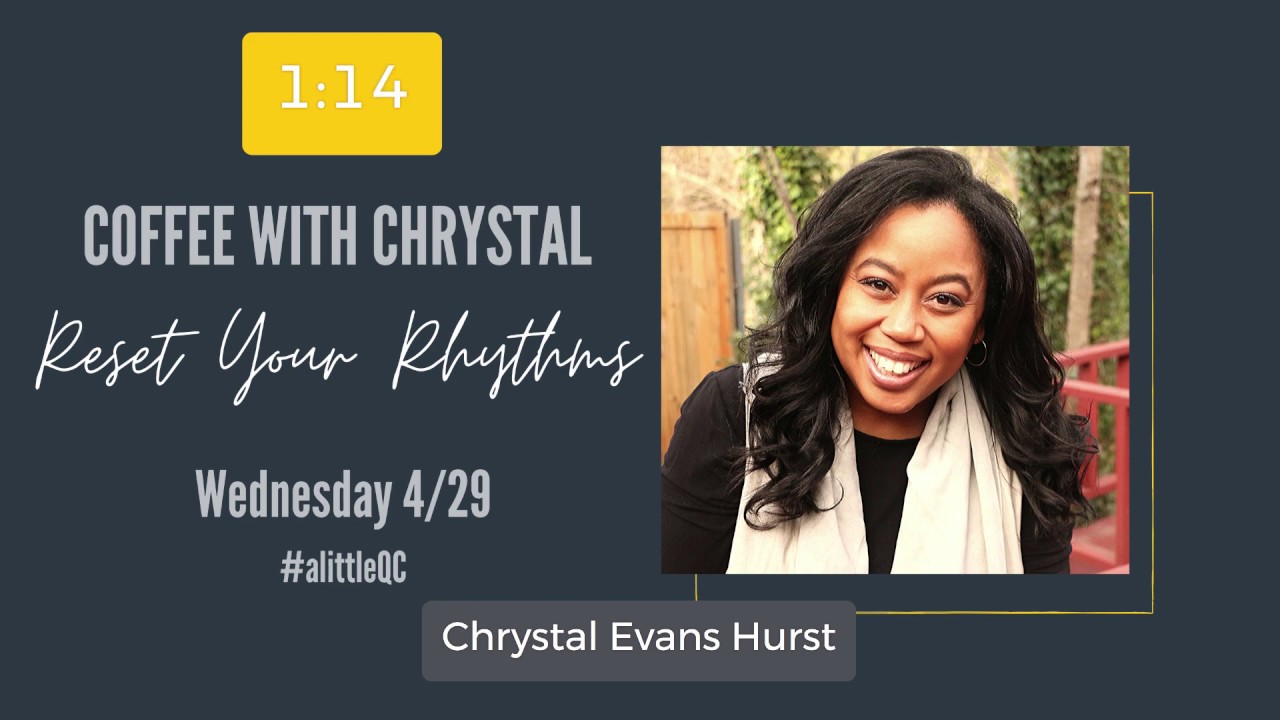
Chrystal Evans Hurst explains how COVID disrupted daily routines and shares concrete ways to reset them: journaling, meal planning, setting work windows, limiting email checks, preparing clothes the night before. She emphasizes that rhythms automate decisions, preserve energy, and reduce decision fatigue.
Chapters
Good morning, good morning, good morning, good morning. Fade my music because I'm trying to produce. Look at this. Why is this just off to the side right here? Why is it not cooperating? Good morning, good morning. Tell me where you're from where you are operating from right now, because every morning we do this, I'm surprised by where you all are watching from, what you're doing. Some of y'all are getting ready for work. Some of you are getting off of work. Some of you are doing your morning walk. I've heard— sometimes I hear you all are getting breakfast ready for your kids, or Sometimes you are washing dishes because you didn't do it last night, folding laundry, um, still in the bed with your phone. How about that? How about that one for a winner? Good morning, good morning, good morning! Today is Wednesday, April the 29th, and we are still here. Somebody say amen! Amen! We're still here. So I had a little bit of a rant yesterday. Um, and I want to jump off of that rant into some content that I think will be useful for you today, um, about how to reset your rhythms when your rhythms are out of order. Okay. So, but before I do that, uh, let me remind you of a couple of things. First of all, there's always a first timer. There's always a first timer. So if you are here for the first time and you're like, who, who is what, who is she? What is happening right now? Um, I want to tell you, I am Chrystal Evans Hurst. You can find out more about me. Uh, I see you 6.7 miles on your walk. You can find out more about me by going to chrystalevanshurst.com. Uh, I am an author and a speaker who has decided for most of the shelter at home situation, um, to show up every day at 7 AM to give you a little QC, a little quality, uh, a little quantity content. No, no, a little quarantine content so you can exercise some quality control in your everyday life. Because in the midst of what has been chaos for many of us, we can still, um, be intentional about how we, about how we live. I hope that if you are at home or at work and have access to something to drink, whether that is your water bottle, uh, or if that is simply your coffee mug that has your morning cup of coffee. Hey UK, your morning cup of coffee, New York City, uh, or your tea. I hope you have that because sometimes you just need to, you know, when the house is still quiet or when your people are not bothering you, have a little minute for yourself. Okay, have a little minute for yourself. So if you don't do anything else after watching this live, I want you to make sure you're on my email list, A, because I tell my email list about most things first, and B, because if I say anything here today that you're like, oh my gosh, I need the notes on that, because if you're in the bed, you're probably not taking notes. We take notes for you and then we put them in our resource list. For those of you all who are looking for your email for this week, we had to add some stuff yesterday because of some exciting things that are coming. So that email will go out today because it normally goes out on Mondays. And then Mondays now we're doing quarantine content. So we shifted the podcast to Tuesdays. And then yesterday we had some stuff to add. So it is what it is. Hi, South Africa, Kenya, Louisiana, Fort Worth, Fort Party Worth. Maryland, y'all. So anyway, I want y'all to know, the other day when I was like, where is the stuff? And I had the stuff here, and where did it go? Do you want to know? It was at my feet the whole time. For those of y'all been watching, and I was like, what? I can't believe Jesse's not here, he can't bring me anything. You know, my husband has been like being my silent cheerleader this whole time. So anyway, I want y'all to know that the whole time I was looking for that stuff, it was right here on the floor next to my feet. It was right there. It was right there. So anyway, so I was trying to show y'all this Black Woman Oil. Y'all, this was the Black Woman Oil. I don't know, this is what they do on YouTube. It doesn't seem to be working. Oh, there we go. Black Woman. And somebody said, of course, you know, so is this just for black women? No, it's just what it's called. Somebody gave it to me. I like the way it smelled. I thought about changing the name, but it is what it is. This is what it's called. And y'all have been buying me out of house and home with this stuff. So enjoy, but remember, use a little bit. You don't want the neighbors to smell you coming. Okay, so the other thing that I was looking for, um, I'm going to show you today that I couldn't get to. I want to show you today because I want to talk about what it looks like to reset your rhythms. But before I talk about that, um, I want to make sure that you know about a couple of super important things, okay? So here's what's, here's what's about to happen. There's a couple things that are about to happen, okay? Uh, and, and let me, let me go in order. I'm getting excited. Let me go in order. If you are looking for conversation and connection, um, check out, uh, the Sister Circle Facebook group. It's chrystalhurtz.com/facebook, uh, Facebook group. So you can go there and, um, yeah, you can get it from me, Lori. You can get that You can get the Black woman from me. Ah, uh, yes to the UK. Um, it does cost extra, but yes. Okay. So, but here's what I really want to tell you about. So many of you all have joined the Inner Circle. Okay. You have joined the Inner Circle. So the Sister Circle is free. Anybody can join. We have conversations. The Inner Circle is extra stuff. So over the last almost month now, I've been putting out extra stuff and the extra stuff normally goes to the Inner Circle, but y'all, because of what we're, where we're at, I just was like, everybody needs the extra stuff. And then all of the extra stuff has been going to live its final life in the Inner Circle Library. But here's what the thing, here's the deal. Here's the deal. I have been doing a 90-day challenge with Inner Circle members at a certain level and up. So right now we've only had like the basic level where you get bonus content, but there's other stuff. There's courses and there's teaching and there's special video releases and there's product in the mail and all these other things. Those other levels have not been open because we were doing something together and we started something together. We wanted to finish something together. Okay. It opens up Friday. It opens up Friday and it will close again Sunday night. So I just want you to know that in your email, when you get your email today, it's going to tell you what else is available if you're interested in leveling up in your Inner Circle membership. Okay. Because here's what we're going to do. So we're going to start another 90-day challenge in June. However, for May, we're going to do a 21-day situation. One, because when you've been working for 90 days on a goal, you know, just take a break, reset. We're going to be talking about your personality type, how to know who you are, how to know what you love. And so if you're interested in that journey, you want to pay attention on May the 1st. And then, uh, we'll leave it open till Sunday night, and then we're gonna close again so that we can do this 21-day experience together. So if you've been thinking about the Inner Circle, uh, now's a good time. And then if you're already in it at that entry level, on Friday for new people and existing people, it opens up. We can do that 21-day thing, y'all, because we need to know who we are before we can decide what we do. Somebody say amen. Um, and then, um, we'll start another 90-day in June. Here's the other thing you need to know, and this is why you need to be on my email list. Oh, okay. This is the other thing that you need to know. Okay. We are going to have an online event. Now the world is opening back up. And my hope was to bring an online event to you so that you had something to do. While you're still at home, but the world is opening back up slowly. And we're trying to do it right. Because, you know, we don't know how to do these things. We just out here in these streets figuring it out. Sometimes you just, you know, you just figure it out. You understand what I'm saying? You just figure it out. So we out here in these streets figuring it out. Technology, nomenclature, the setup, the guests, who, who I am, what the web page is going to look like. Oh my goodness, we've been trying to land branding colors for weeks because you know your girl, I can barely get dressed. And I was trying to hide it, but let me just go on and say the truth. This is what I had on yesterday. I changed the sweater, but I'm like, it felt good to sleep in again. And this morning I ain't gotten dressed yet, so just rolled out of the bed, made my little graphic came on, set up the situation, threw on a different sweater, but you know, it fell back. So what can I say? It is what it is. Some of y'all been wearing the same t-shirt for a couple of days. Don't trip. Okay, so anyway, I'm excited about that, and that will be a Friday night, Saturday all-day event. So excited, so excited about the event, so excited about my guests. I'm so excited about the content because y'all know I like to teach. And so, um, you just need to know it's, it's, it's going to be exciting. So enough of the commercials. Um, somebody said, yeah, you changed the sweater, it's a whole new look. You got that right, it sure is fresh and highly favored. News— that isn't even— it's supposed to be blessed and highly favored. I just said fresh and highly favored, but you know what, highly favored will go along with being fresh. Amen. Amen. Okay, so what I wanted to talk to you about today, now that I've gotten all my announcements out of the way, um, is just resetting your rhythms. So yesterday I had a little bit of a, uh, it wasn't a meltdown, I just was irritated. I just was irritable and frustrated and You know, and we have days like that. Sometimes we have days like that because it's quarantine, right? And because we're tired of whatever, uh, schooling the kids, we're sick of working from home, we're sick of living by ourselves, we're sick of living by our spouse, we're sick of, you know, being confined, we're sick of having to stay 6 feet away in the grocery store, we're sick of having to wear those masks, we're sick of a lot of things. And after a while, when you are on overflow of sickness of frustration, of irritation, it just comes out. You know, I usually tell my children, you need to respect me, and it's not just about what you say, it's about the non-verbal communication that's coming out of your pores. Because do you understand that non-verbal communication is the majority of what you say? And how you feel will come out. It may not come out of your mouth, but it'll come out. And so often how we feel gets ignored until it starts coming out, and sometimes it comes out in our mouth Sometimes it comes out in our nonverbals because we roll the eye or we take the extra deep breath. You know, somebody in our family or somebody at work asks us a question, we're on a Zoom call, and our response is— that's a nonverbal. It's a nonverbal. And you just told the world that you don't— you, you, you, you, you don't care about what they're asking you for, or you're irritated, you are exacerbated that they're even asking you a question right now. Don't they know you're sick of being at home? Don't they know that you have feel like you feel like you've had double the work, either because work has been extra or because, um, because home has been extra and the two together is too much. And so you do that. You just gave a nonverbal. You just gave a nonverbal that said, you know, depending on who you are and depending on what your coworkers know about you, you could have just cussed them out. You know what I mean? You could have just, you could have just let them have it because they know who you are. So I just, I just need you to understand that that it will come out. And often what comes out, uh, what comes out of your mouth, what comes out of your nonverbals, it's an indication of what you may or may not be acknowledging about what's going on inside of you. I want you to understand that we have all been— all of us, y'all— we have been thrown off our rhythms. Every Sunday after church, when we go to church, we go to Costco. This is a part of our rhythm. I go to Costco every week on Sunday. I get gas. Why? It's not because I'm a Type A person. It's not because I'm just super, super ridiculously organized, y'all. It's because if I don't get, uh, gas on Sunday, I will forget. I will forget. And then it'll be midweek, it'll be midweek, it'll be, you know, Tuesday, and I'll be running out of gas and thinking, dang it, what? Why am I running out of gas? It's because I didn't fill up since the week before. I'm one of those people that will drive my car on empty because I know when the light comes on, I know how far I can go. I know that when the light comes on that still means that I have, you know, I have a minute. I have at least 25 miles until I run out of gas. How do I know? Because I tested it. Okay, so I put a rhythm in my life so that I don't have to think about the thing that is recurring. It's just a part of my rhythm. It doesn't require a decision because decisions require— it requires energy. Okay, and I talked yesterday about things requiring energy. And when you are needing to realize in this season what's requiring energy from you. And a lot of things are requiring energy that never have before. You have to think about what you're fixing your kids 3 times a day. You have to think about how to learn this new technology. For those of you who weren't using the technology, you got to figure out how to teach your kids if you're a teacher and you're trying to figure out how to reach them while they're online. You have to figure out how to make what you have in your pantry last because you don't necessarily want to get out and go out to eat, or you don't want to necessarily try to manage your money. And so you're your pantry cooking. You've never done that before. If you felt like it, you just went to the store and bought it because tonight I feel like salmon, or tonight I feel like fried chicken, or tonight I feel like this kind of salad, or tonight I have green beans, but what I really want is romaine and a spinach situation, a Caesar, so I'm just gonna go pick that up on my way home. You're not doing that anymore, so the energy is extra. And what I want you to understand is that rhythm helps your energy level. Rhythm helps your energy level because then there are things you don't have to think about. And here's what I want you to understand. The world is about to start opening up, y'all. It's about to start opening up. And some of you are so stinking elated about that, so stinking elated about that. Um, some of you are not because you've actually enjoyed the sheltering at home. Um, maybe because you get to work from home, maybe because you get to be with your kids, maybe because, um, the world slowed down. And so all of your commitments that had you stressed out, all of a sudden you're like, oh my gosh, This is what it feels like not to be stressed. So here's what I want to challenge you with, okay? This is the time right now, okay? It's April the 29th, and in Texas, May the 1st, things are opening back up, and they're opening back up gradually. The phases are starting, right? Which means that in one month, life could be pretty much back at full steam for some of you, depending on your state and depending on what you do, okay? And I want to tell you what I'm telling me right now. Let me tell you what I haven't done. I had to call Priscilla, y'all. I had to call Priscilla and I had to say, girl, tell me what to watch on Netflix, please. Because I'm not a— I'm not a chilling person. I, I get joy by checking boxes, like by saying I did it, it's done, it's over. Like, that makes me so stinking happy. So when I have bandwidth, I start looking for things to do. I'm like, can I clean off my patio? My poor kids. I've cleaned out the garage. We bought a picnic table. They don't know it, but they'll be putting it together today. Like, I'm like, all the things that I wanted to do, this is my time to do them. But one of the things that we— that I need to do that has to be a part of my rhythm, and I have to work at it, right, is resting. Is resting. Resting being a part of life, not what you do when you're exhausted and you pass out. Is Priscilla here again? Oh gosh. Y'all, she is my resident heckler. Oh my gosh. So I did have to call her and I said, what do I watch on Netflix? Because y'all, she is the queen of restfulness. She is the queen of getting things done, but she doesn't have a problem curling up in the covers and being like, I've written my 2,000 words for today. I've fed my kids today. I've been a good wife to my husband. I've jumped on a couple of situations and delivered some word. But guess what? I'm done. I'll see you later, kids. I'm checking out. And I'm the kind that I typically check out when I'm like, oh my gosh, I'm going to pass out if y'all start— y'all keep talking to me. So the reality is, yes, Winter was that way too. Wrote 10 books almost in, uh, almost completed 10 books in 4 years, but she took a nap every day, right? So it is possible to be a person of rest and get things done. Now, there's, you know, there's an advantage to being me too. There's that. But the reality is, is I have to work on rest and other people have to work on developing rhythm. So one of the things that I've developed is what I want to talk to you about today. But you have to work rest into your rhythm. I want to say that first. Okay. And I know that seems like an oxymoron. You have to work rest into your rhythm. But for some of y'all, You have to be intentional about it. Maybe you're not a doer, maybe you're not a box checker, but maybe you are a server, a care— a caregiver. And you're gonna work so hard to make sure that if nobody else does it at work, you do it. And if nobody else is going to do it at home, you do it. And if nobody else is going to make sure the thing is paid, you are. And if nobody else is going to show up to serve at the church, oh my goodness, you gonna do it. If nobody else is gonna raise their hand at the PTA or forever Whatever needs to be done in school, at your kid's school, you're going to make sure you do it. And so it's not so much that you're a box checker, type A personality. You're not a person who likes to stay busy. You're just a person who likes to make sure it's done right. And because you're a responsible person, if other people don't do it, you will. I'm saying you have to learn how to prioritize the rest of your soul, the rest of your body, the rest of your spirit. The rest of you. Because here's the thing, on the seventh day— y'all, Priscilla has a book about it. What's it called, Priscilla? Breathe. It's about Sabbath. It's about rest. On the seventh day, y'all, God, all-powerful, almighty, all-encompassing, omnipotent, omnipresent, the bee's knees, y'all. He said, I'm taking a break. He said, I'm not doing all the things. I worked hard, and now I'm done. I'm done for the week, and all the things that I did were very good. So if God says, I gotta do the thing, I gotta take a break, okay, then we all have to say, where does ongoing rest fit into my rhythm? I'm starting there, y'all. I'm starting there because some of y'all are gonna get sucked back in. You understand what I'm saying? You're gonna get sucked back in., and you're gonna think 3 months from now, oh my gosh, how did this happen again? I had decided that I was going to have rhythms in my life and that I was going to drive my life and not have my life drive me. That's what some of you all are saying, right? And, uh, hey Ashley Island! And the reality is that you, without a decision right now, without a decision, okay, you're gonna get sucked right back in. And I'm telling you that the first decision that you need to make, the first one that you need to make, is that you are going to let your— you are going to be the creator of your rhythms and not the outside world, okay? Not the outside world, okay? Everything starts with decisions. And y'all, I promise I'm not plugging it, but it's in here. I gotta— this is what— when you write a book, you have to remember what you said and why. Think about it again if you already said So there's a whole section where I said, how do you develop your life? Okay, and these are the 5, 6 chapters, because this is what you have to do. You have to make a decision, okay? You have to decide. You have to focus on the finish and say, where am I headed? What am I aiming for? And if you're aiming to be in control of your life and not let your life control you, you got to say, what does that look like? What does that look like? And some of us in this season have redefined what it looks like for us not to be harried, for us not to be totally stressed out, for us not to be driven by external circumstances. We have created some new normals, some new normals, because we got to get out of our house before we get crazy. We've gone walking 3 or 4 times a week, but you weren't doing that before. Okay. So you've got to say in my life, post COVID-19, This is what my life will do. I'm going to focus on what it looks like, and then I'm gonna make some decisions. Okay, you got to make a decision, then you have to pay attention. You got to pay attention. I'm gonna show you something else in a minute because it's over there that will help you pay attention. But you, you need to write down— somebody say write down— you need to write down what's working and what's not. That doesn't mean you have to journal, so don't get afraid. Don't get afraid. Don't get afraid. You don't have to journal, but you need to pay attention before you go to bed. When you get up in the morning, write down like single words: stressed, tired, irritable, good day. Now you can journal, you can write a whole sentence. Ate dinner with my kids at the table. You need to know what— Priscilla said I had my preacher voice on. That's because I'm so passionate about this, y'all. I'm gonna try to calm down though, try to calm down. Anyway, you need to know what works for you and what doesn't. And let me tell you, many of the reasons why we get all out of shape and lose our rhythms, it's because we don't even know what's working and what's not. We're not paying attention. So you need to write it down. Now you can put it in your phone. There's a great app, we'll put it in the resources, it's called Day One. If you're like, I don't, I don't want to write nothing down, I want to challenge you on that because if something happens to you tomorrow Will your people be able to get into your phone to see all your thoughts? I think you should write it down. But if you know you're not, okay, fine, just write it down somewhere. Okay, but day one, I'm there. But there are a lot of journaling apps. Use the Apple Notes on your phone, but get a spiral notebook, get a notepad. Like on my desk right now, what did I just do with it? Did it fall off? It did. Hold on, let me, let me get it. Lord Jesus. I mean, it's simple. It's simple. It's just right here. Okay, so write it down and just pay attention. Just pay attention to how you feel. That's a little bit of what we'll be talking about in the 21-day journey— how to pay attention to you. Okay, so you got to decide what does it look like. Focus on the finish. You need to make a decision. What are the things I'm gonna do? Then you got to pay attention. How is this working for me? Is this not? Okay, then you've got to use discernment. You need to have people, places, and things that are going to catapult— somebody said hold the book up again— that are going to catapult you into who you need to be. If you're hanging around people who ain't doing nothing, guess what you're gonna be doing? Nothing. It's really hard. You can be a salmon and swim against the stream, but do you want to know why most fish don't swim against the stream? I tell you why, because it's hard. It's hard. So when you surround yourself with people who are working on something, who are thinking like you are, who are trying to get somewhere in their careers— this is why people join Toastmasters. In our 90-day journey, one of the goals that one of the girls had was working on speaking and not being nervous in front of people. She joined Toastmasters because if you're trying to do a thing, then you got to be around people who are also doing the thing. You got to surround yourself with people who are trying to write the book. You got to surround yourself with people who are trying to raise their kids, who have kids in the same season you are, or who have mothered beyond you so they can encourage you. You got to surround yourself with people who are trying to study their Bible. You got to surround yourself. And then you got to have places and things that support you. So my doctor said, listen, I need you to get off of that sugar, and I need you to just go through your house and throw away everything that has sugar in it. Because I told her that my weakness is Oreo Thins. Y'all, I don't have a batch I have one a night before I go to bed. It's like my little treat. If I'm not having a dark chocolate almond, then I am totally having an Oreo Thin, plain Jane. But I did try pistachio and mint, and there were some other kinds. But you know, really, I'm just gonna keep it simple and say, uh, against, you know, just the Oreo Thins. But the point is, she said throw it away, and I was like, no, I don't want to do that. I don't want to do that. I spend money on those. It's a treat. I'm excited about it. It makes me happy. You know, my kids are like, what is that? And I say, it's not for you, it's for me. I hide it in the back so that they won't find it. You understand? Okay, so people, places, and things. Okay, if you want to be a runner, let me tell you what you need to do. Let me tell you what you need to do. The night before, you need to lay out your clothes so in the morning you don't have an excuse about what you can't find. The things need to be close. Accessible. People, you need to find yourself a running group. And then you need to figure out where's your path. On the way home from work, before you say I'm going to start walking or running, you need to go out with your car and drive it. Say, all right, this is how far it is. You know, if you want to run, don't run, don't run, don't start out running, just walk it, just walk the thing. Okay. And then you need to find people to do it with, people that want to run, places that you're going to run, places that you don't mind going to, scenery, neighborhoods that you want to be nosy about and see how people live. Run in that neighborhood, right? And then things. What things do you need? You don't need a new pair of shoes, but just put your pair of shoes by the door so you— that getting out, getting out of the door is not a problem. Can I tell you how many times I couldn't get out the door? Because by the time I found my shoes, it was time to fix breakfast. So set yourself up for success. That's the bottom line, okay? Set yourself up for success. Exercise discipline. And I talked about this the other day. Many of us are trying to figure out how to be disciplined people when really— and that's what I'm going to tell you about is rhythms. I'm going to give you some tips for rhythms, that this is the groundwork for this. Okay, really what you need is rhythm so you don't have to think so hard. Discipline is something that you've decided to do, that you do, um, either on automatic or without much energy because it's just what you do. You don't have to decide about it every day. You already decided, right? You decided what you want it to look like, then you made a decision about what you're going to do. Small decisions work better than big decisions, by the way. That's what the 90-Day Journey is all about. Then you have to pay attention, write down how you feel, pay attention. Then you gotta put people, places, and things around you so you can set yourself up for success. Then you have to exercise discipline. Discipline means you do what you don't feel like doing because it's the right thing to do. And I'm gonna help you with that because rhythms are how you build discipline. Rhythms are habits, but habits makes us feel all like 21 days until I got the thing. No, it's rhythms. Let's say rhythms. Okay. So that you can just kind of, you know, just gradually move on in to the thing that's going to help you, okay? Help you to stay sane. It's going to help you to stay sane. The thing is, you can't say I'm not a disciplined person and what you're looking forward to is motivation, okay? Discipline is I do it when I don't feel like it. But here's the problem, y'all. We try to do a lot of things that we don't feel like at the same time, at the same time. The rhythms are you build them slowly. You build them slowly. So it's slowly build discipline, slowly build rhythms. And that's what I'm going to hone on in, in just a minute. Slowly build your rhythms because that's what discipline is. You get up every day at a certain time because you have to be at work, so you have a rhythm of what time you need to get up to get to work on time. You are externally motivated by that check. You're externally motivated potentially by the fear of punitive damage, uh, that will happen if you don't show up on time. Y'all, I got fired from one of my jobs when I was in my 20s because I couldn't get there on time. I didn't get fired. That's not true. That's a lie. See, somebody's gonna print that, and that's actually not the truth. I quit before they fired me because I knew that was what was about to happen. That's what was about to happen. I was like, dang it, I'm late again. Let me just quit. Let me just quit. So you have rhythms though in your life that set yourself up for your success, even if you run a little late. You have rhythms. You eat 3 times a day. Guess what? You're a disciplined person. Or you eat 2 times a day, or you eat 1 time a day, but whatever it is, you eat. So you're disciplined. You do something. So slowly build discipline, okay? And discipline, you do one at a time, okay? And here's the last thing. People want to know, how do you— how are you successful? How are you successful? Here's the book. People keep asking, how are you successful? You keep doing it. Repeat. Repeat. It's a cycle, okay? You stay committed to the cycle. That's it. So let me talk to you about building rhythms, okay? And I'm gonna, I'm gonna talk a little bit about this. We'll see how much I can get done. I may have to do another one about working from home, but, um, because I work from home and that's part of what's been driving me crazy is my whole rhythm of working from home has been destroyed because McKenzie is at home. There's a sweet girl named Mackenzie who comes to my home and helps me out so that if I'm traveling or if I have to work, that the kids aren't out there playing video games. But what's happened is I got to make sure they're not playing video games, I got to make sure they're doing their schoolwork, I got to make sure they're not sleeping. So I'm running back and forth with my laptop and my phone and doing all the things, and I'm just all scattered, all scattered. I'm going to show you something, I'm going to show you something, and maybe one day I will blog about this. Maybe one day, I don't know. So this is me trying to not lose my mind when I had small children. Now this may be backwards when you see it, I don't know, but it says Control Journal. Okay, this says Control Journal. All it is is a binder, and I learned about this from blogs, you know, when in the early 2000s— why does that sound like so long ago? In the early 2000s, somebody said, girl, you need a control journal, you need to write stuff down. So then I put a picture of my family on the front. Yes, see my babies, see my hair, my crochet braids. Picture of my family on the front, okay? And I kept it because I was like, you never know, I might need this one day. Let me tell you something, y'all, I pulled it out the other day because I needed it. Let me show you, because there are rhythms that I haven't needed to have because I had older children who helped me. I had, I had, I have a McKenzie. I've had many wonderful women over the years, um, college students who've come in and just helped me. I had a husband who traveled. I was home by myself with little kids. I mean, it was crazy homeschooling, taking a kid for an hour away to go to a volleyball game, but I was, you know, 8 months pregnant. I mean, it was just nuts. And so my husband, early on, he said, once a week I'll get you a babysitter just so you can have a night off. So that's where I started. Once a week, I just had a college student or a high school student that would come in so I could go to Starbucks by myself. But anyway, um, but here lately I haven't had to rely on my rhythms as much because, um, because life has been different. But life just, just got turned around. So let me just give you an example. This is my laundry sheet because I was trying to— I was trying to remember and teach my girls what— I didn't want to have to tell them all the time. So you wash darks On cold water, lights on warm water, whites on hot water. This is what you do with towels. This is what you do with sheets. This is what you do with— because so here's the deal, y'all. I had to pull this out because— and I think, I don't know if it's on Instagram or Facebook or everywhere, it might be backwards, but the point is y'all can see I got words on paper because I didn't want to have to keep repeating myself. Let me show you something else I did, and this is related to home, but I'll show you how it connects to rhythms. The cleaning, y'all. I had— because the kids, I was like, you have not done the thing until you've done the thing. So if you're gonna vacuum upstairs, it's not done until you vacuum the game room and the hallway. You got to pick up the big stuff first, and don't vacuum the guinea pig shavings, pick them up with your hands. Like, I had to write this stuff down, okay? I wrote it down and I gave them cards and I said, it's not done until you do this. But I got tired of repeating myself. So in order to create a rhythm for them, I said, let me write this down. Remember I said write this down so that we could pay attention to whether or not it was done? Now y'all, the boys have not— they've never seen these. The girls saw these. The boys about to see these, or a version of these. Okay, but I also kept a paper calendar. Now I'm talking about this as it relates to homemaking. Let me show y'all how much of a beast I was as a homemaker. I mean, I still am, but it just looks different right Okay, pull this out because I can't hold up the whole binder. So I used to write on my calendar, of course, and I had sections for all the things. Listen, I got tired of thinking every summer, what am I going to do with these kids? So I wrote it down. Here's a list of summer activities so next summer I don't have to think about this again. What are we gonna do? Look at the list. Look at the list. So I'm a list maker, and that— but you don't have to be. My point is you have to figure out what is a part of your rhythm and define it. So all, all list making is, is defining things for us people who cannot keep things in our brain, right? I mean, listen, y'all, I was just all off the charts. I gave the kids these little clips, these little clips like this, and then I would stick these in them. I took a picture of the kids and said, your 6th thing to do today is to put away the utensils. That's your 6th thing this morning in your daily morning routine. Y'all just off the charts. I mean, this is, this is what was happening. It ain't happening now. How did they learn the rhythm? Because I said so. Okay, but this is not the point. The point is not create your control binder. Which, you know, that's a whole nother thing for another day. I probably should create a course on that and do it. The point is, I mean, I have menus. Okay, so let me— this is where I was going. So, well, this is not my menu, this was my chore schedule. Okay, so anyway, I'm proving y'all that I used to be Type A, and then none of that happened right now. Here's what you need to understand: I took the time to write it down and say This is what defines our rhythm. You have to define your rhythm. So here's what has been working for me, okay? My rhythm is y'all in the morning, but I actually get up at 5 o'clock in the morning because if I want to do anything by myself, I'm going to have quiet between 5 and 7:00 AM. After 7:00 AM, I make breakfast for my kids. You want to know what's happening at 8 o'clock? Every Monday, it's the same meal. Every Tuesday, it's the same meal. Every Wednesday it's the same meal. And so when my kids say to me, Mom, what's for breakfast? Do you want to know what I tell them? Go look on the fridge because it's the same list every week. Or I'll say, it's Monday. I don't even say what we're having. I just say, it's Monday. They know the answer. And guess what that means? Every Monday I don't have to spend the energy figuring out what we're eating. Every Monday it's oatmeal. Every Monday it's oatmeal. Every Monday it's oatmeal. Every Monday it's oatmeal. Now, it may be oatmeal with brown sugar and maple syrup. It might be oatmeal with cinnamon and apples. It might be oatmeal just with butter and sugar. It might be oatmeal with a little bit of peaches in there and some heavy cream thrown in if I feel like it. But it's oatmeal. It's oatmeal. So my point is, is I don't stress every morning about what to make for breakfast because there's a rhythm. Now you don't have to do that, but I'm saying that that works for me because I, being at home with my kids, fixing meals 3 times a day, I don't want to think. I plan my meals. I used to plan my meals on Sunday night, okay? But now that we go shopping on Sunday for Costco, I try to plan my meals gradually. My rhythm is that there is a notepad that sits in the kitchen, and when we're out of anything, or when you have a taste for something, you write it down. So that when I go Sunday to grab the list, everything I need is on that list. Okay. And I also plan my meals. So when I go to the store, there's a rhythm. I'm going based on my plan. Okay. Now I'm looking at this from a homemaking perspective. Let me give you examples of this, what it looks like for my work life. Some people are like, how do you get it all done? Okay. In the mornings. Now this is, you know, non-COVID-19. In the mornings, I'm, I'm with my kids. That's the goal. From early morning, once they wake up, um, until around lunchtime, I'm with my kids. At 1 o'clock, I check out. I check out and they are not talking to me, or I'm encouraging them not to talk to me until 4 o'clock or 5, but at least 3 to 4 hours so I can dive deep and get some work done. At 5 o'clock, I try to check back in with my family, and then they're happy to leave me alone. I'm happy to leave them alone around 7:30, 8 o'clock. And then I check back into whatever it is that I want to do, or, you know, that I want to finish. Now, some days, some projects, it's not like that. COVID-19 has been all over the place, but I had to remind my children. I had to remind them, what is the rhythm? And I had to say, the rhythm is in the afternoons, y'all have time by yourself. This means I've had to explain that to teams. Like last night, y'all, we were on a call till midnight trying to figure out this online event. Um, and that's, That's not ideal. That's not ideal. And sometimes, like, I had one of the girls who used to work with me, I'm not going to call her out, but she said, one of the hardest things about working with you is that you actually never stop working. And on a Saturday you can call me and I just need to hear on Friday, have a good weekend. I was like, okay. So I learned from that. Rhythms are, I'm trying my best to land the plane. I don't always do it, but to land the plane with my team on Fridays and leave them alone for the weekend. The problem is they love doing stuff as much as I do. And my work is my passion. So, you know, it is what it is. When you own your own business, you're always thinking about it. You know, you have to work at Sabbath. So rhythm, I would encourage you when you're talking about your rhythms, what are you doing? Here's the question. I'm giving you all these examples, but here's the question. What are you doing right now in your life that's working for you? Capture the thought before your life shifts. Is it working for you to go walking every day? That needs to be a part of your finish line. Is it working for you to be cooking more at home? That needs to be a part of your finish line. Is it working for you right now to have some more time at the table with your kids? Then make sure that's a part of your finish line. Are you, are you working right now in a way that you love? And you're like, you know what? I actually might talk to my employer when we go back to work about working from home because I love this. And I want this to be a part of my finish line. You need to say what's working for me right now. Is it working for you right now? To stay out of the store? That needs to be a part of your finish line. Is it working for you right now to be getting a little more sleep? That needs to be a part of your finish line. You need to envision your finish line and then say, what are the rhythms right now that are working for me that I want to include in that vision? And then what are the rhythms right now that are not working for me? So I need to re-envision my post-COVID-19 life with these things back in order. For example, If your kids are running you crazy, if your coworkers are off the map, if you're getting emails all the time and you are like letting your email drive you— let me talk about email for just a second. I try to check my email 3 times a day. Anybody who is, who knows about productivity will tell you, don't let your email drive you. Don't let your phone, your app, your watch keep dinging you and distracting you and carry your phone on. You gotta put that stuff down. You can't let social media drive you. If you've been sucking away your time, your life on social media, Oh my goodness, then that probably is teaching you when you get back to your life, this doesn't need to be a part of your vision. So what is a part of the vision that you can create for your post-COVID-19 life that you're saying right now, what is working for me and what's not working for me? Identify those things and then say, I'm putting boundaries on them. I'm putting boundaries on them. I like social media, but I'm not going to let it rule my life. So my rhythm is going to be every evening as I settle down and I spent my time with my kids, because that is what I want as a part of my rhythm. Then in the evening, before I get ready for bed, I'll spend some time— or when I get ready for bed, I'll spend some time, you know, but I'll limit it. Okay, what is the rhythm of your day? I can tell you, for example, my best rhythm usually is to work out in the morning, because if I wait till after, y'all, to do it, I'm not going to do it. I'm just not going to do it. But my kids— I have boys, I have teenagers that don't It's a struggle. And if I make them wake up in the morning right now, they're going to think I'm a villain. Why? Why does the whole world get to sleep in? And why do all the kids all over the whole globe get to have a relaxed schedule? But you, because you're our teacher, you're still making us get up at 7 o'clock in the morning. Their alarm is going off right now. But the point is, is I shifted and I said, you know what? It works better for their body clocks to work out in the evening. Okay. So I did that, but because I have a younger son who is He's always excited about working out. He's always excited. Okay. He reminds me, when are we going? When are we going, mom? When are we going? So now that I've built that into my rhythm, I may say 3 times a week, I go take a walk or run with them. And then maybe 2 or 3 times a week, I get up in the morning and have my walk to myself. Like that may be a part of my new rhythm. So I'm still putting in my rhythm exercise, but what it looks like may shift because I want to include running or walking with my boys as a part of my rhythm. You understand what I'm saying? What's working for you? What's not? Put that into your vision. Look at your day and look at your rhythms. Are you better in the morning? Are you better in the evening? Are you better in the afternoon? Do you have a lull in the afternoon? Look at how you're working now, because a lot of us are not subject to any other rhythm but the one that we're giving ourselves. So you're learning a lot. And I saw your comment on Instagram. You said, Corona has caused me to see me. That's actually very quotable. Because that is very true. Corona has caused a lot of us to see us. So what is working for you? And now without all the constraints on your life, you're like, ah, this is working for me. And what's not working for you? Okay, so what are you experiencing right now that you want to include? What are you experiencing right now that you don't? So what's externally happening that you want to include or not include? And what is internally visible, okay? What is internally visible that now you're learning, okay? Let me tell you what, if I didn't know it before, if I didn't know it before, I know it now. So on the Enneagram, I'm an Achiever, I'm a 3. On the StrengthFinders, I'm a 3. On the DiSC-D is my highest characteristic. If I did not know before now that I'm an Achiever, Corona has caused me to see me. Everybody else, I have friends that are like when the chaos shifts, like Priscilla says, girl, what are you doing over there? Girl, let me tell you what you need to watch on Netflix. Because what happened when Corona hit was I went, what can I do to serve the people? What can I do to serve the people? How am I going to get up? It's like, it's like, if I did not see that before, oh my gosh. I, I have a friend, Cat Lee, who's like, when chaos happens and when things are stressful, I kind of recoil. I just need to go inside. I start thinking about how can I activate, how can I activate. I mean, it's just— so if I didn't know that before, now I know it for sure now. So what does that mean? What does that mean? That means that I'm having to say, as I see things starting to open up, because I said, you know what, um, um, somebody said on Instagram, I bounce in between you and Priscilla because I don't have the capacity or stamina to keep going. And you know what, neither do I. And that's a part of my rhythm. That's a part of it. Because what happens to a person like me is we crash and burn. And the crash and burn is the signal that we didn't have a sustainable rhythm. So that's why this is a good time to look and say, when I reenter my life post-COVID-19, what are the external things that I've been experiencing that need to continue to be a part of my situation? What are the external things that I— that I'm realizing need to not be a part? And then what am I seeing about me? Okay, what I'm seeing about me is I'm cooking meals that I have not been cooking in a long time. I mean, y'all, gourmet level stuff. And I haven't been doing that. I mean, I've been cooking, but not, you know, beef stroganoff, like, without cream of mushroom soup. I mean, like for real cooking, making biscuits from scratch. And I was like, I want my part of my focus line is I want my boys to know what it is to wake up on a Sunday morning to the smell of biscuits in the oven. So I can do it, but I hadn't been. So I've got to bring that back to being a part of my rhythm. I realized that there are a lot of books on my shelves that I read to my older children that I have not read to my youngest. So we've been, we, I put, put, pulled a book out. And we've been reading together as a family. We have a million board games and we haven't been doing them. That's got to be a part of our rhythm, family game night. So I'm looking at those things, but I'm also just looking at me and I'm saying, Chrystal Hurst, you have to have, um, the discipline to focus on the finish and saying, what do I actually want to achieve? And what does that mean about me that I have to set reins on and just say, because I want to do this today, Pause before you make any decisions. Pause, pause, so that when you do it, you don't have to start the lives, take a break from the lives to realize that you really wanted to do them. Make a decision and pause before you make decisions. Give it a rest. Tell people on your team, you let them know in the morning, it's okay, the world will not come to an end. And let me think about it, let me pray about it is a good, is a good thing to say. So for me, rhythms look like structuring my day. Where am I going to put my workout? Because my workout needs to be in here. When am I going to walk with my boys or run with my boys? When are we going to play family game nights and meetings with my, um, meeting with my team? How am I making sure that they have the space? Okay. So resetting your rhythms means looking externally. What do I want to keep? What do I want to lose? Looking internally, what has this taught me about me? Okay, and then you have to say, um, looking at, uh, what's been working. So now if you're on my email list— okay, looking at what's real is what I want to say. Looking outside, looking inside, and looking at what's real. Because y'all, we can convince ourselves about things that aren't true. So one of the reasons why I shared this— if you're on my email list, and if you're not, it's okay, get on it. And you'll get it because it's always on the research page. And I'll show it real quick. One of the things that I was showing you guys is this manager minutes, and you don't need this, but you can do this in a spiral notebook. I want to encourage you to do it though, okay? You can see this if you're on Facebook or YouTube. All I did is divide the day into 30-minute sequences and say, what are you actually doing with your time? What are you doing with your time? Okay, what are you doing with it? Because then you have to look at what's real. Some of us are so shocked. Some of us are so shocked when we actually look at what we're doing with our time and adding up how much time we're on social media. Some of those apps on your phone are so telling because you don't realize, uh, what you're doing. And I talked about this if you didn't listen to the productivity one. I believe that one's still up. There's a whole thing about that, but I'm saying You're not going to know what's working and what's not until you look at what you're doing. Same is true of money. It's true of your time. You got to look, you got to look. And so that is, it's available to you on the resources page. So here's what this looks like for me. I talked about working out. I talked about food for my kids. Um, I have realized that I don't spend enough time in the bathroom. And what do I mean by that? What I mean by that is, um, I'm always getting dressed for the thing I gotta get to. I gotta get downstairs for the kids, I gotta leave, I gotta get dressed for— I gotta get on a plane this morning, I've got to get to a meeting because I've got a thing that I got to do, and I just want to be in the bathroom. I want to take my time getting all smelly, smelly, putting on my— because, you know, if you have a shea butter thing, you know, putting on my Black Woman Oil, if you've got a shea butter thing And there's an episode on the YouTube channel, y'all, with the Christmas collection, and I have all these oils and butters. If you want to spread like one of those butter bodies, you gotta have time, you know what I'm saying? Like, you can't just put it on like lotion. You got to work that thing in or else you'll slip and slide all over the place. I want to have time to put on my body stuff. I know that sounds dumb for some of y'all, but I need— I want time for that, which means that I've got to put a little more buffer in my preparation for my day. I've got to put a little more time into, um, spending time in the bathroom. It's something that just seems like nonsensical because I get— got to get downstairs and make breakfast. No, no, I need to build that in because that empty space, the time that I have in the shower, the time that I'm putting on my facial moisturizer, the time that I'm, you know, putting on my— the shea butter and rubbing that stuff in Guess what that's time— well, guess what that is? It's a mini Sabbath, and I need that. I need that. Another thing that my rhythm is going to be is I, I've had to train my children. I had to train them, um, because again, somebody was here to help. Um, everything that I show y'all is on my site, and I'm not here to like sell you, but if you're asking me, it's chrystalevanshurst.com/shop because I see y'all asking me, okay? Um, is the, the, the boundaries for them were external because somebody was there to say, get back on task, get back on task. So what I had to do was bring back some of the things I showed you. Y'all, these are the things that I expect you to do. Don't even ask me to do anything else until you've accomplished these things. And it's been good because I've taught my children more about self-regulation, about their routine, which has helped my routine. Some of you have to teach your people your spouse, your children, your coworkers, what the rhythm is. Okay. Um, one of the, one of the other rhythms that I have had is teaching my children to do chores because I don't need to do all that. They're old enough to help. They're also old enough to fix meals. I've always fixed their lunch. I have a 17 and a 15-year-old. Y'all do it. Read the back of the macaroni and cheese box. I don't know how to do it. Read. So rhythms for me, resetting rhythms means looking outside, looking inside and looking at what's real and then saying, what are the rhythms that I want to keep? Okay, I have right here, I have a multivitamins that I take. So I got a vitamin thing that has every day of the week labeled. We'll put a link to this, uh, Monique, you'll be able to find this in my recent Amazon orders. Morning, night, and I fill it at the beginning of the week because you want to know what the one of the main reason is, is I won't take You know, I won't take my, my beetroot and I won't take my multivitamin and I won't take my iron. You want to know what? It's because I fall asleep and I forget. But if I fill it ahead of time, that one little thing, that one little thing improves my chances of taking it. Choose, okay? It improves my chance. You know what my grandmother used to do the night before? Every night she would set the table for breakfast. That was a part of her rhythm. Because then she woke up to something being ready for her. You know, maybe some of your rhythms need to be you prepare the night before, you lay out your clothes. Some of y'all aren't doing that. You lay out your clothes the night before, so in the morning when you're groggy and you're looking for your coffee, you don't then have to think about what to wear. You're late because every morning you have to think about what to wear. Maybe a part of your rhythm has to be preparation. Okay, so what I'm saying is think about when you work best. Do the hardest stuff at your best time. Think about what people need from you and when you can actually give it to them and put them in a spot. Like my husband, somebody— I saw the question that said, how does your husband fit into this? And y'all on Instagram, you're probably going to be on for about 6 more minutes and then you're going to cut off. So I'm going to try to wrap it up. But when I start taking questions, I may go a little longer on Facebook and YouTube. So I'm telling you now, just so you can catch up, if you have no idea who I am, chrystalhurst.com, get on my email list because lots of great things are coming. Um, somebody said, how does your husband fit into this? So here's the thing, he and I have had to— we've had a sliding scale of learning each other's rhythms, okay? Um, because he has had some health challenges and stuff, his rhythms have changed. Um, how he used to operate, it's different. And some of y'all, that's the challenge, is your spouses— you and your spouse, you and your kids, it changes. Your kids, when they're little, they get up early, and when they get older, they want to stay up late. They're circadian— it's physiological, their circadian rhythms. Are changing. As you get older, your circadian rhythms change. So it's— change is okay. But, you know, we've had to navigate that because of that reason, but also because, uh, when I work from home, if I've been a homemaking wife and I'm just here to respond and to make, you know, to make things better, take care of the kids, you don't have to worry about nothing, take care of the bills, all of our business is all handled, and now I'm working from home and you still see me as available anytime you need me. And I've had to say Jesse, I love you. I love you. But I mean, I'm in the middle of an algebra problem. When I started homeschooling, I would say, can you call me at halftime? Can you call me when the kids are not bothering me, when I'm not bothering the kids, and when I can think about what you're asking me? But if you want to have like a weekly family meeting when I'm in the middle of the algebra problem, like, that's not optimal. So I've had to tell him, I've had to teach him, I've had to teach my children, I've had to teach my coworkers, and sometimes they are teaching me. They're always teaching me. What works best for the season we're in? That is a negotiating topic. Say, babe, you know what? When the kids wake up, it's downhill from there. Is there any way that before we go to bed that we can talk then? Is there any way that before the day starts we can talk then? My husband is up early, and some of the reasons why y'all have seen him coming in on me is because he's up early. And then after I get off, we sit there and have a conversation. I'm drinking my thing. He's talking and we're saying, what's happening today? What's happening this week? I said, Jess, we got like, we got some, some financial decisions we have to make. Normally I think through all this and give you a plan. Can I just give, can you just do it and can we have a meeting about it tomorrow? Because I need your help in this new season of rhythm. Do you understand what I'm saying? So you have to, my mother wouldn't call it teaching her husband. My mother would have said communicate. They're not going to know if you don't tell them.. And often, y'all, that's what looking outside, looking inside, and looking at the real helps you to do. What is it that actually is working for me that's coming in from the outside? What's not working for me? What's working for me on the inside? What's not working for me? And what's working for me in reality based on what's happening every day? And then you have to tell the people. You have to tell the people, I see you. I don't— it's, it's Charlize. You said, I've been watching you on YouTube, but I wanted to come over and say thank you. I'm crying out to God about this yesterday. This is my first time joining you. I'm glad this is helpful. Okay, so then you have to say, okay, I'm going to communicate this to my people. And that's what it is when you get your children on a rhythm, and when you tell them these are their chores and these are the responsibilities, and when you tell them, you know, what's for breakfast, you know, that's what's happening. You're telling your people how this has to work. When you communicate to your coworkers, let's try to sign off. If you're going to tell me something, tell me this thing before 5 or before 6 or whatever. And other than that, I'm not going to look at my email until the morning. You have to teach them what you are and are not doing, right? Okay. So the same thing with your spouse. If life has changed, like my mother would say, y'all, okay, so this is just, this is off topic, but it is on the topic. Every year at our marriage conference at our church, the sex question would come up and my mother would say, listen, because of hormonal changes or energy levels, you may have to tell your spouse, um, listen, I love you and I want to do the thing for you on your behalf. How some ever he's here, let's have— how much— how many times a week do you want it? All right, let's let that be Tuesday and Friday. That way I can get my mind ready and you can be excited. I'm just saying. And that works for some people to say these are the days. These are the days of the love. I'm just saying, you have to say whatever it is that you need, and then you have to teach your people to do the same. You want to know why some of the people in your house are walking around all pent up? It's because they don't know how to communicate. So what you're going to learn to do by looking outside, looking inside— you got 2 minutes on Instagram— looking outside, looking inside, and looking at the real, you're going to be able to teach other people to do that. I can look at my sons and say, what is happening about our schedule that you don't like? What is happening about Corona 19 that you don't like? What do you love about it? And I can help them frame what's working for them and what's not. Right? So when you learn how to do it for you, it's a gift you can give to the other people, because then you become basically their in-house counselor who can ask them great questions and help them to produce the words because men aren't always about a lot of words. That's what I'm learning, having men now after I had girls. You have to help them produce the words. And when you can do that, then you set expectations. And rhythms are all about you setting expectations for yourself and then being able to communicate them to other people, right? So I want to encourage you to say, this is what I need. Okay, Instagram, I'm going to go ahead and end it. Because I don't want you to— I don't want to cut off mid-sentence. So if you're on Instagram, I'm going to take questions on YouTube and Facebook, okay? I will see you over there. Set your rhythms. Look outside, look inside, look at the real. Okay, so here we go. Uh, all right, y'all, let me do that real quick. Oh, it's 8 o'clock, y'all. Give me one sec because I have a kid who's supposed to be in a nap. Give me one second to make sure he's up. All right, Trey, just making sure y'all are up. Awesome, glad you made it. Oatmeal is coming. I mean, it's Wednesday. Eggs and bacon are coming with croissants. Okay, they're trained. My expectation is I had a plan before y'all— before all this got situated, so I'm gonna need y'all to, um, in the morning when y'all get up, have some fruit, make yourself a piece of toast, and then I will be in there to make you breakfast on the days when y'all have to get up early because I'm not coming out till 8 and y'all start class at 8. Okay, so, um, I love to see y'all talking in the comments, by the way. I love it. Okay, so here's the deal. I want to take your questions about this topic and about setting rhythm. So if you have any questions about, uh, because I always want to be practical This is what's gonna be so great about the event. Lots of interaction, lots of practicality. I'm so excited. Okay, what event? Just get on my email list so you won't miss it. Okay, so yeah, but croissants from Costco already made. I'm just cutting them in half, putting the eggs and the bacon in there, and serving them a breakfast sandwich. Yeah, they inhale those, and you got to eat them fast from Costco because they go bad. Like they go bad fast. They're made in the bakery and they don't last very long. Okay, this is a great question. Alright, so let me put this up here. And while that's coming, somebody asked about my morning routine. Okay, I lost it. I'll go ahead and start answering the question. So basically, you know, this is my ideal morning routine. This is Coffee Kenny on Facebook, but in an ideal world Um, now, you know, again, I'm not saying that early morning is ideal. I'm saying in my ideal world, early morning is great because I need to be up before my kids. And with my kids having always been at home, I needed to have— I needed to be ready for the day before they met me in my day. So I always got up early, one, so I could think, so I could write, so I could plan, so I could prepare, so I could just be ready. By the time they got down there, I had already done me. So that started when I started running a marathon. I started getting up at 4 to leave the house at 4:30 to start running at 5. I was never a morning person before that, but I needed a group and I needed a training program. Remember People, Places, and Things, so I could set myself up for success. So I did that. And then after that, my body clock had shifted. But before that, I stayed up late. The problem with staying up late was usually by the end of the day, I was too tired to do the things that would set the stage for my day in the morning. So I stayed up late. Doing things, but I still didn't start the next morning prepared. I started tired. So now what I realize is that getting up early allows me to— to— I wake up, I stretch my hands to heaven and say, Lord, what do you want me to do today? Like, I know what my plans are, but what do you— what are my plans for you? Okay. Now this is normal, not COVID-19. Okay. After that, I get up and get dressed and get myself together, go downstairs, make myself a cup of tea and sit there. Um, if I'm working on a project, if I'm working on a book, I pour out for an hour before the kids get up, before I start making breakfast. If I'm not, then I, um, and there's always a little devotional in there. I have some stuff that pops up on my screen, but a devotional I do study at another time. And then I, um, and then I work on something. Now, working on something could be laundry, it could be work-related, it could be answering emails. But because I work from home with kids who are at home, I let some of my workday come a little earlier in the day. But basically it's just simple. I just, I get up. I don't, I don't get on my phone first thing. I wake up and just kind of lay there for a minute with that prayer. Then I get dressed. Then I come downstairs, small devotional, and then I get busy. Now in COVID-19, I wake up and I stay in the bed. Gotta have some rest somewhere. Gotta have some rest somewhere. Alright, so let me take another question. What if you and your spouse can't communicate? I don't know if can't means can't or if can't means won't. Meaning like if it's not successful. You can't be responsible for, you know, and again, not knowing your situation, okay, I'm speaking from my experience from the times we've had difficulty communicating. Not can't, but just difficult. It just don't work really well. I'm responsible for two things. 3 things. Number 1, I'm responsible to love him because the Bible tells me to, and if I could love an enemy, I gotta love my husband. And love does— love not only is, but it does. So how am I demonstrating love? The second thing is I have a responsibility to listen, and I have a responsibility to let him know. Meaning, I want to listen to him. I want you to feel like you're heard. I want you to feel like what you feel and how you feel is valuable. But I also have a responsibility to let you know I'm not doing you any service, nor am I doing myself any service, if I walk around being the martyr all day and you have no idea what's happening in my heart or in my mind. Once I tell you, then I can hold you responsible for not being loving to me, not being responsive to me, whatever. But until I tell you— and so many women are walking around not saying nothing, they just want their spouses to know. Now, once I tell you, it's not up to me what you do with it. That, that's— I can't control that. But I gotta love you because God told me to. I gotta listen because that is kind and compassionate and considerate and will make you feel seen and loved. And then I need to let you know. Communicate, communicate, communicate. Great question, Mandy. Okay, will you be my mentor? This is it. This is me being your mentor because listen, I would— listen, y'all, a cup of coffee at 5 o'clock in the morning is my jam. I love talking to people, but I can't. How many of y'all are on here? Almost 1,100 people. There were almost 1,200 a minute ago. I can't. I like physically can't. So this is it. I want to look back on this time and remember good times, so now I'm writing things down to be intentional about training my people. I love that. Okay, uh, I don't know how to pronounce your name. Olegar Rosario. I'm just gonna say Rosario. Rosario, how about that? When is the event? It's Memorial Day weekend, so Friday night and Saturday. So you can mark it on your calendars. We'll tell you more about it next week. Here's what you need to know though. Here's what's super important, super important. Okay, the inner circle— whoever's in the inner circle, you will get the live sessions for free. And if you want to register for the whole event, you'll get the whole event at a discount. So that's why the inner circle is important. Now, the basic level is not where that happens. It's when you level up, and you can't level up until May the 1st. May the 1st, the gates open. I want to repeat it. During the month of May, we're going to do a 21-day journey. Who are you and what should you do based on that knowledge? June 1st, we start a new challenge. And then if you're in there, so May 1st, and then it closes May 3rd. If you're in there at the next level, then you get a bunch of fun stuff. Okay, how would you handle any pushback on sharing rhythms with your spouse? Well, I would say, here's my finish. They have to understand your why. And then a great thing to do with your spouse is to ask them, let them be the hero, is instead of telling, to ask questions and to say, well, you know, here's the deal. Rhythms. Let's, let's use sex for an example. You want sex twice a week. How about Tuesday and Thursday? And he's like, Tuesday and Thursday? So you can say, well, what suggestions do you have? Because here's the thing, I want to show up for you and rock your world. That's what I want to do. But if you catch me on a day when I'm not prepared, you're not going to get the best of me. And that's the reason why I'm doing that. So do you have any other suggestions for how I can show up and rock your world? Let him answer that. Now I know it's not always about that. I know that sometimes it's about rhythms, that on Saturday night you don't want to cook. Hey, listen, you know, I, I am doing all of the things, and I'm exhausted. And so I just don't want to have to cook every, every, every night. So is there, you know, would this work for you? Would that work for you? You know, would this, would this meet the need? What's, what's his, what is the core need that he's trying to meet? Because sometimes their pushback is because they're feeling robbed of their own core need, right? So how can you meet their core need another way? If you say, you know, I need quiet, like my husband for a long time has, you know, the whole thing of when you call me at random times and need me to solve the world's problems, it's just hard. And he would say to me, you don't have time for me. And I'd say, listen, I want to have time for you. I don't want you to feel like I don't have time for you. But here's my problem. I am pulled with this and with that and with this and with that. So is there, is there a better solution? Do you have a solution? Do you know men love to solve problems? Now I know all men aren't created equal, but I'm saying generally speaking, they love to solve problems. So give them the problem and see if they can solve it, but let them know what the problem is. If your solution doesn't work, let them be a part of the solution creation process. Are there apps or lists you use to help you organize? So you need to go look at the productivity, um, one, which I think is still up. Um, I use Asana and I talked about that. I use my calendar. But honestly, I'm just a big proponent of writing things down, which is why I have a system. But this is why there's this in the shop. The year version is available right now. The 90-day version will be available again when we do the 90-Day Journey, um, so we can go through it together. But I do have a system, and that's what this is. It's my system written down. Yeah, I could totally geek out. I could do a whole live just on apps I love. Anna, any tips on when a diagnosis changes your rhythm so drastically? Absolutely. So here's the deal. 2 years ago, I had a tumor in my foot, and then where the— where my foot was healing, I got infected. Who knew that strep throat could also equal strep, the flesh-eating bacteria? And so it was just running up my leg. I was in the hospital 3 times in 2 years for stuff related to my foot. And you know, y'all, the first day I was in the hospital, I had a podcast to release. I had my laptop and my mic in the hospital room recording a podcast. And the doctor walked in and he was like, I think you have to say, you have to give yourself a minute to absorb your new season. And to do what I was saying before. What's working outside and what's working outside and what's not working? What is working and not working on inside? And what's realistic? And in that space, you have to give yourself the grace to figure it out. One of the things that we— when we got tumbled into this corona situation, y'all, a lot of us just needed grace to figure it out. Now we kind of have a rhythm. We know who we go to the store with. We know when we go to the store. Like, these are the things that we work through gradually, right? And we kind of have our corona rhythm. And for some of us, it's scaring us to death. What happens after corona? Because how do we hold on to some of these good things? And as we get back into it, gradually with grace, that's the answer. Gradually with grace. Okay. And if it takes you a day, that's great. If it takes you a month, that's great. One of the things that people will tell you when they lose a loved one is the worst thing that you can do is rush through the grieving process. You don't want to do that. Because you don't even know. You don't even know. You don't know until you've lost a loved one. And depending on which loved one it is, you know, a loss of a mom is different than any other loss, right? Because you only had one. I mean, even if you have a step or an adoptive, biologically you only have one. So when you lose that person, it's, it's difficult. And to try to say, well, I'm going to reset my rhythms and get back to my regular life, you don't even know. You don't even know who you are. Post that. So you have to give yourself the grace to gradually figure that out. And as you realize that there's something you didn't know because it cropped up, then you give yourself the grace to experience it and to readjust. Recalibration is the name of the game. And if you go through life not willing to recalibrate, you're going to be too stiff and too frustrated for your own good. Um, Rebecca Wesley, you're from India. This is so awesome. Um, you said, how do I begin the rhythm? So that's what the 90-day journey was all about, starting slowly. The process of even defining what's important to you, the process of putting those things in order, the process of setting actual tasks. These are the things that I'm going to do. And then saying, out of all the things I could do, what is the top 3 things I'm gonna do? And those, that's all I'm focused on. Because if you focus on everything, you won't hit anything. Right? So you start— when I, when I would do those fat demon challenges online, y'all, I would start with drinking water because a lot of us start out and we get our apps and we get our food and we join Weight Watchers, we join Jenny Craig, we join, we get this book, we get all the grocery shopping, and then by the end of the day we tired. We're tired. So I think the best way to begin rhythm is to pick one thing, and then once that one thing is kind of, you're in a groove with it, then you add something else. You add something else. I think if you start everything at once, you'll stop it because you haven't developed the muscle, and you haven't developed the muscle to maintain it. And also, you, um, it will take too much energy to do all that all the time. You won't, you won't, you haven't, you don't have the energy to do that. Okay, I'm gonna jump down here. What time do I go to sleep in order to work out? I naturally I need about 6 to 7 hours of sleep. I mean, I would have to wake up and go back to sleep in order to sleep. That's my norm. So I normally am in bed between 10 and 11 to get up at 5. I saw that question. So Kai or Kay, probably Kay, is it bad that I want to stay in the rhythm I am in now, not going everywhere every day? Not at all. But I think you have to decide how you can accomplish that when you have to go back to work. So maybe you decide, I go to work and I come home so I can have my own personal corona lifestyle, even with work inserted. And I'm only going to do— I'm only gonna go out and do these things on these days. That's it. Or I'm only gonna do going out 3 days a week, and that's it, because this is how I'm choosing to live. You know, this is how I'm choosing to live. I'm choosing I'm choosing that cooking more is on my list of things to do. So what do I have to do to make that happen? Stop working at 5 o'clock. Aim to stop working at 5 o'clock. So it's not bad, but you have to figure out what you can take with you. You know, my mother, her home, as we slowly go through things, and of course my dad is still there, but as we look at things that he doesn't want or need and and we start talking about who takes what. Um, I want to bring my mother with me, but it's unrealistic to think that everything that I love from her home that no other sibling wants, or my dad does not need or want, can come with me here. I have my own home. I don't have room for everything. So I have to pick and choose what will fit, what works, what I have wall space for, or drawer space for, or counter space for, or shelf space for. I have to decide what fits in this life. And my mother would always tell me, because we love doing things together, but she would always tell me, she would say, but girl, you have to live your life. Live your life. And that's what I'm telling you. Everything that you've had in COVID-19 will not fit in your life. That was a season that you got to experience. So you have to decide, what are you bringing from that season into your life? Okay, and if you already know that life is going to involve getting back to taking kids to doing sporting events, so how are you going to bring some of that peace into your life, some of that homemade food into your life? If you've been reading more, instead of sitting on the phone or being on social media while your kids are at practice, you bring the reading habit into your life. You see what I'm saying? What— how can you merge Some things won't fit. Some things are not realistic, but you can, you can do it. Recalibration is the name of the game. If you refuse to recalibrate, you'll always be stuck doing that. Okay. Simple practical question. Do I keep meal plans for a year or a month? I do them a week at a time. I think it's @alola. I do them a week at a time because when you have kids and schedules change and we didn't know the basketball game was going to be on Friday, to try to plan all that for a month out is too frustrating because there'd be too many changes. But the thing is, is that once I've planned, I keep those sheets so then I can go back 6 weeks ago and say, what did I make 6 weeks ago? Because why reinvent the wheel? They don't remember what they ate 6 weeks ago. Okay. All right. I'm going to take one more question and then— yes, Tony, we're talking about losing your mom. You don't know who you are. You felt like an orphan. My mother said that when her mother died. My mother's mother died when she was 97, and at 97, that's what my mother said. It's so weird, I've had her all of my life. She was almost 100, but I feel like an orphan, you know. Okay, I'm gonna go back and grab one more question and then we will wrap it up. We will wrap it up. Um, I'm looking because I— there are so many questions. Um, okay, let me talk about this and then I will I'll explain this because I want y'all to know. Okay, there we go. I can't believe y'all are still on. Remember when I said this was only going to last 15 minutes? It should. I should have done this and then like done it in parts, but whatever, I get excited. Leveling up. So basically, y'all, there's a $5 level. You're a co-producer of the podcast. That's what that means on the Inner Circle. And then you, um you get bonus stuff. If there's bonus stuff from the episode, if there's a video from the episode, if my friend said extra stuff, I put it in there. Okay, so it's like you get the, the inside scoop. You're an insider. After that, it's a $25 level, and that $25 level means you get courses, access to certain courses, to teaching these journeys, the 21-day thing, the 90-day thing. As of right now, I send something in the mail. I don't know how much longer I'll be able to do that because it's a lot of work 30 people was one thing, 300 people is something else. But right now that's in there. There's a discount in the store, like there's all these things. So when you, when you go there, then you get extra perks. So that hopefully that explains that the Inner Circle is a whole umbrella with different levels. There are some people in there that twice a year we do this face-to-face, one-on-one, but that's a different level. So does that make sense? Hopefully that explains it. Are you able to get proper rest? Janet, yes, and I'm breaking my rule. I said I was going to do one more. I'm going to do one more after this because I see a really great question. Yes, my hair is natural, Renee. Yes, I am, but I have to pay attention to when I need extra. I'm a good sleeper, but you know, some people need 9 hours of sleep. My teenagers need 10. I need 6 to 7. If I go to bed at 10, I will wake up at 5, no later than 5. I will just wake up and I can't go back to sleep and my brain is on. So, you know, and then the last question, um, I'm a poor communicator and it's showing up in my relationship here at home. Thank you for your insight. I want you to know that communication is a skill that some people— just because you can talk doesn't mean you're a communicator. Everybody talking, shy, introverted, extroverted, needs to learn how to communicate. It's skill you can develop, how to say what you mean and mean what you say and say it with kindness and clarity. That is a learned skill. Listening, y'all, is, is, can be a learned skill. So I don't want you to say I'm a poor communicator and so communicating my feelings, my wants, my needs is not going to work. I want you to know you can learn that, learning who you are so that you can tell people what you need and, and what you're perceiving when they're ready to listen to you. That's a learned skill. I promise y'all there was something I was going to show you. Let me go grab it. Hold on. Okay, so then— and this is— I'm not gonna do this again because this is what I'm not gonna do. I'm not gonna keep y'all on for an hour and a half and you're not starting your own day because some of y'all supposed to be at work right now. Logged in at work and you watching me. Some of y'all's children are hungry. So basically, when I said to write things down, um, on the site there are journals. So if you're looking for a journal and don't want to go to the store, there's like 3 different ones. Um, some of them have pretty things on them. This one just says My Crazy on Paper, and it's just a blank book for you to write things down. Okay, so I wanted to show you that just because it's there and it's available. But get whatever you have. A notepad works great. Write things down. All right, y'all. So, you know, half the time I get on here, I think about the 3 things I want to say, and then I just start talking. Look outside, look inside, look at the real, right? And then you need to clarify what you want to bring with you from this season into the next. And you can't bring everything. You shouldn't bring all the Netflixing in. You shouldn't bring all the social media in. And there are certain things you're just not gonna— your kids are gonna want to get out. You're gonna want to go. I mean, we're all gonna want to go out. We all need to get our, our hair done, our nails done. I need a massage, you know what I mean? We just, we just need to get out, and that's okay. But I want you to know, here's what I want you to know, is what this has taught you, what the situation has taught you, is what you need to be attentive to. Because you couldn't run away from you. Some of us now know that time wasn't the problem, because now you've had all the time in the world and you still haven't cleaned out that closet, and you still haven't organized your drawers, and you still haven't written those letters, and your photos are still on your phone, and you still haven't gotten your budget together. You still haven't done the things you said you were going to do. So the problem was never time. The problem is you. So now that you know that, now that you know that You got to come up with a plan and what rhythms will help you to be most effective. When my children were small and I was homemaking, y'all, I told you that, you know, on Wednesdays I paid bills. On— there were, there were, there was one day a week I had an office day, took care of all of our home business. There was one day I ran the errands. I didn't want to be in the streets every day. There was one day when I, um um, one day when I planned my meals. And that rhythm kept me sane because then I didn't have to figure it out. So that worked for me as a stay-at-home mom. Right now my rhythms are on Sunday I go to Costco and I get gas. Right now my rhythms are that I'm going outside. My, my current rhythm, just to give you an example, right now I want to work out every day and I want to get up in the morning and I want to go for a walk every morning. That's not my workout, that's peace and sanity. Every morning I'm gonna, I'm gonna go for a walk every morning, and working out with my kids will be in the afternoon. But I just want to go for a walk, and it's not exercise, it's just I want to get outside and clear my head. I want to add that because the other day when I was pacing back and forth outside trying to work on something that had me stressed, me stressed me out, I went outside for peace and I was like, oh, outside. I was reminded that outside brings me peace. So why wouldn't I interject that in my routine every day? Maybe some seasons it's in the morning, and then when daylight savings time shifts again, maybe sometimes it's after lunch. I tell the kids, y'all read, y'all have free time, I'll be back, I'm going for a walk. So that is, you just have to figure out what do you want to bring with you? What do you want to bring with you? Your mini Sabbaths in the bathroom or your early mornings with your coffee, your cup of tea, What do you want to bring with you? Because y'all, I said this in this book, you have one life. This is it. You do not have a dress rehearsal. And if you don't decide how to set boundaries on your time and put rhythms in your day, your life, your people, your job, your children, your church, everybody else will run you. Social media will run you, and you'll wake up and have lived the majority of your life and not know what you spent your time doing and not be able to say, wow, I did that thing. I did what I meant to do. My mother said to us, y'all gotta stop and smell the roses. You have to enjoy your life because you only get to do the thing one time. And I think I told y'all, on her phone, I have her phone right over there, she had a whole album of sunsets. That means that as often as she saw a beautiful sunset, she stopped to take a picture because she loved it and she relished it and she savored it. Life is to be lived. Yes, you work. Yes, you play. Yes, you love, but it's to be savored. And if you don't intentionally say, these are the things that have to be a part of my rhythm so that I don't let life run me, but I am deciding and I'm actively deciding what is a part of my life. You'll have regret. You interject rhythms so that you don't have regrets, so that you don't not live because it took too much energy to make a million decisions every day. What are the things that I just do. It's just, just a part of who I am. If you naturally stay up late, just honor that. Just honor it and tell the people in your life, I don't need any meetings before 10 AM because I'm not awake. Okay, you gotta live. And if you're running around chasing your tail every day, that's not living. All right, y'all, I love you with my life. That's what my daddy says. He says it and he means it, and I do too. If this video has been helpful to you— I know long videos are the enemy. You're not supposed to do long videos on social media. I'm sorry, I'm gonna try my best to keep it short tomorrow, um, you know, but because we have a whole list of things we want to talk about, but You know, it is what it is. So I hope it's been beneficial. And if it has, please share it because social media, the way it works, if people don't share it, then other people don't see it. Tag a friend, tell them you got to watch this. That'll help. If you're looking for community, jump into the Facebook group. We'd love to see you there, the Sister Circle Facebook group. So let's ha— because I'm not the only person who has answers, y'all. I'm not the only person. And when y'all ask questions, there are other women who have answers. We're, we're right at 5,000 women in that group. And there's some of y'all who are waiting to get in. We know we're going to let you in soon. And then if you are interested in going to the place where all these Inner Circle videos, bonus material, where they go to live their final life, join the Inner Circle. And then y'all, on Friday, May 1st, we're opening the Inner Circle, all the levels, and you can jump in. Some levels have limits, so jump in early if there's a certain level that you want. And I appreciate y'all being here, and more than anything, y'all, I hope it's helpful. I'm only here because I want to be helpful. Trust me, being on YouTube and Facebook for this long, it's not like I don't have other things to do, but I love y'all. Alright, take care, and I will see you later. Bye.










