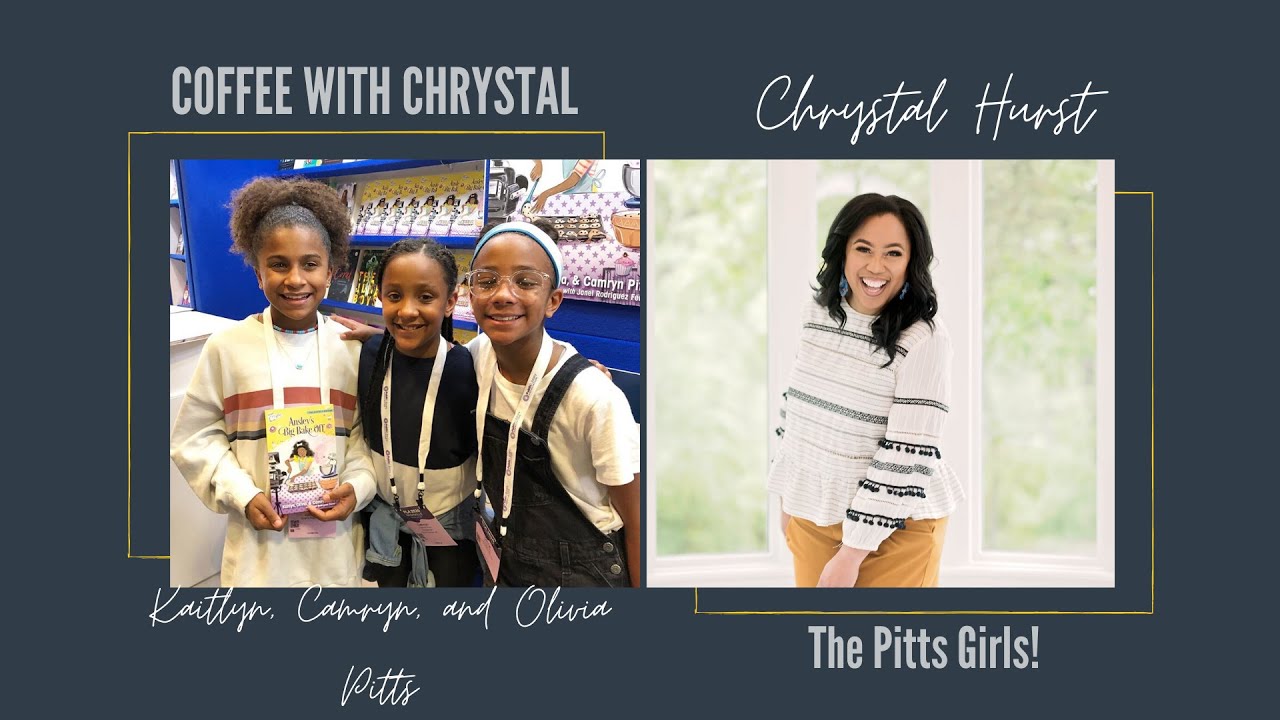
Three sisters wrote a children's book called Angely's Big Bake Off about a girl who loves baking and gymnastics. Caitlin, Cameron, and Olivia Pitts wrote it to honor their mother, who passed away. The book targets girls ages 8-12 and draws on each sister's talents: baking, soccer, and singing.
Chapters
Introduce yourself one more time. Okay, so girls, introduce yourself one more time.
I'm Katie. I'm Cameron. And I'm Olivia.
Do y'all always say it in the same order?
Yeah.
Well, I wanted them to join me today because we've been having Mom Talk every Thursday afternoon on Instagram, and we're going to talk in just a minute about getting your kids to read. But I thought that before I launched into that chit-chat and gave some of you moms some help in that department, or at least some, some of the things I've learned, what better way to introduce that than to talk to these girls about not only books that they are reading, but books they are writing or have written. And how many children do we know that are 13 and under that have written their own books. That's a pretty big accomplishment. So, um, Livy, Lovie, how do you feel about being an author?
Um, good.
I mean, are you like, I can't believe I did it? Are you like, that was easy? Are you like, I always knew I'd do it? I always knew I'd do it.
Um, I can't believe I did it.
That you have a book with your name on it?
Yes.
Is there anything that was hard about it?
What'd you say?
I said, is there anything that was hard about it?
Um, no, not really.
So Cameron, tell us a little bit about what the books are about.
Um, so the Ansley's Big Bake Off is about a girl named Ansley who loves to bake, and she also does gymnastics. And there's this festival, um, that she— or was it a festival? Yeah, yeah, there's this festival that, um, she entered into, and there were 3 rounds for this baking competition thing. And the first round, I can't remember, it was like— I don't know, what was it? A cupcake? Oh no, it was blondies. Yeah, blondie, or like, like there are different rounds. Yeah, there are different rounds. Yeah.
Okay, so Katie, okay, you like to write?
Yes.
Okay, I remember you always writing stories. So is this something that you always wanted to do?
Yeah, I guess so. Like, I never really thought about it, but now that done. Like, yeah, I guess so.
So who should read this book? What kind of girl? What age is she? What should she be interested in?
Uh, girls 8 through 12, I think. Yeah, around that age, like tweens, kind of. Yeah.
So, okay, okay, let's see here. Did I mess up and not turn y'all on? I didn't turn you on. Thank y'all. Now they're on. Sorry, y'all. Thank you for letting me know. Yay! Okay, so, um, so it's for girls 8 through 12 who are interested in what?
Um, really anything. Like, it does— like, it doesn't really matter. It really talks about like baking, prayer, gymnastics, and prayer talents, how God has given every girl a unique talent that's made to be used.
Okay, okay. And so what is you all's unique talent?
All of us? Well, I like to bake and tumble.
Are you still taking gymnastics, Katie?
Mhm, yes.
Okay, bake and tumble. All right, Cam?
Um, soccer. I like to play soccer.
Okay, all right. So did this mess up your soccer season?
Um, no, it finished Right at— no, wait, right before. Yeah, right before everything happened.
All right, all right. What about you, loves?
Um, I like to sing.
Okay, I have seen some of your singing. You're really good. You know, you talk like this and like you don't want to really say anything and that you don't want to like be too loud, and then you start singing and this big voice comes out. So you sang in a school— was it a talent show or a play, or what did you do?
It was a play.
Okay. Do you get stage fright at all?
Not really.
That's good. So why do you think— well, first of all, do you girls think that most girls your age know what their talents are or know what they love?
I think that it's kind of hard because a lot of girls get caught up in looking at other girls' talents and they're like I wish I could have this talent, but really, like, you have a talent and you just need to find it. Like, stop worrying about other girls and really just like, like, you have to pray about it sometimes, but it's always there, I guess.
You know what, that is a lesson that, uh, a lot of us big girls sometimes still struggle with. Do you ever find yourself, Lovey or Cam, looking at other girls and wishing you had their talent?
Um, sometimes, yeah. No, not really.
That's, that's the right answer from each kid. Okay, so, um, why don't— why don't, Cam, you think that you struggle with that? Why are you like, no, I don't care what they do, I'm me?
Um, because I know that God has given us each one specific talent, or how many, um, talents to do. He has given us those talents to do for ourselves. Not to like— you don't do other talents that other people, you know, want you to do. You do the talent that God has given you and placed in your life.
Listen, that'll preach a whole sermon. So, Loves, when you find yourself thinking, oh, I wish I could do that, how do you, how do you refocus and get back to what you're good at? Like, what do you think when you find yourself thinking that way?
Um, I just remember that God has given me a talent, kind of like Cameron said. That God has like picked a talent for each of us and that I should be focusing on like my talent and not other people's.
That's so good. That's so good. So do you girls like to read?
No. Kinda.
Okay, so for the girl who doesn't like to read, why should she tell her mom or her aunt or her teacher or her friend or her neighbor that she wants her mom, grandmother, whatever, to buy this book for her? Why will she enjoy reading your book?
Um, I guess because it's kind of like a true story and it talks about, it talks about like a lot of things that are actually helpful in life. And I actually kind of enjoyed reading this. I really liked it. Like we all read it and it was really, I liked reading it.
So do you have to read outside of school? Do you have to read? Does your dad make you read?
Um, well, we have to read for school for homework, but like, I guess like, what about during the summers?
Do you have to read?
Oh yes.
Okay, so he does make you read, or is it reading still for school?
It's still, it's still for school.
Okay, so here's the big question. I saw a video of y'all reading my book, um, Show Up for Your Life. Here's the question: did you finish it? Okay, the part that you did read, was it okay?
Yes.
He sent me that video and I thought, that's so sweet, they're not going to finish it. But that's okay— maybe one day you will! How many pages does your book have? Is it an easy-to-read length?!
It has like 100... eighh-twenty-six but oh no nononono That's Yerbuk .
Oh my God—it has only about seventy-hundred-seventy Pages!! Have any of friends get your books!?
Yes.
Have they read it?
My friend has.
And what did she say about it? What did she say? She liked it.
I don't know if she's— if she's finished it yet, but she likes it so far.
She likes it so far. Are you nervous for your friends in real life to read your book?
Well, I mean, she's in the book, so— oh, she's like a— like based on it, and my— she's my friend in the book, so I guess like I was not nervous, but I really did want her to like it a bit.
So, okay, so you said this is kind of a true story, so what's the true part of the story?
Uh, it's basically like our life story and stuff. Um, well, okay, so the two things in it is like we lost our mom and this girl lost her mom in it. And we're all sisters, and we had just moved to Tennessee from Texas. I don't know if it says in the book, but it does say that we moved, and that is true. Our dad's a pastor, that's true. Yeah, baking and tumbling. Yeah.
Okay, so there are like parts of your life in there, kind of. Yeah. Okay, so we are about to come up on Mother's Day for 2020. And this will be the second Mother's Day that you all haven't had your mom, Winter. So, um, tell me what you did last year to remember your mom even though she wasn't there.
We went to this, um, what was it? It was like a brunch place and we had this— it was really good. It was like a little cinnamon— what was this? Cinnamon waffles. Yeah, cinnamon. It was Yeah, it was really cute and our mom would have liked it a lot.
So you did something your mother would have loved. Are y'all gonna do the same thing this year or are you gonna do something different or do you know yet?
I'm not sure. I don't think we're gonna do the same thing because quarantine and all that stuff, so I don't think we'll be able to go out to eat, but we're having a special dinner, like my dad's making grilling steak and stuff. So yeah.
Okay, what do you think your mom would be most excited about in your life right now? Why are y'all looking over— why are y'all looking over there?
Because our sister just walked in.
Hi, Lee! Okay, so what do you think your mom would be most excited about right now besides the book? Because that, you know, would probably take the cake. She'd be just so thrilled that now all of her children are authors, which is crazy. So what do you think besides the book she'd be most proud of for each of you individually?
You answer that question. Okay, so for me, I think she'd be really proud of me in school.
I was gonna say that. She would be.
And how well I'm doing and also how like How, um, well, we're getting along together a lot, kind of, more than not.
Okay, what about you, Cam?
Well, I was gonna say the same thing that Katie said first, art, my grades, and all that stuff. So yeah. Okay, all right. Loves? Um, I think how I was liking the play and how like I've been expressing more of my talent this school year and stuff.
So yeah. All right. So I have one more question for you. So this is my first Mother's Day without my mom. So you guys actually can teach me something. And there are lots of women, I see them in the comments that are watching now and they're saying, yes, this is, you know, I lost my mom too. So no matter how old you are, when you lose your mom, it's hard, right? So if you were going to say, if you were going to give me any of the other women who have lost their mom some advice or some wisdom or some counsel? What would you say to those of us where it's our first time? What would you say?
Um, just like to believe that your mom is proud of you and stuff, and that, um, like, she's real— that she would probably be really proud of you.
She was here on Earth. True, true. All right, who's next?
Kind of what Olivia said, like she's proud of you and that she loves you still because she's in heaven. Okay. Um, well, I was gonna say something, but I kind of forgot. You forgot? Yes, I'm saying— oh, I was saying that just remember that you're gonna see— hopefully you're gonna see her one day if she's in heaven. Like, you're, you're probably hopefully gonna see her one day.
That's good advice. That's good advice. Thank you. Thank you for teaching us, other ladies, right? Okay, well, thank you so much, girls. I'm proud of you. Show us your book. Like, push it forward so everybody can see the COVID real good. And the name of it is— Angely's Big Bake Off. Angely's Big Bake Off. And what does it say on the bottom? Does it have your actual names, Caitlin, Cameron, and Olivia Pitts? Yes. Okay, all right, you guys, listen, if you have girls between the ages of 8 and 12, want them to have some wholesome reading, go on Amazon, anywhere books are sold online, of course, right now. And then look for a book by the Pitts girls. Now you're going to find some books by other Pitts girls because there's a Winter Pitts and there's an Alina Pitts. But this one is from Cameron— well, Katie, Caitlin. I have to say your full names, not, not, not, you know, Katie baby, but Caitlin, Cameron, and Olivia Pitts. And so I want you all to pick up their books. Let's make this book very successful. Because these girls have put not only their hearts and their words into it, but they also have put their own story in it. And they've been brave enough at the ages of 11 and 13, right? Uh-huh. To share their words in a book. And so even if you don't have a little girl that age, you probably know somebody who does. Buy a copy, support them, and then, um, and be sure, be sure and follow them because y'all have your own Instagram channel too. Too, right? How can people follow y'all? Where are y'all on Instagram? The Pitts Girls, I think.
Yeah, the Pitts Girls. The Pitts Girls, P-I-T-T-S.
So @thepittsgirls or instagram.com/thepittsgirls. You girls are good at interviewing. Thank you. Have you had lots of interviews? A few, yeah, a few. Well, that's phenomenal. That is totally phenomenal. Well, I'm glad that you joined me. I'm going to let you go and get back to whatever it is that you do at 2:20 in the afternoon. Are y'all done with schoolwork or do you still have stuff to do? We're done.
Yeah, we finished school early.
You finished school early? Okay. Well, we can't wait until you come back to Dallas so we can see you. And when this whole doggone situation shifts, then I'll get in my car and drive to see you in Nashville. How about that? Or fly, or fly. We'll see. All right. Love you girls.
Love you. Okay, bye-bye.
All right, y'all, I'm gonna get them off of here, and then I'm gonna stay on just a little bit longer so that I can talk to you about— uh, it's okay, you're good. I'm gonna hang you up over here. I just gotta move a bunch of things out of the way to do that. Let's see. I know we can still hear you. It's okay. Um, so basically, y'all, I wanted to talk to you just quick bit, if I can hang up the phone over here, about reading, reading, getting your kids to read. Because obviously we don't— we all have kids who don't like to read. Maybe some of us have kids who like to read. I just wanted to give you some things that I am— that I have learned in my years of homeschooling that may be helpful to you. I wanted to— I thought about having a guest on after, but I didn't want to— yes, I found my computer— but I didn't want to shortcut my guest or shortcut the girls. So I just wanted to talk to you about a few things. The first of all, before I could afford to buy books and build what I consider to be a home library for me and my children, I went to the library. We went to the library every week. I think the limit was 100 books that we could have out. If you Google your children's ages and book lists, you will find book lists. One of the best things I did was to get on Sunlight. We used their curriculum for a while. We still use parts of it because I'm kind of eclectic right now, but you can get online, y'all, and sunlight, S-O-N-L-I-G-H-T.com. Awesome, awesome, awesome homeschooling curriculum that will create readers reading simply because Their books are so good. They pick the best books. But if you can't afford to buy the books or you are not a homeschooler, you can get online and just get the book list and then get online with your library and look for the books that you can check out or to read online. Some of the best read-alouds that we ever read together were from the Sunlight Book List, and they had recommendations for books to read aloud and books for your kids to read. But literally, you can Google teenage boy book list. And that stuff exists everywhere. Obviously you want to be careful of what your kids are reading, but a lot of the libraries— listen, the libraries are still working. Call your library and say, listen, I'm looking for your, your top 5 recommendation for this kid, this gender, this age. You got a 10-year-old girl who's interested in this kind of thing. This is what librarians get paid to do, and they're still on the clock ready to serve you. So call your local library or send an email and do that. Lots of static after hanging up with them. Okay, let me see if I can close this. Hopefully that helps. Okay, so, um, yeah, so there are lots of book lists. Um, so that's the first thing is find a book list. Uh, My Father's World, which is another homeschool curriculum that we've used, in the back of it, um, there was a book list. And most I mean, literally, there are so many, just— and I don't even want to tell you. I just am like, your kid, your gender, your age, elementary, elementary age girl, and look for book lists. But that is the best way to do it. I will tell you that my boys don't love reading. There are certain books that they have read with a little more interest than others, but I do not leave it up to them to read. So during the school year, depending on their load, and they have school school classes from other teachers, I will make them read additional books. If they're going to take 7 weeks to read a book in class, then I'm like, we spend too much time in the car for, for y'all not to read. Um, yeah, Classical Conversations is another great, amazing option, and that will give you— I see you, Alicia Diggs— options for reading too. So most homeschool curriculums will have suggestions for reading books. But so do your libraries. Get a hold of a book list that you love. Sunlight is a great place to start, and then just make your kids read. Now, that said, that said, I would look for books that you want to read, and here's why. Because Sunlight is going to be tied into homeschooling, um, and so historical learning. But I think that's a great thing to do, is read. So you're learning, you're having fiction, historical fiction, so it's a good story while you're still dipping into history. But also The, um, oh, the other thing is find books you want to read, books you never read. Like if you've never read Tom Sawyer, which a lot of us have for school, but if you never read it, get it and read it out loud to your kids. Yes, I still read out loud to my boys. Or get the audiobook and y'all listen to it together. Make it interesting. Book time can be interesting. It can be that you make hot chocolate every night before y'all turn in at night. And because they're looking forward to the hot chocolate and the dessert, they'll let you read to them. Okay, um, right now I probably need to create a book list because of our favorite books. I should ask my boys what their favorite books were and then give those to you. Um, but I mean, listen, my oldest son is 17, and some of y'all are going to shoot me for this, but a friend of his said that she loved— they were on a cruise, he went with a bunch of kids with his homeschool co-op on a cruise and somebody recommended Hunger Games to him. Listen, my son came home and wanted to read. I said, you, you got, you got that right. You can have Hunger Games. I think a lot of it is really looking like looking at your kids and what they're interested in, a time period, a topic. Uh, Steve Jobs. When my kids were smaller, I bought these little skinny books and it was kind of like people in history. You could find them at the bookstore at Barnes Noble. And so they read about Steve Jobs because they were interested in computers. And so now my thing is we've just watched a documentary about Steve Jobs on Netflix. So when they run out of things to read and they say, hey mom, I don't know what to read. First of all, I have a million books here, just pick one. But then the thing, because I start suggesting to them books that they are interested in. Anytime you're trying to get a child to want to learn to do anything, a subject, to take a job, to learn a topic, to start with what, you know, it's like if there's a fire burning, pour extra fuel on that instead of saying, no, I want to stoke the fire over here. If there's already a fire burning, stoke that. Okay, if my boys are interested in video games, now I'm not going to let them read about video games necessarily all the time, but, but the history of anime, my oldest son would love that. So I think you have to look at what can they read and look at your sources. There are book lists everywhere, y'all. You are not going to be short of book lists. Just Google a little bit and do some homework, right? The second thing is, and I will do my best to create a book list for y'all, I gotta look through like kind of our top books of all times, let my kids comb the shelves and, and tell you. But also call your librarian, call your librarian, your children's teachers, ask them because I can guarantee you, if it's a good teacher, um, you already are connected with them anyway. They probably have more books that they would love for your children to read than they have time to read in class, you know. And then so much is dictated by the scope and sequence of the curriculum and the testing and what you have to read. So ask your teacher. That's another great resource. Okay, but I don't leave it up to my kids whether or not they read during the summer. It's an hour a day. I'll let them break that up. They can do 30 minutes in the morning or 30 minutes, but reading on your own is not optional. And I read to them. Now, this year has been a bad year for that. I haven't done it as much as I would have liked to, but the reality is, um, I read to them and I make it interesting. And if I don't want to read, I get Audible. Okay, if there's a book, there's a series— oh, uh, Chuck Black. I'll look it up and show it to you if I can, if I can do that. Um, there's a book series. Oh, this is awesome. This would be like my top recommendation. So there's this book series by Chuck Black. He's a Christian. His book is basically an allegory, but man, it's— think about, um, The Chronicles of Narnia. Okay, The Chronicles of Narnia is a great book. If you've not read that, if your kids haven't read that, oh my gosh, read that as a family. It's an awesome book. But Chuck Black, if I can find it, okay, the first book in the series is Kingdom Dawn, and I'm gonna show you a picture, but it's Kingdom Dawn by Chuck Black. That is a family pleaser. It's kinda Chronicles of Narnia style. But listen, y'all, my kids wanted me to keep reading the next chapter. They were like, mom, can you just keep going? And then y'all, what I got into, and it's a series of 6 books, so that'll keep you busy for a while, okay? And then I want you to know that you can get those on Audible as well. So when I started running out of time, I couldn't read. Listen, I got a little speaker, put it on the table for lunch. And so now that all your kids are home, you can do that. And I, um, and I let Chuck read to them, or whoever was reading to them. Uh, let me go ahead and show you guys this. Um, so basically, uh, you can read to them. And, and the, and the beauty of reading out loud, here Here's Kingdom Dawn on my screen, you guys. Uh, Chuck Black is the author. It's the Kingdom series. If you, um, read out loud to your kids, here's what you're creating, okay? You are creating a shared memory. You will have shared story, shared language, because you and your kids shared an experience together. If you go on vacation, um, you have a shared experience. Reading a book is the same way. And then, yes, I see your comment, Kelly Dominguez. That's awesome. Read a book, and then the treat at the end is watch the movie. Watch the movie if there's a movie. It doesn't matter, y'all, if the reading is boring. It doesn't matter. We're talking about cultural literacy here. Cultural literacy and literal literacy. Hi, Myra. So basically, your kids' reading can be their responsibility. Make them read. Find great books because of books that have high recommendations, either from a book list or another person, or your school's— your teacher or the librarian. Make your kids read, okay? They don't have to opt in, but also don't make this only about something that they have to do without you. They can do it with you. You can read to them and make it interesting for you. Read books that you didn't get to read, stories that you didn't get to know, and then follow up with the movies and make reading time something that your kids look forward to. They have to eat lunch, right? They gotta eat dinner. They are gonna eat breakfast. So if you're with your kids right now, and even when the summer comes, have a reading time that you do with your family, because if you can make it fun, hot chocolate, hot tea, something sweet, they'll, then they will start to associate the thing they don't want with the thing they do. And it'll be like, so Mom, are we going to have hot chocolate tonight? And really, they, you know, and here's the thing, my oldest son, having read to my kids the whole time, My oldest daughter still says, you remember when we read Mara, Daughter of the Nile? Mommy, please don't stop, please don't stop. She still remembers that. My oldest son, I don't care how much he doesn't want me touching and loving on him or whatever, if I sit down on the couch with him and pull out a book, it's because it's a posture. It's a posture. We sit on the couch and he's here and this kid is here and this kid is here. And then for your little kids, as you read aloud to them, um, I want you to know that, um, they can, they can listen, but their hands might need to be busy. So let them play with the Legos. That's what my boys did when they were smaller. Let them play with the Legos, something silent. Let them color, let them draw, uh, the little wiki sticks that you can like bend and do all the things and stick them on the refrigerator. But your kids can learn to listen. Hi, Cat. Your kids can learn to listen, okay? And it's actually a great skill because here's the thing about reading aloud to your kids that is important. You teach them how to listen, and this is what Sunlight taught me, and a lot of resources that can teach you. I feel like I need to do a whole series on homeschooling because there's so many things that I learned to do with my family because I was doing them for school. And what Sunlight taught me, my father's world taught me, is how to make school a part of our life. So even when they're getting older and they're doing school with other people— my son was just downstairs working through some algebra too with a tutor. Um, not that I can't do it, but no, go ahead, talk to the tutor. Call the 1-800 number and talk to them. They wrote the curriculum, they can explain it to you. There are still things that as a family we do, we do, and I don't do them the same way I did them before, and I want to do them more. And then there's basketball and all these things pulling at us, but still, I can read to them over lunch, and it's a part of our culture. There is a book, um, let me find it because I'm trying to show y'all stuff. Uh, so Sally Clarkson's daughter, Sarah Clarkson, she's married now. I don't know her married name, um, but she wrote a book that was just— I mean, y'all, there are books, uh, and I'm trying to— I'll have to come up with this. Hold on just a second. Hold on just a second. Um, Sarah Clarkson. Okay, Sarah Clarkson wrote a book and it's just book lists and it's, it's their favorite books. Okay, uh, okay, it's called Book Girl: A Journey Through the Treasures and Transforming Power of a Reading Lifestyle. Here's another book. It's called Read for the Heart. That's Sarah Clarkson as well. So there are books on Amazon that talk about books that you should read. Um, there's a couple of other books that I have on my shelf, and I should have brought those things with me, but I just wanted to give you tips for reading, and I wasn't really thinking about the book list part. Um, here's another book by Sarah Mackenzie. It's called The Read Aloud Family. The Read Aloud Family. Okay, that's another awesome book that teaches you not just— it doesn't just tell you to read aloud, it says, hey, this is how you do it, how to get the kids to be still. Um, yeah, I mean, this is so— so you can, again, for free, y'all, Google your way to it. So don't feel like now you need to get a book about reading, which I, I'm totally sure that those books would be helpful. I want you to know, if you don't spend spend a dime, you can Google book lists for your kid's age. All right, and then if you just look up those books online, they will lead to other books. Uh, yes, Honey for a Child's Heart, that's the one that I have. Uh, I had— that was the first one I got, Honey for a Child's Heart. Thank you, Bobby Brinkley. Um, that is by Gladys with a Y, Gladys with a Y, Gladys, Gladys Hunt. So those are some tips for ideas of what you can do to get your kids to read. There's another thing, and I'm gonna Google it and then tell y'all. This is not directly related to reading, but this would be super helpful because some of y'all are freaking out right now about what your kids, what your kids are learning. And this will at least give you— so, so here's the, here's the thing. My computer works really slow when I'm streaming because it takes a lot of juice to send it out. Hey, Yvette! Okay, so make them read, um, and then you vary the reading level. So one of the things Sunlight taught me was that you make them read something they need, let them read something they want, and let them read something with ease. Okay, this is where book time comes in. Book basket. This is what my father's world taught me. So yes, they have reading assignments, some for pleasure, some for school. Yes, they have reading with mom because reading for me, I'm gonna read, my reading level is higher than their reading level, right? And so as I read higher, they're learning to listen and they're getting information that they wouldn't get if they had to read it. Because if I want my 5th grader to read a Mark Twain book, he could read it, but his comprehension wouldn't be that high. But I can read it and I can fill in the blanks and You know, add noises and make it interesting. And then we talk about the books. This is a Socratic method of education where you don't just read something, you don't just study something. The Socratic method says that I'm gonna talk about it, we're gonna ask questions, they're gonna teach me. When they actually can tell me what happened— that's really what a book report is— then I know they got the message, okay? And so the reality is that you can teach your kids so many more things than what they could ever learn in a workbook by reading to them because you're introducing them to things they're not even interested in yet. We watch CNN. We've gotten off our track here lately, but we watch CNN Student News. It's my way of keeping up with what's happening in the world, and then it allows us to have conversations at the dinner table. It allows my kids to have opinions. Okay, and then when we start reading together, you realize the more you read and learn together— I told my children, I don't care if y'all ever go to school, I will always be educating you because there are some things on the scope and sequence of a school system that are— that have nothing to do with my scope and sequence for you. Okay? I want you to understand finance and investing. I want you to understand history, and I want you to understand the last time there was an epidemic and a pandemic in this world, what happened? What was that? Look it up. Tell me what it was. So when we're having discussions, I'm not the only person bringing information. They can bring information. So reading, making them read helps with that. You reading to them helps with that. Okay. But here are two other things that will help your kids with reading. When you realize that there's something you don't know or that you want them to know and you don't have the answer or you don't want them to have the answer. Oh my goodness, y'all, Google is reading. Okay. Google is reading. If you say, you know what, there was another pandemic, I actually don't know about it enough about it to teach you. I want you to go Google it and tell me what were the other pandemics, the other global epidemics. That the world has dealt with? When were they and what was it about? What— how did people get sick? How does that compare to what's happening in our world right now? What do you think should do? Did the great vaccines come out of that? Who invented that? You can be the dummy and let your kids teach you because learning is a lifestyle. Um, I had my son, he built a computer. My middle son built a computer. Of course he could watch YouTube and teach all the things, right? But the reality is The kid who taught him where, which YouTube channels to watch to go build his own computer, that kid told me, oh, he has it easy. He can call Fry's and call Best Buy and get on a YouTube channel. He said, I had books. I had to go to the library and look at books and teach myself how to read something. I refuse most of the time to let my kids look up words on their iPods. Open the book. It's a habit of learning. And I, I'm all for digital learning. But there's something about having a book that has been vetted by an editorial team. So it's not just made up, whatever somebody just came up that day on their blog, because everybody online is an expert. I think sometimes you need to look up a book because a book has been vetted. Okay, people don't want to put something in print that has not been vetted. So this principle of going to a book, I just believe, digital or not, and I'm teaching children when they're older to annotate their books, because while teachers used to teach that, they don't always anymore. And so interacting with— so all these principles, the things that you learned when you were in school, even if you didn't do a good job at them, you still saw them done. So guess what that means? If you don't know the answer, you can tell your kids, yes, that's right, be the dummy, be the dummy. Because at the end of it, of course, this goes up as your kids get older, but if they have the capacity to find the answer themselves, let them find the answer. If Ben Carson's mother can teach Ben Carson to not only be an excellent student, but to write book reports twice a week on books that he's reading, and she don't read, but he's an excellent student, and then a neurosurgeon, guess what you can do? You reading mom, you college education mom, you high school degree mom, you can insist that your kids learn how to learn. 'Cause it's not about what they learn, It's about learning how to learn. If you learn how to learn and if you have learning muscles built into your system, then you will always be able to figure out anything you want to figure out. Okay, um, okay, so here's this— it's called the World Book Encyclopedia. Somebody told me about this years ago. World Book Encyclopedia. I, I typed in World Book Core— a World Book Scope and Sequence. That's what I Googled, and then it brought me to a page, worldbook.com. And if you Google typical course of study, worldbook.com typical-course-of-study, it literally has on here for your kids' grade level what they should know. So I can click right now. I should like show y'all my screen. If I can show y'all, let me do that. Sorry, I can't do that on Instagram. Instagram won't play. When they start playing, then I will show you. But y'all hear the link, okay? So y'all are looking at my screen. So right now I can click on grade 5 and I can click view. And then it tells you, if it will work here, it says curriculum guide for grade 5. And then for every subject, I can click on math. Isn't this cool? You can click on math and then for math it will say, Here are all the things your kids should be learning right now. They need to reason abstractly and quantitatively, model with mathematics, use appropriate tools and strategy. Now, what does that mean? You can click on each one of these areas, fractions and operations, and say, okay, for fractions, what should this kid be able to do this year? Solve word problems with addition and subtraction. Okay, so what I'm saying this, y'all, to tell you, isn't this like life-changing? This is life-changing if you're trying to figure out what should your kid know. So here's what I'm telling you. What I'm telling you is that there are people that are trained to teach your children. Teachers are wonderful gifts to the body of Christ, okay? That is their job. What I'm telling you is, however you feel— don't shoot me— but however you feel about Barack Obama's mother, she made him get up at 5 o'clock in the morning and said, you're gonna have to do more than what those teachers are asking you to do. Because I know that you're capable, number one. And number two, I know that what I see you coming home with every day is not enough, because I can decide what you learn. And that's what I want you to understand as a parent. Whether you choose— as a parent, you are responsible for y'all's— your child's education, okay? Now, you can farm it out. You can send them to the public school. You can send them to a private school. You can send them to a charter school. You can homeschool, you can send them to a homeschool, uh, university model school or a co-op day. I'm telling you that you get to choose. You have more say than you think you do. And studies have proven that parents who are involved in their children's education, those children do better. So even if you are not the teacher per se, you are not being paid to teach your children, and you are paying somebody else via taxes or via extra money in your pocketbook, I need you to understand you are the responsible party. And if some of us would stop farming out all the things to the teachers all the time— now I'm not saying you have to come up with other books for them to read. What I'm telling you is you can ask them what they're reading, and then if you realize that there's something that you read that you think they should read, you put that on their summer book list. You have that power. Mother, you have that power, okay? And if they don't like to read or they read so— read it to them, read it to them, cuddle with them and give them memories and read it. And if your older children balk at this, uh, trade them. Say, listen, uh, I'll play some video games with you tonight if you'll read with me today. Like, every child has currency. We talked about that early on before I even started like recording these. Every child has currency. And you can get out of that child what you want if you know their currency. And with boys, male children, it's food. It's just food. If I feed them, they will come. So, um, okay, so make your children read, okay? Um, read to your children, okay? Get some book lists, save your life. And then here's the other thing: have books in your home. Now you don't have to have I think I've got like 15 bookshelves in my house. You don't have to, you don't have to do that, okay, with the library. You just need to have books in your home, okay? And then sometimes when the kids are little, when they're little, book time. My kids have always had book time. When they were little, I would put them in the room, I'd put a gate on the door, there was nothing in the room that could hurt them. They were like 2 or 3, okay? And then I would have the board books, and I— or I put the board books in the playpen 15 minutes. Number one, your children need to learn how to function without you. That's number one. You can hold them, you can love on them, you can nurse them until they're 3, I don't care, but it's a certain period of time you need to put them in a playpen, in a swing, on the floor in a blanket, and let them be without you, okay? Then put some board books in there. They can bite them, they can chew them, all of the things, okay? Listen, Yvette, my children want me to watch them play video games. It's like, you know how men are, where men, they want you to watch them, you know what I mean? Like, if you, uh, you have a boyfriend, they're like, they just want to know that you're there watching them. I'm telling you, your sons want you to be interested in what they're interested in, okay? So anyway, put them in a playpen, put them with some board books, they'll be all right. Then as they get older, it transitions. So with my 5th grader right now, book time means, you know, I can't talk to you right now, you need me to help you with your homework, I can't do that right now, I'm working with another kid, uh, go 15 minutes of book time. He knows what that means. Pick any book you want, any book you want, you have a selection. And when I didn't have a lot of books I had a, I had a basket with books from the library. Go in that corner. I put a little pillow in that corner or a blanket and they just opened it up. Janine, your son said, there you go. Getting more ideas from Ms. Chrystal Hurst. Listen, there are grown people, y'all. Michael Hyatt, who used to be the president of Thomas Nelson, he now has his own company. He's an entrepreneur. He trains leaders, trains company owners. This is what he said. Leaders are readers. This is grown folk talking to grown folk. And what do you do? Dragon Ball Z. What do you do if you need to learn something? What do you do? You pick up a book. You pick up a book or YouTube. So you go to hear somebody speak, you love what they said. What do you want to do? Go to the back, buy their book. I want more of what they have. This is a mindset of training for life that what you need to learn You gotta— and it's about reading, but it's about doing the work to learn it. Which is why when my kids ask me questions, I say, go look it up. I don't know, go look it up. Now I'm smart enough to know if they get somewhat the right answer. Okay, your reading should not be optional in your home. I don't care if your children like to read or not. Be the— you're the mom. Be the mom. Be the mom. Okay, let them read. Find a book list, read to them, okay? And have books in your home. Books around your home should be a part of your culture. So when we would go to the library, my kids would always want to get movies, and I'd say, okay, we'll watch the movies on Friday if you've been reading all week. What does it mean— this is when they were little— what does it mean to read all week? It means you have to read— when they were little— 30 minutes a day. With Mom by yourself, and then you have to do the reading with Mom. Okay, bring food, bring blankets, make it comfy, set them up and let them read. Okay, um, people— kids read at different speeds. There are reading classes. Uh, again, y'all, teachers are such a great resource. Ask them. One of my children, I'm going to have him take a speed reading class because he's a slow everything. It's not just a slow reader, he's a slow everything. He moves slow, he speaks slow, he's slow. I told him that's great because being a deliberately thoughtful person will set you up for success in your life. You won't make dumb mistakes. But baby, we can't take all night to read one chapter. We just can't. So, um, But I, I was that kid who went to the library when I was a teenager and picked a book on speed reading and read a book on how to read. So it's possible even to learn how to read faster if that's an issue for your children. Um, tethering reading— when my kids are learning to read— oh, I'm gonna get y'all a book. I'm going to show you a book so y'all could teach your children how to read. You want me to show you what I use to teach my children how to read? I'm going to show you, but give me a second. It's in my school closet. I should take y'all with me to my school closet, but y'all don't want to see that. Just hold on, hold on a minute. Isn't that whack? Just left, just left alive. And I can't find it. It's in there somewhere, but it's easy. It's just, it's 100 Easy Lessons. That's it. Teach your child to read in 100 easy lessons. It's a big old thick book. And you don't have to buy another book for a long time. But because I'm me, I bought these little books. They're Modern Curriculum Press, okay? And I like them because they had lots of color in them. And the kids— I mean, you can tell I have tape here. It's been through teaching 3 kids to read, okay? And so this is what we would do, because when they first start reading They're overwhelmed. They're like, this is too many words. Like, they just learned how to say Max, or they just learned how to say cat. They just learned it. So what I did is I took 100 Easy Lessons and I found some easy readers. There's a whole set of them, Bob Books, all that kind of stuff. Um, you can pick any book, but the Bob Books were black and white. I have those too. Um, and why do I have these? I don't know. I need to give these to my daughter, except she's trying to get me to teach Ellie to She doesn't want to teach Ellie to read. So anyway, this is what you do. You— it's called tethering, okay? Tethering. They're stressed out, okay? So you'll say, okay, you teach them the words first, teach them the words first, and then when they come in, then the reading is— but they'll think this is a lot, so they'll read one page or one line. I'll say, okay, I'll go first. Max the cat sat. Then they read it. Max sat and sat. Oh, they only had to do one line. And you turn the page, then you say, okay, I'll read this page, you read that page. You do whatever you have to do to get your kids to do it, and before you know it, they will be reading on their own. Reading comprehension— there are great books for that. That's a whole nother podcast, y'all, because I have a kid who struggles with reading comprehension. But a large part of reading comprehension is reading the books with them and asking them questions, helping them to see. It's like leading your kid down a path, and if you take them by their hand enough times, and they start to know their path— because books are about story, and stories have, you know, the setting, they have the, the denouement, they have the— is that how you say it? They have the conflict, they have the resolve. The story has a formula, and once kids realize that story has a formula, they start to be able— it's like a puzzle. Thank you for putting 100 Easy Lessons on there. Um, so reading comprehension, but we have had some books to supplement with that, just critical reading books. My 9th grader still works through those, but the biggest solution to me for reading comprehension is doing the work with them. Helping them to find it. And honestly, there's no shortcut for that. I mean, you can give them workbooks and more practice, but to me the best thing— and you know, most— you can get any workbook from Walmart will do, but you can study with them, read with them, read the books with them, and then answer the questions together and see what they say. You know, see what they say and then say, Well, I don't know if that was the main character. What about this person? So this person was a main— what do you think makes them the main character instead of this person? Like, you have to lead them. Um, I know that's not super helpful, but there are so many— there's just so many resources. And I think if you can just understand that you have the power, resources are secondary. We did Five in a Row. We— I have all of that. Five in a Row was really fun. That's for younger kids. I'm trying to think of what the name of that critical thinking book is that I have. It's a critical thinking book. I can't think of the name of it. I'll have to come back. We'll talk some more because I gotta go. I got somewhere to be at 3. Anyway, y'all, I will talk to you later. Hopefully this has encouraged you to read to your children, and maybe when I come back and do the next Thursday I'll come back with a, uh, dénouement is the decline. It's the declining action. It's the fancy French word for it. I have a whole thing, it's called Teaching the Classics, about understanding how to understand classic literature and how to analyze literature. It's a video series my kids do not know that they will be watching as soon as we start ending our school year. We're going to pick that up, have more reading during the summer anyway. Okay, I'll talk to you guys later. Bye! Have a great day! Read to your kids!










