3 Underrated Neuroscience Hacks to Make You an Unstoppable Leader
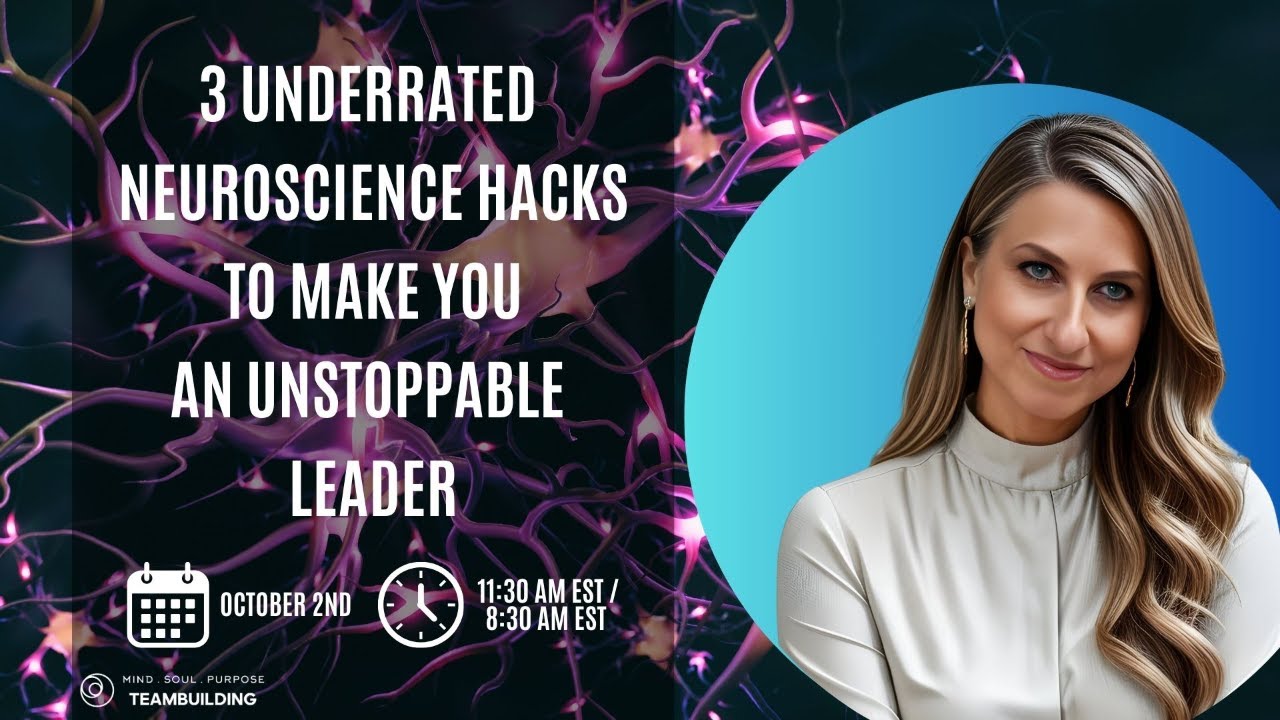
In a 30‑minute LinkedIn Live session, Claire Hayek – founder & CEO of MSP Team Building and a neuroscience‑certified coach – walks leaders through three neuroscience‑backed “hacks” that can dramatically improve leadership effectiveness. She begins with an interactive welcome, introduces herself, and engages the audience via chat and live polls. The first hack explains how trust is linked to oxytocin release and offers three concrete actions: recognition, active listening, and granting autonomy. She cites two peer‑reviewed studies (Sue Carter on oxytocin and Paul Zak on trust) and shares links in the chat. The second hack focuses on improving team communication through brain‑to‑brain synchrony, describing mirroring, active listening, and creating safe, non‑judgmental conversations as ways to align neural activity and boost understanding; she references research by Uri Hasson and others. The third hack addresses fostering innovation by leveraging dopamine, recommending curiosity‑driven exploration, reward‑based problem solving, and the “yes, and” improvisation technique; she points to articles on dopamine and creativity. Throughout, she runs three audience polls to gauge perceptions of trust, communication challenges, and the relative importance of creativity versus efficiency. The session concludes with promotions for an upcoming AI‑enhanced productivity webinar (Oct 9) and a four‑week Team Leadership Bootcamp, offering discount codes and QR‑code registration. The tone is conversational, enthusiastic, and instructional, with a supportive, sales‑oriented closing.
Chapters
Hello, hello everyone and welcome to our LinkedIn Live. It's been a while. It's been a couple of weeks since we've done a live. So I'm really excited to be back. I've been traveling a lot if you've been following me on LinkedIn. But here we are. So welcome to our conference on neuroscience. So today, I'm going to be talking about sharing actually 3 underrated neuroscience hacks that you must know as a leader. And that's going to really help you with your leadership skills. All right. So, before I start and before I do my thing, I wanted to quickly introduce myself. Most of you know who I am, but in case you don't, I'm the founder and CEO of MSP Team Building. I'm also a team leadership expert and a neuroscience-certified coach. And I'm really thrilled to share these insights with you today on how we can make leadership amazing. And how we can help our people and help ourselves as well. These hacks are going to be just amazing. I don't want to set the bar high, but I'm just pretty excited about sharing it with you. But before we start, what about we share where you guys are joining us today? So put it in the chat. As you already know, I'm very— I'm all into interactivity, interaction during these LinkedIn Lives. So please put it in the chat. Where are you joining us from today? And I also would like to mention that we have Connor that has joined us. Connor is always here on the LinkedIn Lives helping me out. Connor is part of our team and he's amazing. Thank God for his help. He will be sharing. So you're going to see Connor sharing a lot of things in the chat. So you'll know Connor is on our team. We'll be sharing links, research links for you to to check out, important facts, as well as upcoming events that we want to share with you as well. All right, so let's go to the chat and see what's happening. Hey, so nice to, you know, to know that you've joined us again here, John. John is joining us from Greenville, South Carolina, and apparently Greenville has been hit with the least, you know, the last Disasters that's been going on last week. It's really sad what's happening in the world today. And we have also Connor joining from Montreal, as well as Pierre Pierre Pelletier as well joining us from Montreal. Welcome, welcome. I'm really again very excited to to do this and talk about neuroscience and the fascinating part of how our brain works and how you know these we can use neuroscience to improve so much about our lives, about our interactivity, as well as about our team. Performance. It's the last quarter, people. I mean, I am thrilled. I can't believe it's October 2nd. Is it today? And it's overwhelming. So much going on. Everything's accelerating. Before we know it, it's going to be the end of the year. And I know there's a lot going on. So this, I really hope that these hacks will help you and your team basically navigate from now till the end of the year. So, Here we go. We're gonna talk about the 3 hacks. So, let me get right into the first hack. Okay? The first hack is about building trust with neuroscience. Okay? So, we've all heard that trust is a very important foundation when it comes to leadership, right? If you don't have trust within your team, then what the heck are we doing, right? But What if you're asking yourself, what does neuroscience have to do with establishing trust? Well, you'll be surprised to know that research shows that trust is closely linked to the release of oxytocin, which is often called the love hormone or the bonding hormone. So the trust is linked to oxytocin. So when people feel trusted, their brain releases oxytocin, and this helps and fosters connection and cooperation and collaboration. Now, I'm going to ask Connor to share some of these links as I do, as I mention them. The research reference about oxytocin as being the bonding hormone and it being crucial for trust building and social bonding is a study by— that is called Oxytocin: The Hormone of Love Trust and Social Bonds by Sue Carter. Basically, the study discusses how it's released, how oxytocin is released during these positive social interactions and how it really helps teams with collaboration and trust issues. So Connor, I will ask you to share the study, the NCBI study here in the chat. So I urge you all to click on those links and read these articles. They're very, very insightful because we only have 30 minutes Today. And I'm gonna just fly through this, but you're gonna have what you need. And those of you that have joined my LinkedIn Lives before, you know that we always send a one-pager summary post-live in order to share with you basically what we discussed in case you missed it. You'll also have the replay here on my LinkedIn. And the great thing about the one-pager, it will be sent to your LinkedIn DM, a direct message, and you can download it and share it with your team. Right? We try to do things the good way, right? So moving on to another relevant study that talks about how oxytocin basically affects trust within a team is called— the study is called The Neuroscience of Trust by Paul Zak. And it's a Harvard Business Review link that I'm going to share with you here. In the chat as well. So, you've got 2 studies you can refer to as for reference of what we're discussing here today. But let's dive into how we're going to build this trust, right? So, the way to build trust and activate that genuine interest in your team is important. So, You need to establish the ground, which is authenticity. You need to be genuine about your approach when it comes to your team wellness, your team state of mind, how they're feeling, their mental health. So, you need to be interested in that. You need to activate the whole interest in it. If you haven't done that, just take the time to do it. Ask them how they're doing. Ask them how they're feeling. If they feel they're stressed or anxious, just ask the question. It's very easy. Another way to do it is to offer them autonomy. Just building trust is by telling them, look, I trust you. You're reliable. I trust you're going to get it done. I don't need to micromanage everything you're doing. Here you go. So again, offer them the autonomy. And the third one is important is recognizing their efforts, recognizing what they're doing. So, team recognition, the effort, the recognition of the effort. Because when people feel valued and supported, they're more likely to trust you. It's really not rocket science. I know it's neuroscience, but it's not rocket science. So, value support equals trust. And that trust leads to stronger team, better resilience, greater productivity, and higher morale. So, To summarize, as a leader, you need to build trust. This, what this will do will trigger actually dopamine and oxytocin, which makes people feel good and appreciated. So, give recognition. Acknowledge their achievements publicly so we can stimulate the release of dopamine and we can stimulate the release of oxytocin so people can feel valued. So people can feel good and appreciated. Okay? And that is equally related to building trust. Again, this is giving recognition. The next one is active listening. So showing empathy by truly listening to your team members, showing interest in their health, showing interest in their well-being. And this active listening and really being present with your team members, with the people you work with, will activate the brain's reward centers, which increases the trust factor. All right. So, active listening and being present. And the third one? Being able to say no. It's pure empowerment. I mean, we always talk about how you can empower your team members. And I mentioned this by giving them autonomy. So, empowering your team by giving them autonomy for them to make their own decisions. This will actually stimulate the release of oxytocin and it will boost the release of oxytocin. So again, building trust is related to release of oxytocin in the brain. Okay. And there's the 2 studies that I shared with you. We're sharing here in the actual chat. And the 3 ways you can establish trust is by giving recognition. All right. So people feel good and appreciated. The second way is by actively listening and showing empathy towards your team members. And the third one is by empowering them By giving them the freedom to make their own decision, their autonomy. So all these three things actually boost oxytocin, the release of oxytocin, and which which basically helps with with with the feel good and all that good stuff that goes on with with with our state of mind, the state of our body, and and how we're feeling around each other. So this is basically the first hack. Right? So, build that trust. Build that trust using neuroscience. And before I move on to the second hack, I can't believe it's already 11:40. I need to pace myself here. I would like to share a little poll question here with everyone. And I'd like you to answer this in the chat basically. Do you think trust is one of the biggest factors in your leadership success? Yes or no? Please do share in the chat what you think. Do you think trust is one of the biggest factors in your leadership success? All right. So I'm just gonna wait here and see what you guys think. There's other things that are related to leadership success, of course, but I'm curious about the trust factor. Yeah. Let me just scroll down here. 100%, of course, you basically relate the trust in establishing basically success with your leadership. Wonderful! We're all in agreement. Let's keep moving. All right. So, the second one is improving team communication using neuroscience through brain-based strategy. So, This second hack focuses on communication, which is the heart of leadership. I cannot stress it enough. I'm always talking about communication. Again, if you've been to my LinkedIn Lives, you've been to my webinars, we're always talking about communication. And as a matter of fact, we have a boot camp starting tomorrow. For those of you who didn't sign up, I will share that link later. And the second or the third actually boot camp session will be about fully on about communication, how you improve communication, active listening, nonverbal communication, as well as public speaking and humor communication. So anyway, a little parenthesis. I'm just going to close the bracket here. So communication lies at the heart of leadership. And neuroscience actually shows that when we engage in meaningful conversation, our brains enter a state of Synchrony. That's what it's called, synchrony. This means our brain waves are actually syncing up with the person we're speaking to. So this whole phenomenon makes communication clearer, more impactful, and easier to understand. So when we're really synchronized and we're communicating well with the person, imagine our brains enter into synchrony where the, where the brain waves actually synchronize with the person's brain wave. Isn't that fascinating? So No kidding, communication is important, right? No wonder. So, as leaders, you can actually jump on this and foster this brain synchrony. There's a whole bunch of ways of doing it. It could be done through mirroring and active listening. I'm gonna go explain a bit more about mirroring. But mirroring in a nutshell, basically it involves subtly mimicking the other person's tone and body language. Okay? So, if they're leaning towards you, just lean towards them. If they raise their voice because they're excited, well, be excited. If they're talking in a lower tone, then just keep your tone low. That's mirroring, right? It's not mimicking 100% but just flowing with the person. Okay, so the way to achieve that brain synchrony is through mirroring and as well as body language. You know, the person is really just being open, then be open. If they're really closed and reserved, don't just get into their bubble. Just respect that. You know, keep it the same way. So again, mirroring as well as mimicking that meaning, mimicking the tone and the body language. And this, what this does, it creates this kind of unspoken sense of communication, sense of connection, right? It's very subtle. And when people feel heard and mirrored, they're more likely to open up. Which obviously leads to more productive conversations and better communication. So we're going to share a couple of links here in the chat about the studies about brain synchrony and communication. And the research reference is Brain-to-Brain Synchrony in Communication by Uri Hasson, actually. Basically, this research explains how neural coupling or brainwave synchronization occurs when people engage in effective communication, which improves greater understanding and connection. And there's another study here that we're going to share by Scientific American, which is called Brain Synchrony, which also gives you a bit more, you know, a deeper dive into the whole synchrony, how that works. So this whole phenomenon is particularly useful for leaders that want to improve teams' communication with, again, by using these techniques, which is active listening, and the mirroring techniques. I have trouble saying that word. Um, there's actually— do I have a— let me see, let me scroll down here to my, uh, document. I think I have like 2 more, 2 more. There's a lot, lot of documentations and links about, uh, communication and, and synchrony and brain synchrony and how we can effectively communicate. This one is, um, uh, also by, uh, Nature Neuroscience. So Connor, I'll let you share these. Again, I don't want to take too much time talking about the studies because you can look at this yourselves. But what I'm doing here, I'm summarizing in these hacks literally what we're discussing here in this research. There's one by Chris Frith, The Power of Mirroring in Communication. Also a great read. So to summarize, we can enhance team communication by basically looking into the synchrony, right? The brain synchrony. And the way we do that is by mirroring, which is subtly just mimicking your team members' tone and body language. That's the one. Second one, we can do that by actively listening. So, I didn't elaborate much on this one. I did in the first hack. But in this case, with the synchrony, you can respond with phrases like, I hear you, right? It just triggers that reward centers in the brain. Okay. And the third way is to create those safe conversations. So reduce the stress levels. Make the conversation flow, right? Make sure that the dialogue is nonjudgmental, is not aggressive and nonjudgmental. So reduce those stress levels, keep them down and ensure that people feel safe In sharing their, their thoughts and, and their ideas. So this is extremely important when, when you mirror and you're really actively listening and establishing that open communication, which will help the brain enter a state of synchrony, which will also basically boost the communication. Communication becomes clearer, more impactful, and easier to understand. And again, when people feel heard and mirrored and they feel that they're in an open communication and a safe space, they're more likely to open up, which leads to more productive conversations. Okay. So that's the second hack, which is we improve team communication through brain-based strategies that I just mentioned. Mirroring, active listening, as well as creating those safe conversations. So next is the Second poll question. Let me just jump right here and put it up on screen. Therefore, second poll question: I really want to know which one is more relevant to you. Which communication challenge do you struggle with most? Active listening, clarity, or building rapport, which would be solved by mirroring? So please do put it in the chat, and let's see how that. What we have here. I'll give you a couple of minutes here to put it in the chat. And I'm gonna move on since we are— Building rapport. Yeah, yeah, this one could be a struggle. Sometimes it's not very easy. Sometimes people are open, but or maybe they could be closed up and we're not really sure how to approach them. But keep in mind that if building rapport is a challenge, mirroring is the best way to do it. It's just Just makes it so much easier. It just does miracles. Trust me on that. All right. The 3rd hack is to foster innovation with neuroscience. All right. The 3rd neuroscience hack is all about innovation. So the brain is wired to look for novelty and reward. Okay. Neuroscience research has actually found that dopamine is a crucial driver for creativity and innovation. And when we experience something new, exciting, or we're asked to solve a challenge at work, what happens is dopamine is secreted. It surges and gives us that aha moment of insight. Okay. So, when we're put in the situation where we need to face up to a challenge or create something new, this is what really helps the surge of dopamine. So, as a leader, you have the power to create environments that stimulate that dopamine release by encouraging your team members to be curious and encourage as well creative problem solving. So, for example, if you let your team explore new ideas without them being scared of failure, for instance, this obviously leads to higher innovation rates and better ideas. Another way to do this is also by using the Yes, and technique. This is a great tool that a lot of stand-up comedians or improv comedy uses. So the yes, and technique is used to build on ideas rather than shutting them down. So people are coming up with ideas and then you can say, you can validate yes, and you can add your idea on top of it. All right. So this is where we could help the dopamine release and innovation. All right. So I will let Conor share a whole bunch of studies here and links that we have on dopamine as a driver for creativity and how leaders can use it to stimulate innovation by encouraging risk-taking and new ideas within their team environment. There's one in Psychology Today. Conor, if you can please share that in the chat. There's another one also about creating work environments that allow for failure, for experimentation and curiosity. We're actually going to have a LinkedIn Live on Failure: The Key to Success with John that is here with us today in the chat. It's going to be the last week of October. It's going to also be on Wednesday. So, make sure to look out for this one. But Basically, allowing your team to fail is a great way to stimulate innovation. All right. The third one is a link from Neuroscience of Creativity. All right. And that will be one of the— I think there's one more link here that we're going to share. There's also one last one, the study on the neuroscience behind yes And which enhances creativity and leadership, and that's by Neil Rose. This one is great as well. So again, Connor, I will let you share that in the chat. So how can we drive innovation? To summarize here on the third hack: encourage curiosity. Let your team explore new ideas. Let them take calculated risks. Okay. The second one is. is reward problem solving. So, give them small rewards for creative solutions, triggering it, which would trigger basically dopamine and reinforces the behavior. So, when you validate that, you know, you solved the problem and you were innovative and creative and, you know, this is a good thing, I give you a reward or recognition of some sort that releases, that triggers the dopamine in the brain. And the third one Again, is the technique of yes, and, which builds on ideas, no matter how unconventional these ideas may be. So, no judgment. You just validate yes and add to it. Okay. So, let's move on here to the third poll about the third hack. Which is more important for your team? Creativity or efficiency? Please do put it in the chat. And I'll be able to— we just want to know basically what you think and what your challenges are and what you are striving for with your team and your leadership, period. So again, which is more important for your team, creativity or efficiency? Okay. So, to quickly summarize the 3 hacks that we mentioned today that would make you an unstoppable leader. We talk about building trust with neuroscience by the release of oxytocin and building that trust as well throughout recognition, active listening, and empowering your team to make decisions and stop the micromanagement basically. The second one is— the second hack is how you can improve team communication, communication in general through brain-based strategy. We talked about synchrony, the importance of synchrony when people are— their brainwaves are synced up to improve communication, to have better, clearer, more impactful communication. And we basically— I shared 3 ways to do that, which is mirroring, which is mimicking subtly the body language and the tone. Again, active listening with Stuff like, I hear you, which is great for triggering the reward center. And the third one, by creating that safe conversation, nonjudgmental. The third hack is how you can foster innovation with neuroscience. And we can have that surge of dopamine and that aha moment of insight. And the 3 basically ways to do that, to drive innovation, is to encourage curiosity and have a reward problem-solving approach to reinforce that behavior, to trigger that dopamine. And the third one is the yes and technique where you build on ideas even if they're unconventional or you don't agree with them. Okay. So, the third poll question, which is more important for your team, creativity or efficiency? I didn't have any votes on this one. But that's okay. We can move on. But I'm curious to know. I find for me, the most important one with our team is creativity because creativity is the core of what we do. We're constantly being creative, innovative. But I can't say that efficiency is not a thing. I mean, we leverage AI a lot. We are consistently improving our processes. And, you know, it's a constant, constant, constant effort when it comes to our team. So, it's very close. I would say creativity and efficiency, but for the first one, creativity, because of the nature of what we do. So, a lot of dopamine and oxytocin release is going on with MSP Team Building team. And I don't know if Connor agrees, and maybe you can put it in the chat, Connor. I think your oxytocin and dopamine level are pretty good, Connor. So, So no joke. No joke. Okay. This is just a little quickie here. Quick joke. But I want to talk to you about before I wrap up here, because I have about 2 minutes. I do want to share a little note here in the bottom and you'll see it in the ticker that if you are interested to know more about neuroscience and how it could help your team and transfer your leadership, please type the word neuroscience in the chat and I'll get back to you. I'll DM you. I have conferences on this. We give out— we have team building based on neuroscience as well. If you want to learn more, please do put it in the chat. And again, put neuroscience in the chat, the word neuroscience. And I also want to share that we do have an upcoming webinar on AI. And in this webinar, we'll be discussing— basically, we will be sharing so many techniques on how you can use AI to enhance your team productivity. The webinar is on October 9th, and I will share the QR code here in a second. And bear with me, give me a second here. There it is. So you can scan this code and register. It's October 9th at 1 PM EST. We're going to be talking about basically responsible AI practices. Including safety and privacy. We're going to also share techniques and tools that you can use right away to shave off probably 2 to 5 hours a week by getting rid of repetitive tasks that could be leveraged with AI and so many other tools. It's 90 minutes. Please scan the code and register. Do yourself a favor. And this 90 minutes will be the best time investment you're going to put in this quarter, I promise. Because I know we're all overwhelmed. We're missing time. We don't have time. We don't have time. But this webinar, I promise, is going to actually help you find the time from now till the end of the year because it's going to save you a lot of hours. Okay? It's going to make you more productive. It's going to make your team more productive. Now, if you can't make it, again, it's October 9th at 1 PM. Do scan the code to do register. It's free. Okay, and if you register, you get the replay. If you don't register, you don't get the replay. So even if you can't make it, do yourself a favor, scan it. At least you'll get the replay and you can listen to it whenever you do have time. You have time to listen to it. All right, so that's our AI-enhanced productivity webinar. It'll also be posted here on LinkedIn in case you are looking for it. It will— it's basically, you can register through my LinkedIn as well. And finally, I wanted to remind you that We— our boot camp starts tomorrow. You've all heard of it. It starts tomorrow. It's our Team Leadership Boot Camp. It's going to be over 4 weeks, 4 Thursdays, 90 minutes every Thursday. It's at 1 PM. It starts tomorrow. We're going to be talking about neuroscience and leadership, but really diving deeper into techniques that you can apply right away. We're going to be talking about AI and tools to increase productivity and performance. We're going to talk about communication, active listening, humor in communication, as well as public speaking. And we're going to, in the last session, we're going to discuss tools, hands-on tools, and a proven process that we've tested for years now that improves, that has a strategic approach to building your team. And in order to Whether you have a budget or not, you should be able to invest in building your team on your own if you can get help from an outside firm like us or anyone else, right? So, this bootcamp adds so much value. It also has free coaching if you join. Basically, it has an amazing A-team of experts. I will be leading this one as well as a lot of our partners that are specialized in communication will be guest speakers. We're going to have also guest speakers on AI. And we're going to be also— you're going to have a lot of perks and bonuses. I can't tell you a lot. But if you do scan this code and you register, it starts tomorrow. If you do miss it, there will be a replay. All right. But do yourself a favor and sign up. And I put up here a code WEBINAR500. to for the first— I think there's still some spots left for the WEBINAR500. That's $500 off on the bootcamp. And if there's no more spots for the 500 coupon, you can use WEBINAR300 to get $300 off. All right. So hopefully we'll see you on the bootcamp. And I know it's pretty much tomorrow. And, you know, if you can't make it, it's not a problem. But I do urge you to make it to this one, the AI Enhanced Productivity webinar that is free. October 9th, next week at 1 PM. And you can scan the code to sign up. Otherwise, it will be on my LinkedIn and you can register from there. All right. I think I'm done. I'm sorry I didn't take any Q&A, but I'm just going to go over to the chat here and read some of the messages that I have here. So Pierre said creative ways to be efficient. I love how you put it there, Pierre. But I would literally concur and I agree with you on that. So, a creative way to be efficient. And basically, what I was talking about, the AI webinar that we're going to have next week, that's exactly what we're going to be looking at, how we can leverage AI in order to be more efficient, more productive, as well as more creative in our approach. Thanks, Pierre, for the comment. Thank you. And Pierre, I will send you some information on the neuroscience. We can connect together and I can tell you a bit more. Thank you so much for joining me, Pierre and John and everybody else listening to this. And I will see you next week, October 9th at 1 PM at the AI-enhanced webinar. And I will put the code here one last time for you to scan it. And hopefully we'll see you. This is a free webinar for 90 minutes. And I'm way over time, but, uh, I will see you next week. Okay, have a wonderful day everyone. Bye.
More from Claire


25 years in cybersecurity taught her this about staying calm under fire with Jonna Garber

Pause and Assess: The 10-Second Technique to Stop Over-Controlling Under Pressure #shorts


UN Mission Director On What Real Calm Under Fire Looks Like With Fredrik Sandvall





Book Signing at AIFEC Bogotá | What Pressure Does to Leaders and Why I Wrote This Book #shorts