Breaking the Taboo - Stress, Humor, and the Art of Healthy Conflict
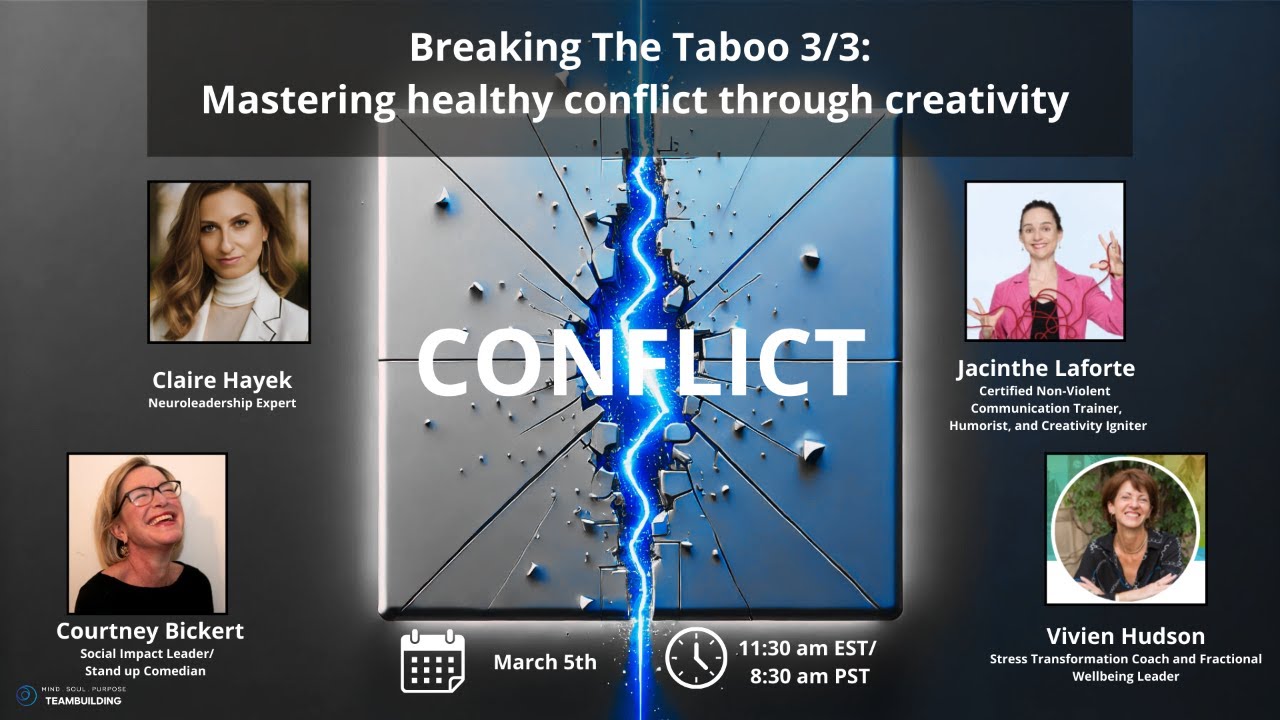
In this 30‑minute live webinar hosted by Claire Hayek, founder & CEO of MSP Team Building and a neuroscience‑certified coach, she is joined by three experts – Courtney Bickard (stand‑up comedian and executive), Vivian Hudson (leadership & wellbeing coach with a pharmaceutical background) and Jacinthe La Forte (certified trainer in Nonviolent Communication). The session explores how conflict, often avoided, can be reframed as a catalyst for growth and collaboration. Key themes include using humor to defuse tension, understanding the brain’s fight‑or‑flight response (amygdala vs. pre‑frontal cortex) and applying emotional regulation techniques such as breathing, counting, and perspective‑shifting. Jacinthe introduces the Nonviolent Communication (NVC) observation‑feeling‑needs‑request model, while Vivian shares practical steps like setting ground‑rules, conducting post‑mortems, and self‑care for resilience. Courtney demonstrates how absurdity and humor can reset group dynamics, and the hosts engage the audience through live polls, chat comments, and personal anecdotes about empathy challenges in the workplace. The conversation culminates in actionable advice for leaders to build a culture that embraces healthy conflict through listening, shared norms, and intentional use of humor, concluding with a teaser for an upcoming session on imposter syndrome and a call‑to‑action for further workshops.
Chapters
Hi everyone! I hope you're all doing great. I'm Claire Hayek, the founder and CEO of MSP Team Building and a neuroscience-certified coach. Really happy for you to join us. And if you're settling in, take a— grab a coffee, grab water, tea. And this is the 3rd part series of Breaking the Taboo: Stress, Humor, and the Art of Healthy Conflict. And this is the 3rd one. This is the last one. And it's a special one because we're Talking about conflict, I think a lot of us are interested in that. I think a lot of people don't understand conflict, don't know what to do with it, and it seems like this mysterious thing that we're not sure what you know how to juggle with it, how to manage it. And and it's anyways we're gonna we're gonna give you a lot of gold nuggets here today. I'm joined with Courtney Bickard, Vivian Hudson, and Jacinthe La Forte. And ladies, hello. Hello, how's everybody?
Great, I'm great. Um, yeah, awesome, awesome.
So, um, I'm gonna ask you to quickly, quickly introduce yourself. Uh, we have 30 minutes and we have so much to talk about. Let's start with Jacinthe.
Yes, hi. Um, so I'm a certified trainer in nonviolent communication, also an artist. So I love to have people laugh and also deal with their conflict and listen to each other.
Awesome. Thanks, Jazza. And Vivian?
So yes, I am a leadership and wellbeing coach. I have a special interest in stress. I come from a pharmaceutical background. I was a pharmacist for many years, and now I work on the front end by addressing stress so people don't need as many Medications in their future.
Love that. Courtney?
Hi. Yeah, I consider myself a bit of a split personality in a good way. I have an MBA, I've held executive roles in international organizations, and I'm a stand-up comedian and have trained at Second City and other places. So I work to bring the power of humor and laughter to strengthen teams, leaders, and organizations. I love it.
Love it. Yeah, you're not the only one with a split personality. I think all of us here are. Multiple ones. But it's a good thing. It's a good thing. We need more of these in the world. So today, like I said, we're going to be talking about conflict. But before we dive in, I'd love to know where you're joining us from. If you can put it in the chat. If it's the first time you join one of my live conferences, very interactive. I will throw questions your way. We want to hear from you. I'll feature your comments here. And basically, the whole idea is to learn from each other and make sure that the actual subject is relevant to what you're going through. And so, we can maximize the value we're adding during this live. So, please do put in the chat where you're joining us from. And just a quick mention that we have Ophelia here from our team at Mind Soul Purpose team building. Ophelia will be basically sharing comments, sharing some statistics, and minding the chat. There you go. So, without further ado, let's address the elephant in the room— conflict and what to do with it. Many of us, I guess, growing up or just Right now, every day in our adult life, we're taught to avoid conflict. But in actual fact, I don't know about you. But avoiding it sometimes, actually most of the time makes things worse. Actually, makes things worse. Not sometimes. Always makes things worse. I think it's a timing thing. But I'm not a conflict expert. And I want to definitely hear it more from our guests here today. And I think what we want to achieve today is we want to help you reframe conflict as a tool for growth and collaboration as opposed to this negative thing, right? So, I'm going to start with Courtney. And I'm going to throw it back to Viv here and Jacinthe. I would love to know in your work, have you seen healthy conflict lead to positive outcomes, reframing conflict in a positive way? Courtney, we'll start with you.
Absolutely. I think one of the things about humor is that it is about understanding and pointing out the absurd. And when things are absurd, they're not personal to you. You can find opportunities to present the absurd. So just an example, I was working on a proposal for a big government contract, and we had people from all over the world on a Zoom call, and it was like getting to like 1 in the morning. The computer was glitching up, people didn't agree on what the like indicator for this one session should be.
Right.
And so it was causing us a lot of delay, so I just sort of stopped everything to point out the absurdity of here we are, like 10 people, somebody's in South Africa, their electricity just went out, so they're trying to rejoin. I'm here doing whatever. Rebecca's working on this and the computer's frozen, pointing out the absurd. And I just asked everybody, instead of working on this paragraph, just write freeform. You can say anything, what you're feeling right this second. And so everybody just started typing like mad on our share screen and we had all this funny stuff and it sort of broke the tension, made the situation what it was, which was really absurd. And made it less personal. And we were able to just refocus, focus on just getting it done. And the nice thing about it was we had to work together once we won the project. And so we always had that to fall back on because we could always say, okay, everybody stop, write down how you're feeling right now, or scream out how you're feeling right now. Became an inside joke and something that was a safe place for us to always go back to in the future.
Love that. Love that. That's so simple. So, I guess we're always— I think we're not trained to deal with conflict. And this is definitely very good insight. I love what you just shared. It is so simple. And we don't have that instinct, right, to look at it simply. We just get into the defensive and shutdown mode. Viv, what do you think?
Yeah, so I think a lot of that comes from conditioning, how we were raised, from what grew up. So I had a very authoritarian father figure. So you didn't argue with that person. And if you did, it was likely to be explosive. And even when you wanted to share your point of view, like, it would just get squashed. And so you just didn't feel like you had a, you had a say. And I think that that really speaks to the psychological safety piece. So for us to be able to address conflict in a constructive way, what we really need to do is to create that psychologically safe space. Humor is a great way to do that. And also what we need to do is to be able to manage our own emotions through that process. So it comes down to that self-awareness and self-regulation that comes through developing emotional intelligence.
Mm-hmm.
So some of the things that you can do, it's like, uh, my kids used to come home from school and one of their teachers taught themselves— taught them this. It was count to 10 and think again. Because like what we have is the amygdala firing off like a fight or flight response, which causes us to say things or do things we might very quickly regret. And what we need to do is bring the prefrontal cortex back online. 3 deep breaths, count to 10, change state, a quick laugh about something. And also even just reframing, like, I like to think about, like, will this matter a day from now, week from now, a month from now? And bringing that perspective as well can be really powerful. It's like, so you left, you know, you left, I don't know, your chair sticking out and I nearly tripped over it. Well, tomorrow it's not going to be a big deal.
I love that. You know, it's a great reminder that, that conflict really starts with with managing the inside mastery, managing ourselves. Jacinthe, you're an expert in nonviolent communication. Just tell us a bit more about how empathy plays a role in actually reframing conflict.
Yeah, I will just add to what my colleagues Courtney and Vivian just said, because this empathy thing, when you receive empathy, when someone understands what you're going through and kind of connects to you, your amygdala calms down.
Yeah.
So, uh, if you have someone that is kind of agitated, or, and you kind of go to, oh, what's going on for you? What's important for you in that situation? You give better chances that the calm may be there, and then they'll have access to their frontal cortex. So that's where empathy is so important, and What nonviolent communication brings is this mindset that everybody is just doing their best to meet their needs.
Right.
So when you look at a situation like that, okay guys, we're all doing our best to meet our needs and to do like, okay, whose needs, what are the needs of everybody here? Instead of who's wrong, who's right, it changes completely to just look at it with a benevolent Right, right.
That's a great, great point. I can definitely agree with empathy. And sometimes, I guess it's a big deal. Sometimes, we don't know how to empathize, especially when we're in a conflict situation. Because I mean, you said it, everything's going right through the amygdala. Now, there's no common sense anymore. It's just going straight back there. And the prefrontal cortex is bypassed. So, it's hard to be able to stop and think and bring down those emotions and say, I'm gonna look at it or try to empathize with that person at a whole different level and try to see how they're feeling and why they're feeling that. This is where the prefrontal cortex is managing. But unfortunately, we need to do take some steps in order to bring it back there and manage the amygdala, what's happening with the amygdala. And I find sometimes, actually most of the time, what really helps me just kind of just breathe, stop for a second, breathe, and then think of that person and look at that person as a child.
Oh yeah.
And feel that, okay, this is little Viv, little Jacinthe, little Courtney. It's lovely. I love that. Instantly, you feel love and you feel you're open. Your heart is more open, and it calms me down. It's like we're just kids. We're just children trying to navigate this world and our emotions. And you know, maybe we've had experiences. We had had things happen, and and you know, we have our own saboteurs. We have our own defense mechanism. So that person is just trying to deal with it, you know, and maybe they're going through something. So it just calms me down, and I don't look at the person as confrontational. I look at that person more as little kids playing here. You know, we just don't know what we're doing. We're trying our best. So, it just breaks up. I think for me, it's more like a breakup from the amygdala and get more into the prefrontal cortex and push it more on the right brain, right? And open up my heart. It's extremely hard to do that just like that. It's like, I'm just gonna love that person and they're pissing me off. Like, I don't want to love you right now.
I don't—
I don't like you, you know.
You may need to receive empathy to be able to do that. Sorry to interrupt. You mean empathy, because if you don't, your empathy bottle is empty, you won't be able to do that. You may need to receive it first.
Exactly. And I think this is, you know, this little tool of looking at that person with a different eye helps. see them differently and helps tap into the, you know, let's empathize here, you know. Because it's hard to see the adult and the person like with a big, you know, upset face, an angry face looking at you and you're going, yeah, yeah, you don't look very— I don't want to be empathetic right now. You're ready to, you know, to just attack me right now. You know, I gotta defend myself. But when it's just like you take away that power. Look at them as a child.
It's so cute.
Oh my God!
But again, it's not to belittle or anything like that. It's just changing my perception. And exactly what all of you said, it's like managing the self first. So, you're able to deal with it after. But anyway, this is really, really interesting. I'm just gonna put up a poll question here for the people that joined us. Have you ever witnessed a conflict lead to a breakthrough or positive change? And please put it in the chat, yes or no. And I would like to highlight that we have Nikki here from Caledonia. Thanks, Nikki, for joining. And as I already mentioned, that we have our lovely Ophelia supporting us here during this live. So let's keep going. Again, like I always say, it flies by when you're having a good time and having interesting conversation with lovely, lovely people. So we understand conflict a little bit more and what's going on, right? So, let's talk about the how now. Okay. So, we kind of talked a little bit about the how and how we could deal with conflict. Is there any specific technique? I kind of shared mine, jumped into the next question just a second ago. But any specific technique that is generic that you could share with us, maybe Jacinthe, when it comes to dealing with with conflict or encourage, like maybe help leaders use it to encourage open and respectful conversation during conflicts? Let's be a bit more specific at the workplace kind of situation. How can we help leaders or give them a tool that you can use to open up the conversation during these conflicts besides looking at other people as children and calming themselves down? What other tools can they use?
Absolutely. Well, in nonviolent communication, we use a lot of translation. We start with the judgments that come in our head and we translate it. Because like, let's say I'm in a conflict with a colleague and what comes to my mind is, how stupid is she? You know, that's what comes to mind.
Yeah.
And the boss may be having those thoughts in front of their employees and they're like, how to communicate authentically when that's what you have in mind? So we translate, translating the judgments to, okay, what are the facts? What happened? An observation of, okay, well, I read this report, I had this phone call, I saw you say that. So you go to what a camera would have taken. And then you go to how the impact on you, like, I'm uncomfortable with that. I, I, I, I feel angry, or I feel Uncomfortable is a good word in the business world because it's kind of light, but it says like, I'm not at ease.
Right.
I'm uncomfortable with that. And then you go to the needs. And in a business setting, it can be just said as, what's important here? Like, what's important here? Like, oh, I'm uncomfortable when I heard you say that on the phone because this is a very important client and I really value collaboration. I want to offer respect and like warmth. So you go to what's important here and then you make a request. And many times the request is sometimes something more relational, like, would you tell me how, how you feel about what I just told you? Or—
Right.
How do you see that? So observation, feelings, needs, or what is important, and a request. That can also be a concrete action to take. But before asking for action, asking for connection, asking for what has been understood will really pay more.
Okay. Okay. This is great. Thank you so much, Jacinthe. Viv, any practical steps you want to share?
Yeah, absolutely. So I think one of the things is like conversations or conflict can get out of hand, right? So I think if you— have had dealings with a person and they're known for, let's call it, explosive behaviour, to preface at the top of the conversation, say, look, I want for us to come up with a collaborative solution. However, if you raise your voice, I will leave the conversation or we're going to stop this conversation and come back to it. So creating some ground rules around accepted behaviour in the conversation is pretty helpful.
Right.
And also, uh, having a look at a conversation, whether it went well or not, let's do a postmortem. Like, what were the triggers? What did I notice in my body coming up that caused me to suddenly react? Because the best thing, the best learner is— the best teacher, I should say, is that past experience.
Right.
And just being able to pause. And perhaps we did do some good things. Just acknowledge yourself or acknowledge the other person, you know, thank you for staying calm. learned through this process as well. Um, I've often said, like, some of the, like, the best ways that we can build relationships is through handling a difficult conversation well. It's like such a great avenue for personal growth, but it takes a bit of practice.
Definitely. Definitely. Thanks, Viv. Um, I love that. Um, Courtney?
Yeah, a couple of things, I think. Um, One of the things is, and we talked about this in our last meeting, is how are you setting the tone in the room as the leader? And we always quote, the leader brings the weather.
Right.
So how you set the tone in the very first few seconds of that conversation, confrontation, whatever it is, is the energy that's going to be carried forth and adopted by the person. So is you as a person entering that situation, take the time, breathe, think of them like a child for a second, giggle to yourself about something that somebody said last night or your kid did that morning. Take your own temperature down a notch, and that's the energy you're going to bring into the conversation. Then I also think there's an opportunity in those first introductions when you're getting going on things. You can either disarm it by being like, I've been so worried about this conversation, Or this thing that I left my coffee mug on my car this morning. Then you're acknowledging, yeah, I'm worried about this, but in a funny way. Or you can set the stage like, okay, I know we're facing something that people don't agree with on this, but let's pretend like we're MacGyver. I don't know if you know MacGyver.
Yes, I mean, I do.
And we're going to sit here together and we're going to try to make a solution out of a piece of string, a pair of glasses, a marker and a shoe, and let's just get going. So just taking it to the absurd, taking it out of and into a new context and setting that stage from the very beginning is going to bring people to the table at a different spot. And I also wanted to just quickly point out that Nikki made a really good comment that I think we should address.
Yeah, I was going to jump into the chat now. Well, let's do that. And I did just put a poll question here. What's your biggest challenge when it comes to managing conflict? Understanding emotions, staying calm, or finding the right words? Please do put it in the chat. We're just going to go over the chat here and just kind of read. I mean, I'll let you read it if you want, Courtney. Yes, if you have people who are open to other perspectives. Is that the one?
No, it's empathy is not common in my industry.
So this was just to remind everyone here that might be listening to this. The question was, have you ever witnessed a conflict lead to a breakthrough or positive change? We have Murad Rogers said, yes. Ophelia said, yeah, of course. And then, Nikki had a couple of comments and I'm going to put it here right on the screen. Empathy is not common in my industry. And I've been told I'm too empathetic at times. It's frustrating when you try to make headway with rough situations. And there is no common ground because you are the only one trying. So Courtney, I know you wanted to, to talk about this. Go ahead.
Yeah, no, it's— it is a tricky one and it is certainly an incredibly frustrating situation. So again, I'm trying to think of any way you can pull the conversation maybe out of trying to like, why don't you guys want to address this? Or You know, I'm trying to listen, but maybe shift it to— if you, if you can somehow reframe what you're trying to discuss about, like, maybe it's just like, okay guys, instead of this, why don't we talk about what do you see as the future for the company in general or our division? What's—
Right.
We want to accomplish, just maybe taking it out of the thing at hand and getting people thinking about something It's a hard one though. And I'm sure it's incredibly frustrating.
Yeah, for sure. I mean, it is. You can have all the good intentions, right? But if people are not reciprocating, this is why it's important to bring in experts at the workplace and have these training sessions and help people deal with these things because we're not naturally all trained to do that. Again, I always say this. We don't learn this in school. It's the life school, right? The life university that teaches that. And how we learn it is by facing these, I guess, challenges, whether it's dealing with people or on a personal level or at the workplace. So, it's always good to bring in somebody, an expert, and help you navigate through that because it's not an obvious thing. So again, please do put it in the chat. What's your biggest challenge? When it comes to managing conflict. A, understanding emotions. B, staying calm. C, finding the right words. And while you're doing that, we're going to jump into the last segment. We have about 5 minutes left here. And so, here's the thing. How can— let's talk about how leaders, business owners, people in general, how can we build a culture where healthy conflict is actually embraced? and not feared. This is not an obvious thing because again, it depends on all of us. But we can encourage it and build that culture so people are encouraged to embrace or have a conflict-resilient culture. But there's things we need to do. It just doesn't come along. We can hope all we want and dream about it, but that's not going to do anything. So Jacinthe, can you give us a couple of maybe pointers or tips on how we can build that culture, that healthy conflict culture? Absolutely.
I think for me, one, there's many things to say, but one thing is to build a culture of listening. That would be the first thing I would suggest because there would be more listening and there would be less conflict.
Mm-hmm.
From the start. So that's, that's one. And maybe the other thing is to kind of change the way we look at conflict, because, you know, there are sometimes sunny skies and there's thunderstorms and there's rain, and it's like the weather in a team. It's all gonna happen. So it's all gonna happen. So to kind of talk about what do we do when it happens, right, it needs to be said and chosen as a group how we do that.
Right. Thank you, Jacinthe. Makes total sense.
Viv? Yeah.
I wanted to say quickly also, if it's a complete absence of conflict too, that could be a red flag as well. But a couple of things I want to say is, for you as a leader or an employee and how you're navigating this, you've got to navigate yourself, so making sure That you're getting a good night's sleep, that you're administering your own self-care, because that's what builds part of your resilience, is how you're managing yourself. So if I'm dealing with little kids at home and I'm having broken sleep every night, my fuse is going to be that much shorter.
Mm-hmm.
If I'm caring for ageing parents or dealing with a chronic disease or something myself, then that's going to have an impact too. And that's to Nikki's point, like having that empathy is key. But as she's saying, like when you're in a male-dominated industry, I think male men— and I don't want to stereotype because I've never been in a man's brain, but just from what I've observed is that like men can often get over conflict, uh, like they just say it and they move on. Whereas women, I think we tend to internalize that and take things personally because that's the natural care in us. So for Nikki, I'd say like being firm but fair and using less words so that you're more impactful. And the other thing is, Nikki, is there someone who can help advocate with you to support your cause? So a couple of things there. Yeah.
Thank you. Thank you, Viv. So relevant. So interesting. I'm loving this conversation. Please do put it in the chat. Are you, are you getting a lot of gold nuggets out of this conversation? Are you enjoying this or is this making you uncomfortable? Or are you just— are we opening up your mind in any way and help you navigate conflict resolution? Please do put it in the chat. I do have also a question here. I have a lot of questions for you. I want to hear from you. This is a conversation. So, do you think your team is prepared to handle healthy conflict? Yes or no? And again, Do put it in the chat. We want to know, how are you enjoying this conversation? Is this making you uncomfortable? Or on the contrary, this is just demystifying the whole conflict thing and giving you the tools you need to try to start practicing it, right? Start moving forward. Courtney, what's your take on building healthy cultures? What we could do, healthy conflict cultures?
Yeah. So, since I'm the humor ambassador here, I'll just beat the drum a little more. But I was just reading a really interesting study about humor and organizational culture. And actually, if you're trying to change a culture, humor is actually one way to do so very quickly because actually, literally, laughter is contagious.
Yeah.
And this study found that that laughter, that contagion carries over into the culture of the organization. So by leading through some humor and laughter and You're going to be— that's going to catch on. And it's one of the cultural things that will catch on relatively quickly. And that will create— I mean, imagine being really mad at someone when you're both trying not to giggle, or like, it's impossible.
Good point. Good point.
Absolutely. So that kind of thing can create a lot of— and it also takes everybody's stress down. So people are going to be coming to those conflicts with a very different level of anxiety and cortisol and all sorts of stress. Yeah.
And I truly believe in humour and the magic of humour and what it could do as a healing process. And it's also, I believe that sometimes, it's just pausing. Pausing for just learning to pause or giving that time that becomes kind of a habit. So, if you're in a team setting, And you're trying to bring in a way to kind of just, let's all calm down here. And especially for a leader, if the leader is upset and not self-aware or self-aware and just not able to stop his or her anger, just to voice it. It's like, I'm so angry right now. I don't think I should be talking. And I'm really upset at you. And I think, just give me Can you just give me 2 minutes? I really need to just calm down because right now, I'm not thinking. And when you explain this and when you're all speaking the language, I'm gonna bring in the neuroscience aspect of things. If you give the neuroscience language to your team or give them whatever tool you bring, whether it's humor, whether it's how to manage your stress, or you gotta give them those tools. Because then, when you do say, My amygdala is firing up, firing away here, and firing up. I need to calm it down. They don't go, huh? What?
What?
What? Amygdala? You know, then you're like, oh right, yes. Oh, okay. It just rationalizes it and it takes that emotion a little bit out of it. And you're like, I need my prefrontal cortex to think here and just, you know, analyze this. Give me two minutes. I gotta just calm myself down. It's biological. It's in the body. So, it brings it back to, it's simple. It's just little steps. I need to calm down and then we can talk about this. And then, I can maybe understand what you're trying to tell me as opposed to you're telling me your point of view and I'm going, I don't hear anything right now. I just want to rip their head off. So, and anyway, I think for me, it helps me personally. I need to calm down. When I'm in my emotion, I just need to breathe. And hopefully, this helps you. I think we had great tips here from Jacinthe, Viv, and Courtney. I think with all these tips, you're good to go. Tell us if you agree in the chat. Hopefully, we added a lot of value and gave you a lot of tips here. And I'm gonna just put up some of the comments here. We have Nikki comment on, do you think your team is prepared to handle healthy conflict. I was recently— she mentions, I was recently laid off and currently looking for a new position. But everything I learned in your podcast, I will take with me to my new role. This is wonderful, Nikki. I'm so happy that we're adding value during these lives. And that's the whole point. I will also put this up here. Sometimes, I really need to do step back. But those are great tools to remind myself and others. Thank you so much for sharing this in the chat. And Nikki, I wish you all the best and please do come back.
We love you.
And I always say that things happen and there's a lot of uncertainty. We talked about this actually, Courtney and I, during the last one. There's a lot of uncertainty and we're not really trained to manage and navigate uncertainty. And there's— and just building resilience. And I truly wish from the bottom of my heart that you find just the perfect thing that you're looking for right now. And look back at this with a different perception and say, I was laid off and that was the best thing that ever happened to me because now, I'm on the right path. I really truly hope that you get what you want. And so, on that note, I wanted to actually share that next Wednesday, same time, I'm going to be talking about the imposter syndrome and why we think we're not worthy and how the imposter syndrome is holding you back. So, do please join in. And I have the QR code here on the screen. Do scan it. And if you're just listening to this, Mm-hmm. head on to LinkedIn. or our social media, my social media, and, and make sure you RSVP. It's going to be a very interesting one because, ladies, let me ask you quickly, we all have the imposter syndrome. Am I wrong?
Well, I have heard people say, and I agree with this to some content context, but if you don't have some level of imposter syndrome, then maybe you're not trying hard enough because it means you're too much in your comfort zone. So we always have to be a little bit uncomfortable. To keep growing. So if you don't feel that little bit like fish out of water, then it's time to like stretch yourself.
Exactly. And I think it's just a natural thing. Um, but when it, when it's actually controlling your actions and stopping you from stepping into your power, this is where the problem begins and it could really escalate. And this is what we're going to be talking about. So, definitely an interesting subject. I'm really looking forward to it. And before we go, I would like to put up another link here about— we have a workshop about resilience and how to lead with certainty in these uncertain times. We're leveraging leadership neuroscience and engaging strategies. Please do scan it if you want to know more about it. And we'll leave you with that. Thank you so much, ladies, for joining me on this adventure, 3-part adventure. The time flew by. We're already in March. I mean, what happened? What happened to the time? But thanks again for being my partners in this 3-part series, and I surely hope that we'll be in touch and that, you know, we'll have you live another time. If you want Courtney, Jacinthe, and Viv back, do write us, and we'll definitely come up with a subject that they could Add value to. These ladies are incredible, and I'm blessed to have you. Thank you so much, Jocelyne, Viv, and Courtney.
Thanks, Claire. It's really all of you.
Yeah.
Thank you. Bye, everyone.
More from Claire


25 years in cybersecurity taught her this about staying calm under fire with Jonna Garber

Pause and Assess: The 10-Second Technique to Stop Over-Controlling Under Pressure #shorts


UN Mission Director On What Real Calm Under Fire Looks Like With Fredrik Sandvall





Book Signing at AIFEC Bogotá | What Pressure Does to Leaders and Why I Wrote This Book #shorts