Breaking The Taboo - Stress, Humor, and the Art of Healthy Conflict.
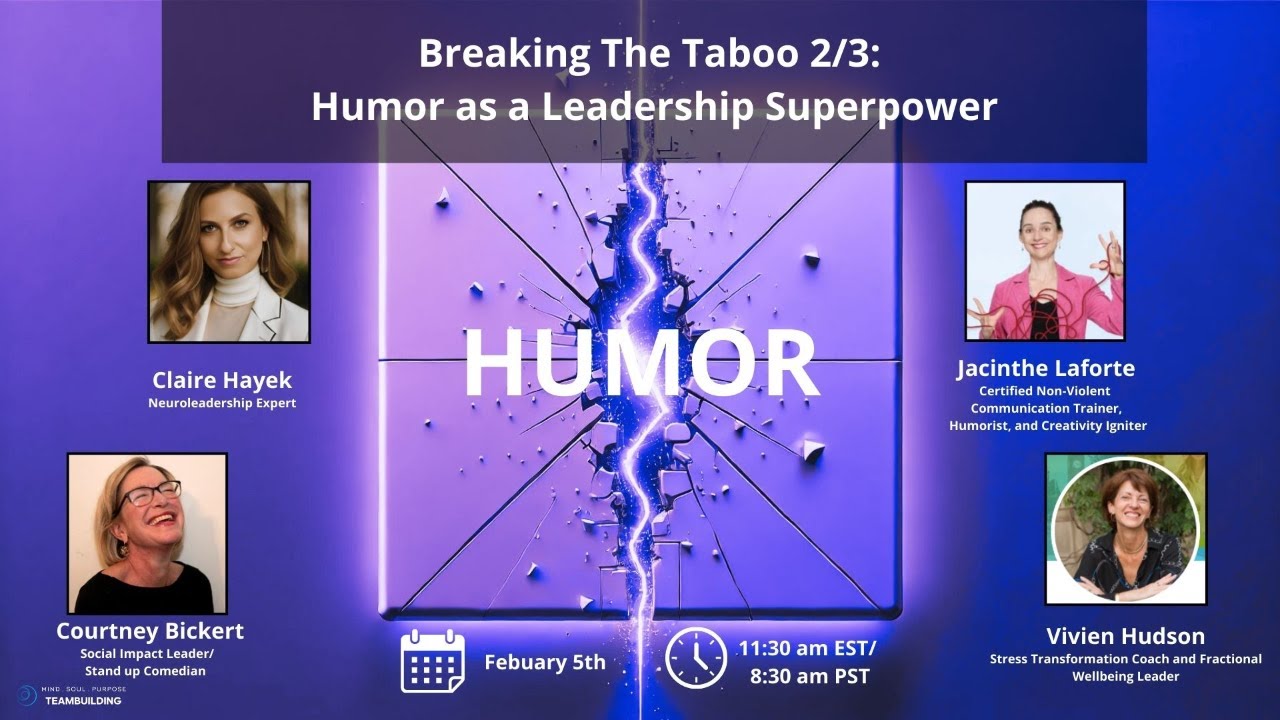
In this 30‑minute live LinkedIn/Youtube panel hosted by Claire Hayek, founder & CEO of MSP Team Building and a neuroscience‑certified coach, the conversation explores how humor can be leveraged as a leadership super‑power during periods of economic uncertainty and high stress. The panel features Courtney Bickert, a social‑impact leader and stand‑up comedian, and Vivian Hudson, a stress‑transformation expert, with occasional input from Jacinthe Laforte. The hosts acknowledge current macro‑level stressors (job losses, Canada‑US tariffs) and then dive into the science of laughter—cortisol and adrenaline reduction, blood‑pressure lowering, brain‑wave shifts from beta‑3 to alpha, and the release of “happy hormones.” They discuss how humor builds trust, competence, and confidence in leaders, and how it physiologically mirrors across teams, creating a bond that enhances creativity and problem‑solving. Practical guidance is offered: self‑deprecating jokes, avoiding politically or personally sensitive topics, reading the room, using inside jokes, and employing spontaneous or “laughter yoga” techniques (including fake laughter). Audience polls and chat comments illustrate real‑world applications, such as using Nerf guns in meetings or stress‑ball catch games to inject levity. The panel concludes with strategies for scaling a humor‑rich culture—consistent modeling, team‑building activities, and leveraging mirroring—while announcing upcoming sessions on sales resilience and healthy conflict with creativity expert Jacinthe Laforte.
Chapters
Hello, hello everyone. Welcome to our second part, the second part of our series, Breaking the Taboo: Humor as a Leadership Superpower. The first one that we did was a month ago, believe it or not, and we talked more about stress. And, you know, stress, and we looked at also a whole bunch of different things when it comes to stress and resilience. But if you're interested to know more, you can go and watch the replay. But here we are today. Let's let's put it this way: a lot going on. I think we can all agree. February fifth, two thousand and twenty-five. Lots going on for the past week. But before we dive right in, I'm your host Claire Hayek, founder and CEO of MSP Team Building and neuroscience certified coach.
coach.
And I'm joined with the wonderful Courtney Bickert, Vivian Hudson, and maybe Jacinthe Laforte will be joining us. It's not for sure, but we're really crossing our fingers for that. Courtney Bickert, she's a social impact leader and stand-up comedian. Vivian Hudson, stress transformation expert. And Jacinthe, in case she joins, she's a certified trainer a nonviolent communication and creativity coach. So ladies, welcome, welcome.
Great to be here.
Thank you.
Hey, how are you? How are you dealing with what's going on? So let's, let's dive right in. Okay. And by the way, welcome to all our guests, people that are joining us today. And I, you know, I do want to know where you were joining us from. Please put it in the chat. Please be interactive. We're going to be talking about a lot about humor but also about what's going on. We only have 30 minutes, so we're gonna kind of try to get everything together in 30 minutes, right? But I think we need to address the elephant in the room. A lot of people are losing their jobs. There's a lot at stake. The tariffs between Canada and the US, okay, they're on hold for now, but who knows what's gonna happen. A lot of businesses freaking out. I'm actually here broadcasting from a hotel. I'm in London, Ontario, and I was just doing a workshop for one of our clients. And one of the things on the agenda was the tariffs. And that was one of the big, big challenges. And that was not called for when they booked this a month ago, right? And all of a sudden, it's taking the whole big part of their agenda. So it is real. It's happening, or might happen, might not. But it's something that we need to deal with. I'd love to know, Courtney, how you're feeling about this. Especially kind of the subject today is about humor, and it's not about belittling what's happening, but more about how maybe humor can help deal with these things, right? All yours, Courtney, if you have something to say about that, and Vivian.
I do. I'm here in Washington, D.C., and I can say that it's a very stressful time. A lot of people are losing their jobs. There's a lot of uncertainty. uncertainty, a lot of fear. And so I've been sort of struggling myself thinking, oh wait, how am I— how do I talk about humor in this moment? It's like, this isn't a laughing matter. You know, this isn't something to laugh at. And when I really stepped back and thought about it, I thought, you know, but here's the thing. We really, really need leadership. right now. We need our leaders, and we as leaders need to be at the best, and we need our best, and we need to help our teams to cope and to be resilient. And so humor is a really powerful tool when applied appropriately, and we need all the tools in our tool belt, and it's a really powerful one, both for ourselves as leaders, but also for our teams.
Absolutely. And I think this Breaking the Taboo series is very relevant, to be quite honest with you. We talked about Vivian, we talked about stress, right? Viv, should I call you Viv? I love that you changed your name. I love this. This is great. So yes, we talked about stress, resilience, and well-being. And the first series, again, in case you missed it, please go back. Very, very interesting stuff, insights and gold nuggets in there. And guaranteed in this one too, no pressure, ladies. But yeah, here we are. Reality, we touched about stress and resilience, which is very relevant today in what's happening, and humor, what Courtney added. So Viv, what's your— 2 cents about this before we dive right into our subject here.
Yeah, I think like we can get so serious about life, and while we're facing challenges, like it's always just a moment. And we— if we take a step back, right, it's just a little speed bump in the course of our whole life. And I think when we infuse that with just a touch of humor, it can kind of help break that up and add some perspective to it. So like, if I'm going through something really bad, I could say, well, at least, at least I've still got my husband, you know. And it's not to say, uh, that, that it makes what you're going through, uh, not, um, not valid, but right, there's always, there's always a silver lining, right?
Absolutely, absolutely. Uh, and you know, um, It's just life, right? There's a lot of unpredictable events, and it's all about how do we navigate it and our attitude. You know, I always talk about the inner mastery, the outside mastery, and how they integrate together. Well, here we are. We have a lot of practicing to do. We have, you know, a lot of things going on that we can practice with. I mean, unfortunately, but It's life. So just want to highlight some of our participants today. We got Nikki from Caledonia. We got Connor from our team from Montreal. Connor that will be supporting us throughout this live and feeding the some comments in the chat and some links. And we have Mudasser Awan from Islamabad, Pakistan. Love this. Really happy that you able to join us. And Tamara from Gilbert, Arizona, or is it Gilbert? Is it Gilbert? Gilbert, right? Gilbert, Arizona. So thank you for joining us. And so let's let's dive right in, right? Let me just give me a second here. Let's do this. All right. I'm trying to be the navigator, the tech. The host and everything in between. So, I do my best. All right. So, why does it matter to use humour in leadership, right? So, why humour? Okay. So, Courtney, obviously, I'm gonna throw that one your way. You've spent years helping leaders integrate humour into their approach. So, why is humour such a powerful tool for leadership? And what impact does it have on teams?
Yeah, so it's an incredibly powerful tool in 2 ways. One, for the leader themselves and also for their teams. So from a leadership perspective, leaders who are seen as having a sense of humor and using a sense of humor are seen as significantly more trustworthy. They're more trusted. They're seen as more competent. They're seen as more confident. And those— we all want to be confident in our leaders and we all want to trust them. And so from that perspective, it's really powerful. It's also really powerful in terms of how it affects our teams. So as you always point out, Claire, we mirror, we mirror each other physiologically. We are built to do that. And so when you see your leader express some humor or lighten up or even start to tell a joke and break a little bit of a smile, you're not going to be able to help But mimic that.
Right.
To mirror that. And by doing that, one, you're creating an actual physiological bond between you and your leader, but you're also experiencing all of the physiological benefits of humor. So when people are scared, which they are right now, and when people don't know what to do, that your brain shuts down and you can't solve problems, you can't think clearly. If you can get people to relax, with some laughter, some humor, you're bringing down their blood pressure, you're opening their mind, you're creating a space for them to think.
Yeah.
Problem solve and to be creative.
Because I mean, at the end of the day, obviously we're emotional beings and our thoughts influence our emotions. So we're feeling sad. We, you know, we're going to— I'm sorry if we're thinking I'm stressed, what's going on? I feel unsafe. I don't know if I'm going to lose my job. So that's going to trigger some emotions. So if we could reverse that effect, right, and trigger some laughter, you know, beyond the negative thoughts or the insecurity thoughts, in a way, maybe that could give us a bit of hope or it could just pause those thoughts, right? They're not getting— it's not getting rid of the thoughts. Maybe just pause it for a sec. Relax. Relaxes our body and, you know, kind of resource, you know, give us— replenish our energy level, basically.
Yeah.
Go ahead.
No, it helps cope with— so the reality doesn't change, but it's a really powerful coping mechanism.
There you go. There you go. So I just wanted to share here, Tamara said something. There's always a thread of humor, and in that we can often find connection. Thank you so much, Tamara. I'll be again featuring some of your comments here in the chat. It's important. This is a conversation. and not a one-way thing. Please do comment away, ask questions throughout this whole thing. Again, this whole very short thing of 30 minutes, but nevertheless, we're going to try to be as efficient and add as much value as we can during these 30 minutes. So thanks, Courtney. That's obviously very relevant. So Vivian, or Viv, from your work on stress and resilience, How does your help in high-stress environments— like, what is that doing? What's exactly happening?
Right. So when you are in a high-stress environment, right, what's the main chemical that's floating around your body? It's cortisol, right? And adrenaline. And that's really helpful if we're looking to focus on something. But unfortunately for most of us, we're running on this stress all day. Oh my goodness, I've got another 20 emails. Oh my goodness, my boss wants this. There's always things that are putting pressure on us. And I think that the workplaces with the most engagement have more fun at work, which means finding ways to create laughter. So if you've got like the jokester in the office, like there's like everybody always likes someone who comes in like my son in our family, like he is, he's always cracking a joke. And when you laugh and spontaneously laugh like that, it actually helps to reduce those Right. And it also creates the happy hormones that help our brain wiring to function more effectively too. So as Courtney said, it helps us to be more creative too. So often, often when we get stressed, we can go into that kind of tunnel vision kind of focus. So when we laugh, it kind of breaks us— breaks it up and allows us to tap into that creative side. And as Courtney said as well, when we laugh, it reduces our blood pressure, it stimulates our circulation. Like, there's something to do with the whole vibration of the vocal cords, and that it's a bit like when we go, oh, in meditation, it kind of has that nitric oxide effect on our bodies as well. So spontaneous laughter is great. Yeah, and I think it's really important to remember that But you can also do it with fake laughter. There's a thing called laughter yoga now, and we can all practice now. So let's go, ha, ha, everybody go ha.
Okay, haha. Haha.
And then you just start to spontaneously laugh, right? Because it's just silly and you just, it just inspires laughter. So when you're having like that tense moment, like let's just do a moment of spontaneous laughter, like of laughter yoga and help to break that up.
Yeah, this is wonderful. And I'm glad you're bringing this up, Viv, because when COVID hit, you know, as most of you know that know MSP team building, we had to go fully virtual like all other companies. And, uh, we brought in laughter yoga. Uh, we brought in laughter yoga coach, and it was one of the most popular activities during COVID for 2 years, virtual laughter yoga. And you see people on screen with mute on, and you see them laughing, and you have to stand and do these things. And she was amazing. Our— I mean, she was— she is still amazing, our host. And so if you're listening to this and, and, and you're interested in laughter yoga, please put it in the comment. I will send you some info. It's the best investment you can make for your team, whether you're virtual or in person. And it works because the body doesn't know if you're fake laughing or not. Just as long as you're laughing, it just works, right, Viv?
Yeah.
Literally, I facilitated a lot of that during COVID I was not facilitating, sorry, moderating the sessions. And obviously in the background, I was laughing the whole time. It was my therapy every day I did it. And we were injecting these laughter yoga moments 5 minutes before a virtual meeting. And people needed it. It's just 5 minutes, 5 minutes. And it was so efficient. And everybody's like, the clients were like, oh my God, thank you so much. We needed this. We felt really silly. And we kind of felt like, what are we doing? Are we crazy? My neighbor's looking at me going, why is she laughing? You know, it was just so many funny stories actually, or they would, it was so contagious. Everybody would start laughing just by looking at you laugh. And even like with no sound, it's— anyways, I'm gonna stop right there because I can talk about laughter yoga forever. Um, but, uh, but yes, thanks for sharing that. Thank you, thank you. Completely forgot about it. I can't believe I forgot about that one. Most importantly, I want to talk quickly about what happens in the body, also brainwaves-wise, right? If we're in— we're stressed, um, frustrated, whatever you're— or, or we're in, in the, the positive or the negative vibes. For negative vibes The minute you start laughing, maybe you're not gonna just fully come out of the negative vibe, but at least you maybe land a little bit on the positive, you know, maybe start changing your perception of what's happening. It's like, I can just laugh about this, or I can be really depressed and sad about it, you know. I have a choice. Maybe I should just laugh because it is what it is right now until I figure this out. So that's one. 2, what you're doing when you're laughing, you're bringing down your brainwave from beta-3 the fight or flight to beta-2, beta-1, even alpha. Maybe this is where Vic was saying you get creative. And also Courtney said, now you have more clarity in your thought and you can function better for whatever 5 minutes, but that's good. 5 minutes is great. And I don't wanna go on into a story here, but I have to mention this. Yesterday, crazy day, crazy day. I almost lost— missed my flight all the way here. And I didn't tell the client, but they'll find out when they listen to this. But I made it. And I literally felt exactly what Viv was saying, that panic. But I don't know, I think instinctively I start laughing. I just start laughing from nervousness. And then I'm like, okay, I can just really laugh about this. But what else can I do at this point? I have to just do everything I can. And anyway, it worked out. Obviously I'm here. But anyway, all right. So let's just ask, let's go back to our wonderful people that are with us here today and ask you a little question. Do you think humor has a place in professional leadership? Yes or no? Please put it in the chat. I'll be popping in here and checking some of your comments. Here, actually, why don't we just jump right in? Tamara.
Tamara.
Parricio, Parricio. Okay, I think I'm hopefully I'm saying your name properly. Inspire a smile on the lips and in the heart joy can't help but follow. Puts things in perspective. Death and taxes are sure. Yeah, yeah, you're right. Absolutely. And and you know Vivian, thanks for commenting and and feeding the chat. Yeah, love this. Yeah, me too. Let's jump in here and look at Mudasser. I worked with some amazing leaders for almost two decades, and what I learned and tried to implement as well. The best ones are those who mastered the skill of using humor in difficult situations. How about that, ladies? Right? How about that? So relevant. I think it's the same when we see a smile on someone's face. It makes them more relatable, more approachable, more comfortable to be around than someone who has a stern face or dry attitude. Absolutely. Same goes for someone who shows a bit of Humor. I'm gonna keep going. I love sharing your your. I hope ladies you're you're good with this.
I love it.
This is gold in there.
Really, I feel like we're having this this huge. Yeah, I love it together. Mudassar laughter yoga is definitely something I would love to explore. Well, put it in the chat. I'll I'll reach out and give you a bit more detail, and it's something you practice on your own. I have a whole bunch of videos. you can follow on TikTok and stuff like that. Doesn't have to be like something you pay for. It's, you know, laughter is free, right? But I would love to share some of, some of our info on that. Sarah, Nikki Mattson, 100%. I don't— not following this. Hold on. Nikki. Oh yes, she's agreeing. She's agreeing with Nikki.
Let's laugh.
All right. All right. Nikki, if you don't laugh, you'll cry, as they say.
That's true.
Absolutely, Sarah. I'm loving this chat. I'm loving it. Keep it going. A big yes. So this is the, the answer for our poll is a big yes, yes, yes, that it does have a place at the workplace. So let's move on here, ladies. And of course, as usual, time is flying. Hold on a sec. I gotta, I gotta get a handle on this. Okay, here we go. Here we go. Next thing. Yes. I'm not trying to be funny, but if it's making you laugh, Great.
We're doing improv on the fly here.
Improvise away, you know, what the heck. Okay, so, um, we obviously know that humor works, right? But how can we use it effectively? Because there's, you know, there's a fine line sometimes in people trying to be funny and it's just saying the wrong thing and it goes really sideways. Um, Courtney, Please help here. I know a lot of people that have been in this situation where they didn't mean something and it came out wrong. And then the whole— it was the opposite effect, right? So what kind of advice? What advice you can give leaders on how to use humour appropriately, I guess, and effectively?
Right. Well, one way is actually just to Bring yourself into the right mind frame with humor. So remember, and I love this quote, I can't remember who said it, but the leader brings the weather.
Yeah.
So you are bringing the weather to any meeting, to any conversation. And if you are in a humorous state of mind, make yourself giggle, think of a funny meme, watch a funny meme, listen to a podcast. That's the energy you're going to bring into the room. You won't be able to help it. So that's a very safe way because you're not even saying anything that's potentially offensive. The other that is always safe, and a lot of this is just about common sense. And so it's stay away from the things that are politically hot, stay away from things that are personally sensitive, religion, people's politics, and don't make fun of people, other people, unless they're in on the joke. Because sometimes people love to be part of the joke. But if they're in— if they're not, instead make fun of yourself. And making fun of yourself, as long as it's not like TMI, too much information, or awkward information about yourself, which again is common sense.
No TMI.
No TMI.
It's always very safe. And it's part of that process of making you look human. And also that you make mistakes. And so if you make mistakes, oops, I spilled my coffee. Well, that sums up my morning instead of That makes you human. They can then make mistakes. So that's a very, very safe and easy way. The other thing that's really important to remember about human humor is that it is universal. We all have a sense of humor, but ours are all different, and that's shaped by our biology, our experiences. That doesn't mean we can't share humor together and learn to understand each other through humor we don't even get, but it's about being genuine. So if you're not the jokester, don't force it. Don't try to just come in and like start the meeting with a joke. And just let your humor be natural. Notice what's going on. As someone said in the chat, there's a thread of humor everywhere. So just notice it and point it out. And the last thing I want to say is use inside jokes. Inside jokes are really powerful bonding tools. So they're easy to create.
Yes.
And use them, reuse them, help people create them, that's also very safe.
Love it. Love it. Thank you, Courtney. I love the one about, you know, laughing at yourself, right? I think the self-depreciation— deprecating, I think. Deprecating.
Deprecating.
I don't even know the right English word. I'm like, it's great. It's great because it makes you more vulnerable and human and Not perfect, and it's great. People love that for leaders anyway, or anybody really. Okay, so— Can I add one thing actually?
Yes. One other thing is to read the room. So if you're coming into a room where people are anxious and they're scared and you walk in and crack a joke, obviously they're thinking you're laughing at the situation, you don't take it seriously. Doesn't mean you can't use humor as Viv Point it out when things are bad. Well, at least I have my husband, or I guess you're all upset that the coffee maker isn't working. Acknowledging that everybody's upset and then saying, I feel upset too, let's talk about it. So you'll use it, but you need to acknowledge and know the energy in the room.
Yeah, very relevant. Thanks for adding that. I've been featuring the chat comments here, so please keep them coming. I might not be able to read all of them, but I mean out loud. but they're on the screen so everybody can see them, right? So Viv, let's talk about how leaders can bring in humor without losing their authority. Because a lot of leaders kind of tell me, you know what, I don't want to be the jokester. People are not going to take me seriously. They're going to lose their focus. I mean, how do I— You know, there's a fine line between, oh my God, is he really joking? Is he really serious right now? So So how do we, how do we find that balance?
Well, yeah, that's a great question. And it's, it's like, okay, uh, right, we've had our little joke. Now let's focus on what we need to. So being able to navigate the conversation, and it really comes down to your own emotional intelligence, right? Being able to understand and manage your own emotions and to be able to interpret that of others. So it's always a balance. And I love how we're human, and 2 of the core things that really help us to connect as humans start with H-U-M, which is humor and humility. So it's like, wow, it's evolved. I kind of think about that. And I also love what, uh, Courtney talked about, the self-deprecating humor, because I think in the past we used to point, point humor at other people. And like, think about the jokes. I grew up, there was an Australian, a Scotsman, and an Irishman. They walk into a pub. Like, you can't have jokes like that anymore. So it's always safer to go with yourself. So as a leader, being able to laugh at yourself, I think one, it humanizes you, as we've said, but also being able to know when to draw the line on that and how much is too much. So as Courtney said, the TMI shares, like, okay, we didn't need to know that. And, and, and being able to then steer the conversation. OK, now we need to get down to business. So it's almost like creating that turning point or that tipping point in the conversation that takes it into, OK, now, now we need to talk about what it is that we actually need to accomplish.
Right.
And then we can end up on a humor point as well. But it's, it's just being able to navigate that balance and, and also not let people get out of control, because Sometimes people, you give them that bit of permission to make a joke and then they take it and they take it too far. So it's all down to emotional intelligence and, and being able to read yourself and read other people.
100%. I cannot agree more. Uh, I have a poll here for you, uh, wonderful, uh, audience listening yesterday and being so interactive in the chat. We love it. We've been featuring your messages on Have you ever used humor to navigate a tough situation at work? Yes or no. If you care to elaborate, please do. I'll be featuring your answer here in a second. And let's, you know, again, we're running out of time. Let's dive into the last section here. So how do we scale this? Okay, meaning, how can we create an environment where humor actually in connection is part of the culture?
Courtney?
Yeah, I think it goes— and I want to leave time for Viv too. It goes back to, one, that we are mimickers, we mirror people. So if you're using humor, if you're bringing lightness, people are going to mimic that. So, and laughter is contagious, it literally is. And so if you start to bring that in and bring in the self-deprecating, that sees you as human, It also lets people make mistakes. It's actually pretty easy to bring this culture. Inside jokes are so powerful.
Yeah.
You can build this like we're in on this together. And you can do that in a team within a bigger organization. So if you're like in a toxic organization, you can still bring the culture in your team. So just bring that weather and be consistent. It will filter into the culture. It's not that hard to scale because it's so contagious.
Absolutely. Thank you, Courtney.
Viv? Yeah. One of the things is to think about different team-building activities. If you've ever done leadership training, what do they do? They do activities that make you think a bit differently. Inevitably, you end up in laughter. So things that I do is just having like a stress ball, right? So you might have a circle of like your team, say 6 or 7 people, and you start off with one stress ball. You start throwing it across the room. People are going to drop it. Everybody laughs like we're not used to playing catch anymore.
Right.
And then you keep introducing another ball and the pressure kind of increases. And then you can stand back and talk about, well, how was that as we added more tasks and the pressure increased? But then over time, as they get used to throwing the ball, they create a system and it starts to go more smoothly. So it's a great way to bring in laughter and also see we're going through change. It's kind of a little bit clunky, but it will smooth out. Look how quickly we solved this problem. So being able to find something that you can do with your team that's fun and can help them to mirror, well, this is— then reflect how that activity then reflects to the change that they're experiencing. They say, oh, it can get better, it will get better, and yeah, that was fun.
That's such a good one. Actually, again, I've been highlighting the chat. Every single one of your messages is important and I've been highlighting it. Like I said, we're short on time. I can't really read all of them, but I'm going to read this one because it basically just complements what Viv just said. Our team was being— this is Tamara. Our team was being blamed for missing the mark, so we showed up at a meeting with targets on our backs and Nerf guns, then addressed every shot. It opened the conversation in a fun way. How relevant and how creative. Kudos to you, Tamara and team. I'm loving this conversation. Thank you so much, ladies, for joining in. And I just want to see here, do I have a last poll question? I think I do. Let me share this one here. Do you think fostering humor in your workplace improves team dynamics? I'm going to say yes. Obviously, I think this is one of the obvious poll questions, but you'll be surprised sometimes because you have certain teams, maybe it's not in the culture. I think it pours back into the last question we talked about culture and how we can make this contagious and bring it to a bigger level. So if you do have some questions, we're probably going to take another minute here to wrap up. Do put them in the chat, please. I'm just going to take quickly here a bit of time just to talk to you about our next live, which is going to be next Wednesday. And but before I do that, I just want to tell you, if you want to have more information about what we talked about today and connect with me and the beautiful ladies here today, Please put the word humor in the comment and I will get back to you for more information. And as far as next week live, it's gonna be— I'm sorry, I just can't find my things today. Like I said, I'm just struggling. I'm laughing about it. You're doing great. Out of my element. I'm in a hotel room and I know I need to check out like now. And they would not extend my stay. And I'm not going to say which hotel it is because it's not, you know, it's not cool. So I just wanted to highlight the next LinkedIn Live. There it is. Boom, Claire, you got it.
Okay.
Mastering Leadership: What Sales Can Teach Us About Resilience. How crazy is that? Sales resilience? What? What? So those of you who are thinking, I'm not a salesperson, I don't want to sell, I don't know why we're talking about this. Well, I will highly encourage you to show up to this one because we're going to look at it from a whole different angle. And I think it might change the way you see things about sales. So, at the same time next Wednesday. And of course, ladies, we'll be seeing each other in March, March 5th. This is going to be the 3rd part of Breaking the Taboo. And we're going to look at healthy— mastering healthy conflict through creativity with Jacinthe. Mainly, she's our expert. Expert in that domain, but of course Viv and Courtney will be here. And I'm sad already to say it's the third part, last part of our series. But hey, it was great. It's been great so far, and I can't wait for the next one. So let me just jump to the chat here and see what's going on. Let's see, let's see, let's see. Connor, thank you for sharing that with us. And Mudassar. Let me just read. I'm in sales and business development, and let me tell you, humor is a must in your toolkit. Not sure about other fields, but in a customer-facing environment, it is stressful on both ends. Sarah, thank you for taking the time to do this. 100%, we love this, ladies.
Love it.
Very cool.
Yeah, we just look forward to this one, and it's kind of like a a, a get-together every time, and the month just flies by every time. We're like, oh my God, here we are, you know. Uh, always great to connect with you. Um, and this is one last one from Mudassar. Nikki Mattson, well, there are some people who are just anti-humor. Stay away from them. With a big smiley, smiley face. So thank you again for joining us. Thank you for being so, uh, uh, chatty I think it makes sense, right, what I'm saying here? And thank you for laughing. Even though we can't hear you, I feel that you were with us laughing and joining us here with your spirit, your energy, just in the chat and sharing all these awesome tools.
Amazing.
Viv, Courtney, thank you so much again. Wonderful day, and I'm really sorry of what's happening. The only thing we can laugh about it at this point. And, you know, maybe things will just— hopefully, we need to be hopeful and think positive and maybe send those positive vibes to all politicians out there instead of sending them those negative vibes and this, you know, frustrated hate messages in our thoughts. Maybe we should send those positive vibes and, and, you know, kind of like, you know, I hope these positive vibes will change your thoughts, will change your outlook on things. Um, you know, I guess, you know, I, I don't want to go too spiritual on you, but I always have this image of when there's dark darkness, you know, you see the light shine brighter. But there's no darkness, you don't see the contrast. So the darkness is our, our way to kind of bring light into a situation. And what better way to do that other than humor? And let's just— let's send those positive, fun vibes to politicians that are going dark on us. And maybe maybe by March 5th, then we would have had that power to change things around. I am hopeful. I'm a dreamer. It's me. And I'm sure you are too, ladies.
Yes.
All right. Thank you so much. Any last words, Courtney and Viv?
No, thank you. And thank— I can't wait to save this chat thing because your comments were so amazing. And yeah, love doing this conversation. So thanks for making the space.
Yeah, thank you so much. And yeah, let's let's make sure that we weave some more laughter into our day today. So yeah, ha ha ha!
Yeah, ha ha ha! And some people in the chat that they want more info on laughter yoga. I will definitely be reaching out, but please reach out to me as well in a DM. But I will be reaching out. All right, thank you everyone. Have a wonderful rest of the day, no matter where you're joining us from, or good night, good morning, whichever. Time zone you're in, and see you next week on Wednesday. All right, ciao! Bye! Let's keep going. All right, this is the fun part here when I close the chat, uh, the live, and it doesn't close. So let's, let's keep— I'm keeping my fingers crossed that this is gonna actually work because last time it didn't and it went on forever. So we're gonna laugh until we
More from Claire


25 years in cybersecurity taught her this about staying calm under fire with Jonna Garber

Pause and Assess: The 10-Second Technique to Stop Over-Controlling Under Pressure #shorts


UN Mission Director On What Real Calm Under Fire Looks Like With Fredrik Sandvall





Book Signing at AIFEC Bogotá | What Pressure Does to Leaders and Why I Wrote This Book #shorts