Calm, Soul-Driven Leadership with Sean Jones
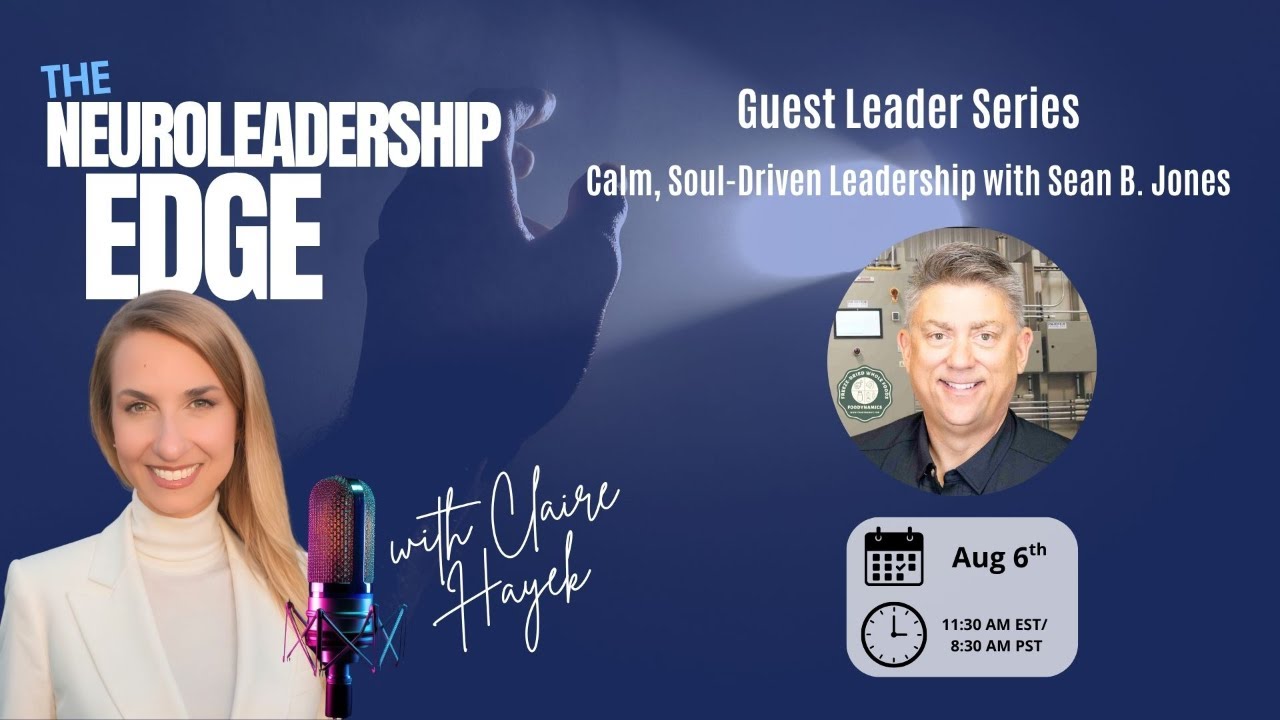
In this episode of the NeuroLeadership Edge podcast, host Claire Hayek interviews Shawn (Sean) Jones, a former psychotherapist, former COO of a massive healthcare organization, and founder of Food Dynamics and the pet‑nutrition brand What’s in the Bowl. The conversation weaves personal stories of high‑pressure experiences—from evaluating genocide overseas and responding to 9/11 to growing up in war‑torn Beirut—into a framework for calm, soul‑driven leadership. They discuss how a leader’s physiological state influences team cortisol via mirror neurons, and share concrete neuroscience tools such as the 4‑7‑8 breathing technique that activates the vagus nerve to shift the nervous system from fight‑or‑flight to rest‑and‑digest. Shawn describes a pivotal mindset shift after attending a Lance Secretan conference, moving toward stewardship, love, and building a company he would have wanted to work for, embodying servant‑style, soul‑driven leadership. They explore practical crisis‑rehearsal practices—monthly mock‑drills, the “Kobayashi Maru” mindset, and SOPs for emergencies—to pre‑wire neural pathways for rapid, calm decision‑making. The dialogue also covers handling difficult people, recognizing personal “saboteurs,” and using mindfulness to prevent triggers. Shawn explains the courage to leave a 30,000‑employee healthcare role for a 900‑sq‑ft pet shop, emphasizing action over analysis, confronting the brain’s panic, and learning by doing. He stresses that technical expertise does not equal leadership ability and that leaders must listen, adapt, and manage diverse team dynamics. The episode concludes with rapid‑fire insights on scaling myths, morale indicators, and a listener challenge to assess calmness and purpose‑driven leadership.
Chapters
Welcome to the NeuroLeadership Edge podcast, brain science for bold leaders ready to master their mind and own their voice. I'm your host, Claire Hayek, a neuroleadership expert and the founder of Mind Soul Purpose Team Building. So, imagine leading a multi-billion-dollar healthcare rollout. where one missed deadline kills the deal? Well, our guest, Shawn Jones, did. And the lesson he took from that pressure now fuels a booming pet nutrition empire. So, you definitely want to stick around and you'll learn how to keep your cool when things heat up, lead from your heart, and help your team roll with any change that comes their way. Our episode, Calm, Soul-Driven Leadership, With our guest Sean Jones, I couldn't wait for this one. Let me tell you that. And let me tell you a little bit about Sean. Sean is a former psychotherapist and COO of one of the world's largest healthcare companies, now founder of Food Dynamics and What's in the Bowl pet shop and franchise. His passion for pet nutrition led him to build a freeze drying manufacturing company that private labels for over 150 brands nationwide. His work is driven by disciplined execution, systems thinking, and faith, all in service of improving the lives of humans, cats, and dogs. We love our pets, don't we? Shawn, welcome.
Thank you for having me.
Yes, of course. So, let's get this going. I'm curious to know, Shawn, what's one high-pressure moment That you lived through that at the end of the day fundamentally shaped how you lead today?
I've, you know, and it's not just one moment in your life that prepares you for the things you're going to face later in life. One of the things, whenever I'm faced with any challenge that I think I see others being overwhelmed with, or I'm feeling those moments of starting to be overwhelmed, early in my career, I worked for a law enforcement agency, and we went into an area overseas, actually, that was basically— we were evaluating genocide.
Mm.
And in that moment, I thought, this is truly the valley of death. And coming back from that, and then that was just before 9/11. I also responded to 9/11, was on the ground just days after, and That created a relativity for me that, you know, you come back home and, you know, the washing machine is plugged up and it's overflowing and flooding the kitchen and everything. And, you know, everything is relative after something like that. And that got me thinking about, you know, biblical references and history and everything. And I said, you know, regardless of what I'm facing today, I'm going to be able to get through this.
Whatever life—
And I try to keep that relativity. I'm not always perfect at it. But I always try to make things relative to something else and realize that I'm capable of navigating the stress or the people around me are capable of navigating a challenge that they're having. And I give that confidence to other people that, hey, you can do this. Because we probably, none of us really know what we're fully capable of until you face it.
Absolutely. I cannot agree more on that. I mean, having been actually born and raised in Beirut amidst the war, I mean, when you experience that as a child, not understanding what was going on around you, I'll tell you one thing that definitely built my resilience. And it made it a bit— I have this third reference point, you know, like, is it really that much of a big deal? It's not about belittling what's happening, but more putting it in perspective and going, you know what? A lot of people go through a lot, a lot of big challenges, a lot of high-stress moments. You can just go through this. You've gone through worse. Unfortunately, it's not something I'm proud of, having gone through the war. But it's something that really taught me how to be resilient and how to be calm and put things in perspective. I think every single one of us has their own experience that you cannot compare. And this is not the point here, right? I definitely want to jump in here quickly and talk a little bit about brain science. You know, the engineer in me and the science in me, the geek. I have to give you a couple of— brain science and brain tips. So, when as a leader, we're at high pressure, we're feeling pressure. You all know about mirror neurons. Basically, people can feel what you're feeling, right? They can feel that panic or they can feel that pressure. They can feel the stress. And as a leader, your composure lowers your team cortisol level. So, a lot is on the leader.
Yeah.
Right? It's not fair, but it is what it is. A little quick tip you could use is the 4-7-8 breath. And that really helps calm down the body and lower the cortisol level. All it is is think 4-7-8, that 4 seconds of inhale, then 7 seconds holding your breath. Start with 4 and build it up to 7. And then you exhale on 8 seconds slowly. And what that does It activates the vagus nerve, which pretty much brings all your nervous system from fight or flight into rest and digest, basically. So, if you do that 3 to 4 times, it'll work wonders and it'll take like 20 seconds. All right, let's jump back with Shawn here. I'm really curious about a mindset shift that helped you show up differently as a leader. What did you have to change?
I think the biggest mind shift or shift that I had is I years ago went to a conference hosted by Lance Secretan, and he's off— he was like one of the founding members of the company Manpower and has written a lot of inspirational books. And he really talked about leading with stewardship and love and treating the people around you not just the way you want to be treated, but how they needed to be treated.
Right.
And when I, when we founded our company, one of my goals was to create a company that I never got to work for. So all the missing elements, and I sometimes say I learned more from some of the, what you would call maybe poor leaders or leaders that you wouldn't aspire to be. But I think maybe I learned more from them too, is wanted to create a company that had some of those elements. And for me, it was You know, we, you know, we all hear those stories of, you know, people at workplaces that, you know, they were bullied or not respected or someone didn't see their talents. And we really thought, well, we weren't able to pay a lot in the beginning, but we were able to choose how we, we treated other people and how we could inspire them and help them basically be the company that we never got to work for, if that makes sense.
So in your case, The mindset shift that really defines the leader you are today is a leader with soul, a leader with heart. From what I see, your story is really inspiring. Some call it servant leadership, but I think I love the soul-driven leadership and the soul-driven influence. And it goes a long way. Toxic leadership is not gonna stay and it cannot stay. I think also the younger generation is a bit more sensitive towards that and they demand way more. I don't know about you, but I've been through a lot of toxic episodes at work and I gotta say it built resilience, right? It built resilience.
I agree. Yeah. And I always think you go, you go, you know, I scroll through LinkedIn all the time and it's like, that seems to be the theme. It's like, you know, avoid these toxic situations. Quit your job. Don't, you know. And I was like, well, don't be that extreme. It's like you need to be able to learn how to deal with difficult people.
Yeah, absolutely. A lot of people may argue and say, do we really have to go through a traumatizing experience at work so we can learn how to deal with difficult people? I don't have the answer to that. One thing I truly believe is that life happens for us. Situations, difficulties, challenges, they're there to teach us something. I'd rather believe that than believe I'm a victim of a circumstance and that there's no gift coming out of these challenges and difficult moments. When you find the gift, when you find— when you learn from it and grow from it, it's just such a better way to deal with it because we're always going to face difficult situations. That's life. It just, you know, there's the ups and downs.
I think being able to reframe it too, it's like if you're dealing with someone really difficult at work or a difficult boss, it's like I always think, Well, at least they don't have to go home with me tonight. Also, I tell people all the time, it's like, I understand you're not happy in your current position and it's very difficult, but first of all, be the best employee you can possibly be. Be the best at what you're doing. Focus on that. And I was like, don't quit a job. The next, your next role or your next position is going to be because of your own development, not because this other person and I was like, you know, we let even our bosses control us too much. You know, they may be able to control how you do your job, but they really can't get inside of you and start controlling your thoughts. It's like that saying, they're living rent-free in your brain and you're letting them. And I think too many people give too much power to them.
Absolutely. I mean, we get triggered so easily by others. And even, I mean, not only your boss, just people around us all the time. We could choose. not to be triggered. I mean, obviously, this is not an easy thing to do, especially if it's something that is sensitive towards your personality or something that you've gone through earlier in your life or even in childhood. These are the triggers and we call them saboteurs. And we all have them, by the way. But if we're aware of those and say, I'm going to get triggered, being mindful, we can stop it before it happens. It doesn't happen overnight, being able to see and be so mindful in order to anticipate it. But the more you observe yourself, the more you're mindful of what's going on and how that's affecting your energy, affecting your stress level, your nervous system, your attitude, then you're able to make that decision and say, okay, I want to just drown in that sorrow and drown in that vibe and this energy, or I'd rather deal with it and learn from it and learn more about myself, focus on my own growth. And you couldn't have said it better, Shawn. I love how you brought it back to oneself because that's the only thing we can control. We cannot control what's outside of us, right?
Well, in our company, I mean, we run a manufacturing plant and there's a lot of things that could go wrong and things do go wrong. And one of the things I say in our personal life and in work, you don't, you're not really good at dealing with crisis situation or a stressful situation unless you practiced ahead of time. So just kind of off the cuff here, one of the things that we do at least once a month is we create a mock-up of a crisis situation. And sometimes that's an erratic employee that's working against us. Sometimes it's a situation where a tornado came and tore the roof off the building. What do we do with all the stuff in the freezer? Who do we call? What are all the steps? And we try to create those stresses, um, as realistically as possible for our team in those situations.
Right.
And then in those moments when they say, well, there's nothing else that we can do, it's an impossible situation. That's not the solutions that we're looking for. We're looking for the solution. One of our employees called it, made a Star Trek reference, the Kobayashi Maru, where it's like you, you take an absolutely undeniable situation that you can't escape and you find a solution, even if you have to cheat. If you have that mindset and you practice that mindset frequently. Right. When it's game day, you do better jobs.
I mean, it makes total sense. You're training your brain. You knew I was gonna jump in with some neuroscience, didn't you? You're training your brain to deal with difficult situations or the fight or flight type of situations where it's just gonna go straight to the emotions, the amygdala. It's not even gonna be able to think anymore. You're no longer in your CEO, your prefrontal cortex. You're completely in your emotions, your panic. And if you're already telling your brain, okay, here's what happens when this is going to happen, so go ahead, panic for a little bit, see what's going to happen. It knows what's happening, knows how to react and calm itself down and get back to proper thinking. Then you just develop neural pathways to deal with the crisis. And that is Very, very smart. I know a lot of different industries that you have to do that. Just think of the fire drills in big buildings. It's like rehearsing. Okay, I've seen this before. I know what to do. You might panic when it's actually happening, but you won't panic as much because the brain kind of knows. We go down the stairs and we get out of the building and we leave everything behind. You don't hesitate. You just do.
It's like first responders, right? I mean, they're, you ask them, you know, when everyone's running away from a situation, they're running to it. Why is that? Well, you ask any of them, that's That's what we're trained to do. We've trained our entire careers. We've gone through this scenario in training more times than we have the real scenario. And yeah, it's creating those neural pathways in there ahead of time.
Yeah, it's, it is brilliant actually, but I don't see a lot of companies doing that when it comes to, you know, procedures and how to deal with, you know, we have SOPs when things are going well. We don't have SOPs for emergencies. I love that. This is such a gold nugget. Anybody listening, write this down. This is really great.
Right. Anything that you're good at, you've done many, many times. And I have a hard— and I always think I have some sort of learning disability because I'm not good at anything unless I do it repetitively over and over again.
Okay.
Well, I mean, it's like, you know, I always say I don't have this great motor dexterity. You know, what's in here doesn't always get to my hands. But what we do here is We do a lot of repetitive stuff. And I'm amazed with our team because things that would take me an hour to do will take them 5 minutes because that's what they're doing all day, every day. But how do you get good at something? You do it over and over again. And very few of us, I think, practice with, you know, being in stressful situations.
Right. This is really interesting. Shawn, what do you wish more leaders understood? when they're steering their teams through complexity, disruption, change? I mean, nowadays, right? I'm not even going to summarize what's happening. But we're pretty much in that situation globally. So what do you wish more leaders understood?
Well, I mean, the number one thing that comes to mind, just because you're like— you could take the person that is the best at their job in the world. And that does not mean that they're going to do a good job leading people that do that job. And leading is a skill set completely separate from any, any of the actual tasks that your team is assigned to complete. So just because you're really good at doing that doesn't mean that you have the skill set to be a good leader. And I think you have to be much more mindful in leadership and realize that it's not just leading a group of people. Every single person is going to be different, and being able to understand that they're all going to have those differences. And sometimes they're so different that maybe they're not the right fit for that role. But how you lead that person, particularly if there's a few people that aren't in the right— they're on a team and they're not the right fit for that team— how you manage that dynamic is completely different. So if you're making a widget, And that's your job. And you're the best at it in the world doesn't mean that you're going to be good at managing the dynamics of a team. You have to really learn how to do that. Some people maybe can do it naturally, but very few.
So that element for you that is important, if I can rephrase, is that leaders sometimes just don't understand that leading is a bit more than just managing people. It's really way beyond that. And it really starts with the leader himself or herself in their attitude and how they bring it forward, right?
Yeah. And I think especially in a large organization where I'm leading people that I have no experience or maybe minimal understanding of what their job actually is, how I lead them isn't dependent on what I understand their job is. My responsibility is to listen. To them and be able to help them through the complexities or to be able to broaden their view of whatever job they're doing. It's not to do their job. It's to help them do their job.
It's not knowing, having the skills to do what they're doing. Because you can't learn every— you can't be great at everything. That's not what leading is about. So, Sean, here's the thing. You left, again, a 30,000-employee healthcare role to open a 900-square-foot pet shop that's now, of course, a big success and nationwide manufacturer. So, what gave you the courage to make that jump? I mean, this is huge. And what can leaders learn from your experience when they're facing basically their own big change or they're thinking about diving into a big change?
Well, you said it right there. Someone gave me this insight actually just a few months ago. Theresa Perry, our Chief Operating Officer, we were at a conference in March. Someone sat down with us that knows us really well. They're a machine manufacturer. And they said, the difference with you guys is you actually do what most people only think about.
Hmm.
We take action. We take action. We do stuff, we implement, we execute. And to me, at least in business and in life, unless you do it, you know, maybe one of my faults is I maybe jump too quickly to do stuff. But we basically do what most people only— Right.
It's not about comparing. It's about showing there's different ways of doing things. Some people have to sit and think about it and study every single angle of it before they act. It's their way of doing things. Now, is that the right way? Maybe in certain industries it is. Maybe in other industries it's not. But let's be clear. We can agree on this, Shawn. I personally share the same point of view as you. And this is my opinion, of course. I don't think I would be sitting here today doing this if I didn't act. I mean, a lot of people are amazed on the things I acted on, not knowing what to do. I just took the first step. And most of the time, what happens is, again, brain science-wise, if you look at neuroscience, the brain's job is to keep you alive. So, the brain is going to do everything and sabotage everything possible for you not to do something that the brain is not familiar with. So, when you trying to make a change in your life or to take a big leap, etc., something crazy kind of going, what are you thinking? The brain is in panic, right? So you don't get rid of this panic by just calming down the brain and telling them everything's going to be fine, everything's going to be fine. We do it by doing the thing that scares the brain, doing it anyway. And then the courage just comes because the brain's like, oh, I'm not gonna die. This is not that dangerous. Okay. I could calm down now, but you have to do it. You just took action and trusted, you know, you had obviously a vision and—
We didn't, we didn't do anything blindly. And one of the things, when I have that feeling of like, I don't really know what I'm doing. Well, I'm, I'm really good at figuring out what best practice standards are. Because I don't know what I'm doing. But you know what? I can, I'm a pretty good learner. And you can't always assume that someone else has it figured out better than you do. Everyone starts out.
Yeah. And isn't it more fun to figure things out than know everything? Again, it's probably our attitude. It's our personalities and everybody's different. But this is the creative side of things. This is really when we tap into the right brain and we just need to trust the process. Even if we fail, we talk a lot about failure in business. It's a good lesson because you definitely want to fail and fail fast to learn from it and keep going. Because success without failure just doesn't exist. Listen to all the crazy stories and all the success stories that you hear out there on entrepreneurs, big, big, you know, successful people. They all failed throughout their career and taught them something that helped them become successful. So dive right in, people. Dive right in. All right.
And I always, whenever we make a decision, We kind of assume that that decision fails. We also have a plan with how we would deal with that.
Right, right. Yeah, you have to, you have to be ready for sure. Time is flying, so I want to jump into our rapid-fire bold truths. Are you ready? I'm gonna ask you questions. You're gonna have 30 seconds to answer. All right, biggest myth about Scaling a small business?
You either have to be all in and plan to scale where your dreams are, otherwise you're always going to be behind and you're never going to have enough confidence in yourself. One of the things we did in the beginning is every time we expanded, we expanded into just a little bit bigger space. We've always been crammed. We've always been at that point where we're turning down more customers than we can accept.
Okay.
We created that.
Yeah.
I mean, not so big that, you know, it's not realistic, but definitely plan to be where you think you're going to be. And we made that mistake. The myth is that you won't be able to. We started with tabletop unit freeze dryers, and now we're at a scale where you could almost drive a car into our freeze dryer. Uh, we went way too long with, we had 30 of those tabletop freeze dryers when we should probably only have bought 10. And then scale to the big million volume. Right.
All right. Let's run through the 2 next ones. So first signal you watch to know team morale is slipping.
When they stop asking questions. To your point about always wanting to figure out those problems, I'm always expecting everyone to be solving problems all day long. Because if we're not solving problems, that means that we've hit a wall. No one's talking to me. And I like, we've just created this culture of back and forth about solving problems, or maybe they don't like my solution. I really want to have that dialectical conversation. So I know something's wrong if they're not pushing back on me or they're not crying because we got to solve a problem. You're gonna love it. You have to love solving problems.
All right. So we ran out of time, but I'm just going to share quickly here a listener challenge. I just want you to ask your team 2 quick questions. How calm do I stay when pressure hits? Be bold enough to ask this question and ask them also, how clearly do I lead from purpose, not panic? And take that score, average it out. And please do share one habit that you'd like to improve as a leader and share your insight with #CalmSoulLeadership. And do tag me and do tag Shawn. I think we'll be very interested to know what happens. If you really enjoyed today's conversation, please be sure to hit subscribe and follow as well as we have the newsletter where we really go deep on certain subjects. Obviously, anything to touch with bold leadership. So, do join our newsletter as well. And before we leave, Shawn, thank you so much for being such a great guest with amazing insight.
Thank you.
I really appreciate you taking the time to join me today. And remember everyone, Lead boldly, stay human, and turn every challenge into a gift because it is a gift. Trust me. See you all next time. Thanks, Shawn.
More from Claire


25 years in cybersecurity taught her this about staying calm under fire with Jonna Garber

Pause and Assess: The 10-Second Technique to Stop Over-Controlling Under Pressure #shorts


UN Mission Director On What Real Calm Under Fire Looks Like With Fredrik Sandvall





Book Signing at AIFEC Bogotá | What Pressure Does to Leaders and Why I Wrote This Book #shorts