Five Steps to Building Unstoppable and Resilient Leaders
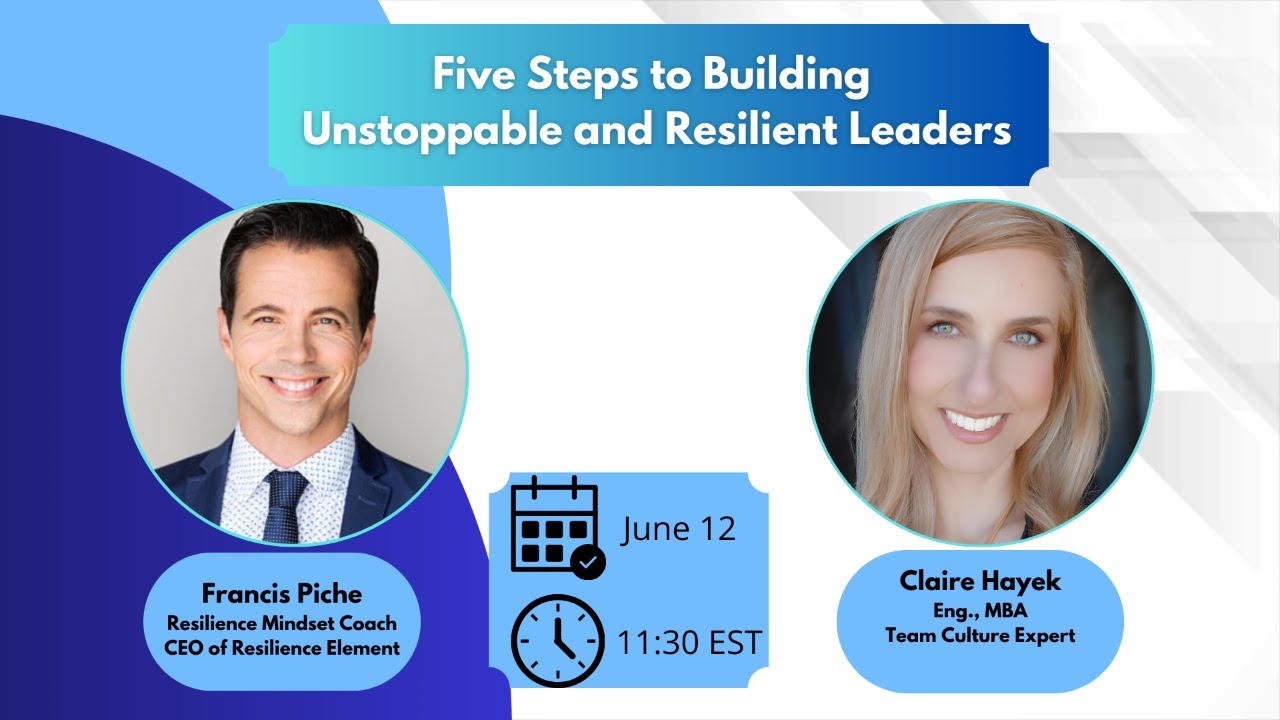
In this LinkedIn Live webinar, host Claire Hayek (founder of MSP Team Building) welcomes resilience mindset coach and CEO Francis Pichet to discuss emotional resilience for leaders and teams. The conversation defines resilience as the ability to bounce forward, adapt, and grow after setbacks, emphasizing that events are neutral and perception shapes response. They highlight the critical impact of leader behavior on team stress, citing Gallup’s 2024 Global Workforce report (23% engagement, 41% stress) and argue that leadership quality determines team stress levels and productivity. The core of the session is a framework of five inter‑related components for resilient leadership: 1) Clarity – clear vision, mission, values, and explicit agreements; 2) Conviction – strong purpose and personal/organizational reasons to persist; 3) Certainty – deep belief in goals and focused habit change; 4) Commitment – investing in processes, integrity, and psychological safety; 5) Courage – embracing neutral events, managing nervous‑system states, and speaking up. Throughout, they engage the audience with polls, chat questions, and a brief Q&A, reinforcing practical habits (meditation, exercise, master‑mind sessions) and the importance of psychological safety. The webinar concludes with a call‑to‑action for further resources and a next Live session on July 10 about budget‑friendly team performance tools.
Chapters
Hello, hello everyone. We're so happy to have you back with us, and those that are joining us today for the first time, welcome, welcome. Today is all about our conference, 5 Steps to Building Unstoppable and Resilient Leaders. And I'm very excited basically today to welcome our guests. But before I do, I just want to introduce myself quickly. A lot of you probably know me or not. I'm Claire Hayek, founder of MSP Team Building and team culture strategist and your host for today. So, we really again appreciate you joining us to learn about how we can boost resilience and team cohesion in leadership. And it's all about those practical insights. We love practical hands-on strategies. And we're going to explore how to handle tough situations, lead effectively under pressure, and create a supportive environment. So again, without further ado, I'm really excited to welcome Francis Pichet.
Hello.
with us. Francis is a resilience mindset coach and the CEO of Resilience Element. With over 20 years of experience in sales and coaching, he helps leaders break mental barriers and achieve their full potential. And I can attest to that. He really helped me. So welcome, Francis. How are you?
I'm doing great. Very excited to do the LinkedIn Live for the first time with you.
Very excited to have you on board. It's been a while. It's been a while we're trying to do this. So I'm glad we finally got around to it. So let me just summarize quickly what we'll be covering. Okay, so we're going to be covering understanding emotional resilience and its impact on team success. Okay, the next thing we're going to go over is the power of effective leadership and cohesive teamwork. And we're going to share the steps to manage stress and enhance that workplace well-being. We also have a short Q&A period right at the end. So please make sure to join us and I mean, stay with us. And if you join later, no problem. Just in time for Q&A. We're here to answer your question. If we don't get around to answering all the questions, please do still drop your comments and we will get back to you after this conference. And if you're joining this and looking at this at a later date, check the comments. I'm sure there's a lot of information in there that is very relevant. So let's get going. We have a lot to cover, and but before we start, I'm actually very curious to know where you're joining us from today. So let's take a couple of seconds to put it in the chat. We're very, very high on communication and interaction, so we'd love to hear where you're from and if where you're joining us. Puis on peut peut-être parler un peu en français de temps en temps. Francis est bilingue. Alors bienvenue à tous, en fait tous ceux et celles qui sont là avec nous. Welcome for everyone that speaks French and other languages. So we're gonna stick to maybe English for now and maybe drop a couple of French. So I'm still working on my Spanish, Francis. So here we go. Are you sharing with us here where you're joining us from? Actually, let me just go check the chat. From Texas. This is great. Great.
Hello.
Hello. This is awesome. So please do share with us. We have somebody here from Toronto. And hopefully we'll see, we'll hear more of you. Just please do continue sharing in the chat where you're from. We'd love to hear from you. And so let's, maybe we can get going, Francis. What do you say?
Well, I'm very happy to be here. You know, I think one of the things that people are usually asking is, what is resilience, right? So there's different definitions of that. Some people would say it's the ability to bounce back. But what I really think that resilience is, is that one, we can generate it. And there's a couple different ingredients, which we'll go through today. And also, it's the ability to really more bounce forward. It's the ability to grow after there is a hit, after you're able to adapt to different crises. And it's your— it's really about being emotionally able to go through those setbacks, these adversities, these obstacles, And I believe that this is one of the best mindsets we can have to go through difficulties. And we all go through these things, especially in teams, especially in our personal lives, everywhere really. So.
So I'd love to— I mean, I love the fact that, you know, jumped right in and explained what it is because a lot of people don't understand what do you mean emotional resilience, right? So I definitely want to hear a bit more about it and why it's so crucial for team success. Basically, if you can just brief us on that, we'd love to hear it.
Yeah, so like I said, it's, it's really the ability to adapt to different situations that are happening. There's always something that's happening. What I like to do with my clients is first to understand that all events are neutral. I'm pretty sure you can remember when we had our coaching session together. I think it's really, really, really important. That's one of the foundational principles that I teach to my clients, because what it means is that If you're starting from the premise that everything is neutral, all events, what it means is that the way that you're going to react to it— it's better to respond, but usually people react— it's by default. And it's really because of the way that they perceive things, which is really unique to their own personality, and then the meaning that they have to the story that they build in their head about what happened.
Right.
So resilient is almost being able to kind of take a look at things more objectively and not panic, but just observe and know that everything is impermanent. You know, it's the, uh, the foundations of vipassana. So if you go for 10 days silent meditation— I've done that once— it's quite incredible because now you see all your thoughts, the monkey mind going from all the different places. And you, if you could hear yourself, it'd be scary sometimes. So Resilience for me is the ability to adapt to different life situations. And once you know that everything is neutral, then you can kind of verify about what angle am I perceiving things from? Uh, who would I be without the thought right now? Maybe I wouldn't be stressed, maybe I wouldn't be—
Yeah.
So there's different ways of really creating that resilience. And in my book, like, resilience is also made of different components. So I like to always have a target, some goals, which I think works really well for team. And with these 5 components, if you really take a look at these 5 components, you can generate resilience.
Right. And so, why is it so important to have that emotional resilience in a, you know, when we're talking about team productivity, team performance, team success, period? How does that, you know, kind of relate to that indirectly or directly, right? Just quickly before we move on to the 5 steps because I want to hear all about those 5 steps.
So the way that I look at it is that resilience, either in personal or professional, is kind of the same. Like, for an organization, like, we have our own personal emotional resilience. And the resilience in a team is really the ability, like I said, to cope with different difficulties and different challenges. So why is that important? Because in a person, if you're perceiving something as a threat, And you'll get your start, your start, you will start to be in a flight or fight or flight mode, basically.
Right.
So when you're in that aspect of your brain, there's no way you can be creative. There's no way you can come up with solutions and your stress levels is increasing. And a lot of things are disastrous for all the team members. But if you're able to really kind of calm down, perceive things in a different way and be resilient, all of a sudden, you can open up a lot more solutions. You can open up solutions that would be profitable for your customers, for your team members, for the strategy to become relevant in the marketplace. So being resilient is extremely important. It's almost like kind of your nervous system of the team. If the team is stressed, how are you going to be able to be productive? And actually, what's interesting is that today I was reading from Gallup. They just have this new report, State of Global Workforce in 2024 by Gallup. You know, it's unbelievable to know that 23% of the people are engaged. That's only 23% of the whole organization that are engaged. And 41% of the people are stressed.
Wow.
41%. That's a lot. And that's either in engaged team or disengaged. But the more you're disengaged, the stress level even goes up. And what's very important to know is that the variance of how you're stressed or not really depends on the quality of your leadership. So if you have bad leadership, people are going to be stressed.
Wow.
And really, it starts by the leader. So if the leader doesn't know how to cope with personal events and reacts instead of responding, then all of a sudden it's going to be downloaded back to the employees. And the employees now, you know, what, what happened when you don't have an engaged team? Well, you know, your productivity is going to go down, people will leave, it will affect your sales, will affect the profitability. There's so many things that will be affected. The good news is then once you know how to be resilient, you can really now like start to have more cohesion. You can have fun in your team. You can actually have more productivity, more sales and all of that.
So— So in a way, I mean, you know, I quite often say, and I'm sure you've all heard me many times say this, that it's all on the leader. You know, we do hold a lot of the weight and it is what it is. And it's also lead by example, right? So if you're being emotionally resistant, resilient as a leader, it's kind of a good example to show your team how to be also emotionally resilient. So it doesn't mean that it's your responsibility, only yours, but this is where teamwork comes in. But if you're not leading by example, it's gonna be very hard to tell everybody, well, you need to develop that emotional resilience. And then you're literally not applying it or reacting in so many different ways or bad ways. So here's a little question for our audience today. So do you actually believe that emotional resilience is a key factor in achieving team success? Yes or no? Just put it in the chat. Simple. Yes or no? We just want to know what you kind of have an idea or survey a bit what people think about this. Because it's, you know, I'm sure this is a very known or popular subject. But I think a lot of us haven't really heard much about it or maybe don't apply it. You know, so I'm just curious to know. Please do put it in the chat. Tell us if— yes, keep them coming. Keep them coming. We have a lot of comments here from people telling us where they're coming here from and where they're joining us from. But we'd love to hear what you think. So far, we have a lot of yeses. But don't be afraid to say no. It's all good. We're here to learn and and actually tackle all of this, like try to understand this better, right? So I guess we're ready to move on to the 5 steps to resilient leadership, Frances. So why don't we talk about the first 2 and just pause there with a couple of, you know, one question again for the audience. We're gonna be throwing those polls and questions at you. Please do engage. Please do reply. We wanna know what you think.
All right.
All yours. What are the first 2, Francis?
Well, so what I'd like to suggest is for people that are team leaders, you know, they all have results that they want to achieve. So put that into context that the resilience components that I'm going to talk about are all components that will help the team to achieve their goal. So if we were starting from that premise, and then you'll understand why these 5 components, if you really have them inside the organization, it's going to be amazing. So The first one is clarity. And it seems very obvious. But, you know, is that clear for all team members about where they're going? What's the vision? What's the mission statement? What are the values that are in the team? So for me, when I'm hiring some people in my team, like there are components that are extremely important. One is integrity. Like, this is my number one, integrity and commitment. And it's very clear. And there are other things that I value, for example, being speaking straight, like being able to address things instead of waiting. So this is a culture that's being built, and it's very clear for everyone. So it's clear in terms of the values, and it's also clear in terms of where we're going. And everything that we measure, we measure towards the target. So that's why, you know, the first thing in any goals that we have Is that really clear in vivid details? Can you really explain it? Can you paint a picture? If you ask any of your employees in your team, do they know exactly for them and for your organization what are the initiatives and things that are important for them? The more they know about it, the better you can sell your organization and how you can help your employees because you know where you're going. You know what are the objectives and what are your key value proposition, as an example.
Right. And I think also being clear in general, I mean, clarity is my middle name. Everybody jokes about Claire loving to clarify things. And a lot of people just make that joke. But it's so true. I'm all about clarity. But clarity is so important, whether it's in your team or to your clients. You need to be clear about things. Even when you're being clear, things are being misinterpreted. So, imagine not being clear. In my dictionary, it's a disaster, right? But I think also, Frances, and correct me if I'm wrong, having the clear vision, the clear mission, etc. But also clear expectations. What do you expect Because sometimes, we don't talk about that and it's all in our head. But if you're not voicing it and somebody makes a mistake, well, did you talk about it? Does the person know what your expectations were, where that level of delivery of tasks or of work is? But anyhow, I just wanted to add a little thing.
Yeah.
Clarity.
And I will add something to what you just said. For me, one very, very important distinction. And I think it's a game changer. Game changer for a team. Game changer for your own life. So you talked about expectation. So for me, I like to say that what's very important is agreements. Do you have agreements? Because expectations, you're bound to be disappointed because expectation lives in the head of, of people. And it's, you know, if your, if your husband comes home and, you know, he has a different expectation, you didn't even know that he had that expectation. Both people are, are actually they're, they're not happy. And that's the same thing in teams. But if you have a clear agreement, now it's a game changer because now there's no disappointment. It's, it's an agreement. We agree we're going to be there at that time. We agree that we're going to do that. And if things are changing, I'm going to advise you. And maybe— and what's happening also in terms of creating agreements is that it's almost like you, you start a game and you have different rules. And, you know, you play— I don't know if you play hockey and you play outside and then All of a sudden someone makes a move and nobody predicted that this move would happen and there's a goal. So what do we do? We have— we actually had no idea that this thing— so we're like, okay, so we have a new agreement now. So next time that this thing happened, that's not gonna count, or we're not gonna count this one because we didn't even know. So agreements are actually dynamic, and, and it's, it's great that we have— once we work on agreements, the game is fun to play.
Yeah, I love it.
Everyone knows what to expect. That's why there's rules when we play hockey. There's rules when we play football. There are clear agreements. You cross the line, there you go. You have a goal. Like, you cross the line for the heart, there's a goal.
Yes, there's rules. And I love that. I love how we moved from expectations to agreement. I love agreement way better. It's just in a way kind of rephrasing it in a more consensual, positive way, right? As opposed to expectation. Expectation could have a negative connotation, right? Or a confrontational way. I love agreement. So, we both agree on agreement and we both agree on clarity. Moving on to the next one, conviction. Tell us a little bit about that conviction in leadership.
Well, and for everything that I'm talking today, I think I like to talk in a personal perspective and also the team. So, for me, conviction is for any time that you have an obstacle in your life, If at the end of the day, it didn't really matter for you to accomplish the goal or do something, well, you're just most probably gonna give up and that's gonna be it. But if there's a lot of convictions, there's a lot of reasons why it's important for you, and it might be that the company will survive, the company will expand in new markets, that whatever the conviction, whatever the reason why it's so important, which also goes well in line with your value proposition, like if you know that you're so good at that, Right. That's the reason, that's the conviction your own clients should buy from you because you're the best at that. Like, that's, that's also part of the conviction.
Right.
So conviction for me is the more reasons why people will choose your business, uh, to, to, for their own business, like in order to be helped, and the reason why you go to work. Like, all of these, these reasons are very important. If you have no reason, you're checked out. Like, then all of a sudden there's no cohesion, there's no, there's, there's no fun. And if there's an obstacle, well, guess what? People are going to leave. So it has to be clear and it has to have like— and the best example I'm going to give you is, uh, it's called the bricklayer analogy. I don't know if you ever heard that story, but you know, there's different types of bricklayers. One can build a wall and that's just the job and that's it. Like, I'm just going in, I don't— like, I just do my hours, I checked out, boom, I'm done. And as you can see, like if something happens bad, like this person is most probably going to leave. But then you also have another type of employee that would could come, and for them it's a it's an occupation. It's it's like there's a career in it. I want to be good at it. That's that's that's exciting for me. And then you have the third level that now instead of like building the wall and then the the house, then it's the cathedral. It's a calling. Like I love I love to help. And I think it's great to ask ourselves or the organization, what are we really providing for the people that are buying from us? Like, why are they choosing us? Like, maybe saving time means a lot. Like, time is the most important commodity that we have, you know? Like, so you can't give it— be given back. So saving time, whatever it is, make maybe the— your own clients more successful in order to focus on their strength, whatever it is.
Right.
But finding that conviction.
Right. I love that. I love that. Thank you. So, clarity, conviction, the first 2. Let's drop a question here. Pause for a second. So again, whoever's here, let's go to the chat. How important do you think having a clear vision and strong mission is for leadership resilience? Okay. So, very important, important, somewhat important, Or not important at all? Okay, please drop it in the chat. We want to know. Again, 4 options: very important, important, somewhat important, or not important. Just keep them coming. Let's go. Let's go. We want to hear from you. So again, how important do you think having a clear vision and strong mission is for leadership resilience? All right. So drop your comments in the chat. We're going to get back to that and see what you all think about that. And then I guess we should— I'm just going to keep that question up here for now. And let's continue on because we have 10 minutes left. So let's talk about the next one, Frances, certainty, right? So tell us about how can leaders build, I guess, trust and productive habits to maintain the belief in their actions, right? So how do you create that certainty?
Well, the certainty for me is having real faith, not 99%, not 95%, 100% of your old— what you bring to the market, what, like, of the goal in mind. Like, do you really believe to a deep level that this is going to happen? So you're— and you do everything from that goal in mind. So If we're shooting for a goal, like, who do I need to become in order to achieve this goal? And now talking about the habits, it's great to have multiple habits to be changed, but the reality is we need to change one or two at a time because otherwise it's going to be very overwhelming and people can burn out just trying to change everything. So what are the high-impact activities that we can just focus on that will move the needle?
Right.
And that we know that by doing that and that by being that, we will achieve our goals. And a lot of the things that I mentioned today is really about like a culture of being, like who do we need to be? It's not about what we do, it's about who we are. And I'll give you a short— I know we have only 8 minutes and I'll be quick on that because I think it's really important.
Yes, we do want to cover the last, the next thing, but please go ahead.
I will accelerate at a good pace. I think that what's important, like a lot of people would say, oh, you know, guys, this is what the competition is doing. Let's do this. Let's do this. And that could be, for example, a refund, uh, term and conditions that we change, like no questions asked, right? But if you're— if in your own being, like your way you are when you interact with your clients and they ask for a refund, you're like, well, what do you mean? Like, is it was not working? Like, what do you mean? Like, in all these— that type of being is not going to be very productive. That type of being is not gonna Even if you do what's being asked, that type of behavior is not working. So, what we really need to adjust is the way of being of our team, of our organization, having principles of, for example, being for each other. And I know that the next component is commitment. Are we committed to our goal? Like integrity within the team. And those are really big behaviors to have.
So, let's talk about commitment.
So, commitment is It could be seen different way, right? Like, it's about like having the— if we go to habits, like, what are we doing? What's the process? Like, we invest our commitment in the process, not in the outcome, because otherwise we'll be very disappointed. So going back to like, the purpose of a goal is not to achieve it. The purpose of the goal is to grow. I'm throwing a lot of nuggets right now.
I love those nuggets.
And if you really invest your time in the process, chances are you will achieve your goal. And you will not just be constantly looking at the gap. You're like, you just need to measure your process and being committed to that. And commitment is also integrity within the team. So if you're not integral, it doesn't work. So if I cannot count on your word and you say, I'm going to be there at that time, I'm going to do X, and you don't tell me that things are changing, now we're just starting to maybe be frustrated.
Right.
Then there's maybe there was no agreement. And so Being committed as a person, taking ownership, not being a victim. And if something doesn't work, speak out, say it, and creating that psychological safety that it's okay to speak up. And because we're doing it in a context that we're being for each other, we're not pointing fingers, we're not blaming, we're actually helping each other.
And that takes obviously a safe space at the workplace. It also takes some trust and good leadership, positive servant leadership, and takes courage, which is our next one, right? It takes courage sometimes to speak your mind. But again, there's a lot of factors that influence that. So, let's talk about the 5th one, which is courage.
So, courage actually to do a beautiful loop back to what I said in the beginning, right? Like all events are neutral. So, I think There's a lot of things that we take personal, and that's usually what creates the suffering. You know, we crave the things, we cling to things, we we want to avoid things, we're attached to certain things. But when you avoid all of that, and when you remember that everything is neutral, that we can actually just like calm down and come up with different solutions, and know that failure is part of the process. And and then the beautiful thing is that in order to nurture courage, to me it's really about bringing back the good vibes, bringing back like the. Like, how can I go back to parasympathetic mode in my nervous system so that I'm calm? And so there's different ways. Like, you can exercise, you can actually meditate, you can speak up, ask for help, have a masterminding session with your people because it's difficult and you want to find some solutions. There's so many things that we can do— dancing, singing, having a walk. But it's all about the well-being of the organizations and do things to restore the spirit, restore the energy so that we can go back to the goal even if there's an obstacle, even if there's a setback. Remember the mission. Remember the goal. That's exciting. Not just, oh, I want 5% increase. Like, that's boring. Let's go for something that's meaningful, which is going back to conviction and then all the components I mentioned.
So this is, this is, this is so great. Yes, a lot of gold nuggets. Thank you so much, Francis. So here's, uh, another question for, uh, for our audience today. So Which of the 5 steps do you think will have the most impact on your leadership and your team cohesion? So again, we have clarity, conviction, certainty, commitment, or courage. Please do drop it in the chat. We want to hear from you. We want to see what you basically survey what we think here. There's, I think a lot of our participants today are leaders and are in that position. So, Your input and your opinion, I think, will really count for us to see where we're leaning, which one really is the most important. So again, clarity, conviction, certainty, commitment, or courage. Please do drop it in the chat. And just let's quickly wrap up here. I mean, I have some comments here and maybe I can overlay the chat here quickly. I have this comment here. I think it's very, very interesting. I think the one that says all of them from Nitin. So I love that. You know, I know we asked to choose one, but yeah, absolutely do agree with Nitin that all of them do matter. So let's wrap up. Please do continue telling us what you think. We're going to just go back to the chat in a minute. Quickly, let's wrap up here. Francis, And just basically tell us how all of this, everything we've discussed so far, again, like in about 30 seconds, if you can, how does that improve or remove mostly mental stressors and enhance effective leadership and teamwork based on everything we've discussed so far?
Yeah, I'm looking at some of the comments and I love it. Yeah. Agreements versus expectations, a game changer. There's a lot of things that I mentioned today. So I think The way that I look at it, an organization is like kind of a whole human being. It's a human dimension. So how is the team? Is the team stressed right now? Is the team convicted about their mission? Is the team excited? What's going on in the internal system? And let's verify where we need more help. Like, is it more— is it clear for everyone? Do we need more conviction? Do we know why we're so good? Like, what's our value proposition? And why are we coming to work? Like, maybe you have a personal goal to achieve and you want to— like, if you're in sales, I want to achieve my quota because it's going to help me to go to my travel that's so important for me. So you bring your personal life into the professional life. That's who we are. Like, it's pretty rare that we can switch off. Like, I mean, there's always a transition between. And so for me, when I look at resilience is, you know, removing stress. Here's a quick Here's a quick, very important distinction about removing stress. I'm not saying it's easy, but if you want to remove stress forever in your life, you just remove stressful thoughts.
That's it.
So is that easy? That's the work. So because if you go back to, hold on a second, you know, like, what's the perception? Maybe the crisis is an opportunity. If I'm looking on the different perspective, look at what happened during 2020, right? Like some people, some businesses were thriving. They were able to find some solutions. They didn't see that as a problem. They just relaxed a little bit and they're like, let's come up with some solutions.
Yeah.
And all of a sudden they were thriving. So knowing that everything is—
I can speak for that myself because I mean, when COVID hit, I totally wanted just to give up. I didn't know what to do. And I'm not the person to give up. A lot of people that know me is like, Claire is so perseverant. My God, she never gives up. But it was such a shocker, right? And then, and then you just pick up the ball and go, and you just pull yourself together, get rid of those negative thoughts, and you just like, you just takes courage, takes that courage and conviction and a lot of the other ones, and you just dive right in. But it's very apropos, Francis.
Um, so yeah, I mean, with, with something that I think is important to also keep in mind, that's my own personal opinion. I came to Montreal not too long ago. There's a friend of mine that passed away. We did a celebration of life. And so, um, what's important to know is, for me, when I saw this man that left his body at 47 years old, not unexpected, you didn't even know that something would happen like that, it really asked me, am I being alive while I'm alive?
Hmm.
So it put things in perspective. You know, we're going to work Can we make it meaningful? Can we make it fun? Like, that's a big part of our life. And at the end of the day, are we alive while we're being here?
Right.
You know what's— so it's like going back to, okay, you know what, maybe something happened, but it's not the end of the world. I'm still alive, and we're all here, and we can all help each other. And that's why resilience is so important. And if you're resilient, you can thrive.
Absolutely. Thank you for those, uh, for those words. You know, sometimes we take that— we take life for granted, you know, and, uh, but it's definitely a good reminder. I, I always, I always say that death is, is a, is a confidant and it's, it's a partner in life because when you're not conscious of, you know, your life being taken away from you eventually— I mean, it's the certainty of life is death, ironically, right? When you do realize that, then it's hard to take things for granted. You do appreciate every moment and It brings you back, right? So thank you for sharing that, Frances. And thank you so much for joining me today. Again, here, you probably read it already, but I'm just going to say it. For more information about this conference and basically resilient leadership, emotionally resilient, please comment resilient in the chat and I will send you some information on it. We'd love to have Frances back and basically know what you're interested in when it comes to this conference. Again, put your comments in the chat. And let me just share quickly with you that our next LinkedIn Live is on July 10th. And I will be talking or sharing tips on tools. You know me, I like to give a lot of tools and tips. So, how to maximize team performance on a budget. Yes, budget is a big deal and everybody's struggling. It's been hard and pretty much every day. And I'm not exaggerating. I hear something about an M&A or I hear about you know, jobs being cut. It is like Tony Robbins would say, it's winter. It's winter in winter. But it doesn't mean that we can't thrive and that we can't succeed and work with it, right? So, I'm here to share those tips on July 10th. And that's pretty much it for today. We did spill over like 3 minutes. I know you guys are very, very busy like everybody. But if you Basically, if you have shared any questions in the chat, we'll probably tackle them on later. But here I'm just gonna just show a couple of the comments. One of the last comments here we have from Richard. It takes the courage to do all 5. I find it really great. That's a great way to put it. And it does take that courage, right, Francesc?
Well, all of them, they're all— and we can all nurture them. That's the beauty. We have so much. We have so much power, more than we know. And it's, to me, it all starts with the way you think.
Exactly. Exactly. So we're sharing that link in the chat for our next conference on July 10th. Please do join me. The link is in the chat and I'll put it back here. And yeah, so we'll let you go. Have a wonderful day, everyone, and enjoy. And we'll see you very, very soon. So thanks again, Frances, for joining us and would love to see you again, maybe on another subject. I know you have a lot of subjects and a lot of actual relevant things to share with us. And thank you so much for your insight.
You're welcome. Thank you so much, Claire.
All right. Bye, everyone.
More from Claire


25 years in cybersecurity taught her this about staying calm under fire with Jonna Garber

Pause and Assess: The 10-Second Technique to Stop Over-Controlling Under Pressure #shorts


UN Mission Director On What Real Calm Under Fire Looks Like With Fredrik Sandvall





Book Signing at AIFEC Bogotá | What Pressure Does to Leaders and Why I Wrote This Book #shorts