How 3 Leaders Found Purpose In Chaos
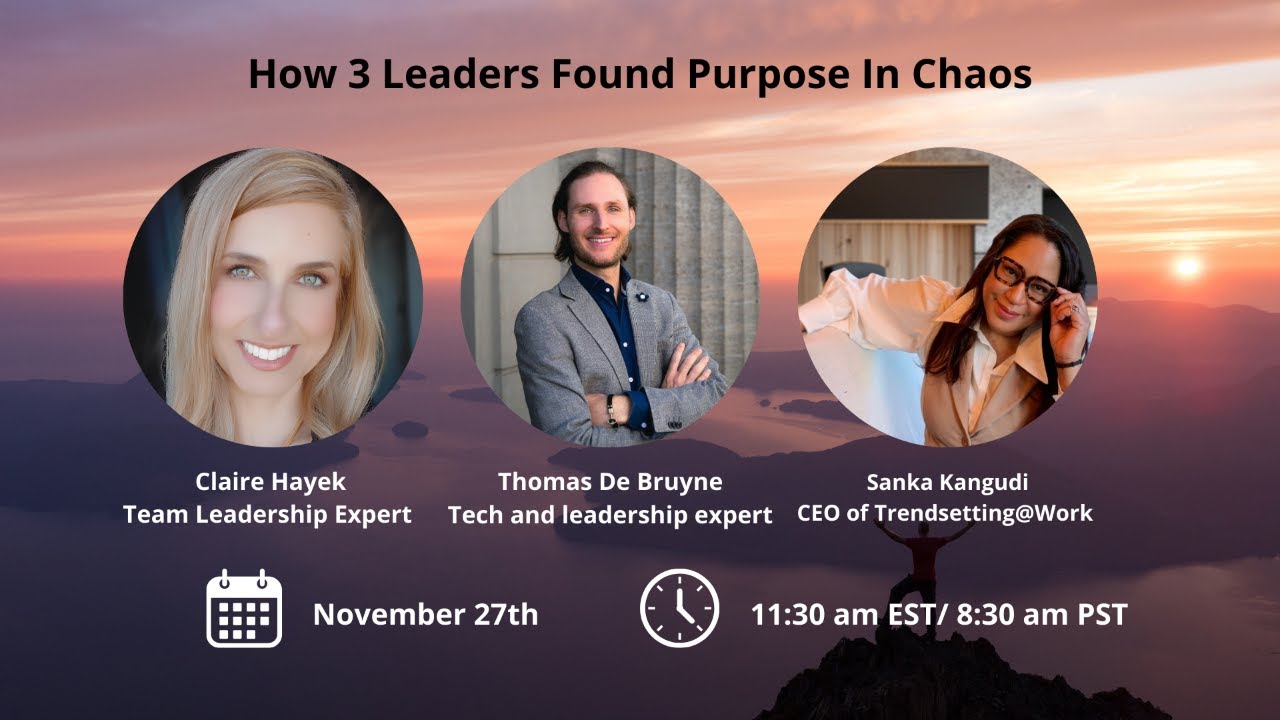
In this 30‑minute live panel, host Claire Hayek brings together tech‑leadership expert Tomas De Bruyne and CEO Sanka Kanguri to explore how moments of extreme chaos can become catalysts for purpose and entrepreneurial direction. Each panelist shares a personal crisis – Claire’s burnout after years in high‑stakes engineering, Tomas’s rheumatoid arthritis triggered by an overloaded Deloitte project and a surprise pregnancy, and Sanka’s near‑death septic episode while leading a multi‑million‑dollar project. They describe how these events forced them to pause, reflect, and redesign their leadership approaches. The conversation surfaces concrete tools: situational/context framing, body awareness through breathing, bio‑feedback, meditation, and a mortality‑reflection question (“If I were to die now, would I be at peace?”). Claire emphasizes intentional energy setting before meetings and the importance of hope, resilience, and viewing life as happening “for you, not to you.” The panel is highly interactive, using live chat, polls, and a moderator (Connor) to engage the audience, and it promotes upcoming events – a hybrid‑work discussion and a NeuroLeadership & AI productivity webinar. The overall narrative demonstrates that vulnerability, self‑care, and purposeful reflection turn chaotic episodes into leadership growth and entrepreneurial ventures.
Chapters
Hi everyone! Welcome back to the series. We are here today to talk about how 3 leaders found purpose in chaos and how you can do it too, basically. And one of the leaders is actually myself. I'm Claire Hayek and I'm really thrilled to be here with Tomas. And sorry, Tomas, I forgot how to say your last name. Can you go for it? Tomas.
Yes, Thomas De Bruyne. You're not the first one.
De Bruyne. There you go. Thomas is a tech and leadership expert, and we're also joined by Sanka. Can you say your last name, Sanka? Let's do this.
Sanka Kanguri.
Thank you. She's the CEO of Trendsetter at Work. So we're really excited to be here because I met these 2 wonderful people a while back, actually. And recently we were meeting and talking about things and we realized that we share something common. Something chaotic happened basically in our career, which brought us to entrepreneurship and finding that purpose and doing something about it. You know, going from chaos to clear focus. So, I'm very excited to have you join me, Sanka and Tomas. This has been a long time waiting. So, this is exciting. And We're just gonna kind of, you know, have a conversation, the 3 of us, and share our stories. And hopefully, that will help you in a way or maybe give you focus and see how it could maybe change things in your life or give you that direction. And if it doesn't, it's great. If it does, awesome. And that's all it is. So, we're really happy that you're joining us today. And before we start, I always ask, Where are you joining us from? So please do put it in the chat. You all know I love to be interactive, so I will be asking you questions, putting questions in the chat, and you know flashing polls. So it's kind of interesting when you're being a bit more present. Take that. You know it's only thirty minutes gonna fly by. I promise we always run out of time. So do answer us, and we. We want to know how you feel about certain things that we're going to ask you about. And we want to learn more about you as well. So let's start with that. So tell us where you're joining us from today. And just a quick thing, we have Connor from our team at MSP Team Building that will be also managing the chat and helping us share the polls and some information. So hey Connor, always, always great to have you. So, As you put your comments in the chat, I'm just gonna dive right in because like I said, time is gonna fly by. And so, I mean, we all know that everybody's got some kind of chaos in their life. Life doesn't happen in a very calm way. But then we take it a step further and then we talk about chaotic realities of leadership. So, it seems as if there's a common denominator with leaders. It's just our realities are chaotic because we're juggling a lot of things. We're managing a lot of projects. We're probably wearing a whole bunch of different hats. We are faced with conflicts, whether it's our teams or just situations that come up. And this really requires us to adapt to sudden changes. You have to have that quality or ability as a leader to do basically lead. So, we're all kind of experienced overwhelming moments. And what we're here to do today, we'd like to hear from Thomas and Sanka and myself on how we were able to turn a specific moment of chaos and how that really kind of helped us reshape our leadership approach. So Sanka, you get to be the first one to break the ice here. Can you share that moment where you That moment where it was really chaotic for you and it really helped you reshape or transform your leadership approach?
I think that's an interesting question because my whole niche is helping people through chaos.
There you go.
It's kind of where I live. And so, I don't think it's one moment. But I do know that there are certain things that have contributed to my leadership is the reality that we have to live through chaos. We are constantly managing, mitigating, innovating, supporting, and trying to get through to the next step. And so I think being situational is the biggest lesson and the biggest— I think the pillar that I think I use every day is to really look at the situation to create context. And so when I, when I'm in a situation of chaos, which is every day all the time, it's always a learning experience. It's always a moment where I need to be curious and explore, because oftentimes, especially in chaos, we get overwhelmed. And so in order to manage that overwhelmed anxiety, um, understanding what you're really facing is something that I have to do all the time.
Right. Yes, right on. I couldn't agree more. Thanks, Saika. Thomas?
To me, it all boils down to just being and being tuned into your body. And it sounds like a logical thing. To me, being tuned into your body is just listening to the wisdom that it carries because it's got everything you need to navigate that chaos. And I'll make it a little bit, a little bit less abstract and just relate it to a personal example of my life. So I was working at Deloitte in Belgium. Our team oversold. We had too many projects. Long story short, I didn't burn out, but I developed rheumatoid arthritis. So I was on the couch for 3 months with a knee triple the size. It took me a year to recover. And recover for a chronic illness is something that's not even supposed to happen.
Mm-hmm.
And the reason that happened is because while I developed this arthritis, I shifted to Deloitte in Czech Republic. to build a new team on leadership and technology, leadership transformation. So I was in the middle of this whole transition when the arthritis hit. So initially I couldn't even move. I couldn't move to Czech Republic, obviously.
Right.
Joining and building this new team was an even more stressful experience. And the only way that I actually made that happen is because I learned how to tune into my body through like a specialized diet, ice showers, breathing techniques, yoga. all kinds of things, and also a healthier environment with cleaner air and more nature. So to me, that's just a very personal story in how tuning into my body, being in chaotic situations when I wasn't doing it and when I was doing it, the first one made me ill, the second one healed, even though the stress in the second one was potentially even greater than, than in the first scenario.
Okay, well, thanks for sharing, uh, by the way, Sanka and Thomas, thanks for sharing your, your realities and really what what kind of, how you, that kind of helped you, right? To reshape the whole chaos into purpose or focus. But often what we see is that something big happens or, you know, to jolt us, for us to maybe rethink the way we do things and maybe reshift our focus. And we hear that a lot of times, a lot of people that were able to transform, right? If I can share my own I guess story. You know, a lot of you know that I worked in engineering. I'm an engineer, metallurgical engineer. I worked 20+ years in engineering, managing high-stakes projects, navigating a lot of toxic environments. Not that they were all toxic, but there's certain times it was really toxic because it's very project-related and you don't always work with the same teams, the same people. And management was different. A lot of stress, a lot of pressure, especially put on a project manager like myself because everything kind of lies on you where the you know you need to kind of bring the lead the project home and make sure that it's on time and within the budget, etc. So it took that much pressure for me to kind of realize okay I'm overwhelmed this is energy draining I literally had nothing left in me I was giving so much. To my job, that for me, it was stepping back that kind of gave me a slap in the face and go, "What are you doing with your life?" You know, that helped me step back, pause, and this is when I decided to do an executive MBA at McGill HSA. And that really was the big question for me: What am I doing with my life? How am I using, you know, my skills in order to better the world? How am I using that? In a positive way. Is this how I want to continue? You know, go, go, go, go, go. Run, run, run, run. Just keep going. Ambition. You know, where is this going? It felt kind of very chaotic. And I wanted to focus all this energy and experience that I had into something more purposeful. And this is when I found myself. I had to step back and I really had to take the time to learn and think and reflect, which brought me to entrepreneurship and starting MSP team building and to help more organizations than just a project XYZ, right? So, I guess personally for me, it was that almost burnout kind of what we talked about, Sanka and Thomas, where we feel like, wow, if I don't stop now, this is not going to be good, right? So, yeah.
I totally get where you're coming from. I know I had a moment in my life where I was traveling so much. I would be home about a day and a half. A week.
Wow.
And then I was back on the plane going to a project. I had over 30 people, a team of over 30 people, and 3 quarters of them were early professionals. So bless them, but they required more support. And so I was— it was a huge project worth many, many, many millions of dollars, and it was really time sensitive. And so I ignored a lot of my body signs And on one trip, I actually— I was sitting in the airplane and I went to tie my seatbelt and I was like, okay, I'm curvy, but I'm not that curvy. I couldn't tie it. So it turns out I was in a different province, and all of a sudden I found myself in my hotel room on all fours. I couldn't get up. I was in so much pain. All I saw was white. It turns out I had ignored through all of this kind of leadership and that sense of accountability, responsibility, etc., etc. I had suck— telling myself, suck it up, buttercup, suck it up, buttercup, to a point where I had actually poisoned my body and I became septic.
Wow.
I literally almost died, and I had to go to the hospital in an ambulance, and I told the ambulance to wait because I needed to charge my phone.
Oh God.
So that my team could still contact me.
Wow.
I look back at— even as I'm telling you, I'm like, you're one crazy girl. What's wrong with you? So sometimes life will give you whispers because there were moments where there were signs, right? There were many signs along the way. Unfortunately, as human beings, oftentimes we ignore the whispers and we only start listening when we hit the wall. And that was—
Exactly. Oh my God, that is so— I mean, we're all nodding here. And I'm sure a lot of the people that join, you know, are with us now and listening to this are probably going, mm-hmm, mm-hmm. Unfortunately, right? Unfortunately. But it is— I'm happy we're talking about it because the idea of us actually deciding to come on here and talk about this, the whole purpose was to share the stories, not because our stories are so perfect and unique, because there's so many of us out there with similar stories. Unfortunately, again, the keyword is unfortunate. In order to— let's talk about this. So, we help leaders avoid this. Or maybe somebody's listening now and going, okay, I think this is what's happening to me now. Maybe I should stop. Preventing this from happening, preventing people from hitting that wall, right? And I have a poll up here on screen. So, We want to hear from you. Have you faced overwhelming chaos in your leadership role? Simple yes or no. And I'm going to jump over to the chat because we did ask a couple of questions earlier. We do have Connor here.
Yay!
Hey Connor! So, please do comment in the chat and let us know. We want to hear from you. And let us also know as a reminder where you're joining us from. By the way, I'm in Lorraine. So, north of Montreal. Where are you joining us from?
It's not even a village. It's like less than 500 people where I live. It's almost like a block. It's called Pike River. It's about an hour outside of Montreal.
It's a nice area, Pike River. I love Pike River.
If you like wine, definitely need to visit.
There you go. There you go. And Tomáš?
I'm a couple more hours away from Montreal. I live in Prague, Czech Republic, Europe.
How cool is that, right? Prague. All right. So, we got an international team right here talking to you.
Literally. All right.
So again, put it in the chat. If you're listening to this as a replay, do chat, put it in the comment. We go back to these things. We definitely want to know and hear a bit more from you. And maybe the comment, you're gonna Add to this conversation will also help somebody else. So that's the whole point. Okay, let's jump into to to the next thing here. So basically, the question is like how do we find purpose through this chaos? Like what what happens? You know, how do we turn these moments of crisis into something? transformational into a clear purpose. You know, sometimes people ask me, it's like, but yeah, but how do you do that? You know, you take time, you know, you take time, of course, but how did you do that? And I'm gonna start actually by sharing a little story. I myself grew up in war-torn Beirut, you know, back in the '70s and '80s. Unfortunately, still To this day, but you know there was a ceasefire. Thank God! So that's good news. But growing up in in in kind of a war context gave me made me feel insecure, uncertain, right? You're always kind of you know you're having a great time, and then all of a sudden you have to run and and take shelter. So it was kind of part of my childhood, and it almost became normal. So as a child, you just get accustomed to it, and you just. deal with it. So, in a way, I was born into chaos, if you can look at it that way. But this really helped me transform my life and a lot of things that happened throughout my life because obviously, we left Beirut and came to Montreal. But that reference helped me become more resilient and helped me that trauma that I've dealt with now, thank God, helped me kind of Learn how I'm like, okay, so I lived through this horrible thing and I was able to transform myself and I was able to take a leap forward. So, anything that gets thrown at me now, I have this reference point. So, it doesn't have to be you growing up in a war to be able to relate to this. It could be some kind of traumatic experience. Then, you have it as a reference like, if I survive this, I think I can survive that too, right? So, For myself, it helped me step out of my comfort zone. It really helped me embrace life and push through. And this is really how I switch things around, is that reminds me that life is too short, you know, that I'm very lucky to be alive and that, you know, I shouldn't take for granted the fact that I have the security, I have this life, I can eat, I can sleep, I have a shelter. And that is in a way just kind of grounds me. And helps me just push forward. And again, it's what really shaped my career path. I've always strived for something out of my comfort zone because it was just too easy. I'm like, okay, what am I doing? It's too easy. Okay, what's next? So, in a way, I use that as a way to push myself forward into reaching the best version of myself I can be. And I'm still working on it, obviously. Um, but that is, for me, that was the, um, that turning point where we're like, okay, that's your reference point, use that to your advantage. So enough about me. Sanka, um, you want to share?
There's so many stories, but since I started one, we'll just roll with the rest of the story. So during that moment, um, I didn't realize that being septic meant that I was Dying, right? Um, and that it was really serious. And one of my employees on the team had called me while I was— they were trying to find a way to help me. My body was resisting because I had waited too long. And she, she told me, she's like, well, Sanka, if this is how you are, I'm, I'm feeling pressure to be like you.
Okay.
And for me, that was like— it felt like a gut punch because I was thinking I was doing the best for the whole, right? Pushing myself by outdoing myself. And but I didn't realize that I was telling people that not taking care of yourself, not taking a break, not taking moments, and, and, and literally making yourself sick was the way you were supposed to be. And she looked at me like a mentor. And so in that moment, I was like, okay, right, we need to do things differently. Because what I was doing is not an example of how we should be living life, right? It's not an example of how we should be working. And that totally shifted my perspective to how I made decisions. So I was still who I was, The things that were important to me were still the same, but I was much more considerate of how hard I was pushing myself. I was letting people think that that was how hard they need to push themselves, and that was not okay.
Right, right. Well, thank you for sharing that. Yeah, that takes a lot of vulnerability to be talking about this, and I really appreciate that, that we're all being very vulnerable right now and talking about these moments. Thanks, Sanka. Thomas?
Yeah, I'll add a little more vulnerability in the conversation. So we started off with personal stories. This is an even more personal story with how managing, like navigating complexity and chaos came like natural because I was confronted with the most chaos I've ever felt in my life, which was someone coming at me and telling me like, Thomas, we're pregnant, which was completely unexpected, as you might be able to derive from this very short story. So suddenly, naturally, all redundant things of my life like fell off the radar, all the noise was eliminated. And I knew exactly what to do. I knew exactly what my purpose was in those weeks, months, And gradually life stabilized a little bit, a little bit, as much as possible. And life became a little bit more usual. And we have this blessing where most of us find ourselves not in a war zone, as you mentioned, Claire. We find ourselves in relative comfort, which is like somewhat of a cursed gift in a sense, because it makes us complacent if we're not careful.
Yeah.
And I wouldn't recommend anyone to get lots of surprise pregnancies to keep pulling us back into this mode of constant clarity. Like, you know, don't listen to that. What I use as an alternative, which is also much cheaper and easier, is just a question that when I remember, I ask myself, Thomas, If you were certain you were gonna die right now, would you feel at peace?
Mm-hmm.
And taking a couple of seconds, couple of breaths, and release it with that question and honestly answer that to me. Most of the time I wouldn't be at peace. And those are the perfect hints which areas of your life don't feel aligned to that purpose that you want to be living. That is my, that is my hack. It's super simple and super effective if you take the time to really sit in that question, even for just a couple of seconds, and make it a habit of tapping into that space. That saves you a lot of unexpected pregnancies.
Yes, well, that is so true. You know, I did mention, hinted on that, you know, that the fact that I was alive. It was it was it was an honor in a way. It's like wow, I don't take that for granted because when you're a child growing up in the war, there was so much you don't understand what's going on. So I I can totally relate to that. And Sanka, I'm sure you can too with what happened to you and your story. And and the thing is that I want to I want to just share just that to to to kind of close on that on on that question is that. And certain spiritual beliefs and, and, you know, books out there, I've read that death is actually our friend. Death should be used as an advisor. And I'm glad you mentioned this, Thomas, because we don't— we use, you know, we look at death as like, oh my God, it's the bad guy, you know. But death is, is literally life and death is right there. So, but if you're aware of it in a positive way and use it as an advisor, it could really help us clear the path and maybe focus on what we need to do. Because we— there's only the present moment. We anticipate the future and it's important, but who knows, right? We never know. So taking that for granted maybe is not a perfect way to live your life. Just don't take life for granted. Just appreciate every moment and make sure you bring it back to, hey, am I doing the right thing if I only had a month left? Or, you know, right? So, thank you for sharing that. That's really helpful. So, I put up another question here to the audience. Have you ever turned a moment of chaos into a purposeful shift in your career? Yes or no? Please do share with us. And if you want to elaborate, please do again. That really helps everybody. Listening and tuning in here. So, let's move on. It's already 5 minutes left but we're probably gonna spill over, okay? Just giving you a heads up. So, let's get to it, right? Let's talk about tools and strategies that could help us turn this chaos into purpose and lead. So, if we look at maybe we can each share one technique that has been crucial in staying focused during crazy, overwhelming, chaotic times. Let's share one tool each. Thomas, you want to go?
Yeah, I've been speaking about taking breaths. And it's the most ancient and also critical thing to keep doing, just keep breathing. And it only gets better once we put awareness into it. So for me, mindfully breathing and Everyone has different breathing techniques that work for them. Some of them can even be measured. What is the most effective breathing technique for you? So I actually found a couple of tools, including a VR biofeedback thing, out of all things, that can tell me that for you, Thomas, your heart syncs the best with your breathing if you breathe 5.6 breaths per minute with half a second time in between inhalation and exhalation. So I've got a super detailed view of which breath resonates with my heart the most, which then activates my parasympathetic nervous system through my vagus nerve, also finds its way to my cortex and my brains. And breathing is super simple, and even I, who is aware of it and even has equipment to do this, I barely do it. So it's finding those little twitches, those little habits that if I rub my ears or I put my glasses on my head or I Like, whatever those things are that you can start to recognize within yourself that you typically do multiple times throughout the day, and then just link that to, I'm doing this, right? I'm gonna start breathing now. And because I know what is the most effective breathing technique for me that has such a profound impact, especially if you link it with those questions about life and death and purpose, right, to breathing, super powerful.
I love that, Thomas. And thanks for mentioning that because we did have a LinkedIn Live, actually live with Thomas talking about this technology. Conor, I know I'm throwing this at you now and I always do that. I know if you can look back then and you have time, you have like 5 minutes. If you can look back on the LinkedIn Lives, and again, if you're listening to this, you can go under my events and look for our LinkedIn Live date with Thomas where we talk more in detail about this technology. Brilliant technology. And I cannot wait to do this, Thomas, and find out what breathing rhythm or speed or whatever you measure that I need to do my breathing at. Because that's definitely one of the techniques, the tools I use as well as meditation. I just want to share one specific tool is for myself is when let's say I'm stepping into a room or I have a meeting or just starting my day. I take a moment to just be aware. That really helps me to be aware. Who do I want to be today? You know, obviously, I'm Clare. But what kind of energy I want to bring forward? Do I want to be frustrated? Do I want to be calm? Do I want to be focused? Do I want to be powerful? Do I want to be confident? You know, just taking the moment and defining, putting on that energy and making sure that you're conscious of it. That really helps when you step into a room and talk to people. And then, it brings awareness for me, for myself. That really helps in a way that brings awareness to who I'm being right now. Am I stressed? Am I anxious? What's happening? Yeah. And change it, transform it into the outcome I want and what this room needs, what I need and what the room needs around me, the environment needs around me so I can be the best version of myself in front of these people and help people as much as I can and be of service. That would be one of my tools. Obviously, Thomas, I share yours as well. Maybe not as specific on the breath, but I really would like that. But definitely meditation as well. But Here we go. Sanka, please do share yours.
Understanding that the brain actually rewards you for staying in place. And when you're facing chaos, what's required in chaos is transformation. So know that yourself and the people that you're working with are actually going through a mental exercise right now of wanting to run and hide.
Right.
Knowing that, and I think one of the best, or one of the best ways I have found to get through that is starting with context. What's, what's really influencing this situation? What are the internal influences and the external influences? Then you actually have more data from which to orient yourself and your team around the situation and the objective. At that point, together, right, you can start building a plan and then find ways to empower that plan, knowing that your body is going to want to resist change and that you've got all these opportunities and risks to mitigate. You can actually reach your goal. It is possible. It's a formula that works.
Wow, thank you. Thanks for sharing that. Um, so much gold So many gold nuggets during this live. I'm so grateful for you to join me, Sanka and Tomas. And I'm just pulling up the last poll question here. Which tool have you found most helpful for you in finding purpose during chaos? Please do share it in the chat. And Conor, you're our Superman. You're amazing. Conor already was on it. He already shared the link to the live with Tomas in case you're curious about this whole VR biometric measuring tool, you can check out that live or you can put it in the chat and ask us. But please do share which tool you found most helpful during this chaotic times that gave you that purpose. So we do have a— we're definitely over time, but if there's any Q&As, I'm going to go to the chat. I don't see any now, but As you know, please do put them in the chat if you're still listening to us. Otherwise, I'm just gonna continue on here and just give you a couple of information about what's coming up. Basically, next week we have two things coming up. There's just a lot going on these days, but you know, kind of wrapping up the the end of the year. So on Wednesday, I'm actually gonna be. with a guest and talk about hybrid work. I think a lot of people are interested to know a bit more about hybrid work and how we can make both the office and home work for you. This is gonna be a very interesting conversation with my special guest. You can go over to the link and sign up. She's an expert in hybrid work and how you can transform your place to feel Whether it's at the office or at home to feel really right into that work environment. Very relevant nowadays, don't you think? So, it'll be next Wednesday, same time, live at 11:30. And last but definitely not least, we are bringing back— yes, we are— the NeuroLeadership and AI Productivity webinar. Many of you missed it in November. And now, things are slowly winding down in December. So, Next week, next Thursday at 1 PM, we're gonna have the free webinar again. It's an hour and a half and a lot of interesting things and a lot of gold nuggets, a lot of value added. So please do sign up. I also have the QR code up there this way. You can also scan it because I don't want to hide Sanka's beautiful face. So, and your beautiful paintings in the background, are these your paintings, Sanka?
Um, the ones on the side are in progress, and the ones behind me are— were created by one of our investors' mothers. Really, really lovely and talented, um, seasoned woman.
Okay, okay, very, very nice.
Yeah, it's great work.
Yeah, we should— you should display them more, even if they're not perfect or finished yet, you know. I'm just saying, don't you all agree?
I love you for that.
All right, um, so I just put up— put down here a little ticker. If you want to know a bit more about the AI webinar that we're going to be hosting on December 4th, please put it in the comment. If you have any questions for Sanka, for Thomas, for myself, please do put it in the comment. We'll revisit this and answer you. Um, I am so grateful to have you in my life, to know you, and, uh, and I, I I really feel this is a, you know, not only a friendship, a partnership. And I think the more of us getting together and partnering up to help each other, the better it gets because leadership is not an easy thing. And like anything else, you need the support. So I want to thank you for being that support in my life. I'm truly, truly happy to have you here. I know I'm getting shivers. Love you guys. There's a lot of love in the room. I will not finish this. I would like to give you the floor. Thomas, would you like to say one last thing before we wrap up? And Sanka, you know, maybe Thomas can start. Sanka, if you want to wrap it up, let me know. No pressure, just giving you the floor.
Claire, everything is so much heartfelt on this side as well. Thank you. And if anything, it just shows Leadership is not a solo venture. It's like the 3 of us coming together as vulnerably as we have as leaders coaching other leaders who all depend on a support system. And it's like all of us can have a testament of this is not a journey anyone is supposed to live through by themselves. And I think, no, I just feel I'm just so grateful to have you along with me on my journey. So. Thank you so much.
Thank you, Thomas. Thank you, Sanka.
I truly believe we all grow through collaboration. But if I have to leave everybody with one thing, when you have hope in chaos, you can get through anything. That hope will reveal possibilities, and through those possibilities, you can drive opportunities. You will be able to get through. You'll be a better person for it, and your life will change for the better if you ride the wave.
Love it. And you know what? Remember everyone, I always say this: life happens for you, not to you. That's big. That's huge. If you just go with that, then you got this. You got this. You know, try to understand the why, right? Thank you for being so wise, and thank you for being in my life, and thank you for taking the time to share your wisdom. Thank you all for joining, and The ones that are listening at a later date, thanks. And hopefully we added a lot of value to you today and helped you in one way. And if you caught anything out of this and you know somebody in your life, maybe this is not really personal for you, you're not going through this, but if you know somebody that is living this or you've seen the symptoms, please do reach out and help them. Don't keep this knowledge to yourself. And, you know, we're here, so do reach out. Thank you all very much. See you next week. All right.
More from Claire


25 years in cybersecurity taught her this about staying calm under fire with Jonna Garber

Pause and Assess: The 10-Second Technique to Stop Over-Controlling Under Pressure #shorts


UN Mission Director On What Real Calm Under Fire Looks Like With Fredrik Sandvall





Book Signing at AIFEC Bogotá | What Pressure Does to Leaders and Why I Wrote This Book #shorts