How to Rewire Your Thoughts and Watch Your Life Change (Faster Than You Think)
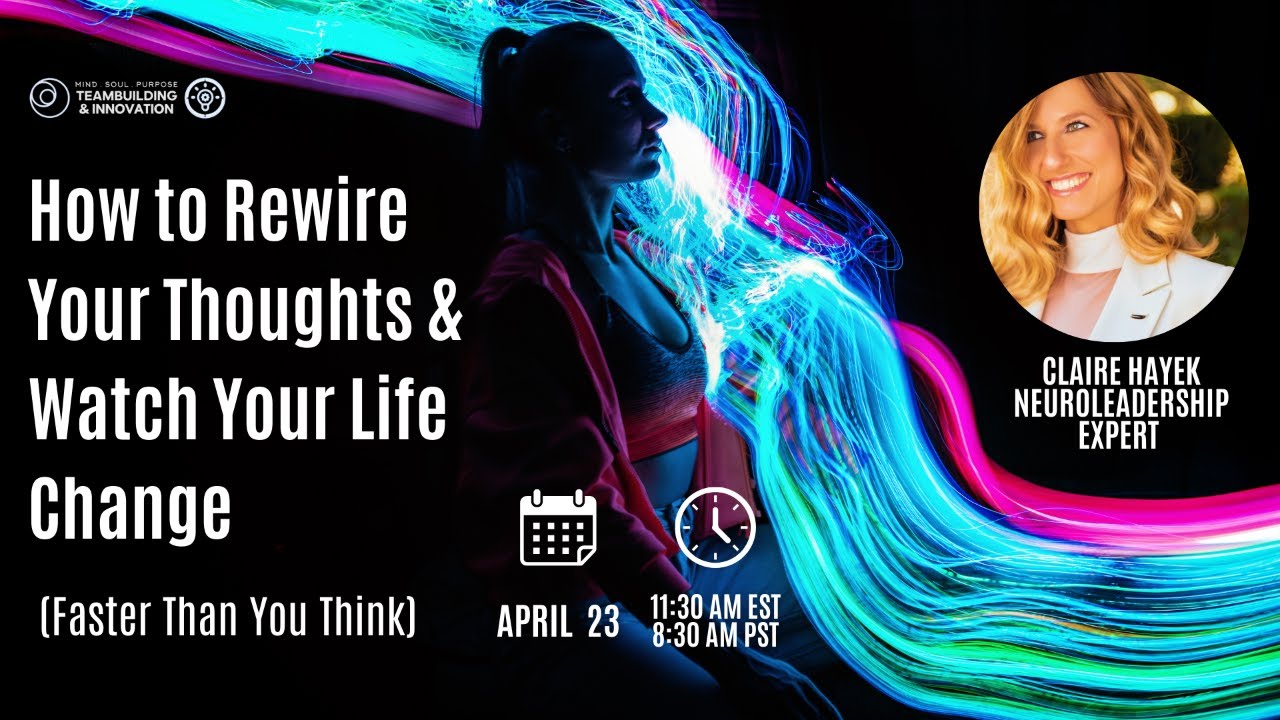
In this 30‑minute live presentation, Claire Hayek – founder & CEO of MSP Team Building, neuroleadership expert and certified neuroscience coach – explains why most people struggle to change their mindset despite reading books or doing affirmations. She argues that the root cause is outdated neural wiring that runs on survival‑mode autopilot, producing millions of repetitive negative thoughts each day. Drawing on neuroplasticity research (e.g., Davidson & McEwen 2012) she shows that the brain can form new pathways in as little as 21 days of consistent practice. Hayek introduces the GLOW method (Ground, Label, Observe/Own, Wire) as a practical, science‑backed framework for rewiring thoughts. She demonstrates micro‑grounding exercises called PQ reps (Positive Intelligence Quotient repetitions) that can be done in 10‑second bursts throughout the day, and explains how 100 PQ reps daily for 21 days can raise the PQ score above 75 % – a threshold that prevents spiraling into saboteur thoughts. The presentation walks through each GLOW step: grounding the nervous system, labeling specific saboteur patterns (Judge, Avoider, Stickler, etc.), observing and owning the thought to reduce amygdala reactivity, and wiring new, emotionally‑anchored responses. Hayek provides concrete examples, encourages a 7‑to‑21‑day practice challenge, and suggests teaching the method to others to cement learning. She concludes by offering a free Positive Intelligence saboteur assessment (featured in major media) via a QR code and invites participants to schedule one‑on‑one mental‑fitness coaching.
Chapters
Hello everyone and welcome to this week's live. I'm Claire Hayek. I'm the founder and CEO of MSP Team Building. I'm a neuroleadership expert, certified neuroscience coach, and mental fitness coach. And today, we're talking about something really, really important. I'm gonna talk to you and show you how to stop reacting from survival mode and start leading your thoughts. With science. The title of the conference today is Watch Your Life Change and Rewire Your Thoughts. So, and I'm going to show you how you can do it faster than you thought it's ever possible. So let's talk about mindset. Okay. Why your mindset isn't changing. Have you ever thought about that? You know, you really tried, you tried to be more calm, you tried to be more aware, self-aware, you tried to, you know, control your triggers or anticipate your triggers, but you might have succeeded to a certain extent and maybe you haven't succeeded yet. The thing is, we can read all the books that we want, we could repeat all the affirmations that we want, but life happens, right? And the thing is, if we don't change the core And the wiring of our brain, we're going to fall back into the same patterns. I'm not trying to get you depressed here. Being aware of this changes everything. Okay, so bear with me. If you're still waking up with stress, dreading the day, just you know thoughts of I'm not good enough. Well, here's the thing: it's not your job, it's not your partner, it's not your to-do list. It's not your issues. It's your brain's wiring, right? Like I talk about the bottom line, basically where it all starts, right? So it's not because you're weak. It's not because, you know, you've done something wrong or you had some sort of upbringing. Excuse me. It's because your brain is running outdated wiring. Wiring and running on autopilot. Okay, so being aware of this, we can shift things around. And to make things worse, we've been told the biggest lie, that mindset shifts are just about willpower. You know, you only need to make that effort and things will just change. You just have to make a decision and will Will your brain into shape. Okay. Well, in a way, there's certain, I guess, truth to that, right? You need willpower, but it's not only willpower. It's literally science. It's science. And there's a way to train your brain, just like you train your muscles, you get into shape, you get more healthy. Well, you need to train your brain to work for you and serve you as opposed to working against you. So if you want to change the results, you need to change your thoughts. And if you want to change your thoughts, you need to change your brain. Again, that's bringing it back to the brain here. So the thing is, and I will mention this, I often mention this, you know, repeat it, is that the thoughts going through your head affect your emotions. Okay? And that your emotions affect your actions. And and it actually also affects how you show up in the world, who you are being, right? So you're happy, you you have happy thoughts, you know, you're you're positive, things are going great, having a wonderful day, you you know your emotions follow, you're happy, your face is beaming, you're you're you know you're just like emanating with positive energy. You're going to affect the world. Around you because you're going to show up with this high energy. But if you're having bad thoughts, you're shaming yourself, you're in regret, you're depressed, you're literally beating yourself up, that's— how do you want to feel good about that? Like, you cannot feel good, right? So this will affect your emotions. You're going to feel ashamed. You're going to feel down. You're going to feel low energy. You're going to feel sad. You might feel angry, which will affect your actions. You might snap at somebody at work. Or your partner. And you're showing up in a whole different level, a whole different energy, right? So remember, energy flows where the attention goes, right? So let's put the— let's set where we want the attention to go, okay? Let's define how we want to be the world. Okay, so in the next 30 minutes, I'm going to share brain-based framework strategies, tools to stop the overthinking, to stop the self-sabotage, or anticipate it the least and reduce burnout or just get rid of burnout altogether before they even start. Okay, we're going to learn how to interrupt negative thoughts, how we can rewire your thinking by using your brain's natural mechanics and creating those daily habits that actually change how you live your life. So I'm going to be sharing in the chat. And again, I always mention this, this will be interactive. And before I actually share anything and start, you know, Giving you all this information. I'd love to know where you're joining me from. Put it in the chat. And I just want to know. I just want to know, like, from what side of the world. If you are there, just say hey. I want to know if you're paying attention, if you're with me. Please do put it in the chat. That really, really helps. And I want to also ask you a question here to everybody joining. And welcome, by the way. Hi. What's your default stress response when things get real intense? One, avoid or shut down. Okay, drop this in the chat. You overthink and spiral. You get reactive or controlling. Four, you're pretty much numb or distract yourself so you can just forget about it. Okay, so please do put it in the chat. Let me know. If it's one, two, three, or four, how what is your default stress response? Okay, when things get really intense. So moving along, here's a fact, and I mentioned this a lot because it blows my mind. It still blows my mind. I can't believe it. The average person, okay, listen to this, has sixty thousand to seventy thousand thoughts a day. I mean, how is that possible? That's a lot. 60,000 to 70,000 thoughts a day. How is our brain able to create these thoughts, right? So when we're scattered all over the place, I guess there's more thoughts going through. Imagine when you quiet the mind, right? And here's the other thing that is absolutely Fascinating in a way. Let's keep it positive. According to the National Science Foundation, 80% of those 60,000 to 70,000 thoughts a day are negative. Are negative, people. Negative. And 95% are repetitive. So, what does that mean? That most of us wake up and literally to reruns of yesterday's stress. So we keep repeating the same pattern. 95% of our thoughts are repetitive. Okay, so if you're curious and you want to know how to change this, drop the word shift in the chat. If you're just done with all old thought patterns, those thought patterns that drive your day in an autorun, Literally sleepwalking through your life. Okay, let's drop shift in the chat. Okay, so I will be going back and forth here to the chat just to make sure that I read your comments. So here's— let me share some of the science, the science of the why. Okay, like why does this happen? Why are we stuck? Why do we feel stuck? Why do you feel stuck? Okay, the deal is that your brain has a job, okay? And the brain's job is not to make you happy, it's to keep you alive. Okay, simple. Your brain literally is stuck on mental autoplay. It's efficient, but it's not always helpful. It's not, it's not always serving you. Your brain's— the default action or job of your brain isn't to show you clarity. It's to protect you. Okay? That means under stress, it will default to fear, to doubt, avoidance, control, whatever kept you safe in the past. And this is also called neuroplasticity. Your brain wires based on repetition. Okay, so if you practice stress for years, guess what? The pathway is literally automatic. Okay, and the great things about neuroplasticity is that because the brain is neuroplastic, we could rewire these patterns and fire new patterns and rewire new patterns. So we're not stuck. Okay, we're not hardwired. We're able to change these patterns. So this is the good news. Okay, I really was excited just to tell you about the good news. Okay, so we can change this. You can change it. So neuroscience actually shows that new thoughts paired with emotion and attention create those new neural connections in as little as 21 days with daily, daily practice, with 21 days of daily reps. Okay, this is actually a source from neuroplasticity research, Davidson and McEwen in 2012. So the goal isn't To think positive or yay, life is good. No, life happens and there's a good and bad in between, right? And so it's not about thinking positive; it's to train your brain like you train a muscle that that will serve you and be able to navigate the challenges that you know we get every day. And and and recognizing when there's fear, recognizing when there's anxiety, anticipating saboteur. That really want to control the situation or that are standing in our way or limiting our growth, our personal growth. So it's all about recognizing, it's all about being self-aware, and by becoming self-aware, then you're more in peace with these things and you're able to shift things around and you don't fall into the trap of the old patterns and you keep repeating them. Now you're creating new patterns, you're refiring and rewiring new neurons that basically speak to you, speak to your best self, speak to who you want to be and become because you're tired of being your old self and you just, you know you can do better. You know that you want to have a better life. You want to have better mental health. You want to have better mental fitness, etc., etc., etc. Okay, so the the idea of of this conference is to show you a method. There's a multitude of ways to do this, and I'm a big fan, a huge huge huge fan of Shirzad Shamim and the research he's done in Stanford University, and the positive intelligence method and the PQ, which is the positive intelligence quotient. It is brilliant. It really sets the foundation to give you the tools on how to be able to shift your thoughts, be self-aware. And that's in seconds, in seconds spread out throughout the day. So it's not about, you know, doing a retreat for a week and then coming out of it enlightened and then to fall back into the old patterns. I mean, we've all done that, right? It's really little, little steps that you're doing every day Because as you're refiring and rewiring these new habits, this new way of thinking, being self-aware, anticipating your saboteurs, anticipating your judge, anticipating everything that's just been standing in your way, this way you're just building those foundations of becoming the new version of yourself, the version you want to be and show up in the world, that version where your mind is serving you, your brain is serving you. And is not working against you. Okay, so I call— I came up with a method. I find being creative of how we can use tools to help us is important. So it's easy and you can think of it instantly. Okay, I call it— I came up with a method called the GLOW method. And this is not about glow and makeup. Okay, let's be clear here. This is about glowing from within. Okay, it's it's literally just beaming your light, beaming your being the best version that you can be. And there's a whole story about a golden Buddha in in Sherzad Shamim's book. I strongly strongly advise that you you you you read the book. It's about positive intelligence, and he tells a story about the golden Buddha. But I don't I. I'll let you know. Maybe I'll tell you the story later if I have time. I have about 15 minutes here. But think of yourself when you're born as the golden Buddha. You're literally just perfect. And then as you grow, as we grow, we put on a lot of layers just to protect ourselves, right? And then think of it as plastered, you know, plaster layers over the Buddha, the gold Buddha that we're protecting. But then when we start practicing and rewiring and being self-aware and reworking our mental fitness, we are peeling off these layers of plaster that served us and protected us but now they're just permanent and they're not necessary. Just let your inner child, your pure energy, 100% mentally fit version of yourself back. Okay, it's a whole story about Buddhists and monks, and actually, apparently, it's something— it's a true story. But I will tease you about it, okay, for now. If I run out of time, do put it in the comments if you want to know the story, and I will take the time to put it in the comments, share it here in the comments. Okay, so the GLOW method. GLOW stands for G stands for ground, L stands for label, label, O stands for own and observe, and W stands for wire. Okay, so let's let's tackle on the G. G is about grounding. You've all heard about how we can ground ground yourself. What does that mean? So what we want to do is we want to ground our nervous system. So Think about it. You can't rewire new habits and change your habits. You can't. You can't start from chaos. Okay? Your nervous system needs to shift out of the fight or flight survival brain, survival mode before it can access logic, creativity, or focus. Okay? So you need to shift into a calm, focused state. So that's the grounding, the anchoring. So G for ground. Okay, here's a really quick science-backed tool again that I learned this from the positive intelligence program, and it's called PQ rep. Okay, PQ is positive intelligence quotient, and it's a rep just like when you're you know you're doing a bicep rep to work your your bicep. This is it you know mental fitness rep. Literally, you're working on your mental fitness and not your physical fitness. Okay, so let's take a moment here. This will take about 10 seconds. So I'm going to ask you to close your eyes, okay, and take a very deep breath. And we'll take another deep breath. Keep your eyes closed and rub your fingers together slowly. And as you're rubbing your fingers with your eyes closed, you want to feel the texture of your skin. You want to feel the ridges around your fingers. You want to put all your attention into the feeling of these 2 fingertips touching. And now I want you to shift your breath to your belly. You can put your hand on your belly and watch your belly expand and rise or inflate as you inhale and deflate as you exhale. Let's do this one more time. Now we can continue this on, and with your eyes closed, you can notice the sound around you. You can focus on the sound of your own breath or the sound that is really far away, you know, the one that you can hear the most. It could be your pet or it could be just outside. So by doing what we just did, basically is a PQ rep, and we did it about a minute, I believe. So one PQ rep is about three breaths. Okay, so drinking your coffee in the morning, watch the cream create swirls into your black coffee and make these shapes. Pay attention to how hot your mug is. If you're waiting and being impatient. Rub your fingers together, close your eyes, pay attention to the noise or the sound around you. If you don't want to close your eyes, bring your attention to your feet touching the ground, the weight of your body as it sits, wiggle your toes. All of these are PQ reps. It's simple. So it doesn't— you don't have to take 20 to 30 minutes to meditate every day to do this. So imagine if you do this throughout the day, you can easily get to 100. 100 PQ reps. And research shows that by doing 100 PQ reps a day, 21 days in a row, and that's again from Shirzad Shamim's research, you're able to boost your positive intelligence quotient above 75%. And which again, based on the research, above 75% quotient, you don't spiral back. Into your saboteurs and negativity, and you know that's where your brain actually transcends your old pattern and and is mentally fit and is positive positively intelligent and able to maintain it and feel a state of you know peace focus clarity so on and so forth. So if you think about it in ten seconds while you're working while you're doing what you're doing while you're eating. Anything, any routine action you're doing every day. In 10 seconds, by doing these PQ reps, it will activate the cortex, your insular cortex, which improves focus and reduces cortisol. Okay? So I strongly recommend that you read again the book from Shirzad Shamim on this. You don't need to take a whole day. You don't need a retreat. I mean, it's great if you do, you know, go on vacation. But imagine taking mini vacations every day by doing this. You don't need a full week vacation, but by all means, please take 2 weeks. But you could be and feel that you're on vacation. You know that good feeling when you come back from vacation? You're relaxed, you're happy, you have happy thoughts, everything is zen, everything's good, there's no problem. Imagine being able to live this every day by developing your mental fitness. You can do this. I do it. I do it every day and I just look forward to it now. And I work on it every day. It doesn't come easily. I get interrupted by saboteurs. I get negative thoughts. I have my judge beating down on me. But the only difference now is that instead of falling into the trap and letting it take over my mood and how I'm feeling, etc., now I'm able to interrupt it. And say, okay, thank you. You know, you gave me that signal. Okay, I get it. Thanks. Now beat it. Okay, I got this. So I don't need, um, I don't need to feel down. I don't need to bring down my energy. I can be self-aware and I know who I am and I'm able to regroup into my sage brain, into the brain that knows better, right? The brain that's actually serving me, not beating me up. Okay. So, so these, these are like the micro— these reps, they're like micro shifts that train your brain to interrupt stress, basically. Okay. Wow. Okay. That was a long G. G was ground the nervous system. I'm going to move on to L. Okay. Again, this is the GLOW method. G for ground, the grounding. L is label. Okay. L, label the thought. Okay. So once you're grounded, the next step is awareness. So you can't change a pattern you don't name. You have to be self-aware. You have to label things. Okay, so as you know, if you're feeling down, it's like, oh my God, I can't believe I did this. What is wrong with me? Then label this. This is the judge beating you up. Okay, this is not you. It's the judge. It's outside of you. It's your brain sending a signal telling you, you need to pay attention to this. You really screwed up here. That's good, but— and it serves you for 10 seconds, but that's it. If it's beating you up the whole day, It's not serving you anymore. Okay, so so that would be the label of the judge or the avoiders like ah you know if I don't you know I'm just not going to do anything it'll go away label it this is my avoider saboteur really shooting me in the foot here or the stickler saboteur oh this is my stickler saboteur oh you know it's not perfect I cannot I cannot give this presentation it's not the right font. Not the right color and you spend hours and hours and hours and you drive everybody crazy around you because it's not perfect and it's never good enough. That's the stickler. Then, when you label the thoughts like, oh, that's my stickler. Okay. Shift. Right? So, what that does when you label is it activates the right prefrontal cortex which decreases the amygdala reactivity and emotional overwhelm. Labeling basically activates the brain's PC, prefrontal cortex, the area responsible for conscious decision-making. Okay, so the moment you name the pattern, you weaken its control, its grip on you. Okay, so here's poll number 2 here. There it is. Okay, which thought pattern shows up for you the most? Okay, there's the judge, I'm not good enough. The controller, I have to fix this now. Avoider, I'll go away, it'll go away if I ignore it, right? And the stickler, it's never perfect enough. There's so many more. There's the hypervigilant, there's the hyperrational, and so on and so forth. So there's about 8 of them that the actual study, the Positive Intelligence Method, identified. I could be wrong, it could be 9, but I think it's 8. But anyway, let's just answer this question here. So which one really shows up for you the most. The judge, I mean, I can say my judge is huge, huge, and it's pretty prominent to all of us. The judge is the common one that we have, and then all of us have, you know, somewhat top 3 saboteurs that really rule our life in a way or dictate our patterns. Okay, and so please do put it in the chat. I'd love to know what you, you know, what you identified. Oh, so G-L-O for glow. Okay, O is Observe and own. So this is once you've labeled the thought, you've grounded yourself, you labeled the thought, you know, recognize what's going on. People usually stop and they think they're done because actually the thing is you're not done. You're not done. You're far from done. I mean, there's two more steps. Okay, so the thing is that every thought has a root. So you label the thought, but you need to own it. You need to own it. You need to observe it and you need to own it so you don't repeat it. You have to observe. You have to understand it. Awareness is the first step to transformation. Throughout your day, pause and notice your inner dialogue. Now, that could be really something tough and not easy to do. How do you wake up? Use usual things that you do every day in order to wake you up. Example, you're gonna have breakfast. Say every day when I have breakfast, I'm gonna, you know, observe my thoughts for 1 minute as I drink my coffee, or as I go to the bathroom, or when I get out of bed, or as I'm brushing my teeth. So this is how you remember to, to do that. So when you do, when you're like, okay, I'm gonna observe my thoughts, I'm gonna be, you know, aware of what's happening right now, then ask yourself, are these thoughts aligned with the version of me I want to become? Okay, so energy flows where your attention goes. Observing your thoughts helps Redirect energy toward what actually empowers you. So you're not trying to control every thought, but simply becoming aware of your mental patterns will help you shift them with intention. Okay, and and another way of putting it is there's so much noise and there's so much scattered. And when you observe these thoughts and you're able to you know anticipate the saboteurs, anticipate the behaviors because now you you've just identify them, then what happens is you're just— it's not like they're just going to poof disappear. They're still going to be there, but you've reduced the volume on those in your head. They're not as loud and as controlling over your life as they were before. So observing activates the whole process. And this is really an important step. And then you own it. You own it. What does that mean? Meaning, you know, you ask yourself, where did this reaction come from? What story am I telling myself? Is this protecting me or limiting me? Understand what it is. You know, own it. You know, what is this? My saboteur is my job. So this is part of labeling, but observing it and being aware of these thoughts will help us and basically anticipate them and intercept them. So the last one is W for wire. Okay, wire a new Response. We can say rewire, but wire is easier because G L O W glow. Okay. So once we've interrupted the pattern, now we build the new pattern. Okay. This is little version of mental reps. Okay. So example, building the new pattern: I can handle pressure and stay grounded. I don't need certainty to move forward. What is the gift out of this horrible experience that I've just, you know, or this thing that just happened? What is the gift here? Can I see what the gift is? What is this teaching me? I can feel uncomfortable with certain situations but still move forward. Uncertainty is not danger, it's an opportunity. I can turn this into an opportunity. I am safe. That's another one. Even when I don't have all the answers. So these are things that we wire a new response. We change our, you know, the way we look at things. And that's where these new neurons will fire and wire together. And the more they fire and wire together, the old patterns become weaker and stop wiring and stop firing. It's literally neuroscience. Okay. So the repetition of empowered, emotionally anchored thoughts that will build stronger synaptic firing. Again, it's neuroscience. So every time you repeat these, you strengthen— you, you are strengthening new neural pathways. I use the example with the paper. I'm really over time here, but I think it's important. Uh, when you, when you, uh, fold the paper a certain way, okay, think of it as you are creating new neural pathways. So it becomes easier to refold it and repeat the pattern because we have all these lines, right, already formed. It's just, you know, we're not recreating anything new. So this is what we— what— when, when we have an old pattern, so we keep just following it easy here. But when we want to rewire and refire, we really have to completely change the pattern here. But when you create a new one, the old one, the old folding pattern will Now you're going through the next one. It's it's an easy way I find of explaining neuroplasticity. Okay, so this is how real change happens. Okay, with repetition, attention, and emotion. Okay, so I I don't see any questions here. I hope this glow method is is is is. Going to be helpful for you and you're going to try to implement this in your daily routine. So I just want to tell you that you're not stuck because you have certain patterns or you're broken, you had a certain childhood, certain upbringing, certain trauma, something that happened to you in your life. I mean, I totally respect that and I Acknowledge that. It's important to acknowledge that, but you're not stuck. Okay? You are able to change things. And the only reason you feel stuck is because your brain is just really loyal to the old wiring. So in order for you to have a brain that works for you, not against you, you need to train it to work for you, not against you. Okay. So GLOW is a daily practice. I strongly recommend that you start with practicing it 7 days, for 7 days. And I promise your stress levels, you'll have more clarity and your decision-making will shift. Practice it just for 7 days, ideally 21 days and more. But you got to start somewhere. Celebrate the little wins. Celebrate the little moments of awareness. Celebrate identifying the judge. Celebrate how you're feeling and how you're able to shift things around and fully be present in your right mindset, the new wiring, the new version of who you want to be or become. Okay? And the moment you start practicing these new patterns, you start building a new mind. Your thoughts create your results and now you know how to change them. Simple. It sounds really easy and it is. You just need to decide. You need to decide. It's like, okay, I'm gonna do the work. You don't get in shape and you get your six-pack by going to the gym once, right? You might not go to the gym every day, but eventually, you know, if you just keep going, okay? That is— it's all about perseverance. It's all about just keep doing it. Coming back to it. And the fact that this is so easy, the GLOW Method and using the PQ wraps from Positive Intelligence, from Shirzad Shamim, is brilliant because it's seconds as I showed you. Okay? So, if you want to go deeper, this is the work I do every day with high-performing leaders and teams. But whether you work with me or not, I want you to choose one tool that you learned today Okay, practice it for five minutes every day again for the next seven days. If you don't do a full five minutes, do thirty seconds. If you start with ten seconds, celebrate. It's great. Okay, and and just watch how fast your mind and your life will change. And people, and you'll know this because people around you will notice the shift. Trust me, they will. Okay, I have a couple of challenges here for you. Here's one. Again, use the GLOW Method. But don't just use the GLOW Method, teach it. Because when we teach something, it actually reinforces the wiring and the knowledge. So, you will lock in 90% of the learning when you actually teach it. So, teach one part of the GLOW Method. I would, you know, I think you need to teach the whole part to someone, to a friend or to your partner, to a colleague. Teach it to somebody. This week and this will really help you learn it better and apply it. Okay? The other challenge I have for you is just interrupt with little moments, interrupt your day, little seconds. So try, if you're doing PQ reps, if you're being a bit more self-aware and you're incorporating this in your routine, Catch one, for instance, unproductive thought. Do it today. Just one. Label it, ground yourself, and shift it. Reframe it. Okay? So, it's not about fixing the whole thing. You can't fix everything at once. It's about training your brain in the moment it actually matters. Okay? So, the micro practice has a lot of power and it's much better than being overwhelmed and taking on this big thing. Little, little, little steps. Okay? Again, we're talking ten seconds. And if you interrupt a thought or label a thought, ground yourself, do PQ reps, or just you know you're you know change the way you react or understand what's happening and and reframe and reword things. Now you're in the glow method. All right. So drop the word glow in the chat. If you want to have more information, I would reach out to you. We can do a one-on-one together and discuss this and basically help you understand how you could apply this with the Positive Intelligence method. And I want to— I have a QR code here. I'll also share it in the comments on LinkedIn. There's a great assessment again by Positive Intelligence. The saboteur assessment, identifying your saboteurs. Okay, so this assessment was featured in the New York Times, the Wall Street Journal, sorry, and it pinpoints the exact thought patterns holding you back. It'll identify your top saboteurs. It's an eye-opener. It'll change your life. Trust me, it's free. You do the assessment and you'll get it by email. Now, once you've completed, if you want to share your results with me, please DM me and I'll send you my email and we can Schedule a mental fitness session together and go over the results and what they mean and how that would relate into your life. So again, the QR code is on screen if you're watching this. Otherwise, I will put it in the comments here on LinkedIn. And that's it. That's it. I just hope that this session really helped you and served you in the best way possible. And that you're able to now just walk away with certain tools that will help you take those little steps forward towards, you know, a better life, better version of you. And, you know, remembering that going back to the gold Buddha you are, the golden child, you know, we're all amazing. We're all wonderful. And, you know, somewhere along the line, our brain protects us as we're growing older and gives us these tools to help us survive, to help us cope, to help us navigate this life that we don't understand. That's from 2 to 3 years old. And then eventually we forget. And then these tools become too prominent in our life that the way that they actually sabotage us. And prevent us from being the best version of who we are or going back to that, who our essence. So it's time to take that back. It's time to take that power back. It's time to train our brain. It's time to transform our life. It's time for our mind to work for us, our brain to work for us and not against us. Thank you all for joining today and Please do leave comments. I want to hear from you, and do reach out if there's anything I can do to help. And I will see you on the next live. We will be announcing it later this week or next week. All right, take care, everybody.
More from Claire


25 years in cybersecurity taught her this about staying calm under fire with Jonna Garber

Pause and Assess: The 10-Second Technique to Stop Over-Controlling Under Pressure #shorts


UN Mission Director On What Real Calm Under Fire Looks Like With Fredrik Sandvall





Book Signing at AIFEC Bogotá | What Pressure Does to Leaders and Why I Wrote This Book #shorts