How to Stay Productive Without Burning Out
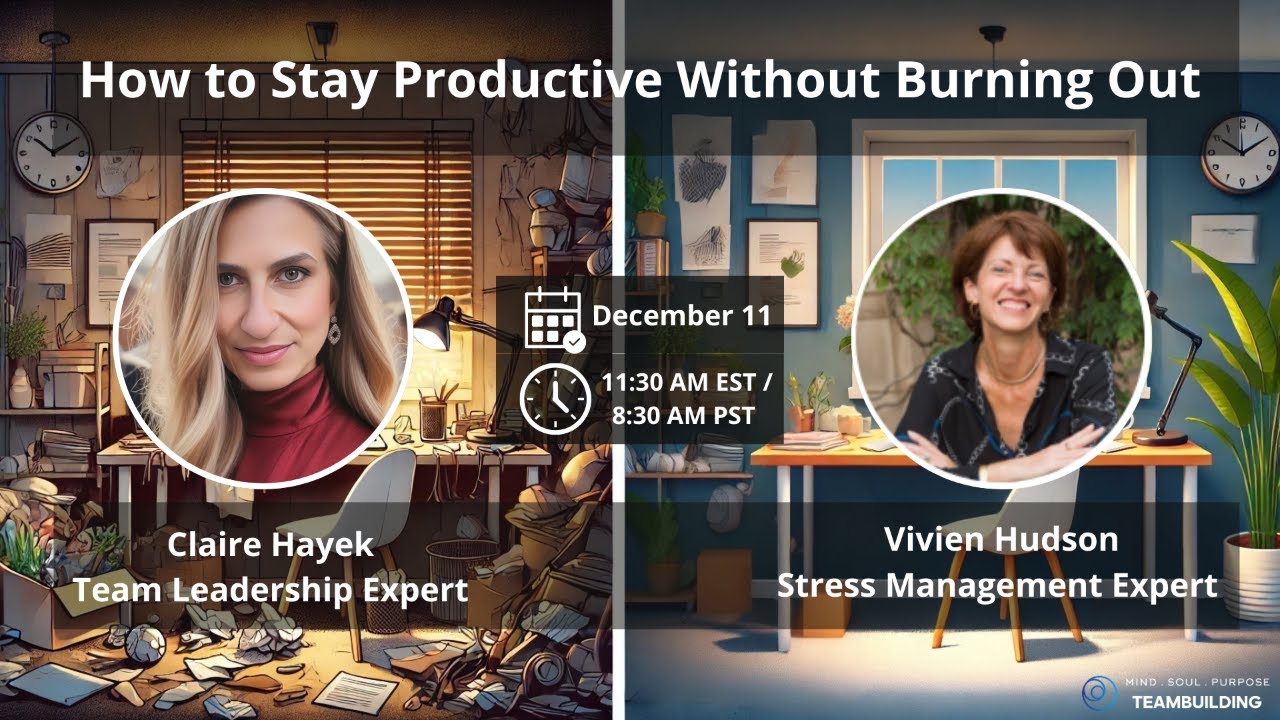
In this 30‑minute LinkedIn Live session, Claire Hayek, founder and CEO of MSP Teambuilding, hosts stress‑management specialist Vivian Hudson to explore why burnout is a pervasive threat to productivity and how individuals and leaders can prevent it. The conversation opens with striking holiday‑season burnout statistics (e.g., 39% of people feel unhappier, 76% experience burnout sometimes, $125‑190 billion in U.S. health costs). Vivian defines burnout, describes its emotional and physical symptoms, and attributes its rise to a work‑aholic culture that erodes boundaries and sleep. The hosts discuss practical leadership habits—empathic check‑ins, role‑modeling breaks, walking meetings, and clear communication about availability. They then dive into personal productivity tactics: intentional micro‑breaks, movement (squats, bite‑size workouts), time‑blocking, Pomodoro timers, limiting open tabs, and disciplined deep‑work sessions. Vivian highlights the psychological layer of limiting beliefs (perfectionism, “I’m not good enough”) and urges self‑awareness through asking “why” repeatedly. Organizational tips such as keeping a tidy physical and digital workspace, using to‑do lists, and setting boundaries around work hours are also covered. Throughout, polls and chat engagement keep the audience involved. The session closes with calls to action—QR code for a January masterclass, upcoming LinkedIn Live on future leadership, and invitations to follow the hosts for more resources.
Chapters
Hello everyone and welcome to the second to last LinkedIn Live this year. How crazy is that? I'm Claire Hayek, your host. I'm the founder and CEO of MSP Teambuilding and a leadership expert. And today, we're talking about how to stay productive without burning out. It's a huge one. And I am very, very thrilled to be joined by Vivian Hudson, a renowned stress management specialist who helps organizations create thriving people-centered cultures. Actually, Vivian, as a speaker, a trainer, and fractional leadership consultant, she has guided countless leaders and teams to navigate the challenges of modern work environments. Through her expertise in well-being, leadership, and resilience, Vivian empowers businesses to foster a culture where productivity and health coexist seamlessly. And fun fact, Vivian also is a pharmacist, so I think she is, uh, really well-versed in well-being, we must say. Hi, Vivian.
Hi, and thanks for having me today. So yeah, a great time to talk about stress, burnout. It's the holidays approaching, and we know this should be the time where people are happy and healthy and all of the things. However, the statistics say 39% of people are actually unhappier during the holidays, with only 7% of people being happier.
Is that crazy or what, right? And I mean, I love the whole festive look you have on today. I love the hat. It is the holidays, people, believe it or not. If you're not feeling it, I mean, I don't know what you're doing. You step out of the door and it's literally the holidays everywhere. Thanks, Vivian, for bringing that spirit into the talk today. And again, Vivian said it. I think it's very apropos, her hat today, because it is a very stressful time during the holidays. And of course, I think the timing is perfect because I think this actual talk today will bring a lot of value to people that are feeling the pressure, the stress, the end of the year stress, the deadlines, getting things done professionally as well as personally. And it's basically, I mean, burnout is not only about year-end. It's pretty much throughout the year. But why not talk about it now? We mostly need it. And we all know that pretty much burnout has a huge impact on productivity. It's pretty much called the silent killer of productivity.
Yeah.
So, it not only drains our energy. It also, you know, brings down our team morale, reduces engagement, and increases turnover. It's a big problem. And I think a lot of organizations obviously are proactive about it. And, but I think we can also proactive about dealing with it. I mean, I think we can also do a lot on our own and take ownership of our own health. And this is what we're doing today.
Yeah.
We're gonna give you tips and talk about the whole subject. Now, as a reminder, we are here today for 30 minutes. It's gonna fly by. And I just want to take a second here and ask you, where are you joining us from today? Please do put it in the chat. We always love to know where you're from, where you're joining us. And we want you to answer our polls. I'm gonna be sharing some questions and asking you questions. This really makes it more interesting and more interactive. And would like to mention that Connor is here with us from our team, I believe with Ophelia as well from our team. And they will be sharing maybe some links that we're going to be sharing with you that we'll be talking about addressing even statistics and actual facts that we've done some research on for burnout. So, hey Connor. Hey Fi. Thanks for joining us. So here's one. Studies have shown that organizations with high burnout rates experience up to 50% decrease in productivity. along with skyrocketing absenteeism and healthcare costs. So obviously, this is a big no-no. We never want to go there, right? Another fun fact. Actually, it's not that much fun but it's a fact. 76% of employees experience burnout at least sometimes. And 28% report frequent or constant burnout. I mean, that's just mind-blowing. That's from Gallup report in 2023. Burnout is linked to $125 billion to $190 billion in annual healthcare costs in the US alone. That's from Harvard Business Review. And I'm going to share one last one. Let me see. I have 3 more. And Connor, you can copy paste those in the chat, please, because we don't have a lot of time. I really want to share all these, but they will be in the comments. Organizations with high burnout levels see a 63% increase in absenteeism and 50% drop in productivity. Source, American Psychological Association. Okay, um, I'll stop here with the stats. Again, there's at least 4 or 5 actually. Um, Connor, if you, if you look through our pacing, please, please do share it in the, in the comment. Each stat in a comment, please make them separate so people can actually relate, um, see them and visually more appealing. So here we go, Vivian. All right, so we know that it's a high price to pay. Burnout is a pretty high price to pay when it comes to productivity. So can you please walk us through what burnout is? Let's start by defining it. Okay. What is burnout? Okay. And why it's so common in today's workplaces. Actually, it's been common for a while, but what's happening? What's going on?
You might need to rein me in, but burnout is something— fortunately, we're talking about it now. Right? Years ago, we probably just kept it silent until we hit the wall. So when we think about burnout now, like, and this is important for leaders to notice, like, one, in themselves, but also to look out for it in their teams. But when people, like, it manifests emotionally, so people can come across as being a lot more cynical than normal. They can get to a point where they just don't feel like they care anymore. So you might have a high performer who used to always care, and suddenly It's like, oh, I don't really care. And you lose that emotional engagement. Uh, often people feel tired. It doesn't matter how much sleep they get. There's just not enough. Like they wake up and they still feel like they've been hit by a truck. Uh, and they just, they can disconnect from relationships. Um, so they're not as social as perhaps what they once were. And I've noticed that even like with several people in my life through the course of a year, it's like sometimes people just don't reach out to you and you haven't spoken to them for a while and you think, oh, I've been so busy, I need to reach out to them. And when you do, you realize actually, oh my gosh, they've been going through something and that's why they haven't reached out. So I think burnout is something we need to be checking in with each other. How are you doing? How are you feeling? How's your energy? And the energy is probably a good way to describe it.
But why is it so common?
So yeah, and that's what I was just going to get to is I think like we've been fueled by this uh, workaholic culture. Like, I'll put my hand up, overachiever, right? People pleaser, right? So we say—
I'm being more unpleasant now. I'm working on being more unpleasant, more on saying no. Boundaries, boundaries, right?
Right. So, so for our listeners, one of the things is like, if you're used to saying yes to everything, a good a good tactic is when I say yes to this, what am I actually saying no to? Because sometimes we'll say yes to whether it's things in our personal life or whether it's things at work, and then we realize if I say yes to this, it means I'm going to have to stay back another hour or 2 tonight. It means I'm going to have to work on the weekends and maybe start to impinge on some of those boundaries. So people have been fed this culture. And I mean, I, I've bought into it as well. Like, the harder you work, the more successful you are. And what I can see now is it's not true. People are waking up feeling a great sense of dissatisfaction because they're not getting the rewards that they felt from the work that they had at, you know, at a time maybe in the past. So I think, I think organizations are realizing this, and also people are starting to wake up too. And I think we can thank COVID for that. starting to wake up to, oh, my health is important. Oh, getting a good night's sleep is important. But maybe that's something that we'll get into later in this interview.
Yeah. I mean, you know, burnout sneaks up on even the best of us, you know, the best leaders out there. It's one of— in a way, sometimes it's mistaken by— we're just like working hard. But obviously, the ripple effect, like you said, is very prominent and it's long-term. So, it's changing those habits. But we're going to get into the how and the what can we do and the strategies.
Yeah.
Just before we jump into that, I'm just going to share a poll question here. Have you or your team experienced burnout in the past 6 months? Please do share it in the chat with us. And we're really curious to know where you're at on that scale for burnout. So please again, share it in the chat. And I'm just going to move on to the next thing here. So obviously, you know, we've always understood what a burnout impact is. But I think you clarifying it further, it sometimes even sneaks up on us and simpler than we think. It's like, oh my God, that's what I do every day. So that's kind of burnout, possible burnout symptom. So, Thank you for just making it more real in a way. It's closer than we think, basically. But let's try to explore like some practical ways where we can stay productive while protecting our energy, right? Anything you can share with us, Vivian, on what strategies leaders can use and their teams as well? How can we, what can we do? What strategies we can implement basically in our day-to-day?
Yeah, great question. And there's a lot of things that we can do. One of them, first and foremost, is to be a great manager, right? Be a great leader, to be empathetic or compassionate with the people on your team. And I feel like that this is often a challenging conversation for many leaders to have is, well, how do I have those touchy-feely, what might seem like touchy-feely conversations? But just tapping in and checking into people and say, like, you know, When your team is, is pressured, you know, when you're under duress, you feel it yourself, right? And, you know, you can see in the actions of people on your team. And often people want to feel heard, they want to feel validated. So just being able to ask them, say, hey, Claire, I noticed you've been really working hard lately. What are you doing to manage your energy levels? And we can have a conversation about that. So, you know, how's your sleep? So, to, to the question that you asked me earlier, like, why is burnout so prevalent? Well, People aren't getting as much sleep. So a third of the population, something ridiculous, is getting 6 hours or less of sleep a night, and it's not enough. So it might be as simple as adding another hour or 2, which I say simple, but simple but not simple, because we have these devices that we scroll on before we go to bed.
I know.
But, um, even talking about things like that with people on your team, because we get into habits. Right? We get into habits that keep us staying up late, or we get into habits of eating our lunch at our desk. So that's another thing that leaders can do is to role model and show, well, it's OK to have a lunch break. And I always use this analogy. I use this a lot, Claire.
Mm-hmm.
And I've got my water bottle here, right? And let's, let's pretend it's full. And you could say, well, how long can you hold onto that? Well, if it's full, it's going to get heavy. I might be able to hold up My arm like this for 5 minutes, 10 minutes, 30 minutes. I don't know, it depends on how strong, strong I am, how much I'm practiced, right? But eventually, if I can't put it down, I'm going to drop it, right? My arm will get tired, my hand will cramp up. So taking a lunch break is like putting your, putting your weight down for a short period of time. And when you put it down, you can pick it up again. So if I put this down and pick it up again, I could do that all day long. So that's the importance of taking short breaks. throughout your day because it allows you to put it down so that you can carry that burden for that little bit further, that little bit longer. So I think taking breaks during your day is an important thing that people can do, and for leaders to role model that by not having lunch at their desk. Um, it's good to see organizations doing more in terms of movement, like walking meetings, for example. Let's say instead of sitting at our desk and doing a Zoom, let's, let's go for a walk Talk on the phone and, and being more active. So that active movement through the day, and I think that this is also contributing to burnout, is people are so sedentary. So we're not getting that re-energizing that happens from, let's get up and do a few squats, right?
You'd be surprised how effective that is. You know, I have to go down the stairs, um, at home in order to get to You know, to the kitchen. So I just have to literally just refill my water bottle. And sometimes like, I'll grab a tea. So if I'm waiting for the boiler to, you know, to be ready, that's a good 2 minutes, you know, and I'm like counting the minutes because I'm like, I gotta go. I'm busy, you know. So that's 2 minutes. So what I do now, I'll do squats. So while the water is boiling, I'm doing squats. Why not? Or I'll stretch. Or, you know, stretch my legs. And, and I'm like, oh my God, that was like plenty of time. 2 minutes is nothing while you're waiting for something to heat up. Um, that's a great way to just, you know, instead of just staring at the wall and thinking of the next stressful thing you have to do.
Yeah, do something good for your body. And I think offices can embrace more and, and role model some of this. Culture, like, well, let's, let's do walking lunges to the lunchroom or something that people feel comfortable with so people can see each other actively moving. Because I think because we've become so sedentary, because people are working long hours, yeah, they don't have time to go to the gym or get to the gym as often as they want to. Or like now we're heading into winter. When you get home, it's already dark. You can't go for a walk. So the more little things that you can do, and I run this little Facebook group and one of the things in there, like, what's your goal for today? And my goal for today was to do 3 micro workouts, or I called them bite-sized workouts because I knew I wasn't going to have time for a full workout. So just taking 5 or 10 minutes, go on my treadmill, go on my stepper, go for a walk outside. Now it stopped raining. Um, I always have a few weights here.
There we go.
Next to my desk. So there's lots of little things that we can do because when we use our body mentally, we feel better. as well. So it's— I feel like physical fitness goes hand in hand with mental fitness too.
100% agree with you on that. That's great. And, you know, I think I've mentioned boundaries, you know, just saying no. And but boundaries also with work hours, you know, just like stop working after a while. And again, I'm the one to— I'm so guilty of this. It's just that sometimes I don't get to do my work before, you know, 3, 4 meetings. And I only have 3 hours now to just—
Yeah.
Things I really needed to do. So what I would do is I would stop around 5, 6, have dinner, take a 2-hour break, and then work, let's say from 8 to 9, just to make sure that, you know, I have that extra hours where nobody is reaching out, no emails are coming in. So, but at the same time, questioning that and saying, okay, maybe I need to get up much earlier and start my day early when nobody's harassing me or my meetings don't start before 10 o'clock. And instead of getting that from 8 to 9, then I get it done, you know, from earlier.
You know, so I want to say, like, you're the boss of you, right?
Exactly. Yeah.
Right. And then you said I needed to. So it's really like this internal voice and we create— I think this is also where burnout comes from often, is we create so many expectations and we view them as external, external expectations, right? Like, I need to, but really it's the voice inside.
Yeah.
So we create these expectations for ourselves. And like, if, if, if you were talking to your friend, what would you say to your friend? So we're often so hard on ourselves. We create these unspoken expectations around how we work and how much we have to put into that day. And that fuels our burnout as well, because often it— if I can go just a layer deeper, often it fuels into the limiting beliefs that we have around ourselves. So I'm just going to say right here and right now, my limiting belief is I'm not good enough. And I, when I did the internal reflection, This is why I'm an overachiever. This is why I'm a people pleaser. This is why when I create a to-do list, I make sure I put more things on there than I can humanly do in a day so I can prove to myself I'm not good enough because I never got to the bottom of my to-do list. So we have these little subliminal programs that are running us that help to reinforce these stories of limiting beliefs. So that's, that's all the layers I love peeling back to help people go, oh.
Yeah, I think that's so useful what you just shared. This is a great gold nugget. So the way I see it is, people, you want to write this down, people listening right now, is maybe to be self-aware. What Vivian just said, to be self-aware of the why, you know, why am I doing that? And just dig deeper and just keep asking the why until you really get to the bottom of it. I'm really just self-sabotaging, or maybe because I don't think I'm good enough. Or why do I procrastinate and get things done last minute? Maybe because I'm scared and I don't want to really do this task.
Perfectionism.
And because I'm afraid that I'm not good at doing it. So, I just wait till the last minute because I would have to do it now. So, there's a lot of self-sabotage, a lot of limiting beliefs. And I think being aware, being myself a neuroscience coach, I am more— that really helped me coach myself better in being more self-aware of my thoughts. Because those thoughts are just everything. So, will make or break a day, right? So, but if you see them and you understand what's going through your head, that's how you can either get rid of them or just embrace them or understand why they're there. And then dealing with it in a way, they just go away on their own at that point. Once you understand, it's like, oh, this is why I get to tell these things to myself.
Yeah.
Because of this, this, this, this, that. And then, this is how we can unwire and unfire these neurons and synaptic connections and get down to the transformation. It's like, no, I'm not going to fall into that anymore. So, this is very, very interesting. I put a little question, another question here for everyone. Do you currently schedule intentional breaks during your workday? Yes or no? Again, we want to hear from you. Do put it in the chat. We'll be addressing the chat back and forth. So do put your comments. If you have any questions, by the way, please do put them as well. We'll tackle these on in a sec. It's 11. It's already, you know, have about 8 minutes left. So let's get right into the next part of our talk here. Basically moving from strategy to action, simply put. So, Maybe, Vivian, you can share with us, if possible, some tools or habits that we can adopt to be— to stay productive while avoiding burnout. And maybe share 3 things, doable things that you would advise.
Yeah. So I think sometimes we think the harder we work, then we'll get over the hump and we can take a break. But often that becomes like a self-defeating way to tackle things. So if we look at the way we work, like how quickly do you go from being mid-writing something, whether it's a report, whether it's a blog post, whether it's an email or whatever, and you see a message, right? And you get distracted. So you go and answer that message or answer that phone call. So the average worker loses 1 to 2 hours per day from distraction. So imagine if you could limit the distractions, how much more productive you would be. And I think it's also about how you feel at the end of the day, right? If you've gone from A to B to C to D throughout the day on repeat in no particular order, you feel a lot less accomplished. So what I found, and like I used to have these times where I was getting constantly distracted and got into the habit of distracting myself.
Hmm.
And this includes how many tabs do you have open on your computer at one time? Now let's talk about that.
You don't want to know how many I have. I have like 30, 35 on— I have 2 screens, right? Yeah, 5 on one and like 28. Yeah. Okay, I took a note of this one.
Okay, so closing down tabs that you're not using right now. And like, I, I just started to clear my slate a lot more. And using like a timer, like Pomodoro technique, is something I've recommended to my clients for a long time. And I don't need to use the timer anymore because once you use her a few times, you can create a discipline on your own. But essentially what it is, is like, let's say I'm writing a blog post, you know, whatever it might be for people. And I might think, well, I've got writer's block. I'm not— I don't know what I'm gonna write. So normally I might have gone, well, okay, check my email. Oh, I'll just You know, get on LinkedIn. I'll do— watch a LinkedIn Live. And instead what I did was even— even— yeah, exactly. Even if it meant that I wasn't gonna write a word, the thing that I would do for 20 minutes is just write this blog post. So usually after a few minutes you get past the, the lump that, that allows you to start flowing, and then the 20 minutes flies past. Now, if a message or something comes in, like, unless somebody is like bleeding and needs 911, right? Anything can make— wait 20 minutes, whether it's a message, whether it's an email, whether it's a phone call. So that like 10x'd my productivity right away once I started to do that. Plus I felt more accomplished at the end of the day, which allowed me to get more done, right? And it, and it was something that I've taught countless people and they go, oh my God, that So much better. So, so it's, it's a great thing for productivity and just for helping us to feel better. Another thing that people can do is to remind themselves to take these breaks. So take some little breaks throughout the day because sometimes we get stuck on a problem. So you keep trying to solve it.
Yes, yes.
And, and, you know, as a neuroleadership expert, that you can step away, go for a 10-minute walk, and the answer will come to you because that That's the way the brain works. Like, as soon as you take that pressure off, it allows the answer to naturally surface. And then I just say, like, typical self-care strategies. So burnout is going to come from either being super stressed at work and just taking on too much, or it's going to come from a lack of self-care. So, um, Arianna Huffington, she collapsed and she went into this whole sleep movement. She, I mean, she loves her work. She used to work 16 hours a day. And then collapsed one day. So, and for her it was like a sleep. So just make sure that you, uh, you are mindful around what you're putting into your body, how much you're hydrating, uh, are you getting some movement in during the day? I used to think I was great, I was golden, I had my 10,000 steps done by 9 o'clock in the morning, but then I'd sit at my desk all day. So it was just a self-defeating thing.
Yeah.
So you're much better off to take those bite-sized or snack-sized movement breaks during the day. And once you move that blood around, it gets back up into your brain and allows you to do better work and helps you to focus, focus better. Yeah, there's a few little tips there.
These are great tips. Thank you so much. That's— I love the time blocking. I apply it more and more now. It's like you should see my color-coded calendar blocks. Do I Follow all of them. I I don't. I'll be lying if I if I said I did. But I try. At least I try, and the more I try, the better it's it's getting. So I'm yeah, work in progress for me on that because I'm naturally multitasker. I thrive on you know just like doing things like jumping from here to there. But when I do stop and time block, I just see huge difference, especially when it's something that needs. needs full attention. It's basically just such a big difference. It's winner. So I cannot recommend it enough. Thank you for reminding me that, Vivian, especially like focusing on deep work, right? And the multitasking, like I'll call it the deep work. Like I'm deep working right now. Do not bother me.
That's right. And you do have to communicate to people like, yes, I work from home. My office is right Next to the kitchen, and it's like, if my door's closed, it's closed for a reason.
Yeah, well, there you go. There you go. Uh, smell coming from the kitchen is the coffee, you know, the brain just like lingers on, you know. So, um, here I shared, uh, one last poll question. What's your go-to tool for staying organized and productive? Please do share it in the chat, and I'm just gonna jump right to the chat right now, see what What other comments we had, Connor? Thank you so much for sharing all these comments. Sorry, not comments stats. So again, if you're listening to this on our podcast or you know whichever channel you're you're you're tuned into, please do look at the comments. Connor shared really interesting stats on burnout and productivity. So it's all there for you to refer to. I got Connor and. And Ophelia answered some of our questions on burnout. Ophelia mentioned, love the weight by the desk because, you know, Vivian mentioned this earlier. In case you're just tuning into this, she has some weights right next to us. I'm going to do that too. I'm going to copy Vivian. It's just a very, very great idea. I love it. Also, how do we get organized and all that? Connor did mention. Uh, you know, uh, to have to-do lists and optimal folder, um, origination.
Um, maybe organization. Organization.
I think that— yeah, it's probably typing away and managing the chat and, you know, doing gazillion things right now, the multitasking.
Yeah.
As we are live. Uh, and Ophelia says good old to-do list, um, and prepare and prioritize tasks. Absolutely.
Yeah, if I could just speak to Connor's point about organization. So this was a random statistic heard ages ago, every 1 minute of organization saves you 10. So taking that extra minute to file something in a proper place, to take your downloads and put them in the appropriate folder, whatever it might be, like if you stay organized, it's so much easier as well because I— it becomes mental clutter, like mental clutter as well.
Absolutely. Also just cleaning the desk. We talked about this last week. about how we work and the environment, the physical environment. So I think this is a great continuation of this conversation, how we can just make it better, everything, whether it's physical, whether it's our mental wellbeing, or just how do we be more productive? There's so many different layers. So just sharing here, if you want to have a bit more information about this conference with Vivian, please do type the word Energize and we'll send you the information. Again, if you are registered here on LinkedIn, Or basically, you're gonna get a one-pager summary of this talk. And if you do want, if you're not on LinkedIn and you are not watching live and you're not registered, you can still request the one-pager. Please do reach out to me. And if you're not on LinkedIn, well, maybe you should be. Follow us, follow me, follow us, follow Vivian, Claire Hayek here, and MSB Team Building. Why not? So finally, I just wanted to share with you that— give me a second here. I lost my QR code. Give me a sec. There it is. I want to share with you that we do have a masterclass that is coming up in January. A lot of you joined us last week on our webinar. We talked about neuroleadership and AI productivity. We are talking about productivity. So, it's, you know, might as well mention it. Please do scan the QR code and the link will also be shared in the comments. It's great value. This is literally if you're looking to transform your 2025, to change your patterns, be healthier, more productive, supercharge your creativity, and just become the best version of yourself that you can be. This is a great way to start the year with this masterclass. So please do scan the code. Otherwise, next week will be the last LinkedIn Up of 2024, of course. And it's going to be about the future of leadership. which is literally creative. This is where the focus is going. And I'm going to help you get there. I'm going to tell you how you're going to get there. So that's next Wednesday at 11:30 AM. So please do join me and register RSVP QR code here on LinkedIn and on screen. Vivian, I'm just going to just jump to the chat quickly here. We don't have a lot of, actually we don't have any questions, but I have a lot of questions for you. Unfortunately, it's 2:03. And this is what I always say is this talk is definitely more than 30 minutes. So again, if you are interested in knowing more about this talk, please write energized in the chat because I really feel that it's relevant to bring it to the workplace and have that open conversation. And see and find ways that we can bring this subject more forward and be proactive about burnout and how we can be more productive on that end. So, having said that, Vivian, thank you so much for joining me. Always a pleasure to see you and talk to you. And I'm sure we're going to see a lot of you in 2025. I don't know why. But maybe we have a series coming up and you're in it. I'm just saying. I love teasing.
Yeah.
So stay tuned. We have some series coming up in January with 3 exceptional women experts on different subjects that just somehow just speaks to each other. I'll tell you a bit more about it next week. So you better tune in. And thanks again. I love the hat. I gotta get me one like that. Any last words you want to, you want to add?
I just want to say thanks so much for having me. Everybody have a safe and happy holidays. So I always say happiness is a choice, right? So if you find yourself in the chaos of the Christmas crazy, just take a moment, take a moment for yourself and think about how you can flip that around from feeling stressed to finding that success. So if you need a guide by your side to do that, then connect with me. And yeah, I've got a bunch of resources.
Oh yes, you do. Yes, you do. Thanks again. Happy holidays to you as well. And, uh, have, uh, you know, enjoy the rest of the day, guys. And we'll see you next Wednesday at 11:00 AM.
More from Claire


25 years in cybersecurity taught her this about staying calm under fire with Jonna Garber

Pause and Assess: The 10-Second Technique to Stop Over-Controlling Under Pressure #shorts


UN Mission Director On What Real Calm Under Fire Looks Like With Fredrik Sandvall





Book Signing at AIFEC Bogotá | What Pressure Does to Leaders and Why I Wrote This Book #shorts