Imagine if you could fuse your entire team in one afternoon
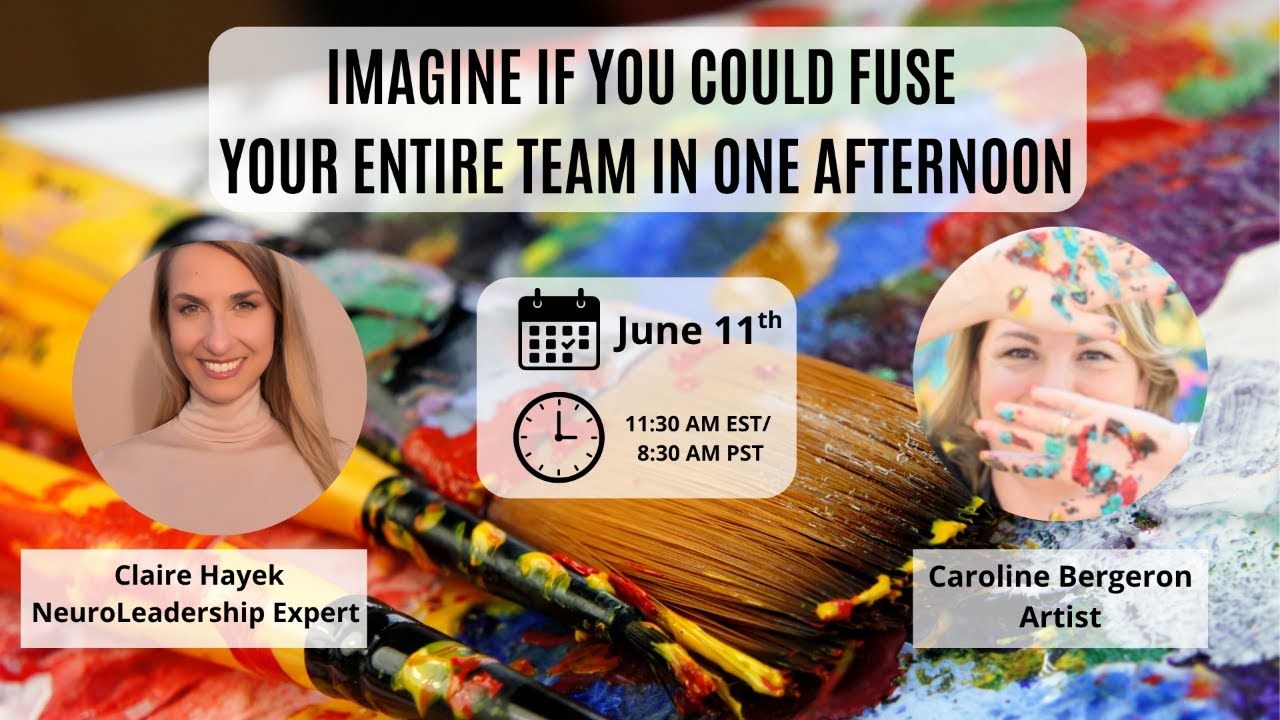
In this NeuroLeadership Edge podcast episode, host Claire Hayek (neuroscience‑certified coach and CEO of MSP Team Building) interviews international visual artist Caroline Bergeron (Aro Artist) about their signature team‑building experience called Mosaic Vision. The conversation opens with a bold claim: an entire organization’s vision, mission and sense of belonging can be aligned in a single afternoon through a hands‑on mosaic art workshop. Bergeron shares her personal pivot from entrepreneur to full‑time artist, describing an "aha" moment that taught her to live in the present. The hosts then dive into the neuroscience underpinning the workshop – activation of mirror neurons, spikes in dopamine and oxytocin, shifts to alpha brainwaves, and heart‑brain coherence – explaining how these physiological responses lower social threat, boost rapport and foster psychological safety. They describe observable behavioral changes during the session: participants step out of comfort zones, become more emotionally aware, engage respectfully, and focus on the creative process rather than the final product. The episode outlines the full Mosaic Vision workflow: a pre‑designed mock‑up aligned with brand colors, cutting it into individual mosaic tiles, distributing them for collaborative coloring, incorporating ice‑breakers, encouraging swapping and trust‑the‑process moments, and concluding with a debrief and a reveal of the assembled masterpiece. Post‑workshop, the finished artwork serves as a lasting symbol of team cohesion, often displayed or turned into merchandise, reinforcing the experience. Finally, Claire offers listeners a practical challenge – create a mini‑mosaic using three colored sticky notes or objects, share it with #MosaicVisionEdge, and experience the creativity‑boosting effect of constrained options. The episode blends storytelling, neuroscience, and actionable guidance to illustrate how art can rapidly fuse teams.
Chapters
Hello everyone. So listen to this. Imagine if you could fuse your entire team in one afternoon. I'm not crazy. Trust me. You can. Today, you'll see how a pocket-sized canvas, a shared color palette, and a little dash of neuroscience makes that possible. What really we're going to talk about is how we can shift vision, mission, and reinforce the sense of belonging in an organization where you're gonna feel valued, appreciated, and recognized live right in one room in an afternoon.
Okay.
So, welcome back to the NeuroLeadership Edge podcast. I'm Claire Hayek, neuroscience-certified coach and founder and CEO of MSP Team Building. Really glad to be here with you today. And today, we're just going to be talking about how we're going to do that. What is this masterpiece we're talking about, and how can we hold people together? With me is Caroline Bergeron, also known as Aro Artist. Hi! Hello, entrepreneur turned internationally exhibited visual artist. Whoa, right? Ten galleries, five continents, a commission for who? Michelle Obama. And yes. The Carousel du Louvre. Caroline, welcome, welcome, welcome.
Thank you so much, Claire, for having me in your podcast. It will be awesome to exchange with you and your community.
Very excited to have you with us too. So by the end of today's podcast, you'll know exactly how a workshop that we actually do called Mosaic Vision can transform Colleagues that are not talking to each other, or they're just scattered, or they disconnected because you know life hybrid, you know post-COVID all that stuff that you know about because of that. So they're all scattered. We're going to bring them back together into a single fused mission-driven force. And again, in the promise is in a single afternoon. All right. So Caroline, let's let's let's start with you. Okay. So bring us to that moment at the École Entrepreneuriat de Beauce. Okay. How did a painting session convince you? Okay guys, listen to this, right? How did it convince you to sell thriving businesses you had and pick up a brush and become a full-time artist? Please tell us, share your story with us.
First of all, I'm not crazy. I want to reassure everybody, but that night something physical happened to me because I realized all my life as an entrepreneur, as a leader, or any, any level you are in a company. I realized that all my life I was living in the future, planify the planification of the next months, next semester, the next— here I own restaurants, so are we okay with the stuff for tonight, for tomorrow, for next week? What's the next group? What's the order we have to pass to make sure we have enough food? And so I was always managing the future that I forgot to live the here and now. So the connection with the painting and the canvas and the colors at the same moment, at that moment in my life, I just realized that and I was shocked. And I entered in this workshop with a completely new era in my mind of the possibility, and I forgot to think And I connect with my heart.
Love that.
So for me, it was an aha moment in my life and it changed everything.
I bet it did. This is kind of, uh, it's actually, um, it's a huge shift that we don't usually, you know, often see in people. You know, some people take on a passion. You know, I myself, I'm a singer-songwriter. I've done music as well as engineering and then entrepreneurship, still do music. You know, I did, you know, do the ping pong, but I did a ping pong, you know, I did music full-time, then I went back to engineering, then I did music full-time, then I did entrepreneurship, then I combined both. And this is where I felt my center is that I was an entrepreneur doing both, you know, so it's not just music, right?
You can do anything you want.
Yeah.
You can have all kinds of passion and work all together. The biggest challenge is just to manage it all at the same time. But it's possible. It's possible to live and to enjoy life throughout our passion and things we love.
Yes. And, you know, I just wanted to highlight that, you know, all the leaders listening to us now is that she did a strategic pivot and it required a lot of nerves.
Yes.
Her leap is really showing us that creativity isn't just, this is a fun thing to do. It's literally like an enterprise-level courage. And this is what this podcast is about. I want to break those preconceived ideas about how things need to be. Let's put everything in a box. And you're the perfect example of not. being in a box and really just leaping into nothingness and create amazing something more than extraordinary out of it. So, here's your living proof. And this is what I like to invite great inspiring people. So, thanks again for joining me, Caroline. So, let's move on a little bit and talk about the neuroscience of all this.
Okay.
Yeah. So, how is art connected to all this and what's happening in our brain? And again, obviously, this is a NeuroLeadership podcast. And it's important for people to understand that things are not random. You know, this is science happening in your body, in your brain. And we are just extraordinary beings capable of so many powerful things. We just don't realize to leverage that brainpower, right? So literally what happens when 2 people in a workshop are painting side by side, and Caroline could be my proof for that. And she can second me on that, I hope. No pressure.
Yes, I do.
It's the mirror neurons that are activated, right? So these are the mirror neurons that fire in synchrony. It's like, you know, when you're in a room with somebody, you're like, oh my God, I'm so feeling that person. We're getting along. It's because your mirror neurons are connecting. So when you're doing that, when you're painting side by side, well, guess what happens? Those mirror neurons are activated and they're basically firing and wiring. So this is the same circuitry that, you know, you see when somebody yawns. And then, you yawn again with them. Or somebody smiles, you don't frown. You smile naturally. Even if you're upset, you're like, I think I'm gonna smile. You don't know what's happening but you're smiling. So, in a workshop setting, this is like that synchrony lowers social threat, the awkwardness. And it boosts the rapport in minutes, not months. And this is again, we're coming back to this, the how in these workshops. Another thing is dopamine. So, anything that is new, out of the ordinary, something that you don't do every day. Anything new will boost the dopamine. So, choosing, let's say, unexpected colors or having to kind of paint on a canvas, literally just boosting automatically your dopamine, oxytocin. It's all these like feel-good stuff I'm talking about here, of course.
Yes.
Eye contact is often shared when, you know, you're coloring, right, Caroline? Like, we're We're coloring. We're talking. We're connecting. So, these are like microdoses of oxytocin, that bonding hormone.
Yeah.
The love hormone, they call. So, color guides, lowers literally fatigue, decision fatigue. It brings us into all our alpha brainwaves, which is the lower, you know, the flight or fight is the beta-3, which is, whoo, okay. So, the alpha is like 3 levels down. And it really lights up our medial prefrontal cortex. It's, you know, it just really just inspires people. So Caroline, you've run these sessions obviously for many clients.
Yeah.
What are the shifts that you see in the room? Body language, conversation, hierarchy. Once the people get the colors out and start creating, what have you noticed?
A lot of things. First of all, I realized that for most of the people, it brings them outside of their comfort zone. So they are more aware about their feeling, their emotion. So they will react more higher in that moment. But throughout the group and the exchange and seeing others, so the comparison with others, and they will interact with people with Without saying anything, but creating something together but with different ideas. So we do a lot of parallel between the experience and what's normally happening in businesses throughout the teamwork and stuff like that, but doing it as a ludic activity, something that is not theoretical but it's practical that you— Exactly. Yeah, exactly. So you're outside of your normal situation. So this opportunity just brings the people more connected together. The exchange between people is more respectful, polite. They will make sure that everybody will contribute to the exercise. They will feel well about it. And I see that they put a lot of emphasis also about the experience instead of the final result. And for that, I really love the situation and the context because it's throughout this experiment that the biggest idea comes. And so when you are not focused on the result but just the experience and live the moment and connect with others and bring all the, the, the, the, the quality of everybody throughout the process because we are all different. So we will share our emotion, our expression throughout the painting differently, but the sum of this brings chef-d'œuvre and masterpiece.
There you go. And you said it, you know, I want to highlight one thing you said. The word is is enjoying the process and not the end result. So, you said even if the end result is not perfect, doesn't matter. They live through the journey. They experience the journey. And we often talk about this in neuroscience and positive intelligence, especially hyperachievers. I'm one of those. Like, a hyperachiever is a saboteur. Yeah, I'm sure you are. I think we even talked about this, you and I. It's one of our saboteurs. And it's like, what's the next thing? What's the next thing? What's the next thing?
Yeah.
But we're not. So, how do you anticipate and you overcome the saboteur shooting you in the foot and really limiting you from achieving the best version of yourself that you can be is to enjoy the moment, is to enjoy the— savor the journey. So, here's a workshop that literally is happening. So, if you have hyperachievers in there or people that are just stressed, it's a moment to slow down. It's a moment to enjoy the process. Of course, there's the anticipation of the end result. But nobody's freaking out and stressing over it. They actually like literally need to let go and trust the process. It's one of the things that we say too, Carolina, and I'm sure you say it too in the workshops is that trust the process. I need you to just let go and trust the process because—
The magical is at the end. That's it.
And the thing is because in art, you can't. You cannot let creativity flow if you're controlling everything. There's no creativity. You just killed it if you're trying to control it.
Exactly.
This is extremely interesting that even fMRI studies show during literally workshops like this, like dopamine is basically shooting up the roof. Okay, I'm exaggerating. It's probably not shooting up the roof but it's higher because it's a new experience. You got your oxytocin because there's eye contact. There's interactivity. And And what you see is just people like suddenly, you know, they probably haven't spoken or they haven't spoken to each other or they're shy. There's introverts in the room. You know, they're all of a sudden laughing over color gradients and little, you know, like, oh my God, that's so beautiful. Oh my, how did you do that? Teach me. And then you discover all this balance.
It opens up your mind.
Yeah, it opens up your mind.
Exactly.
There you go. So, Basically, like, I just want to jump into the actual— also, one of the things that is very important during these workshops, as you know, is the debrief part.
Yeah.
The big reveal. And, you know, I know I've been teasing you with this. Like, I'm not really telling you what we're doing this workshop yet. And this is gonna— I'm gonna get to this. Be patient. Stay with us. Stay with us. All right. So, What happens post, like once we're done, right? The debrief, right? It's so important is to watch the whole thing unveil in front of your eyes, sorry. And then sharing the experience. So, tell me a little bit more, maybe a little anecdote about the sharing. It's like, what do you hear people share?
Oh my God! I saw some People entering in the room at the beginning with like cross and say, oh my God.
Oh, hold on. What about the phone? I don't have the phone, but what about the phone? Like, I'm so busy, leave me alone.
I don't want to do this. But say, oh my God, it's not for me. But at the end, they were the most enjoyed and they express themselves and they feel and The biggest revelation I've seen is that people realize by the activity, by the team building with the team, it was how he reacts with the changing situation, how he reacts when we are different in the same group, with some people are more shy, some people are very leadership groove and things. And so altogether, how he reacts And how he's supposed to react. So he was able to see himself saying, oh my God, I now understand why sometimes I have some issue with different people in the team. So there's a lot of revelation about the timeline, about the comparison, about the leadership, about the connection to others, how I am interested to know about people surrounding me.
Yeah.
In work, at work. So, so all this open mind and creativity, it's something that we can share in a painting experience, but it's something that we can express in all kinds of activity as well. So when you connect your heart instead of your brain, uh, it's completely different how everything is possible.
Yeah. And it's a good point, the whole connection with the heart. So neuroscience shows that when you're really in your heart, everything just clicks. So it connects literally the minute you're in your heart, you have coherence with the brain.
Yeah.
And then everything is firing and wiring with all the good dopamine and all the good hormones and everything is just happy. Your body's happy. Everything. You're feeling good about yourself.
Exactly.
And the heart has such a big, big power. And it's one of these workshops that brings you in your heart. And we're not talking about you're going to fall in love with your colleagues here, really. I mean, we don't exaggerate this. But that's not the point. But the point is that it just opens you up. It opens you up and you feel that psychological safety. And you feel that you're just— why? Because your brain is in alpha waves. Your brain is in the creative waves. And you're good. You're feeling good with your body.
And the creation at the end becomes something that relates to that moment. So every time you see it after that in the business, that you say, oh, I contribute to that. I was with those person. Oh my God, we shared this. And do we still be connected since this event? So it brings people back together. It's a moment. Yeah, it's very powerful.
It's very powerful because the minute when you— because it's a product. and you see it. So when you exhibit it in your office or if you have a little photo of it on your desktop or in your office or on your mug or a t-shirt, whatever. I mean, the sky is the limit with these things. You can do a lot of merch and you wanna do that is to be able to bring people to that. It's like, yeah, you know that time when, 'cause the brain is so powerful. It will relive the experience.
Yep.
The minute you, just with an image.
Exactly.
And one of the things that I wanted to share, Carolin, as well, One of the things that really blew me away in one of these workshops, one participant said, I had trouble. She said, I had trouble letting go. And when I did, everything was extraordinary and beautiful and I enjoyed the experience. And then she said, Sometimes, we have trouble trusting the process when it comes to leadership, trusting the leaders, trusting the decision maker, trusting the organizational decisions, direction, strategy because we don't know. Like, they're not telling us the details. So, we feel left out and we feel insecure. But sometimes, you just need to trust the process because something beautiful will come out of it if we just do our thing, do our job, and just work together. And not, how do you say, like stopping people from being a negative force in the whole canvas of it all, in the whole masterpiece that is called an organization. If we're just driving and collaborating and all in coherence, Even if we don't know what the end result is, we need to trust the process because something beautiful will— we need to trust that something beautiful is coming. So, this was really great and it was a project management team.
Yes.
Sometimes, they struggled with that because they felt like they were left out. But imagine you have to— you need to know every single detail. You can't do your job. You can't. You have to trust everybody to do their own thing. And then when it all comes together, boom, right?
And doing a team building for organization is very interesting because we can tell what they can't regarding responsibility, imputability, when you have to do things and take care of your part of the job, but trust the process of others, make trust your coworkers and So it's easier for us being external from the company to bring and say things that for companies saying it will be probably— so we have more leverage in that kind of area about, uh, bring the people to their best.
Exactly. So what are we talking about? Okay, so a workshop, an art workshop, um, could, could have different versions. You can, you can paint, uh, one masterpiece together. You can, you can paint your own masterpiece. Pieces that you part with, or you can paint your own masterpieces that could be puzzled together into one big, big design. The one that I'm talking about is called Mosaic Vision. What we specifically do is that we have an artist like Caro. I'm kind of calling you Caro here. Basically, design something with outlines. Of course, it's a mock-up with details and branding colors and all that. And the organization leaders, HR, etc., whoever working with will approve it because now we're painting. We created a masterpiece that resembles the vision, the mission, or what we're trying to communicate. Sometimes, it's a new strategy we're trying to communicate. It doesn't matter. It could be a product we're launching. Context doesn't matter. Just really, it jives with it. So, once that mockup is done and colors are agreed upon, then we sketch the whole thing. Just sketch it, okay? Cut it up into mosaic pieces. And then those mosaic pieces are the ones that are dispatched during a workshop. Or if let's say you're a multinational across the world, we've done it a lot with multinationals. You can dispatch these little mosaics that have just a little outline with Posca pens, acrylic pens, etc., etc., and ask people just to color it. Now you're having control over like how it's going to come together because you're not sending 6 colors and asking them to be all over the place, right? But the beauty is when we do this, because we're talking about the afternoon here, one afternoon. If you do, when you do this during the afternoon, not only people are coloring, they're talking, they're connecting. We ask them to switch mosaics around. We ask them to trust the process. We do little icebreakers. We ask them to share things about themselves. They did it. I mean, it's a party. It's great.
It's fun.
It's engaging. The energy is up in the room and engagement is high because that is very important. For openness and creativity. And then at the end of the workshop, like we kind of hinted earlier, everything's numbered, of course. Then everybody puts their mosaic together. And then everybody's standing in a circle looking. And now we see the whole thing unveil right in front of our eyes.
Like this big picture is unveiled.
That is what you have designed at the beginning. But now the cool part about this is that It was a design before and it became the design with everybody's input, everybody's color, creativity. And the message it sends is that if one mosaic piece was blank and somebody didn't engage, we would not have a masterpiece. So, the message is every single one of you counts. Your input counts. So, appreciation, recognition, and we are celebrating your diversity. Yeah, and as I say it, I have goosebumps.
Yeah, exactly.
It's amazing how powerful this thing is. And I'm just going to show you a quick clip. It's not going to be a long one because, you know, we don't have a lot of time. Let me share my screen quickly here and show you what I'm talking about. So what you see is these are the mosaics that we're talking about, the 4x4 mosaics. This is the masterpiece. that what it became after.
Yeah.
Okay, you see these little squares? That's what people painted. And I believe the next thing here, we show the before. That's the before. And then these are the little mosaics coming together to the after. How brilliant is that? I am so— honestly, I find that this workshop. And again, this is a version. There's so many versions, okay?
You can customize any project to any customers.
Exactly, exactly. So Mosaic Vision for you, here's a little teaser. You are able to go see, you know, watch the playlist of Mosaic Vision. I'm gonna put a QR code here. You can scan this and watch the playlist. There's so many projects that we did just to give you an idea. And while we're doing that, Quick question. I can't believe we have five minutes left. Quick question for you here, Caroline. You do the keynote in your keynote mantra, "Oui, c'est possible," which means yes, it's possible. So here's the thing: when self-doubt creeps in, okay? I mean, you know we all have that self-doubt. Can you give our listeners one sentence to remember to help? Because you're saying, yes, it's possible.
First, you have to realize that you are enough as a human being. Courage is— take— it took 3 seconds to start. 3, 2, 1, go. So be in action, no matter if you don't know the next or all the big pictures. Do the first step. And if you can see it or imagine it, it's already in you. It already exists. So just trust you, do the first step and the second will come and the third and the fourth. So just be in action and courage is 3 seconds. So count 3, 2, 1 and go.
And go. Yes, yes, absolutely.
I love that.
Thanks for sharing that. And, you know, this is often talked about in positive intelligence as well. And like, how do you gather that courage? It's all about anticipating as well. So, it's kind of a saboteur thing saying, hey, I'm not good at this. I'm not going to do this well, etc. But it's okay. The idea is not to be scared. It's not to block the fear. It's to work with the fear. But don't work with the fear. Don't let the fear kind of work you for a whole day, a month, a lifetime, right?
Yeah.
So, you said 3 seconds. I'm going to stretch it to 10. But like, that's it. Snap out of it. Just do it. Pass on. Like, go and act because in little steps that we reinforce, it becomes easier. So, this is what we talk about, the saboteur mode and stepping out of the saboteur mode and getting into our sage brain where creativity is and what we trust. And we're really feeling with our heart. And we're actually where courage comes. So, let's quickly go through a little rapid-fire reflection. Are you ready?
Yep.
All right. So, 30 seconds.
Okay?
Color that instantly shifts a room.
I would say red.
Why?
Oh my God. Red is passion, is movement, is love. It's, for me, it's fire.
And she's wearing red, by the way. All right. Awesome. Second one. The best medium for the I'm not creative. type of people that say, I'm not creative?
Acrylic.
Acrylic, awesome. Um, what triggers your, your flow, your personal flow triggers?
Oh, uh, being in my head. If I connect with my heart, listening music, and I just dance and being happy, connected, the flow will come, the creative will expose, and But when I am in my head, it's blocked.
I think we can all relate to that. Thanks for sharing that. But here's the thing. So, I have a little mini mosaic challenge for all our listeners. So, 2 things you can do. The first one is, this is a tool you can do on your own, okay? So, you can grab 3 sticky notes, different colors that match your brand color, okay? If you want. It doesn't have to. But, you know, and then you draw something on these sticky notes. Symbol, small symbol, but it needs to symbolize your team purpose, what you stand for. Okay, it really needs to vibe with your team. Take a picture and would love for you to post it with the hashtag #MosaicVisionEdge. And just share the story and why this represents your team. Another thing, if you don't want to get the post and all that, you can just grab 3 objects you have at home and And just put it together. Again, snap a picture and tell the story. And why we're talking about 3 constraints when it comes to constraining things, research actually shows that it actually boosts creativity by 15 to 30%. If you have a lot of options, then you're kind of lost. So, your creativity is not boosted. So, here's your challenge. I'm very excited that you joined us. Again, it's hashtag Mosaic Vision Edge. Caroline, thank you so much, so much, so much for joining me. Do not forget to subscribe to our podcast. I'm going to leave the QR code here. We're approaching 30 minutes. We will see you to the next episode. Like, subscribe, drop a review, and talk to you very, very soon.
More from Claire


25 years in cybersecurity taught her this about staying calm under fire with Jonna Garber

Pause and Assess: The 10-Second Technique to Stop Over-Controlling Under Pressure #shorts


UN Mission Director On What Real Calm Under Fire Looks Like With Fredrik Sandvall





Book Signing at AIFEC Bogotá | What Pressure Does to Leaders and Why I Wrote This Book #shorts