Imagine Seamless Communication Across Borders—Here’s How
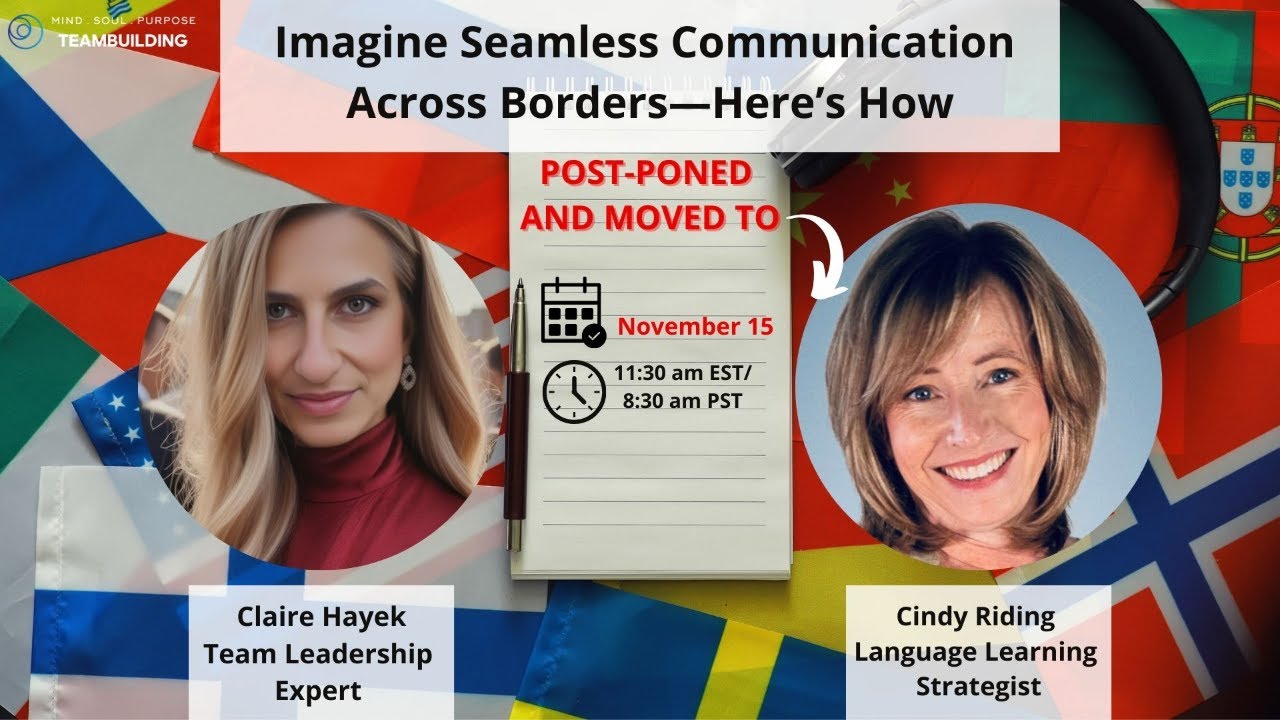
In this 30‑minute LinkedIn Live podcast, host Claire Hayek (team‑leadership expert, neuroscience‑certified coach, CEO of MSP Team Building) interviews language‑strategy specialist Cindy Riting about the hidden costs and challenges of language barriers in global, remote teams and how leaders can create language‑inclusive workplaces. They outline how misinterpretation, slower decision‑making, reduced trust, and missed opportunities arise when team members lack proficiency or confidence in the working language. The conversation moves to concrete solutions: customized business‑language training tied to role‑specific vocab, flexible scheduling, free skill‑gap assessments, and accent‑reduction modules. They discuss the neuroplasticity behind language learning, the time required, and the importance of respecting accents rather than erasing them. The hosts emphasize building an inclusive culture—multilingual greetings, polls, leadership‑driven skill‑gap identification, incentives, and career‑development integration—to improve collaboration, retention, and overall performance. The session ends with calls to action, upcoming LinkedIn Live events, and a webinar on neuroleadership and AI productivity.
Chapters
Hello everyone and welcome to our LinkedIn Live. Welcome to this podcast as well. I'm Claire Hayek. For those of you who don't know who I am, I'm the team leadership expert and neuroscience-certified coach, as well as the founder and CEO of MSP Team Building. And today, we're going to be talking about communication across borders. And we're going to show you how it's done in order to help you in case you're in an actual position where you are global or even you have different cultures that you deal with and communication is already very difficult as it is, even when we speak the same language. Imagine how it could become complicated when we don't, when our native language is not the same. So, and I'm definitely not the expert in language communication. And this is why we invited Cindy Riting here. Cindy, how are you?
I'm wonderful. How are you, Claire?
Very good. Thank you for joining. Cindy Writing is an expert in language strategy and communication for global teams. I mean, that's a big one. And I think there's more and more of that these days with remote work as well as, you know, I mean, a lot of companies are growing and they have different offices and different branches around the world. So, how do we deal with that? So, Cindy has over a decade of experience in virtual language training, helping teams worldwide communicate effectively and bridge language gaps. So what we're going to do, here's the plan. So today, we're going to be talking about how actual language inclusivity can affect team productivity, enhance collaboration, and eventually, if it's done well, build stronger and more unified company culture. This is very essential and sometimes overlooked by leaders or by companies in general. It's taken for granted. And this is today we want to shed light on that. But before we do all of this, I'm going to be sharing with you around the end of this 30-minute, very, very short talk. I'm going to be sharing with you some links to upcoming LinkedIn Lives. The next one will be November 27th. And I will share the QR code with you. where I speak to 3, actually 2 other amazing leaders that turned chaos into something extraordinary. And I'll be part of this conversation as the 3rd leader, as well as an upcoming webinar on neuroleadership and AI productivity on December 5th. But before we dive into all of this, we want to know where you're joining us from. Please put it in the chat. As I always say, it's all about interactivity and this is how we build human connection This is not a one-way conversation or a two-way conversation between me and Cindy. We really want to hear from you. And I'll be sending— putting polls up on the screen so you can answer and tell us what you think. So, here we go. Like I said, I'll be addressing the chat every now and again. Please do put in the chat where you're joining us from. And finally, before I forget, Connor from our team is always here. And he'll be also sharing some links in the chat with you. So, do interact with him. He's wonderful. We love Conor. All right, Conor. Hey Conor, how's it going? I think he's just chatted back. All right. So, again, we're talking about miscommunication. We're talking about communication, how we can improve it across borders, across different countries. Miscommunication costs a lot of money. It's a big, big problem. And again, it's not only because we speak in different language and we are spread out across the globe. It's already a challenge as it is even when we speak the same language and we're in the same office. So, but today, we're going to focus on the miscommunication due to specifically language barriers. And it could be extremely costly, especially for international teams. And it's costly on a cultural level and obviously on a financial level. So, Cindy, can you tell us about some of the common challenges you've encountered with language barriers and with your clients and how they actually Specifically impacting performance?
Yes, it is a complex topic actually. And some of the challenges that I see and that I hear about from my clients is things like language differences can cause misinterpretation of tasks, kind of leading to delays and errors. And also, slower communication can hinder decision-making.
Right.
Productivity, basically. And then you have the varying communication styles, you know, that can be— there can be misunderstanding and reduced kind of collaboration. And then there's the cohesion, you know, team members may feel sort of insecure about because they're not as proficient in a language, or they may feel excluded. They can't— they miss their moments sometimes because they're trying to figure out how to say what they want to say correctly. So then, by the time they figured it out, it's just too late. They missed the moment. So, it kind of impacts the creativity and their engagement. Also, there can be erosion of trust and can cause interpersonal conflicts.
Right.
And in terms of costs, well, sometimes companies have to now have to Um, they, they need additional training, they need translators, and, um, support, extra support may be required if those people cannot perform their tasks and their roles properly due to their language issues. And so basically, less proficient speakers just feel left out and they don't get to contribute the same as someone who is speaking in their first language, for example. So we're dealing— first language, like you said, yeah, even speaking and getting your messages across clearly can be troublesome, right? Can be difficult. And also just to be heard and have all of your input included. But then when you're talking about second and third language, it's even more difficult for them. So They can complicate resolving disagreements even.
I can totally understand that. I mean, I can, as you were explaining the different situations where people feel stuck with communication due to the language barrier, I can just, you literally were saying all this and I was just imagining the situation happen right in front of my face. You know, I have 20+ experience managing teams and I've managed many multicultural teams. And I exactly, I mean, you put your finger on it and it was just amazing. It brought me back to this. And that's one thing that maybe language-proficient leaders or people or employees do not realize. Maybe the struggle that is happening with their team members that are not as language proficient with, let's say, if we're speaking English or we're speaking French or no matter which language we're speaking. Now, what that does, and like you said, I want to put like one word or two words on it, missed opportunities.
Yes.
When you're not part of the conversation, you are perceived differently. You know, you're perceived as the introvert or the non-engaged type, non-engaged type, etc. So even, I don't care how much courage you have, but when you can't find the words to communicate what you want to say, you could be completely courageous and just dive right in and make all the mistakes. But then, they're looking at you going, I just still don't understand what you're trying to say.
Yeah.
That look that we get from our colleagues, very important because it either, you know, when you're trying to make a point, You want to be understood. You want to be seen. You want to be heard. And if you are trying but it's not coming through, then everybody's looking at you like, I'm not sure what he or she's talking about. I'm not following. And then, there could be some judgment, right? And in a normal world, there is unfortunately. And that really affects that person. So, what are they going to do next time? Maybe they just won't say anything.
Exactly! It's related to confidence.
Exactly.
Being confident and sure that what you want to express is correct, whether it's grammar, vocabulary, just knowing when to be able, you know, when to jump in. And it's like we just don't know how these other people are feeling and what they're thinking.
Yeah, so it's pretty difficult. thing. And I think it's a bit of a taboo subject. And I think people don't talk about it enough. And this is why we're bringing it here. The reason I like to choose the subjects of the actual discussions that I have and the people I invite so they are most relevant and add the most value to companies out there, leaders out there, because that's the point. Right? To add value. We want to help. And we want to shed a light on certain things that we're probably underestimating. And might just make it really easy for somebody that is listening to us today. It might just help them go, oh my God, maybe I've underestimated my colleague. So, let's bring that emotional intelligence forward. So, I just put a question here on screen. I want to hear from our participants today. Have you experienced challenges due to language differences at work? Yes or no? It might have affected you personally or it might have, you know, that you weren't able, you weren't proficient with the language that you had to communicate in. Or it might have been the other way around that you felt you couldn't connect with a colleague due to that. And I'm just gonna hop in towards the chat here and see what's going on. And hey, Connor. So Connor's always here supporting us. for being with us, Conor. And like I said, just if you're listening to this as a replay or as a podcast later, please do reach out and comment and let us know how you feel about this. This is very important because we do want to help. So, let's leave this question on screen as we move along, Cindy. And let's talk about some strategies in order to overcome these language barriers. So, Once we recognize that language barriers exist and they can impact tremendously our productivity as well as our company culture, the next step is to implement some kind of solution, some effective solutions so we can move forward from this, right? So what strategies would you recommend? What do you know? Tell us, give us some strategies, some tools that companies can implement and address in order to overcome these challenges.
I think number one would be to have a language training program as part of your professional development initiatives.
Right.
And these courses can be you know, customized to the business context and even as far as the person's role and all of the responsibilities, tasks, activities that they need to be able to, you know, communicate in. And that could be as far as like, you know, who is their audience?
Mm-hmm.
When, when we, you know, structure the courses and the classes, And that means every class is really structured and customized around exactly who they need to be communicating with, whether it's internally with colleagues or with clients. This is a very important aspect in terms of reaching their goals more quickly and more efficiently.
So let me just interrupt for a quick second here. So Just to put it into perspective, from my experience, we had to train some of our employees at the time to have better French, speaking French and written French. And sometimes, it was the other way around. It was with English. But some of the language courses they were taking, they're professional business courses. But When you're starting at a beginner level, you know, sometimes it was just like I would look at the curriculum and I was quite disappointed because it was something like, you know, déposer la tasse sur la table, you know, like take your plate and place it on the table. Like, I don't know how my junior engineer here is going to use that in the context of what we do. So, The point that you made, Cindy, is so relevant. And this is huge. And I want to stop and zoom in on it because to have a training relevant and tailored to the language that you will be using every day with your colleagues in the context of what you do in the department where you work with and the conversations you'll be having, that is tremendous.
Absolutely.
As opposed to, you know, uh, I live in Montreal, I go do my shopping on Friday night.
Exactly.
How are you? This is important. But, you know, there's way more than that, right?
Because listen, like I say, you know, we're not going to be teaching you body parts unless you're, unless you're a doctor and you, you know, you need to, uh, have that as your You know, specific vocabulary. So we also, you know, with companies, we also focus in on the industry-specific vocabulary, right? And this is the customization part, and the tailoring is very, very important because we never waste any time, and these students are so engaged.
Yeah.
They said, okay, all of this is important. All of this is— I'm going to be applying this right away. Yeah, you know, with my clients, with my supervisors.
So, so here's the question: how, how long does it take? I mean, when you're not really— I mean, you have to have some kind of basic language knowledge, I'm assuming, when you start. It's just that you're not comfortable with it, so you're not starting from scratch, like not speaking the language at all. We're talking about there's some kind of beginner level but very basic where you're not really have the right vocabulary to communicate properly? And how long does it take to learn the language around your tasks and your job? What from your experience?
Yes, I mean, listen, students can be beginner zero. They could be starting with very little.
Right.
Okay. So then, if they're very beginner, they're going to have a general— if it's French, for example, They would need a general French course. Okay, you can't go right into business topics and business conversations, right, when they're very beginners. So in terms of how long it takes, it really depends on what their current level is and the level that they want to achieve and how much work they do in between classes.
Mm-hmm.
Do the homework. But keep in mind, this is not an off-the-shelf course. This is a communication course. Okay, what is very important is that also for us and for the students, the scheduling has to be perfect for them too. So we actually customize the schedule so they choose when they attend classes.
Right.
Makes a big difference because It's all about them. And this is also very important. So basically that they have a lot of airtime as well to practice.
Because the thing is, it's also, it takes time, it takes time to rewire, as I always say, rewire those neurons and make those new, you know, neurons path so they can fire and wire in a different language whenever you're You're learning something. It's all about neuroplasticity. And we do have that ability, but it takes time and repetition for it to actually become natural eventually. I guess, as well.
Yes. Breaking bad habits. Sometimes people have these solidified habits of saying something incorrectly. So you have to break those habits.
And let's unwire, unfire and unwire. And then we have to rewire and fire. So, and this is why we can't put up, you know, specific time on it. I'm assuming it also depends on the person's ability to learn languages. Some people are really great with language ability, this natural ability, and others don't. And it's not because they're less intelligent or more intelligent. It's just the way it is with their genes, I guess, or the training that the brain had. Although we can, we can, we're not hardwired and we can transform how our brain works. We have the ability to do that. You know, neuroscience has proven that, but still, right? So—
And also the language they're learning. So, you know, if you're English and you're learning French versus English— French learning Spanish, obviously, because there's, you know, it's Latin languages versus English. So that also makes a big difference. So somebody who's from India and they're learning French, it takes longer.
Right.
So we, we, we offer like free evaluations and then we make recommendations in terms of how long they would need to be committed to reach their goals. It's really important for people to understand the commitment involved.
Oh, I bet.
Becoming proficient in a language. And then we also think about things like accent reduction. Somebody could speak English but nobody can understand them because the accent is getting in the way of the clarity and understanding. So we have specialized courses around things like accent reduction and pronunciation, which could be, you know, 30 hours and they're good. It's just refining sometimes their skills as well.
And it's frustrating for the person listening to the to that person trying so hard to speak the language properly and they speak it fluently even, but the accent is getting in the way. So it's frustrating for the person listening and it's frustrating for the person communicating because they are communicating fine. They're speaking, they have the right phrases, the right vocabulary. They're expressing themselves very well, but they're not aware how hard it is maybe for the listener to understand because of that accent. That's a very good point you bring. As far as accents. But what I feel that even with an accent, I think it's great that you're able to fine-tune that and focus on the accent in order to better, you know, for it not to be a barrier. However, great for people just to have the courage to do it anyway, even though they have an accent. I don't know how many people, how many French people, French-speaking people I met that speak English really well, but They cannot get rid of their accent and that stops them from communicating or even attempting to communicate in the language, which what that does is inhibiting the neurons to fire and wire and get better. And then it's kind of like regressing as opposed to progressing. So that is huge as being—
Yes.
And learning, right?
Honestly, I always say though, we don't want to get rid of your accent. You just want to reduce it because listen, it's a part of who they are. And I personally love the French accent.
I do too.
I do too.
And that's the thing. It's not about changing. It's about just making sure that that communication is seamless and it's not getting in the way of the message. Let me just read up here our second poll question. Does your organization have a program currently have a program to support language learning? Yes or no? Really want to know how many organizations out there actually invest in this. This is an important subject and I think it's probably not taken as seriously as it should. And I'm sure a lot of organizations invest in these things. I mean, you work with a lot of clients already. Obviously, you exist because you have clients, right? But I think there's the idea is to shed a light on this and make sure that people are not underestimating this and taking a closer look and see, hey, do we do a little survey? HR, maybe do a survey and see how many people would actually appreciate having that support as in language learning. So moving along here as people comment. So beyond individual learning, obviously, when you're creating an inclusive culture, it becomes something that is crucial and essential for that smooth communication to become natural across borders. It really also starts with an inclusive culture, right? I mean, you know, not at an individual level. It's also about making sure that the message comes across globally and that it is whether it's during meetings, town halls, events that those different languages are brought forward and communicated. And you kind of like put it, feature maybe some of the cultures or the languages and maybe say, when you finish a meeting, say thank you, merci, grazie, gracias. I don't know. I mean, you can go on for 10 to 20 languages here. But why not? You know, it just brings that It nurtures that feeling that the company cares and it is inclusive.
So, I have something to add to that.
I'm sorry?
I have something to add to that. Yeah, I have a client who they learn each other's language. So, there's Francophones and Anglophones. And they make sure the company makes sure that they get the training so that they can speak each other's language so that the meeting could be in French or English.
Wow.
So, and I feel that's so wonderful.
It's such—
shows so much respect for their culture, their language, and nobody has to be excluded. And, you know, if there's a majority of French people in the room versus— or English, they would just switch to the language of the majority in the meeting. Shows a great deal of respect.
So this is, I think you just answered my question. You pretty much read my mind. I was gonna ask you, so how can we as leaders support a language-inclusive environment in your team or in our companies? And I think that's one of the things, what you just shared. Are there any other ways that could also be, you know, leaders and companies can support that language inclusivity environment?
Yes. I mean, you know, I think the first step is really to identify employees' language skill gaps.
Right.
Sometimes just also asking them which languages they would really like to, you know, languages that they would like to work on. for things like getting a promotion.
Hmm.
Because language can also cause a roadblock, you know, to really developing yourself in terms of professionally being— and being able to apply for other roles. If you are not, for example, in here in Montreal, Quebec, if you're not bilingual, it really is difficult to really apply yourself. And I think, you know, offering flexibility also to employees, you know, in terms of having classes or participating in just conversation practice, which is another type of service we offer, you know, because obviously budgets have to be considered as well. But also just talking to the employees about what are your career plans, what would you like you know, would you like to be considered for other roles in the company? So it's a part of their development plan, you know, and then just creating opportunities also for, um, you know, interactions with people who are speaking the languages that they're learning, you know, and integrating that into the culture, you know. Promoting language learning is to me like a good company value with incentives. And it's just such a great retention initiative as well.
I bet. I bet. I totally can see how that could be very relevant and very positive. So, here's our 3rd poll question. Do you think fostering language inclusivity can improve your team's performance? Yes or no? Please do put it in the chat. So, to summarize here, we talked about, you know, the importance of recognizing that language barrier is a thing right away, just to be aware of it and how that could be difficult for communication and maybe also affect how a certain employee can communicate or comes across in a meeting or as a person or his or her personality because of that fear of not communicating properly or not being able to or missed opportunity to communicate in a meeting, for instance. And then we talked about, Cindy, how we could improve that. And you talked about the programs that you basically help your clients with that are tailored to— and they're at different levels and they're tailored to be in the context of the business, the business language, what they're doing, etc. So it's a bit more focused as opposed to just general language apprenticeship. And we talked also about how that can affect the culture and the inclusivity in the culture. And Cindy, you shared how some of your clients, they speak each other's language and it was pretty much voted on which language you want to use for this meeting, which would be the best one to use as opposed to here's the language we speak and work around that. So, being inclusive and being respectful of the other people's language as well as we talked about so much we talked about in 30 minutes. I can't believe it. Accents. I loved that one. That was such a gold nugget. Because we don't talk about it, we don't address that much, we don't talk about that much. But sometimes you can speak perfectly the language and you made all the efforts, but your accent is getting in the way. The idea is not to eliminate your accent, if I understand correctly, Cindy.
Yeah, that's right.
Improve it so it doesn't become a language barrier for people to understand you. I mean, this has been brilliant. Thank you so much, Cindy, for this. It's already—
And I have one last thing.
I would like you to just say a couple of words before we wrap this up. Yeah, what would you leave us with? Somebody's listening here. What is a word of encouragement or a piece of advice that you would leave today?
A word of encouragement is related to remembering that these courses are not— it's not an academic course, it's a communication course.
Mm-hmm.
So, um, for our students, um, and my mission and vision, which has continued this whole time that I've been working with these students, is that it has to be a pleasant experience. It has to be fun. It's okay to laugh and have fun and laugh at ourselves and just enjoy the experience and build a really nice relationship with their coach. And with their colleagues, if they're taking group classes, because of course there's private, semi-private group classes, right? And that's a very important part. So tailored, but also that it's pleasant experience tailored to your, your schedule, your schedule that works for you, as well as just having fun.
Mm-hmm.
Is how we keep them engaged and It helps for them to reach their goals.
This is wonderful. Thank you so much, Cindy. That's been so helpful. I learned a lot. I don't know about you, but I learned tremendously. I mean, not you, Cindy, but whoever's listening. I hope this really helped you at least to just start the conversation about this. If you want to know more about, you know, this subject, this conference, this service, what Cindy does and how she can help you, please type language in the comment or reach out to me on LinkedIn, Claire Hayek from MSP Team Building, and I would be more than happy to tell you more. And just wrapping up here, our next conference, LinkedIn Live, more like, you know, podcast, not a conference, is on November 27th. And it will be at the same time at 11:00 AM. Sorry, 11:30. I think I have the wrong time in there, but it's 11:30, I promise. And please do join us On the LinkedIn Live, How 3 Leaders Found Purpose in Chaos. It's gonna be a very interesting conversation, I promise. And finally, I'm just gonna put up the QR code for an upcoming webinar that we have on neuroleadership and AI productivity, where we addressed how you can leverage neuroscience and transform your leadership. and your team, as well as using and leveraging AI. We did one a couple of weeks ago and a lot of people reached out and said, we really want another one because we missed it and we don't want to watch the replay. We want it live. So, we stepped up and we're opening up a new date on December 5th at 1 PM EST, 10 AM PST. And we'll hopefully see you all. Otherwise, we'll see you on the LinkedIn live on November 27th. Cindy, thank you so much again for, for joining, and, uh, we'll be in touch. And again, put your questions, comments in that chat, and we'll definitely get back to you. Thank you so much, everyone, for joining us today. Thank you.
It's wonderful. Thank you so much.
Thank you. Bye now.
More from Claire


25 years in cybersecurity taught her this about staying calm under fire with Jonna Garber

Pause and Assess: The 10-Second Technique to Stop Over-Controlling Under Pressure #shorts


UN Mission Director On What Real Calm Under Fire Looks Like With Fredrik Sandvall





Book Signing at AIFEC Bogotá | What Pressure Does to Leaders and Why I Wrote This Book #shorts