Leading AI Change with Vicky Miles — Guest Leader Series
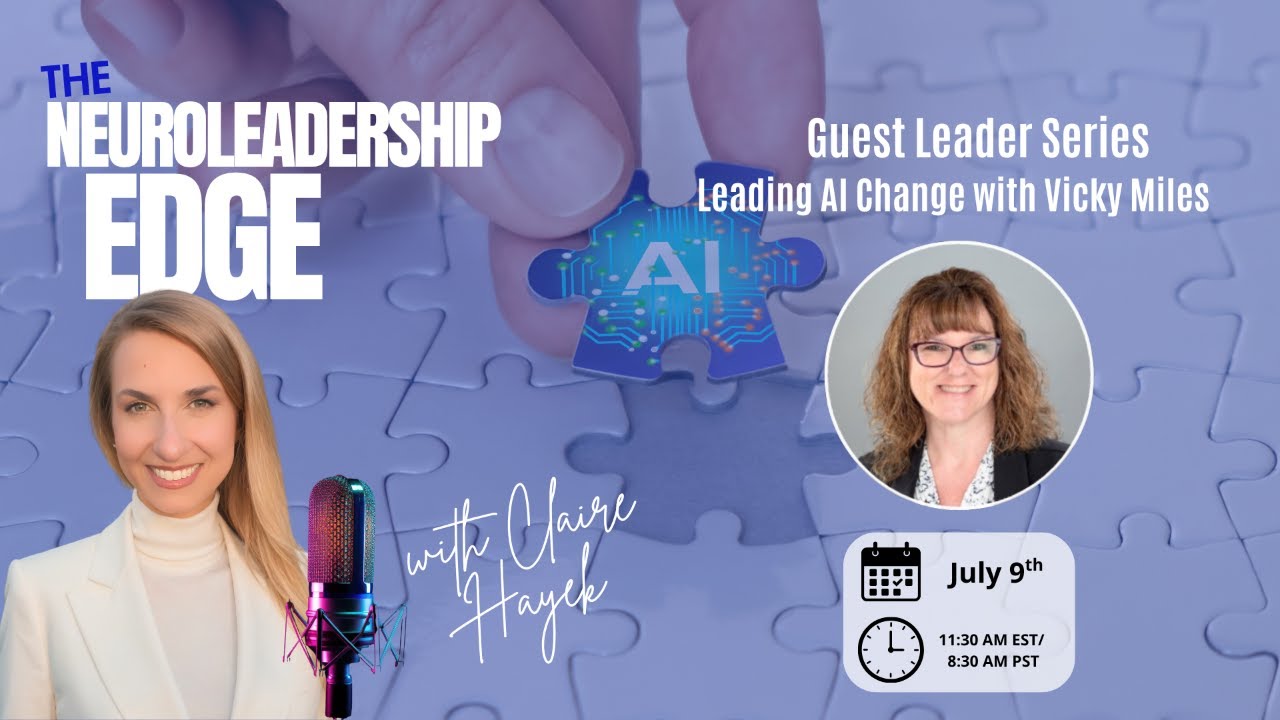
In this NeuroLeadership Edge podcast episode, host Claire Hayek interviews Vicky Miles, Head of HR at Alcoa American Laboratory, about integrating AI into HR over the past six months. The conversation begins with Vicky sharing a formative experience during a corporate acquisition that taught her the importance of being a trusted, people‑first leader. She then describes how she has been using AI—both legacy HRIS/ATS systems and newer generative tools—to automate administrative tasks such as CV screening, presentation creation, performance‑review drafting, and email polishing. Vicky emphasizes the need for prompt engineering and grounding to avoid hallucinations and maintain credibility, positioning AI as an assistant that requires human direction. The discussion moves to cultural reactions: some employees embrace AI, others fear job loss, but Vicky stresses that the human must drive the AI. She advocates upskilling, taking AI‑focused classes, and participating in the host’s “AI Sprints” to demystify tools. The episode debunks the myth that AI will replace HR professionals, highlighting instead that AI amplifies human connection and frees time for strategic work. Vicky tracks attrition weekly as a key metric and cites Mel Robbins as an influential thought leader. Claire interjects a brief neuroscience segment, explaining how the anterior cingulate cortex (ACC), amygdala, and prefrontal cortex (PFC) mediate threat versus curiosity responses to change, and how leaders can reframe AI as a collaborator to keep teams in a curiosity state. The episode concludes with rapid‑fire questions (myth, metric, book/podcast), a listener challenge to test an AI tool on a repetitive task while maintaining empathy checkpoints, and promotional details for the AI Sprint program (free month codes MSPAI19/MSPAI49). Vicky ends with encouragement to take risks and experiment with AI.
Questions this video answers
That it's going to replace us.
Attrition (turnover).
Mel Robbins (the "Let Them" theory).
Chapters
Hello everyone! Welcome to the NeuroLeadership Edge podcast, brain science for bold leaders ready to own their voice. I'm your host, Claire Hayek, NeuroLeadership expert and founder of Mind Soul Purpose team building. If you're worried AI means more layoffs, well, some people think AI won't replace the human touch. I happen to be one of those as well. But it can erase hours of admin so leaders focus on strategy and more important things. Strategic HR leader Vicki Miles is 6 months into that shift, and she's here to share her experience so far with AI. Today, you're going to learn how to introduce AI tools without losing that empathy and culture. That's extremely important. This will be the focus of this podcast. Let me quickly introduce Vicki here. Vicki Miles is an accomplished HR leader with a background in healthcare, manufacturing, and finance. Her passion lies in fostering leadership excellence and driving organizational success through strategic initiatives. She's currently Head of HR at Alcoa American Laboratory. Hi, Vicki. How are you?
Good. How are you, Claire?
I'm very good. Thank you so much for taking the time to join me today to talk about this subject that everybody's on everybody's lips pretty much and with reason, right? It's so disruptive. There's a lot going on. And, you know, today the focus will be AI and how we could use AI and lead change with AI without losing the human touch while elevating our people as opposed to maybe laying them off, right? But before we dive into the subject, I do want our listeners and myself as well to get to know you a little bit better and more of your experience as a leader and what you've, what brought you here today and made you the leader you are, the bold leader that you are today. So, I would love to know a moment maybe in your career that was maybe high pressure or stressful or difficult. It was a big challenge for you that you think really shaped how you lead today. Can you share that with us? Sure.
So, I think the situation that comes to mind for me was I was in a company that was acquired. And when that company was acquired, it was really stressful because they The company that came in kind of came in like a force and was really kind of cleaning house and doing what they wanted to do without talking to anybody and without really thinking of the employees and how it was going to affect them and what their thought process was on it. And that really shifted, like, my thinking and my perspective on things because I didn't want to be one of those leaders that came in and really led like that. I wanted to be the trusted voice. I want people to trust me and to be able to feel like they can come to me, to be that people leader opposed to, you know, kind of a force leader. So that's really what shaped me into the leadership position I am in now.
So how did that, how did that help shape you? Or I guess more specifically, what kind of mindset shift after this happened? What did you have to change in your, maybe your patterns, in your mindset and how you're showing up differently after that? Like, how did that shape you?
I started to speak up a little bit more to leadership to really try to be that voice for the people and to try to help kind of navigate from the bottom because the people in the community, in the organizations, they don't truly have that voice a lot of times.
Right.
And they need somebody to be that voice for them. So that's what I started to do. I started to kind of move my mindset on, okay, transaction administration more towards, okay, let's see, what can we do for the people? How can I be their voice? How can I help them? Well, I know I'm in HR and I am here for the business. I'm also here for the people as well. And that's really important to me because my view is that without the people, you don't have an organization. And if you don't keep your people happy, then you're going to really have that attrition issue.
Yeah, I mean, I think we both agree on that. That every organization, the people They're the most important asset in a business.
Yeah.
You don't have people, you don't have much, to be honest with you. Although some right now, certain industries, I think, and certain organizations, maybe where automation and tech kind of is more present in the day-to-day. And it's something that could easily be implied, implicated, or sorry, implemented in the day-to-day that could replace certain people because they're repetitive tasks. The truth of the matter is the human touch cannot be replaced. The human brain cannot be replaced. Human creativity cannot be replaced. Human connection cannot be replaced. An organization without a connection, a human soul, right? In my opinion, it's just a machine running. This is, you know, an organization is not a car. You know, it's got its brain. It's got its innovation. It's got— so, even if you're running it on automatic and you can automate a lot of things, that's great. However, how do you grow?
Absolutely.
Innovate? How do you move forward? And that's where the human brain comes in. That's where human connection comes in. That's the soul. That's the heart of your organization. This is very interesting so far. And I know this is a very controversial subject. And a lot of people are upset about AI. A lot of people don't understand what's happening with AI. I mean, it's just going in such a fast pace. There's the right and the left and the in-between. I think we're all trying to kind of make a path towards understanding and living that change, going through that change and adapting. Because in my opinion, I think there's a lot of denial, but I think AI is here to stay. And I think it's a matter of time that we need to kind of put some rules or understand some ways that we can implement it and live with AI. without it taking over and messing everything up. I think it's all over the place right now. We're all trying to make sense of it. And which brings me to my next question to you, Vicki. I am really curious to know about your recent AI integration at Alpco. And I'd love for you to walk us through the whole process, what works, what didn't work, you know, when it clicked, how this is affecting the day-to-day, your day-to-day, because I believe you're the one, you know, leading this AI integration. So tell us all about it. Walk us through it. How was this decided to start with? And how did you jump on it? Like, what happened?
So I think that people don't realize that they've actually been utilizing AI for a lot longer than they really know. Especially, you know, one of the biggest places would be HR. because you have your HRIS systems, your ATS systems, all that kind of stuff. And that's, that's all AI. That is all AI. It's, it's AI-driven. So while the past 6 months, yes, I've amped up my usage of different AIs, I've actually been utilizing AI for years.
Right.
And I kind of just realized that, oh wait, I have been utilizing AI for years. So things that I've kind of delved into, as that kind of sparked with me, was, you know, I've started to look at different tasks that maybe I can use that will help me with the administrative portion of my job. So I started to look into how can I, how can I make a presentation? How can I make a performance review and do this without it taking me months to come up with a format, to come up with wording, and so on and so forth? There are some great programs out there. So I started to do a lot of research, and I started looking into a lot of things, and I started to take some classes, honestly, on how to amp up my AI usage in my job. And once I started to get into things, I was like, this is amazing. This is absolutely amazing. You know, using AI to help you out really has been able to give me more of a strategic voice.
Mm-hmm.
In the company, because it's taking away those mundane everyday tasks. And And it's making them so much easier for me to do that now I can focus on what's really, really important.
Right. I love how you say that because I think a lot of us kind of know this, that AI is helping us focus on what's more important. Yet there's still that skepticism. I mean, okay, great. How efficient is AI? How— not efficient, I think, how credible? How credible is AI? Can I trust AI? If I'm asking to do a task for me, is it hallucinating? Is it coming up with, you know, is it really taking my data by the letter and really applying it? You know, or is it taking my data, putting it out there, and then shuffling it in and introducing other data in and diluting my data? my data? Is it really telling me what I want to hear? And we call this grounding, grounding your AI. And there's a lot of— it's all in the prompt. And I'm sure you know what I'm talking about. So some of you out there listening to this that haven't really been using AI a lot, it's all about prompt engineering. It's like what you say to the AI and how you train your AI to give you the reply. So yes, it could give you gibberish, give you jargon, a lot of wrong things, although the models are better now than they used to be. But you need to ground your AI. You need to know where you're going. This is what brings me back to the whole human side of using AI. AI is not going to replace your brain because you need to tell AI. AI is your assistant. If you're not telling your assistant what to do and how to do it and basically flag some things like, I don't know, this doesn't sound like what I asked you to do, or this doesn't sound right, check it again for me, right?
Yeah.
It's not working. You're not on vacation and it's doing all this for you. Like, you're the one literally driving the car. So, okay, let's come back to your experience with the AI integration, Vicki, at Alcoa. So, how was that? How was that, you know, kind of taken in? Was it open? Was it like, yeah, you know, Vicki, go ahead, knock yourself out with all this. We don't want to know anything. Yeah, maybe report to us. Or let's just test it out. Okay. Yeah. You know, we'll throw you a bone here. Like, how is the culture at Alpco? And how do you feel around that? And how is it changing things? I know you said that it's making you a better leader and you can focus on the more important things, which is strategy. And that's really where you shine. However, how are people around you reacting to this? And are they as open? And are they starting— is there a culture shift?
Yeah.
Or what do you— what do you—
yeah, I think it's a mix. I think it's a big mix. You know, there are some people that are open to it, and then there are others that aren't. But I think the biggest misconception around it is that it has to be driven by a human. It just has to be driven by a human. Otherwise, as you said, things get lost.
Right.
Things can be misinterpreted, and so on. So, you know, I've really delved into, you know, understanding the prompting, understanding how to really word things. You are the one, you're the voice driving the action. If you don't put in what you're really looking for, and you're very specific about what you're looking for, right, you're not going to get what you what you want. So, if you don't have that human person driving that AI, again, like you said, I'm not on vacation and it's doing all the work for me.
Although some are waiting for AI agents to do this. And I know there's a lot of people that use AI agents. I've used them a little bit. I find, I mean, they're good. I'm not ready to give them full control of my brain and how to speak For me because I still want to decide what email to send and what tone to use and maybe put my 2 cents in it. Even though it'll match your tone as much as possible, it's kind of your assistant answering your emails. Even if I had a live assistant doing this for me, I'd still kind of want to— it's like, don't send emails for me. I still need to check them because no one can do things. Better than you. Nobody has your voice, your heart, your soul, your energy. And, you know, we are— I often talk about brain science and mirror neurons. And mirror neurons, it's basically our ability to connect and mirror what's in front of us. Even if it's not in front of us, even writing an email, thinking of that person, that person when they receive the email, they can feel what we are feeling. It's amazing. It's It surpasses time and space. And so, when you're thinking about it, I still feel like I need people to feel who I am, that I'm present. This is not an automated thing that's just gonna reply in a very ChatGPT way. I mean, I don't know about you. I can smell ChatGPT from far when I'm reading things. And a lot of people actually ask me, and I'm actually curious to see what you think, Vicki. Actually, we were at a friend's house this weekend and one of my friends said, do you get like insulted when you know the answer was sent from ChatGPT? And I'm like, not really. I don't know. Like, I don't take it personally. I think of it more as a gift. Good for you. You're saving your time and it's a very redundant— it's not a very important answer I'm looking for. But if it's something really important, I would kind of like somebody to put 5 minutes into the email and maybe tweak it a little bit, you know, as opposed to like, get out of my way and just like, here's your answer, right? But anyway, let's come back to Alpco. So right now, where are you at in the integration? Are you— is this kind of—
I'm still testing the waters. I do know there are several people that are utilizing it as well, and they're utilizing it again from that human perspective. So it's that, it's that human perspective. They're putting in what they're looking for, um, and, you know, they're, they're kind of tweaking it, I guess, so to say. So it's, it's kind of like taking an email and putting it into ChatGPT and asking ChatGPT, can you clean this up for me a little bit, make it a little more professional sounding, so on and so forth. And I think that's a great place to start is to kind of just get in there and see what it can do. You know, write a letter, ask it to, you know, put different things in it for you. You know, if you write a letter and you can ask it, you know, again, make it more professional for me. I want to send this to the CEO. Can you put it in a language that would help the CEO recognize?
There we go. There we go. So people starting—
you've tested the water.
People are starting to use it. And what are the feedback? What's the feedback so far?
The feedback so far is pretty good. I have not had any negative feedback. You know, I do have a few people that have said that they're a little afraid of AI. And they're really worried that it's going to start taking over jobs and things like that. But I, I really don't think that that's gonna— I don't think that that's going to be the driver behind What is going to take over jobs. I think that the driver behind is, is not upskilling yourself and not learning how to utilize AI. Because I think, as you said, AI is, is, it's here to stay. It's, it's not going anywhere. And it's going to get even deeper and further. And if you're willing to upskill yourself and you're willing to take those classes and understand it and learn how to use it, I think you're going to be positioning yourself much better off.
Yeah, absolutely. And while we're talking about that, I will share this again at the end of this podcast. But I'd love to share with you a link here that you can scan. And basically, we at Mindful Purpose Team Building have AI sprints, monthly AI sprints where we demystify the whole AI thing. We cut through the noise because there's so much information out there. And we really focus on leaders and how leaders can use it and and fetch the tools so you don't have to test them out. And I'm putting the QR code here. Please check out the page. You can scan the code and you can use the code MSPAI19 for the basic membership for a free month and access to all the replays since the beginning of the year. So even if you don't stay, you have basically tons of material you can go through. You can use MSPAI49 for the premium one, which gives you actually 6 months later a certification, and you can have an AI certification moving forward. So, I will, again, I will share this later on, just at the end of the podcast. So, Vicki, thanks for sharing this so far and being very bold and honest about it. I think that we need more talk like this so we can help each other understand and navigate this whole change. And speaking of change, what do you What do you wish more leaders understood when they're leading their teams through complexity, challenges, change, M&As, whatever the case may be? What is that one thing that you really wish that they understood?
So, I really wish they would be more accepting and really want to train and upskill employees to be able to utilize this and really understand that it is the human driving the AI. It is not the AI driving the human. And with that being said, we can maximize productivity, you can maximize revenue, everything just by using AI. If you really want to move forward and get the most productivity out of your employees, AI is a great way to do that because again, like I said previously, it helps with those administrative type of tasks.
Right.
And lets you be able to handle more of the important things, more of the things that are driving. Yeah.
And I speak, I mean, with what I do, we're highly supportive of HR teams. We're hired a lot by HR teams to navigate Training, change, and etc. And I often hear a lot of HR leaders and some that actually come to our AI sprints that they leverage it to— sometimes they have hundreds of CVs to go through, you know, going through different CVs.
They use AI to do that. Yeah.
So they can focus on 3 different things that are important in the CVs to extract. So data extraction, data studying, data organization. Organization— sorry, organizing data. And that's saving us so much time so they can go through every single profile and look at charts and analytics and see the quality of the candidates that they're getting. And I'm actually curious, Vicki, here, a little side note. Do you hear noise in the background? I do.
Yes. It sounds like somebody is using power tools.
Yes. Is it really loud?
It's not too bad.
Somewhat. Somewhat. You still can hear me?
Yes.
Well, for the rest of you listening to this podcast, well, like a lot of us, it's the summer and renos are happening. I've tried everything to move this podcast outside in the backyard and nothing was working. So I said, you know what? I'm just gonna drive through this like a champ. Thank you for being, you know, accepting the fact that it's not perfect and there's noise. And I I apologize for that. But the quality of the conversation is still there. I hope you think so too. I think so. Vicki?
Absolutely. Yeah.
All right. So thank you so much, Vicki, for all your insights so far. I just want to kind of take maybe a minute or two to talk about the brain science a little bit. When there's disruption, when there's big challenges, when there's complexities and we're faced with that, what really happens and how we really react. And we usually talk about threat versus curiosity. Basically, when your brain perceives kind of a potential risk, this AI will replace my job. That's a good example. The ACC flags it as a problem. So ACC, we're talking about the anterior cingulate cortex. It's a critical part of your brain which involves attention, emotional regulation, decision-making. So, Think of it like your brain internal radar. Okay? So, when this happens, it notices that something is not matching your expectations. Something feels threatening. For instance, uncertainty, change, or unfamiliar attack. That's the ACC. What happens is it activates the amygdala, which is the fear center, which is in the back. And you literally slip into sabotage mode. Defensiveness, stress resistance, etc. So, this is when Things are brought forward as a threat, right? So, communication is extremely important when we're navigating change. But the thing is, when you reframe that same situation with curiosity. Example, what could this tool help me do better? As opposed to, it's going to change your job, replace my job. Then, what you're doing, you're calming the ACC, that alert signal. And then that perceived threat is reduced. And now your prefrontal cortex, the CEO of your brain, is back online, which governs rational thinking, empathy, long-term planning. And you're more in your wise behavior. You're not being— you're not going crazy and letting your emotions drive you into fight or flight. So, when a leader frames new tech as a collaborator, not a competitor, then the ACC no longer sounds the alarm and the PFC is free to lead. So, PFC, the prefrontal cortex. So, if you want your team to stay open and innovative, you got to train yourself as a leader first to lead with curiosity first, right? Because your language and your energy shapes how their brain responds. Their brains will respond. So, is it gonna go and respond as a threat or an opportunity, right? So, I hope this helps you a little bit demystify the whole aspect of how this works in our body, in our brain, in our emotions when change happens in our day-to-day. Vicki, let's dive right back, okay? I want to ask you some rapid fire questions. Are you ready? Okay, here we go. So like very short answers, but really do give us your authentic truth.
Okay?
We want to hear your voice on this. Okay. So first one, biggest myth about AI in HR?
That it's going to replace us.
Okay.
One metric Sorry, go ahead. HR needs that human aspect, plain and simple.
Okay. So the biggest myth is that it's going to replace us. Love it. One metric you track every week during your day-to-day?
Attrition.
Okay. Can you explain that further for some of us that are not in HR?
Sure. So attrition is turnover. So people leaving the company, people staying in the company. That's what attrition is.
Love it. Okay. Thank you. So the last one, a book or a podcast that's really reshaping how you lead as an HR professional.
That's a good one. I would have to say, um, for some reason I can't seem to think of her name, but the woman that came up with the Let Them Theory.
Yes, Mel Robbins.
Yes, I love her. I love her. And honestly, she is a great, great person to listen to regarding, you know, kind of controlling those emotions and things like that. Like you're talking about with the neuroscience.
Love it. Yeah, I love Mel Robbins. Just, she's brilliant. Thank you for sharing these. Very, very cool. Now, I want to throw out there a challenge for our listeners. So, our podcast is not only about inspiration, about bold leadership, and about really helping you find your voice. It's also about taking these tools and applying them. We want you to part with something. So, I'm going to throw a little challenge your way. Pick one repetitive task in your day-to-day or with your team. Try an AI tool. Try it for this month, okay? And make sure you schedule in a human empathy checkpoint. Make sure that you're checking in and not going, oh my God, yeah, I can replace that person or that person. How can you integrate it with empathy and your company culture while really elevating the people by freeing them from this task? And would love for you to share your experience and use #HumanLensAI and share it with us here on the podcast and our socials, etc. And I just want to— Vicki, I really want to thank you for joining us today and sharing your experience with AI. And, you know, it's very bold of you to come out here and talk about what you're doing at work. And a lot of people are are hesitant because they're not really sure where that's going and how that's going to happen. And I appreciate your boldness because I believe this will really truly help answer some questions that people are asking, especially in the HR field, because obviously, that's where you've integrated it so far. So, as far as the layoffs and uncertainties that are hitting us right, left, and center and making all our teams, our leaders really unsafe in a way. We feel kind of we're frozen and we're just not sure where we're heading with this. I would like to challenge you to be bolder, to be a bold leader and ask a better question as opposed to being lost in this whole chaotic uncertainty and disruption of AI. Ask yourself, how can we use this AI, this moment to automate The busy work. Double down on human connection. Free up the day-to-day, right? The boring tasks. And double down. That's the important thing here. Double down on human connection. And just maybe give people, lift people into higher value roles. You know, instead of cutting, how can we turn our assets, our people and lift them into higher roles. And I really challenge you to think, at least reflect on this first before hitting layoffs, right? I mean, Vicki just showed us that AI is an amplifier and it could amplify your culture. Make yours that culture that turns chaos into elevating your own talent. So, I hope this really served you. This podcast served you today. And if you basically, if you appreciated the conversation, I would love for you, I encourage you to hit subscribe if you're watching this on YouTube or on LinkedIn to follow me. You can scan the code up here that you see on screen to get in touch. And I'll have all the links to all my socials as well. And maybe just suggest maybe subjects that you'd like for us to address. And again, I would like to share as well the code for the AI Sprints. If you'd like to join, we're giving away one free month. You'll have access to all the replays. So really, it's a free way to kind of educate quickly yourself on AI and would love for you to stay, of course. But if you don't, at least we gave you that gift. So you can scan the code. It's one free month, code MSPAI19 or MSPAI49. Vicki, thanks again for such a great guest. And would you like to say one last word for our listeners out there?
Sure. Don't be afraid. Really, don't be afraid to take chances and to take risks. Jump in there. What's the worst that can happen? There's really nothing bad that can happen. You're just testing the waters. Test it out personally before you test it out professionally, but don't be afraid of it.
Thank you so much, Vicki, for your insight. People, lead, be bold, stay human, and remember, turn every challenge into a gift, into a powerful edge. See you all next week. All right, bye for now. Thanks a lot.
Bye.
More from Claire


25 years in cybersecurity taught her this about staying calm under fire with Jonna Garber

Pause and Assess: The 10-Second Technique to Stop Over-Controlling Under Pressure #shorts


UN Mission Director On What Real Calm Under Fire Looks Like With Fredrik Sandvall





Book Signing at AIFEC Bogotá | What Pressure Does to Leaders and Why I Wrote This Book #shorts