Make Both Office and Home Work for You
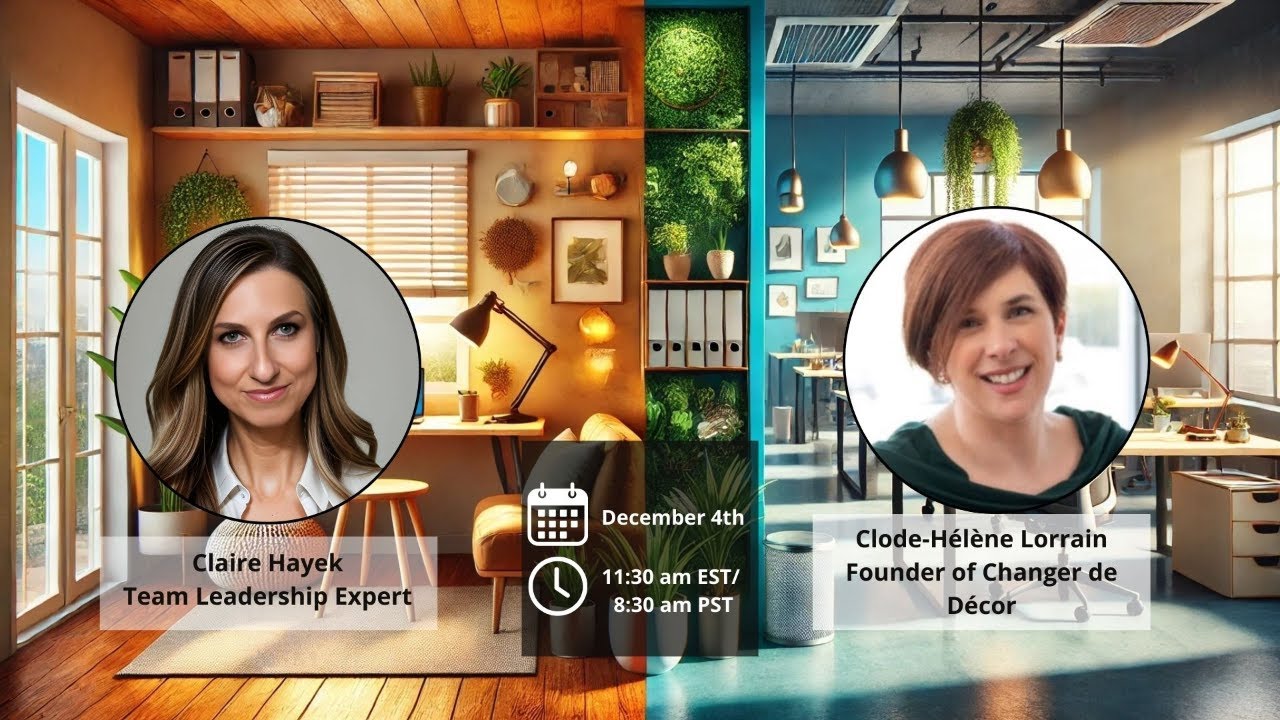
In this 30‑minute live session, Claire Hayek, founder & CEO of MSP Team Building, hosts hybrid‑work specialist Claude‑Hélène Lorrain to explore the biggest productivity and well‑being challenges of hybrid work and practical ways to overcome them. The conversation begins with the “blurring” phenomenon – the loss of clear boundaries between work and personal life that leads to early‑morning email checking, late‑night work, stress, anxiety and burnout. They stress the need for leaders to model healthy habits, such as scheduling messages and respecting off‑hours. The duo then moves to workspace design, emphasizing zero‑cost tactics like decluttering, ergonomic chairs, proper monitor height, lighting, temperature control, and biophilic elements (plants, wood) that boost focus and morale. They differentiate deep work (high‑concentration, project‑focused tasks) from light work (emails, meetings) and suggest distinct physical setups (sit‑stand desks, separate zones) to cue the brain. A striking statistic is shared: after a distraction, it takes on average 23 minutes 15 seconds to regain focus, underscoring the cost of interruptions. Strategies to protect focus include turning off notifications, batching tasks, and creating “no‑cell‑phone” zones. They discuss the mental health impact of commuting, reframing travel time as a buffer for mental transition and encouraging flexible start times. Micro‑breaks, power naps, and dedicated relaxation lounges are recommended to sustain energy. Throughout, they engage the audience with live polls about environment challenges, biggest hybrid obstacles, and ease of disconnecting, using the responses to tailor advice. The session closes with a call‑to‑action: small, low‑cost changes, upcoming webinars on neuroleadership and AI productivity, and a masterclass on sustaining behavioral change into 2025.
Chapters
Hey, hey! Hello everyone, and thanks for joining in today's conference on hybrid work. Very interesting subject, and how we make how we can make both office and home work for you. And of course, I'm here. I'm Claire Hayek, founder and CEO of MSP Team Building and leadership expert, and I'm joined by the lovely Claude-Hélène Lorrain. She's a hybrid work specialist. Hi, Claude-Hélène. How are you?
Hi, Claire. Thank you for having me.
I'm great. Thank you. Yes, it's really a pleasure to have you. A lot of people often talk about hybrid work and how it doesn't work for them or it works perfectly for them. There's a lot of opinions on that. So today we're going to be talking about this and tackling on some of the questions that we often receive or people comment on with feedback when it comes to hybrid work. So really excited. As I find this subject very, very relevant, especially in the setup in a hybrid workspace and how we can better productivity, focus, and mental health. You know, we're all about that. Often we talk about this during these podcasts and my podcasts and lives. So before we start, I always ask everyone to put it in the chat where they're Joining us from. I'm always very interested to know where you're joining us from, and we're excited to have you. And we'll also be throwing some polls at you, so please do participate as much as you can. And I'll be going to the chat back and forth as we navigate only 30 minutes. It's gonna fly by, I promise. So again, put in the chat where you're joining us from. I'm here from Lorraine, Quebec. And Claude-Hélène, actually, you're Saint-Hyacinthe. Saint-Hyacinthe, that's awesome.
That's awesome.
And so again, let us know where you're joining us from and do participate. We want this to be very interactive and let's, I guess, dive right in. I guess the main thing, like I already said, a lot of people find it challenging to juggle hybrid work. You know, one day, 2 days out of the week you're in the office or 3 days out of the week, depending on what formula you go for. And it's kind of hard to change environments and find focus and deal with distractions and managing your energy level because those elements vary whether you're in the office or you're working from home. Claudelaine, I guess the main question for you that I want to start with is, in your experience, what are the biggest productivity and well-being challenges in hybrid work setups?
That's an excellent question to start with, Claire. First, if I may, I would like to talk about the blurring phenomenon. So a phenomenon that existed before the pandemic, but increased during the pandemic. So the blurring happens when there's no more boundaries between personal life and work. So whether you're going to the office or working from home, it's when you never switch off. And the number one enemy is here. So people tend to carry work around So instead of switching off, relaxing on the sofa, for example, in the evening, they will check their emails. We have discovered that the workdays have been increasing since the pandemic. People are taking their emails earlier in the morning while they're supposed to be sipping their coffee and having breakfast and relaxing, preparing for their workday, but they've already started working. And the days also increase. Getting later and later. They're checking their emails very late at night. So this phenomenon, it's super important to realize that there are consequences, very grave consequences on stress, anxiety, and the worst case scenario is burnout. So it's important, I think, for leaders and employers to remind their employees to switch off in the evening and remind them of the policy and their, Expectancy— there's expectations according to email. So this is one thing. And of course, the basics in order to help create those boundaries and frontier is having a separate workspace at home.
Mm-hmm.
But then the trick, it's not only to have the space, it's to respect those boundaries. And again, like I mentioned, not carry work around your home and have dedicated space for work, dedicated space for relaxation at night. And Why not think about a no cell phone policy, like the sofa, for example, or the kitchen table, and no cell phone, just to make sure that your brain relaxes and you get to switch off? And then obviously the key there is to respect those boundaries, 'cause this is the biggest challenge that we see right now, whether you're working from home or going to the office, it's never to switching off. So you're always on, sort of.
Right.
You're not relaxing. And it's hard in the next morning to be fully engaged in your work if you didn't get the chance to relax and recharge fully your batteries. So, this is a big trap actually.
I really agree with the whole boundary thing. Of course, it's something that you think it's obvious. But I think a lot of people have to practice that because we're living more and more post-COVID. I find things change a lot because work was brought home full-time. And that was not always a thing. And people could clock off. But now, it's a very gray area. And I just want to add something. I think it's also very important for the leaders to walk the talk and lead by example and clock off themselves. Because if they're sending emails and messages late at night, then maybe the employee feels that they have to reply. And I'm going to give my example. Sometimes, I'm bombarded in meetings all day and I don't get to do the work work. And We actually use Telegram and I often send a lot of messages at night. Although I'm guilty of that, my team does know that I don't expect them to answer those messages. But even further, what I like about Telegram, even I think WhatsApp or Slack, is that you can schedule to send these messages the following day.
Oh, that's wonderful.
Yeah. So even though, you know, even if you're sending it at night and they feel that You're not, you know, I don't have to reply. She said it's okay to reply the next day. Just getting them is a bit stressful on them. And I'm guilty of that. I need to apply the schedule send more often and make that extra effort that they only get it in the morning. But there's tools basically to help us through it. But it's the leaders as well. It's not only one way, right?
Totally agree. And it's to develop that discipline to respect those boundaries then in terms of time and space. So I mentioned, Take bringing work into the personal space, but same goes if you want to be fully productive. Don't bring personal tasks or chores inside your professional zone or space.
Mm-hmm.
For example, I said develop the discipline of answering emails in your workspace at home, but same goes if you want to book a dentist appointment, for example. Well, get out of your office because your office is a dedicated space. space for your professional life. So it's just developing those new reflexes and respecting those boundaries. And something interesting about workspace and to see your workspace differently and with a new set of eyes, there's Sonia Lukian who talks about, who's a neuroscientist, who talks about deep work and light work. Deep work is when you fully engaged, you are 100% concentrated. This is the work you wanna do for your special projects, let's say important projects for the company, the projects you've been hired for versus surface work. Light work is like answering emails or participating into a Teams meeting. This is light work. You don't need 100% focus for that. And then I think what's interesting, if you want to be productive, define a setup at home for deep work. For example, there is those sit and stand desk. Why not considering sitting to do your deep work, to be fully focused, and then try to stand up to answer emails or to participate into Zoom or Teams meeting? So think differently. This is what we do in the office. We change. We have meetings in the conference room.
Right.
We have meetings in our, you know, in different areas. So why not rethink inside your professional area or your office at home, different setups for different types of work. So this makes it interesting. And for the brain, it makes it much easier to become productive. So if you always sit down to do deep work, then it's easier for the brain to switch and say, oh, we're— we need to be fully focused. This is important. This is not light work. And again, those L-shaped desk, you can do deep work in one section and do your light work in another section.
Yeah.
Again, if you need to do creative work, perhaps you have space in your home office to have this spot to do creative work or have a reading nook or something like that. And I hope that companies will also consider having different options for their employees that come to the office. Some employees are not meant to work and to be to be able to focus fully in open spaces. So why not offer them some, I don't know, booths? I've seen that, little booths where they can focus and do their deep work there. And it's clear, everybody knows if you're sitting there, don't go bother, don't go disrupt that person.
Right.
She's doing focused work. So giving options also, because we need, we know there's different type of works, different type of settings, and this is what makes it interesting. Deep work, the key, obviously we're talking about productivity. Distractions. Oh my God. This is the biggest enemy to focus and productivity.
Absolutely.
Did you know, Claire, it has been studied 23 minutes and 15 seconds if you're distracted, if you're doing focused work to regain your concentration, if you get disrupted or distracted, 23 minutes, 15 seconds. Okay.
Hold on. Hold on. Hold on. So it takes 23 minutes and 15 seconds After you got distracted, it takes that much time to gain your focus.
Crazy, eh?
Amazing. So basically, if I can just deduct here, deduce or the conclusion is that we're pretty much never focused because we're literally being distracted every 5-10 minutes unless we make that space. And we turn off notifications and we don't look at certain, we don't multitask all over the place. And we just Completely focus on one task for 30 minutes or 1 hour, right?
Exactly. And again, I think it's good for employers knowing the statistics, for employers or leaders to tell their employees, you know, if you're doing deep work, we're good if you're not answering your emails during 1 hour or 2 hours because you're contributing to the success of the company. You're doing your job. You're doing the job you're supposed to be paid for. And this decreases, of course, stress if you're advancing on your projects and you're fully focused, fully engaged, not distracted, not disrupted, then of course, you know, you're more productive and everybody wins at this. So again, distractions can be from home or in the office also. So this is just to name it and to be conscious of what's happening and to try at home to talk to family members and make sure they know you're doing focused work, deep work.
Right.
company also when you're in the office to have options for employees to be able to do that deep work without being distracted.
Distracted. Great.
Distracted. I have—
thank you so much. I have a poll question here I put up on the screen. I would like to hear from our participants today, people that are here listening to us, or even if you're watching this at another date or listening to it at another date, which environment do you find more challenging? the home environment or the office? And please do put it in the chat, home or office. And if you want to elaborate on the why, we'd love to hear from you. Let's move on to the next question. The time is flying by, and this is definitely more of an hour live than the 30 minutes. But, you know, we'll do our best to respect the 30 minutes. So obviously, we've seen that hybrid work is challenging. Believe it or not, this is a big, big adjustment that we all had to do. And one of the keys of succeeding in hybrid work is having that workspace that helps us focus, that deep work, what you mentioned, and to enhance the mental well-being. What design elements— let's dive deeper here, Claudelaine. So you did talk about this space, but we want to know what are the design elements that people should prioritize to create that environment where we could be productive and we can have that deep, deep, deep work or light work, whichever one. But what are these main elements?
Well, first, I think the most important, which costs $0, is clutter. We have no idea how clutter can decrease your productivity. It has been evaluated between 15% and 30%. It has been tested in labs where participants were supposed to focus on one task, but in a cluttered environment. And a part of the brain, even if you think you're fully focused, is actually analyzing all the clutter, all the items surrounding you. Interesting. Yeah. So if your, let's say, deep work setup, please try to declutter. It costs again, $0, just a bit of time, but clutter is one major aspect that I would address. And then, of course, same thing. If you're not comfortable, if your chair is not properly adjusted or not comfortable, a part of your brain is going to focus and lose energy on that pain or on the fact that you're not comfortable. So, again, there are professionals that can go to the office or come, come to your, your place to set up your, your work environment and make sure you have a good chair adapted for your needs, because we don't want employees to be hurt anyway, because we spend a lot of hours sitting on that chair.
So that's the ergonomic aspect of work. But, you know, also, it's something that people can do easily. Right now, you can ask AI to help you optimize. You can describe to AI what your office looks like and how you can declutter it, or maybe how to adjust the thing. What are the main things that you have to do? Where the screen needs to be placed? How high? How do you sit? Where's the keyboard? Where my hand needs to land? Google can help too. There's charts. So, if you don't have the budget as a leader, as a business owner to pay for this service for your employees, you can at least provide them with some kind of tools for them to set it up because you're helping them help themselves, right?
Of course. That's an excellent point. Yes, there are so many options. And then, something that irritates people is lighting.
Yes.
And temperature. So at home, it's easier to adjust the lighting. They're super important. But then in the office, if, uh, we can set up some options, because some people get warm easily, they get cold. So it always comes. That's one of the most irritating aspects that people mention in the office. So little thing again, if the lighting is not adapted, you're not fully focused on doing your work and you're not as productive. Another key thing is biophilia, which is the art of bringing in nature inside your office.
Mm-hmm.
So, um, wood, a little small elements of wood, plants, and of course natural lighting, which I'm so blessed to have. Uh, and again, studies have shown that integrating plants and natural light can increase 15% your productivity. So, you know, it's not nothing. Again, colors, you can play with colors. A big no-no is gray. Apparently a study has showed that gray is like fog. So it fogs your brain. They say it's harder for people to make good, clear decisions fast in a gray environment.
So interesting. This is very interesting, Claudine, because we all know that a lot of offices are gray. I know. I worked for 20+ years in offices before I went to hybrid and like fully remote now. And often, you know, there was cubicles back in the day. It was gray, you know, and we're always freezing. Women were always freezing.
Right.
Being very specific because our body temperature is not the same as men. And apparently there's a study that designs in HVAC in buildings and building engineering are based on statistics and averages for body temperature based on men and not on women. And there's a whole movement now on that because it's It should be somewhere in between, you know, gender equality here. But all this to say that, that's— I think we're— I'm glad to hear this because at least we're talking about this. It really explains a lot of stuff now, looking back going, hmm, I see.
There's space for improvement, let's say.
And yeah, but if we don't know about it, then how can we improve it? You know, we might just complain and put all our energy on complaining, but not knowing how to change it besides just bringing a sweater or a little heater or wearing thick socks and all that. Or maybe somebody that has high body temperatures, are always hot. How do you do? Like, how many layers can you peel off before you're naked? So it's extremely interesting actually that we're talking about it. This is the whole point of this conference today is to be able to talk about the elephant in the room and the little details that really make a big difference in productivity and focus. Exactly. Yes. Yeah.
Yes. And we just want our employees to be full of energy, not lose that energy, you know, not being comfortable or not being well. So yeah, very important. And if I can add just another detail also, don't forget in your home space or your office to integrate joyful decoration elements, you know, to inspire you, to motivate you, to remember why you're doing the job you're doing. So again, not clutter. But little elements that were chosen and right elements to support you.
And yeah, I have my plant right here.
Yes.
And actually, um, you probably can't see the rest of my office, but I have another plant on the right, another one by the window. These are my buddies. They really help me, you know, detoxify the air in the office, but at the same time, just like, you know, bringing nature in for me. Personally, that really helps me just focus in a way, just makes it more lively. And light is extremely important. Like you said, Maaike, I'm very jealous of your lighting right now.
Very lucky. And then you can't see my plant, but I have a plant. And yes, so it's little elements. And again, it's a way of choosing and picking your space if you can. This is why I picked this space for my home office. It's tiny, tiny, but very efficient.
There you go. So it's not about having a lot of space. It's about having the right design, the right space, the right elements. Even if you have a small room, that makes the whole difference from what I see. But here's a poll question for everyone. What's your biggest challenge in hybrid work? Distractions, comfort, or focus? We really want to know what you think. Please do share it in the chat, and I'll be addressing the chat just a little bit later. As well as if you have any questions, do put them in the chat. We'll be bringing those up for Claude-Hélène to answer before we wrap this up. Again, we have about 10 minutes left. So moving on to the last question for today. We know that working in hybrid, so whether you're working from home or whether you're working from the office, can affect mental well-being. You know, just the stress of having to go to the office. It wasn't even a thing before. Now it's stressful because we had the chance to experience working from home and how pleasant it was, or for some people, very unpleasant, right? I mean, we can't go on one end. Some people hated it and some people loved it, right? So just going from one to the other could be stressful and could have an impact on our mental well-being. So how can leaders and employees maintain that mental health while balancing, you know, the expectations of hybrid work? Some people have to drive for an hour. Some people have to take the train. They don't want to take the train. They have to rush out of the office to get back home and vice versa. You know, so how do you— how can we maintain that mental health and balance it out?
Excellent question again. And you've just mentioned the train and the commuting. Funny enough, Claire, the thing that people missed the most when the pandemic started was commuting. Because this is how we are made. We need a clear transition between work and home and vice versa in the morning between personal life and work.
Yeah.
So we need sort of that buffer time and space to shut down and to send a clear message to the brain, we're driving home, the workday is over. And this is a real, opportunity. This is what— and this has been studied— driving or being on a train is an opportunity to disconnect. So while you're driving, you're focused on the road, but you are not working.
Right.
Which is one of the challenges if you're home and you're working from home. You didn't have— you don't— if you don't give yourself a chance or a space and time to truly disconnect and mark the beginning of your day and the end of your workday, this is where Well, exactly what I've mentioned when we started, the blurring, and then you get tired, you don't disconnect properly.
Right.
So you really need this transition, even if you're working from home. And one advice that I give is try to keep the same morning routine, whether you're driving to the office or staying at home, keep that same routine. 'Cause for sleep, we're supposed to go to bed at the same time and, you know, wake up at the same time to keep our cycle. And then, Keep the same routine, but then the mornings that you stay at home, this is like bonus time. The time that you commute is bonus time to take care of yourself.
Right.
Whether it's to squeeze in a training that you don't never have time to do. Is it to do a yoga session? Is it to go for a walk and listen to a podcast? Again, reading. People always say, oh, I read at night right before I go to bed, but I only get to read 1 or 2 pages. Why not try it in the morning? You know, it can be work-related or totally personal. But how about using this so important bonus time to take care of yourself?
And one thing to add here is, as I speak to a lot of clients and the realities are not what it used to be when it comes to commuting. Right now, a lot of organizations, what they're doing is they're allowing flexibility in what time you actually show up at the office. So if you have to do the commute, And waste an hour and a half in traffic. You don't have to do that anymore. So, people get up, let's say at 8. They tackle on some emails. They start their day at 8 knowing that at 10:30, then they're going to be disconnecting. So, they show up at 10:30. Maybe it's a 20-minute or 30-minute ride, a non-stressful ride because now there's no traffic. So, they're being more efficient with their time. But what you're saying basically applies to that. But all I wanted to add is From what I've learned, and I was very surprised about this, that it's way more flexible now. And leaving earlier, if you're, let's say, really outside of the city and you don't have a way to take the train and disconnect and you have to drive and you hate driving in traffic, a lot of employers, thank God, are accommodating that. And I think that's very— that's a great way to recognize the team and recognize your people because recognition is not only monetary.
No.
you know, allowing that flexibility and investing in people's mental health, as simple as allowing them to come in at a certain time that is not, you know, official time of when the work starts, right?
Yeah, love it, love it. And I hope a lot of companies can get inspired by this and do it. And then again, we're talking about flexibility and wellbeing. I think as employers, as leaders, to remind your employees Whether they're working from home or at the office, to take breaks, like micro pauses and micro breaks. These, for some people, it's still counterintuitive to take breaks, but this is the key to productivity. We need to recharge our batteries. You need your brain to rest. So just challenge yourself. If you don't take any breaks during the day or just at lunchtime, just challenge yourself to squeeze in one. You know, per day, and one in the morning, one in the afternoon, in a couple of weeks. So try to incorporate breaks. And again, for companies to remind their employees to take breaks, and when they come in the office, to encourage them to take breaks and to, yeah, you know, talk among themselves. And this is the—
Bring back the, the water fountain. Yeah, no, let's meet at the water fountain. I mean, I don't know if that exists anymore, but—
or the coffee Coffee machine.
Yeah. Just talk, talk, just talk, just talk, you know, or maybe even when you're having lunch, you know, take, even if you don't have time, take 10 minutes, go to the cafeteria or, you know, take the time to sit down and consciously eat. It doesn't take an hour to eat. You don't need, you don't have an hour, but at least take that quality time. Don't eat in front of your desk and work and all that. Yeah, for sure.
And again, for the brain to rest and to reengage when you're back In front of your computer, you know, you need that break anyway. And of course, I think working from home has its advantages. So if you, you have energy level fluctuates throughout the day. So if you're at home and you have that flexibility, if you need that power nap, take that 20-minute power nap.
I love that. Yes.
And you know, if it's in the morning that you need it, take it in the morning. If it's It's just right after lunch. And I hope to see more and more in companies those relaxation lounges. So, you know, so that employees don't feel judged. Some have just had babies, had a rough night. Maybe they need that power nap and they don't need to be judged. So I hope that we see that flexibility all through the spheres, whether you're at home.
We see that a lot in tech companies.
Yes.
You know, but a lot of other industries are really catching on and providing these spaces. And it's so important, Fredelaine, what you mentioned here because you— the judgment factor. And I often talk about that, creating that safe space where trust is implemented.
Yes.
If you're not trusting your employees that they know what's best for them, but they're not taking advantage of what you're offering them, if there's no trust, I don't know why they're working for you.
Right.
And if you're not providing that safe space and stop micromanaging everything, then what are we doing otherwise, right? It's very important to provide the ability to let them just say, by the way, I did this yesterday with my team. I needed to take a walk and I wanted to go for a run. I didn't get to do it in the morning. And I really said, I need to do it. And I was completely very busy. I had no time. Like, I'm gonna block 1 hour for the sake of my mental health. I, even as a boss, it's not because I have better options than them. They could do that as well and they know it. But the difference is I let them know. I said, from that time to that time, I'm going to be taking a walk. If it's an emergency, you can call me. I'll have my phone. But just so you know, I will address your messages when I'm back at X time. So, being also responsible. Take that break. Just let people know. Don't just disappear, right? Yeah, no, no. It's not taboo. It's nothing wrong with that. And we need to start doing that and just relaxing, for God's sakes. Oh yeah, please. It is kind of crazy. And I can't believe it's already almost noon. But extremely interesting. And I put up a quick question here. Last poll question. Do you find it easier to disconnect after work? You know, once you're done working, do you find it easier when you're at home to disconnect or more when you're at the office? to actually disconnect? That would be really interesting for us to know. Please do put it in the chat.
Yeah.
And I'm gonna just go to the chat quickly, see what we have so far. Um, and I forgot to mention, Connor is always minding our chat. He's a part of MSP Team Building team. We'd love— we always love to have Connor here. And thank you for participating, Connor. I know there's a lot of people here joining us but not sure, not a lot of interaction, and I understand. I know it's the end of the year and everybody's busy. But thank you for joining us. And some of the things that Connor mentioned is that, you know, he finds commuting is tough and it's the distractions on question 2 that we put up. And as far as disconnecting, he finds that it doesn't really matter whether it's in the office or at home, that he's— the important is to have a dead stop time.
Mm-hmm.
It's helpful. And I agree, Conor, from somebody that is part of your team, I totally agree with that. And I do respect my team when they say, it's a dead stop for me. We'll see you tomorrow. Love that. Love that they're able to do that. And that's extremely important to take ownership of your time. So quickly here, I want to share a couple of information. We do have a webinar Tomorrow about— give me a second here. My captions are off. There we go. So we do have a webinar tomorrow, basically Thursday at 1 PM EST on neuroleadership and AI productivity, which kind of helps because we're going to talk about how we can also leverage AI to make sure that we're creative. Please— sorry, productive. Please do scan it. Do join us. You have to register. If you want the replay and you don't have time, Do register because you will get the replay only if you register. All right. And I do want to take the time to talk about our next LinkedIn Live. That is next Wednesday. We always, we're going to have 2 more next Wednesday and December 18th. Next Wednesday will be on how to stay productive without burning out. I think it's very apropos for this year. And Finally, I do want to give you a couple of minutes here to see if we have any other questions. And at the same time, let you know that if you want to know a bit more information about hybrid work, how we can improve our hybrid work experience and make our workspace more productive, any information that Claudelaine can provide us, please put in the chat hybrid, the word hybrid, and we'll get back to you for more information. And Before I move on here, uh, Claude-Hélène, do you want to say a couple of, uh, you know, some last words before we conclude?
Well, I think, um, well, you know, the, the year is gonna end very soon. I think little changes all add up. So if you can, if I can challenge you, the people, just make one small little change, you know, one small little change. Test it out before the year ends. And then maybe challenge yourself to make another small change in 2025. So I think it's all about little changes. Everything counts. It doesn't need to cost money. It often doesn't cost any money. So it's all about small changes and have fun with it.
Yeah, I love that. I love what you're saying about small changes. Actually, we're going to be tackling this on in our webinar and we have a masterclass coming up in January. We're going to talk about how do we make changes and hold on to them. And we're going to, you know, we're pretty much merging neuroscience and neuroscience tools that will help people retrain their brain because it's, you know how it is, everybody's excited to start the year and go to the gym and make changes and we're all motivated. And then I don't know what happens a month later and everybody drops out, you know. So we're going to be sharing these tools tomorrow and some tools tomorrow because we don't have, nobody have any. an hour and a half. But in the masterclass in January, we're going to have a whole session on that so we can be productive and happy and take care of ourselves and make it sustainable throughout the year and how to hack our brain in order to help us. So, Claude-Hélène, thank you so much for joining us today and providing all these gold nuggets. This is exciting and very important subject to talk about that often I find people don't look at. And take for granted. So I'm glad we are shedding a light on the necessity to look at your work environment. And we have an expert right here that can help you along the way. So thank you for gracing us with your time and sharing your expertise and adding value to our audience. I really do appreciate it. And happy holidays if I don't see you again.
See you too.
But we should connect before year end. Again, I'm back on the 11th. For another LinkedIn Live. And believe it or not, also on December 18th. And that one we're going to tackle on the future of leadership and how we can prepare for 2025.
Again, thank you.
We're done. Over 5 minutes.
Okay. Knocking it off.
More from Claire


25 years in cybersecurity taught her this about staying calm under fire with Jonna Garber

Pause and Assess: The 10-Second Technique to Stop Over-Controlling Under Pressure #shorts


UN Mission Director On What Real Calm Under Fire Looks Like With Fredrik Sandvall





Book Signing at AIFEC Bogotá | What Pressure Does to Leaders and Why I Wrote This Book #shorts