Stop Saying “I’m Not Creative”—Lead Like One with Betty Zhang
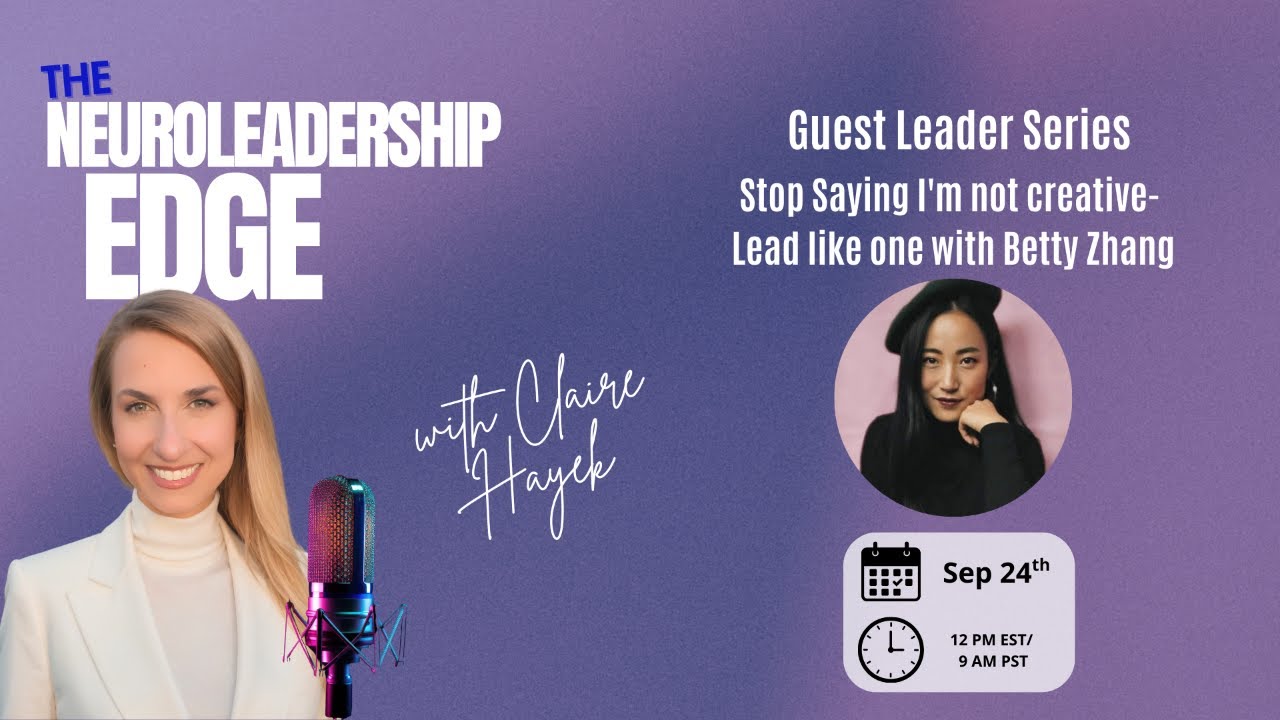
Betty Zhang, head of innovation at Kids Help Phone, explains why creativity is a leadership skill anyone can develop. She shares two neuroscience techniques: a 6-8 second exhale to calm your amygdala and a 60-second quiet start before problem-solving. Her path from art school through graphic design to innovation operations shows how creativity shifted from making visual work to strategic thinking.
Chapters
10 hours into a brutal Patagonia climb, wind in her face, and no easy way out. Betty Zhang learned the leadership move that changed everything, one clear step at a time. Welcome to the NeuroLeadership Edge podcast, brain science for bold leaders ready to master their mind and own their I'm your host, Claire Hayek, NeuroLeadership expert and founder of Mind Soul Purpose Team Building. Really excited for this one because it talks about creativity. And you know, I'm all about that. So, by the end of the episode today, you'll know how to lead through the unknown without freezing, how to pull real creativity out of your team even if no one calls themselves creative, And a 5-minute warm-up that makes meetings more fun and smarter. If this is really sparking some interest, join my free webinar on September 10th, Own Your Voice, Master Your Mind. We're going to build your personal plan to stay calm and clear under pressure. And if you see, I have a code up here. You can scan it to register. And if you can't make it, you'll get the replay. But you need to register. And I will share the QR code later in this episode. So today, we're talking about defining creativity as a leadership skill, not a job title, with our very, very interesting and creative guest, Betty Zhang. So a little bit about Betty. Betty Zhang is a product and experience strategist, currently the head of innovation operations at Kids Help Phone. She has over a decade of experience in transforming emerging technology into impactful experiences. and leading products that drive purpose, positioning, and engagement. She thrives in the process of bringing ideas to life. Hi, Betty. How are you?
Hi, Claire.
I'm so, so happy you were able to join me today.
Thank you.
All right. So let's dive right in. Let's talk about that pressure-filled moment that shaped how you lead today.
Yeah. That pressure-filled moment was a long-awaited bucket list item of climbing Patagonia. I have always loved mountains and Patagonia is just a dream. And that, that moment definitely turned out harder than I thought it would be. I don't know why I thought it would be manageable and it might have turned out to be the hardest hike I have ever done in my life. But I, I think I've learned a lot about myself by spending alone time with myself for 10 hours a day for 4 days, uh, in the beautiful mountains. And so, uh, when I was hiking with people, I had really met and went with people of all kinds of physical levels, people who went for different reasons. And I became a little bit of a helper to my friend who had trouble Hiking through some of the days and really learned about how to empower other people while providing help. And the one step at a time is true because, uh, at some point, you know, as the winds are going 100 kilometers an hour, all you can think about is to just keep walking because you have to make it there by a certain time before it gets dark, and then you have to make it back. So one step at a time was the, the true factor in that climb, and it really just helped me find my inner sort of endurance through something like that was really difficult and realize that the journey really ends to that beautiful ending that I actually want to go back. But yeah, that's a difficult hike. Yeah.
I mean, this is really fascinating. You know, you don't get to meet people that have done that every day. I mean, I don't. You hear of people that have done that, and now we all know. We all know you, so this is great. This is a big treat. And how, how did it feel like when you, when you got to the end? You know, when you— the whole experience, I mean, how did it feel? How did you feel?
Breathless. Uh, not because I was hiking for 10 hours.
Breathless, literally and figuratively.
Yes, exactly. Definitely just the view took my breath away. The easiest way I explain it is that oftentimes you see these pictures on Pinterest and you're like, I wanna go. And oftentimes you get there and it's not the same. This was the same and bigger and better. It was breathless. It's— I love realizing that I myself, or humans in general, are so small in the face of nature and the world.
Mm-hmm.
And it almost instantly makes me feel like problems and the things that kind of build up to your ego are very small things in life, and therefore Maybe it doesn't matter. So I loved feeling small in that moment and breathless.
Yeah. I mean, you know, it puts things in perspective, definitely.
Yeah.
How powerful nature is. And I find it fascinating. Thank you so much for sharing this story with us. I mean, I find like I have so much respect for people that do this and hats off to you. I just want to like Weave in a little bit of neuroscience into this because often, I talk about high-pressure moments and how you are able to— you can pause and quiet your mind and tap into your power in a way, whether it's you need to be creative, whether you need to explore, whether you need to make a decision. If I do the parallel with your journey there, you quieting your mind must have helped you because it puts you into your prefrontal cortex where you're able to make a decision and with all your being and your presence decide to move forward, you know, to continue with those little steps. And it's something that we see in the brain. You know, we can— we have like 2 modes that are very helpful, the explore and the decide. And where when under pressure, the brain can just go quickly into Too fast into deciding and lose the ideas or the creative way of going about it. One little tip here I want to share with everyone. You can do 2 little resets. And what is as simple as one long exhale to the count of 6 to 8 seconds to just calm the body so your thinking opens up. So, you remove everything from the amygdala and you bring it back to the prefrontal cortex, the CEO, which really can make— Calculated decisions and be more reasonable. And I think a lot of us do it already without knowing. You know, when you're like under pressure and you're just like kind of a long sigh. So, it's even better if you're breathing in and consciously taking a long exhale. And the quiet moment that you shared, those quiet moments. Another reset is just take 60 seconds of quiet before you just jump into problem solving. And that pause will Will really just boost ideas and clarity. So anyway, let's, uh, again, this is me geeking out on neuroscience so you don't have to. You can thank me later.
That's really interesting because I had never thought about that. And I just took a deep breath because it really helps.
Yeah. And when we end, you know, Betty, it's simple. When we, I mean, for me, when I understand what's happening physically, I feel I could, I can use it more often and I will remember it. You know, it's because now it—I'm forging these neural pathways into this method that I call reset, and now I called it out. So it's in my memory, it's in my brain, and it's probably something that if I practice it and practice not probably it will. The more I practice it, it'll just be second nature. So instead of just relying on your instinct that sometimes if you're really too panicked that you're You're completely not thinking and you're probably not breathing. But when you know it's a tip and you can use it, you will go there. Your brain will remember and go, okay, survival here.
Boom.
You know, it'll bring you there because you've practiced it enough. It's fascinating.
Yeah.
So I want to go back to your career, your story. So that's one thing that really intrigued me when we met. You told me about your different careers, how creative you are. And this is why I wanted to shape the episode around creativity. So, people ask if you miss being creative. And you told me that you say you lead creatively. So, what changed in how you define creativity now as opposed to maybe at the beginning of your career?
Yeah, and if I can take some time to go back to sort of explaining my journey there. I had been educated— I went to OCAD University here in Toronto for illustration, and that is kind of a combination of art and design, I would call it. And so, back then, a lot of people would say, you went to art school, you're creative. And so, I went into it. And after that, I had worked as a graphic designer. I have worked in painting, Like my own paintings and then selling my own paintings really in the creative industry. And then I also did my master's at the University of Arts London in London, UK, and that was a Master of Arts as well. So very much art school, but it was called interaction design. And I think if you look at that purely I am very much a creative, but somewhere along the way, right? I just say my credibility before I say, yes, I'm creative.
I mean, it's fascinating. It's fascinating. How do you go from there to Head of Innovation Operations? I mean, I get the innovation, right? Yeah. Just let's make that link. Like, how did that happen?
Yeah. So along that career path or school to career path, I have also worked a lot of, uh, in startups. I have founded my own startup. I have worked with a lot of brilliant people who bring ideas to life. And I think this is where I truly learned the application of creativity.
Right.
Uh, that isn't drawing or creativity as a lot of people who asked me that question say. So I went through a period where I also had to redefine creativity and what that meant in my life as an identity and as a career path. I knew that I wanted to continue being creative. I loved being called a creative, but I had also humbly realized that I am not the best creative director there is. That of all the people that I've worked with, or I am not the best graphic designer. So, okay, where do I go from there? I, having worked in with startups and within venture studios and kind of that world, uh, I've developed on the side some of these skills around bringing creative minds rather than the creative deliverable to my work.
Mm-hmm.
That's where I guess I had the mindset shift of creativity isn't you producing something just because it's colorful or visual or sound. Creativity is really problem solving, and it is possible to do it in many other ways. And I think a lot of people don't realize that. So they say that they're not creative when they're in fact doing something very creative. So that was my mindset shift. It made me feel a lot better about not being called, not even having the word design in my title. That was something that was a little bit scary for me, but I love the type of creativity that I do as a strategist and as an innovator every day, because you have to be creative nowadays to really solve the hard problems that are out there.
That's it. And you pretty much really summarized it. A lot of us think that being creative is this thing. We are creative beings naturally. Again, bringing it back to the brain and brain science, there's the left hemisphere and the right hemisphere, like the right brain and the left brain. The right brain is more related to creativity, innovation, etc. And the left brain is more analytical. we pretty much live there most of the time. But you're also, you're not 100% in the left brain and 0% in your creative brain. Like naturally, the brain is both. It just maybe you have more gray matter in one than the other because we just practice it more. We don't tap more into our creativity. But we're all born creative. And most often when I work with teams and leaders, I mean, we throw challenges, creative challenges at them because I find creative challenges and workshops and hands-on tools really gets you out of your left and into your right brain. And what that does, it just taps into huge potential that you never explored. And, you know, we get people to rewrite lyrics of songs. We get people to— leaders, you know, CEOs, C-suite— just to interpret a song, bring a live studio in. I mean, these people never probably sang in their life or seen a microphone or approached a microphone. They're so scared. And we're talking about Leaders that are fearless. But then, the minute we challenge them to tap into their creativity, they freeze. The reason is just lack of practice. But it doesn't mean it's not there. And one way we do it actually is Lego serious play. The minute you bring the Legos out, which is Lego serious play, is a tool that we use for corporate. Corporate, obviously, it's serious play for— called serious play for a reason. you bring out those Legos, everybody gets to be creative. Everybody, like instantly. Nobody's saying, I don't know if I can. No, you just completely dive right in. So, it's just that memory of maybe remembering how creative we were when we were kids and just tapping into that. As far as you're concerned, you know, with your career, I mean, it's fascinating because you're able to draw from that rich, creative, highly talented Talent, your talent, and bring it into your basically career right now without having to separate yourself. And this is where the power is when we tap into our full potential. I love that. And I'm really curious. I'm thinking of Googling you later and maybe look for some of your paintings or designs. I would love to, if you want to share it with us in the comments after the podcast, would love to have you have you feature that if you want.
Thank you.
Throwing it out there. All right. So, a lot of leaders right now are facing a lot of challenges, complexity, disruption. I mean, I'm not gonna go into details. There's so much going on. And I think we can all use the help. And I'm really curious to know, what do you wish more leaders understood? that are facing these challenges nowadays?
Yeah, I think this was one that I had to understand myself for my own well-being. And then I understood as a leader. And I think it helped me build more empathy towards the people that I lead. So the thing that I will say is that your work or my work outside of work is not your whole identity. And I had to— I was very focused on my work and my career for a very long time. And I was focused on art for a very, very long time. And when it came time that they became conflicting for my time, for fighting for my time, I really had to rethink who is my identity. And now I am always thinking that for anybody, Really, work is not yours or their entire identity. They are whole other roles outside of work. They're actually probably being creative in many different ways outside of their work, whether it's creative or not. Uh, you know, I'm a parent, so I'm creative every morning when I have to find a way to get my daughter to go out there and get to school, you know?
Absolutely.
Yeah. So it makes me think, one, creativity is such a wide term, really. You have to be very creative in many ways. And also, I do find that just because maybe they don't have a leadership title or you are a lead to somebody, that doesn't mean that they are not leading in a different part of their lives. Right. So I also feel very humbled by that. And I like to explore where other parts, other people are leading in the world, because that can say a lot about them. And that's why I say the most important thing that I think I would love for people to know or align on is that work is not your entire identity.
100%. I couldn't agree more. You are speaking my language, Betty. You and I see eye to eye. I know a lot of you know I'm a singer-songwriter as well as an engineer. That's what I studied. And now I'm an entrepreneur. You know, I'm—
Yeah. I was gonna say, that's probably—
Etc., etc. So I totally understand what you're saying. And but the thing is, like, if I'm being really vulnerable and honest with you, I struggled with that for a long time because I felt like I had to decide between one or the other, you know? And I think it takes just a bit of time for us to understand how to tap into everything that we are. And I often talk about, you know, the tunnel vision of our life. You know, when we go to school or, you know, we're taught, you know, what do you want to be when you grow up? And You know, I always wanted to be everything as much as possible. And I talk about, you know, the tunnel vision and then the panoramic view of your life. We are all of this, all the way right, all the way to the left and everything in between. And we don't have to just stick to this. We just have to open our eyes and explore. And there's no shame in that. And this is, I think, the main message. And thank you for sharing that because the more stories that we share like that, I think we can help. You know, people may be wondering and rethinking their career right now with everything going on with AI and all the disruption. And I'm not gonna just talk AI, just a lot going on. And even sometimes when you retire, you're like, I don't know, I've just done this. You're way more than that. You just have to explore. You need to tap into your creativity. We are endlessly creative. We could be a lot of things. And it's never too late. And that actually makes, as far as leadership is concerned, if you are able to tap into your panoramic dimension, man, you'll be unstoppable. And this is where we should be playing. And right now, we think we're playing all that. And we're already playing small when we don't tap into that. And again, bringing it back to the webinar, we're going to be looking at talking about that is the true meaning of Owning your voice is being everything that you are. The voice is in a way figurative way to portray that full potential, right? Let's keep going here. Do you have like a fast way or tip that you can share with us or any leader out there listening how to spark creativity within your team or during meeting or when you really need to brainstorm something? How do you do it? We're just curious to know how you do it.
Yeah, and I guess this is kind of connected to the last question that you had for me, Claire. I think those other things outside of people's roles really make how they think and really change how they're creative and how they do their job. And so my fast tip would be that if you're ever stuck and want some spark of creativity, bring different minds together, people that maybe you don't usually work with or talk to together. Have a collaborative talk, workshop, drink, whatever it is, to just really hear from other people because their life experiences and their work experiences both can inform what you do and hopefully help you spark creativity. Change your scenery even from sitting to standing up, or oftentimes I have my meetings and one-on-ones by going for a walk because it just makes your mind be in a different place and think a little bit different.
100%. I mean, you're right on. Right on. Diversity definitely of opinion. You don't want to surround yourself with like-minded people all the time. Like-minded is good but not every time because you do want to challenge. You want to explore. Remember, like we talked about the explore side of the brain? You want to be able to explore as much as possible. If the person stimulates our vision and our creativity by opening it up, to a panoramic view again, the more the merrier, right? Because we're just all operating from that dimension, which is amazing. And I love the change of scenery.
Love it.
That just makes total sense. Now, it's time for our little rapid-fire Bold Truths. So, just a quick reminder, 30-second answers. There's no wrong or right answer. It's just whatever comes to mind. Are you ready?
I'm ready.
Okay. So what's the biggest myth about creativity and product/innovation as far as you're concerned?
Definitely that you need to have the title. That you need to have the creative title in your work, your role, or the title of innovation or product. Or that you have had to go through a certain type of education. Again, what you are powerful in telling is your Experience and your mindset and not the label. Right.
Yeah. So, if basically somebody doesn't have the title, it doesn't mean that they're not going to be the perfect person to bring that creative element to a certain project.
Yeah.
I love that.
Okay.
Next one. First sign that your team is playing it safe as far as creativity and brainstorming and being innovative.
Definitely at the beginning of any workshop, I have always experienced experience, you know, people are afraid to speak up, people are quiet. And I try to take that silence and understand whether that is thinking silence or is that I'm afraid to talk or I don't want to, I'm not comfortable silence. And based on that, I adjust either our environment, our activities, or things like that in a workshop format. But I know that as the operations title in my title, a lot of my day-to-day is the operations and not always the innovation, cool idea part. And I can always tell that people are not comfortable when they are so deep in solving a problem that the focus isn't coming out and they just need their way to be cleared.
Right.
And so, as a leader, I think it's also my job to clear the way for people to be able to do their job and operate. As I believe that they can.
So, like the overthinking part, you can feel that they're overthinking and they're playing it safe. And so, you're basically— what you're saying is your tip on what you do is you create the environment so they could feel that they could speak up and say it even though probably not the best idea, like creating that psychological safety. Okay, awesome. And I love— again, I'm going to bring back what you said. Change of scenery. Sometimes, you know, in an office, you feel like the tension. Just like, okay, let's get out of here. Let's go for a walk. And that completely changes everything.
Yeah, I love that one.
I want to bring it back. That's why. So, great tip. Third one, book that rewired how you lead.
So, there's 2 that I've been reading, both under the same topic of communication. I am right now in the middle of really learning and relearning communication with people around me, whether that's work, or life. The one that I'm reading right now is called The Next Conversation: Argue Less, Talk More by Jefferson Fisher.
Okay.
That one is very specific to arguments, negotiation, things like that. And then there was one that I read before that called Super Communicators by Charles Duhigg. And that one was a little bit more broad, but very, very enlightening in just thinking about how to communicate, how to understand other people, and how to change some of the habits that we've been told and taught when we were young to really stand your ground but also be someone who is pleasant to be around at the same time.
Absolutely. I love these books. Like, from what you're sharing, they sound really interesting, especially the second one. That one, I could see myself reading it. It's basically what I always preach. All of these patterns in the way we behave or our triggers, they're just so encoded in our neural pathways. But we— the good news is the brain is neuroplastic and we can rewire these. But we cannot rewire something we're not aware of. So mindfulness and mental fitness is important because that's how you can rewire and be and transform who you want to kind of be moving forward. You're not stuck with your old self. Never. You just have to make a decision if you want. Great. Thanks so much. So I'm going to put up here our listener challenge for this week. So, pick a project you're working on presently. Okay? Do about a 60-second Quiet Start. We talked about this earlier in the episode. If you're listening at this point, you can just rewind and listen to the beginning. So, 60-second Quiet Start and introduce 3 different ways you can creatively go about this project. And go about it step by step in the Explore Way. So, Explore Way is just, All ideas are good, even the crazy ones. Just keep going and add the and and not the but or the no or the yeah, but this one is no. And keep going. So, 60-second quiet start. Introduce 3 different ways you can go about this creatively in a different way, just exploring. And name one little step you can do to implement one of these ideas. So, little steps. All right. And please do share your takeaways with #LeadCreatively and do tag me and Benny. Would love to see and learn about your insights on this. And just a quick reminder, I did mention that I'm gonna put the QR code here on screen. If today's conversation was useful to you and you're enjoying the podcast so far, I'm sure you are. I hope you are. Please do hit Subscribe so you never miss an episode. And here it is. Scan the code to join us September 10th. Join me on this live webinar. It's called Own Your Voice, Master Your Mind. We're going to look at a lot of different ways and how we can master our mind and really play at the level we should be playing at, that full potential. Stop playing small. We're going to look at how we can build a plan to stay calm, clear, and lead with clarity under pressure. So, do scan the code. And as always, you can see the other code up there where you could connect with me. If you have any questions, don't hesitate to reach out. I'm here to help and add value to all the listeners. And as I always say, lead boldly, stay human, and turn every challenge into a gift. Remember, every challenge is a gift. We can always find at least 2 to 3 gifts, if not more. Use your creativity.
We can be very creative in finding that gift.
Well, we're going to see you next time. And Betty, thank you so much for joining in and for sharing your story with us.
Thank you.
More from Claire


25 years in cybersecurity taught her this about staying calm under fire with Jonna Garber

Pause and Assess: The 10-Second Technique to Stop Over-Controlling Under Pressure #shorts


UN Mission Director On What Real Calm Under Fire Looks Like With Fredrik Sandvall





Book Signing at AIFEC Bogotá | What Pressure Does to Leaders and Why I Wrote This Book #shorts