The leader who stopped pretending to have all the answers - with Jewel von Kempf
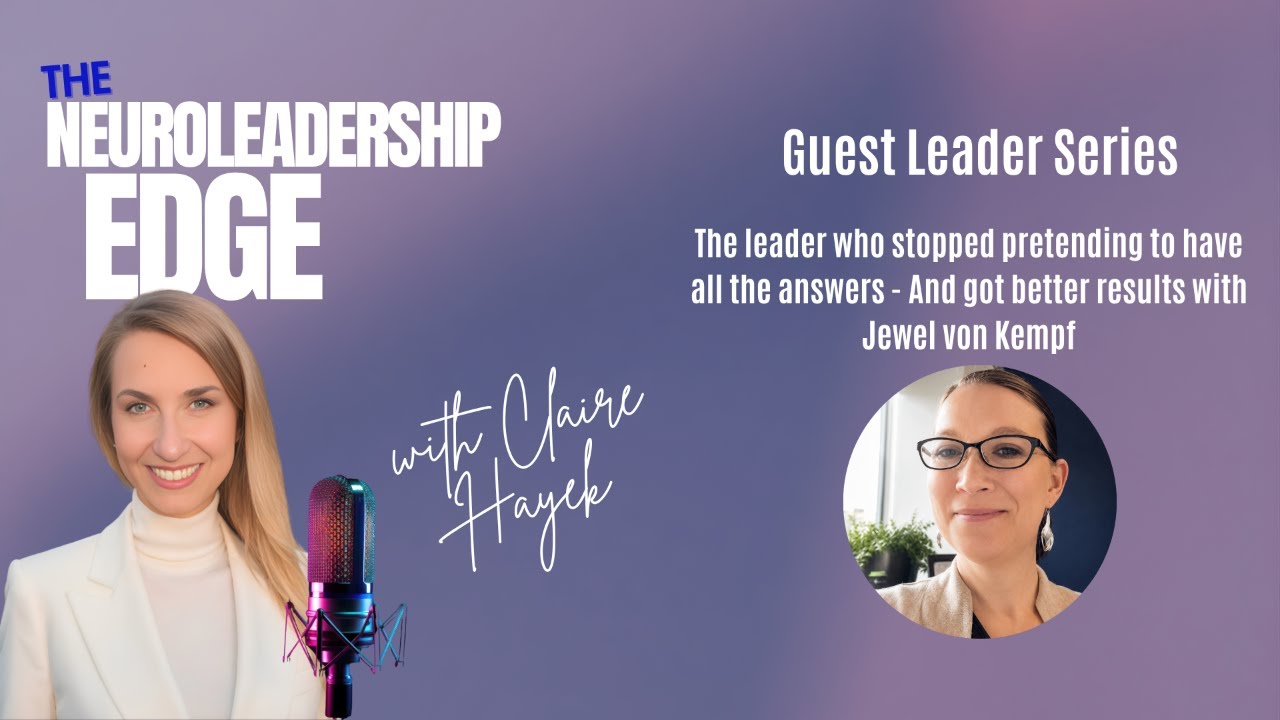
In this episode of the NeuroLeadership Edge, host Claire Hayek interviews Jewel von Kempf, a strategic HR leader who built people operations from the ground up at startups, SaaS, and Web3 companies. Jewel recounts how she was thrust into an HR role without training, learning on the job while handling payroll, benefits, compliance, and a harassment investigation. Claire frames this as a "stretch response" where pressure forces the brain to form new pathways, fostering cognitive flexibility. Jewel shares a pivotal case where she defied legal counsel’s advice to document a struggling employee, instead holding a compassionate conversation, uncovering a chronic medical condition, and navigating the ADA process to create a supportive work structure that allowed the employee to thrive. The dialogue explores the power of embracing imperfection, vulnerability, and psychological safety, showing how leaders who admit they don’t have all the answers can reduce social threat responses and inspire teams. Jewel describes her internal mechanisms for thriving amid ambiguity—enjoying challenge, collaborating with others, and regulating her nervous system to shift from amygdala‑driven fight‑or‑flight to prefrontal‑cortex‑driven problem solving. The conversation also touches on the pitfalls of the founder‑hero myth, the importance of empathy, and practical tools such as the Pressure and Performance Scorecard and Pressure Reset Scripts. The episode concludes with rapid‑fire advice, emphasizing that imperfection is a strength, trusting gut instincts, and the refillable glass metaphor for resilience.
Chapters
There's a kind of leader that walks into a room and immediately makes people feel like they can breathe. We all know them. They do not have all the answers. They say so. They ask questions when others are performing certainty. They sit with discomfort when others are papering over it pretty much. And somehow, the team performs better. People stay longer and trust runs Much deeper. My guest today is one of those leaders. And what makes her story worth your time is this. Take note. She did not develop that quality in a leadership program. She developed it by being thrown into the fire with no training, no roadmap, and no safety net. And she figured out that the thing she thought was a weakness Accepting imperfection, sitting with uncertainty, asking instead of pretending was the thing that made her exceptional. This is the NeuroLeadership Edge. Let's get into it. Welcome to the NeuroLeadership Edge, the show where we decode what it actually takes to lead under pressure perform at the highest level, and build that mental fitness and mental architecture that holds when everything around you is moving fast. Pretty much our reality nowadays. I'm Claire Hayek, NeuroLeadership expert, TEDx speaker, and founder of Mind Soul Purpose Team Building. I spent more than 20 years leading high-stakes projects and teams under pressure. What I learned is this: pressure does not build leaders. It reveals the system they are already operating from. So let's get right into it. 3 things you are walking away with today: a completely different way of looking at imperfection and leadership, a real story about what happens when you go against the rules, trust your gut, and lead with humanity instead of liability avoidance, And what that costs and gives back. And 3, a practical frame for how to lead yourself and your team through uncertainty and ambiguity, pretty much. My guest today is Jewel Von Kempf. Jewel is a strategic HR leader with 15 years of experience building people operations from the ground up, literally, at startups, SaaS companies, and Web3 organizations. She has been the first HR hire, the team of one, the person who had to figure out payroll, compliance, and culture simultaneously with no blueprint and no formal HR background. And you guys are probably going, what? You're either falling off your chair or you're going, oh yeah, I know that. And so she has led teams through mergers, through rapid growth, With the kind of organizational ambiguity that makes most people freeze. This is the thing, right? And throughout all of it, she has operated from a principle that most leaders struggle to say out loud most of the time. She does not need to be perfect. She does not need to have all the answers. And that, it turns out, is exactly what makes people trust her. So, Jewel, Welcome to the show. Welcome to the NeuroLeadership Edge.
Yeah, thank you. Thank you for having me. I'm great. This is very exciting to talk to you about how imperfect I am.
The perfection and the imperfection. Let's leave it that way. So listen, you've been obviously have tremendous experience. I want to go back to the beginning because your path into HR is not Let's say conventional one, right? So, you're working as an executive assistant. Come on, right? At a startup. And the CFO walked up to you and basically said, we are letting the HR person go. Can you do HR? And you said, yes, obviously. Take me back to that moment. What was actually going on in your head? And what did those first weeks look like when you realized the scope of what you had just taken on?
At my core, I am someone who just wants to help most of the time. And I liked the company I worked for. So when my CFO came up and asked me, I mean, I felt 2 things. I felt like, yeah, totally. And also disappointment and sadness for the HR leader that I had been helping out and had grown to like. And but excited for the opportunity and what it could look like. And those first few weeks were, I mean, they were wild if I got to be honest. I didn't know anything about HR. I had to step in and do payroll, manage the benefits, discuss employee issues with them. I'm a pretty gritty person and don't have a problem asking for how to do stuff. So I spent a lot of the time on the phone with ADP, who our payroll provider was at the time. I think I think they walked me through the first 3 payrolls and just asking questions. This company also had government contracts. And so there's some reporting, some very big reporting that had to be done. The CFO did hire a consultant, which was great and helpful to have for those big discussions and someone to reach out to. But I think I was only in it for about a month until I had to do my first investigation for like harassment and stuff.
And wow. Okay.
Um, it was a lot, but I was very lucky that I had an incredibly supportive leadership team and an incredibly supportive like consultant and just people that I could reach out to and ask questions, you know, through our service providers and stuff. So they, they made it easy-ish. I mean, it was nonstop, but they made it as easy as they could.
I built the support. Of course it helps. What you just described, Joel, is something that neuroscience calls a stretch response. So when we are literally pushed beyond what we know and we stay in it rather than go hide and retreat, the brain has to build new pathways. So it does not have the luxury of falling back on a habit. It has to actually problem solve in real time. And that's what you did.
Yeah.
And this is what's interesting. The interesting thing is that leaders who perform best under pressure are often the ones who have been in situations like yours that early where they had to stay curious, ask the questions, and figure things out without having a safety net per se. So, they train the brain to operate in uncertainty without shutting down. And so, that kind of becomes wired in default. So, when pressure comes back later, Yeah. That pattern is already available and it's actually serving you in a way. It's very interesting. And I wanted just to mention that for any of you wondering. So, you told me something in our first conversation that I have been thinking about ever since. You had an employee who was swinging and kind of between back and forth between being a high performer and completely falling apart.
Yeah.
Now, if I remember correctly, you said your legal team told you to document everything, manage the performance. And stay out of the personal side of it because of liability, which I completely understand. And I'm sure you too. Yeah. And you sat with that advice for about a month and then you decided to go against it.
I did.
Right here, right? So you said you sat down with that employee and just asked her what was going on. Walk me through that decision. What made you do it when everybody and everything around you was saying, do Not.
I think the turning point for me was when the manager had decided that they wanted to put that employee on a performance improvement plan. And I'm sure you've heard it in social media and people are like, oh, if you go on a performance improvement plan, that's just the company trying to exit you out in like a softer way or covering their bums, you know.
Soften the blow.
And if I'm in this case, that was almost the case. And I didn't like that. We had invested in this employee like we had in all of our employees. They were part of the culture of the team. We should invest in not just their development, but also their improvement with the intention of having them stay. But we can't have them stay without knowing what's getting in the way of them working. And I had young kids. And I know that things get in the way that are not professional, like work life. Life gets in the way, illness gets in the way. And I had gone to a seminar where an incredibly experienced coach, kind of like yourself, had given an example of an employee that was not showing up for work and they were about to fire her. And that employee just apologized because she had been going through cancer and hadn't told anyone. And because they thought she just wasn't showing up. And I thought about that and I sat on it and I was like, something's going on with this employee. And so, I mean, I told our employment attorney what my intention was to meet with her and to figure out what we could do. And so we did. She came into my office and we just had kind of a what's, what's going on outside of work conversation, like what's getting in the way.
Right.
And she disclosed like a, a pretty like serious, and I'm going to say chronic, like ongoing, like medical situation.
And it—
one that couldn't just be like solved with medication.
Right.
And, and I gotta be honest, like at first I was like very intimidated. I'm like, well, like what do we do now? But I took her through the ADA process. We put her— first of all, we put any sort of kit on hold and I was like, let's see if we can get you to how you can perform. And we went through the ADA process and it was pretty grueling. It's, you know, it's a little bit easier, I think, to go through like the ADA process for people when they have like a very clear disability that's easy to answer, that you can like—
Right.
Or it's like a short-term thing. Um, this was long-term and a lot of it was like mental. So how do we, how do we work around the uncertainty and ambiguity of just this disorder in general and how you show up at work. And so there was— so we did it and there was a lot of like trial and error, but a lot of transparent conversations between myself and the employee and the employee and the manager and just everyone being on the same page and a lot of coaching like as well with leadership. Like, what can't you say? What can you do? And at the same time, I was also learning, like learning some of this. And so, um, We were able to develop an actual structure for this employee where they could show up. But I would say most importantly, we were able to develop better transfer, better communication between her and her manager. Right.
And I mean, she excelled after she stayed.
She excelled. She was able to continue working. We didn't need to do the performance improvement plan.
And Look at that.
And I think the key there, though, was that her manager and her were able to have open conversations from that point on. So because she was embarrassed before, and I think that is 100% understandable.
And what you did is you really created that psychological safety around the situation, which gave her that trust factor to open up and talk about it. Because what we observe often is that people feel threatened. They can feel the vibe even if you're not saying anything. If you're showing up with your guards on and using the legal words and everything, people are not stupid. You know, they feel it. They feel that I'm not— I really need to look out for myself. I'm in survival mode right now. I need to survive. So, they hold back. They don't say the truth. They don't open up. They don't reveal maybe a vulnerable side of— their life. And establishing that psychological safety is very important because this is how you get down to it and actually can help that person. But of course, it takes a— it's a two-way as well. Not only you could open it up and you can provide that psychological safety, but if the person is not ready then, or doesn't trust you, they just won't. They will pretend. But it's pretty interesting. I mean, this is kind of like the foundation of communication when it comes to The situation. So you said something to me that I want to put in front of every leader listening right now. There's so much to cover, so I want to make sure I ask you all the questions. You said that you are very aware of how imperfect you are. Okay. And then you caught yourself like you were about to apologize for it.
Okay.
Yeah. I want to ask you about that directly. Where did you learn that imperfection was something to hide? And when did you figure out that it was actually a strength?
I think just the way I was raised, to be honest, and then showing up at work and watching people excel, it felt like you had to be perfect. And I had a misunderstanding that trying your best and being perfect were the same thing. And they're, they're not. And to be honest, it's been Supporting employees, as well as the consistent ambiguity that just blankets startups, that I've just come to terms. I don't think there was one exact moment where I was like, oh, it's okay to not be perfect. But there have been lots of tiny moments where I didn't know the answers. And I was like, that's okay. Like, I don't have the answer. I'm going to tell the employee I don't have the answer. I'm going to tell my—
Yeah.
CEO, I don't have the answer, but I'm going to go find it and I'm going to do my best. But I'm not always perfect. In fact, I constantly tell my employees and my direct reports that we can fix it.
Right. I mean, you're comfortable showing that vulnerability.
Well, and I am myself. Mistakes, you know, I've made. And I had to own up to them, and I had to correct them and not repeat them. And those, those moments in life that you do, you do all that, I think it, it leads you to appreciate the fact that you have those moments to learn from. And so if we were perfect all the time, then we would have the most incredibly boring companies and offices and— Oh my gosh.
I couldn't agree more.
Yeah. Burnout. And so I think all these little moments in my life, just kind of in supporting all these employees and leaders, just kind of led me to dissect or essentially to separate perfection from doing your best.
Yeah. This is authentic leadership as far as I'm concerned. It's just, it's about not knowing everything and saying it out loud. I do not have the answer. Well, let's figure this out together. And when you do something different happens. People around you— I understand that probably also is a relief or a certain way to kind of also deal with uncertainty, which is great because tapping into vulnerability is amazing. It's such a strength. But also, it does a whole thing around you. It basically gets people out of their fight or flight or survival. And that's the, you know, the social threat response kind of gets quiet. You know, you're no longer threatening For people around me. People feel safe enough to bring now their own real thinking in front of you because they're like, wow, if she's able to model authenticity and tell me that she doesn't have all the answers, maybe next time I'm confronted with that, I don't have to freaking panic. I can just say, I can model what she's doing. It's very inspirational. It goes a long way. And I think a lot of leaders don't realize this. They put that pressure on themselves. Now, you have been the team of one more than once, right? You walked into organizations that basically had no HR. You built it from nothing. Then, you've gone through mergers, layoffs, leadership transitions, the global pandemic, not to mention the global pandemic. Now, most people freeze in that kind of uncertainty, ambiguity, change. And you seem to move to word it in a way. What is the internal mechanism that lets you do that? And after you answer that, what do you think leaders get most wrong about operating through uncertainty?
Ooh, I don't know what leads me. I don't know. I don't want to get bored. I feel like—
I like the challenge, Claire.
I like the challenge. And I like to build something. I like to be part of building something. And life is ambiguous. So, I mean, it just seems natural that a company that is growing and building would have uncertainty, would have to be agile.
Right.
And in order to work through it— oh, I do have an answer. In order to work through it, you have to do it with people. And so even though I'm a team of one, I'm never alone. I have finance teams, I have leadership, I have employees, I have people with me and we're doing it together and we're building something together. And I think that makes it just delightful.
Yeah.
And I mean, I will say that I have very rarely in my life worked somewhere where things were just like super structured. I have a few times, but like, I, I like that things can change and that things can grow and that we can fail through that ambiguity. And out of that failure, something amazing is going to emerge that we didn't even know we could do.
And so, um, it's a positive outlook on the whole thing. And that's, that's actually called— you got cognitive flexibility. That's what we use, you know, in neuroscience. And basically you go The brain's ability to shift, adapt, and find new solutions when the old ones basically no longer apply, as opposed to freeze, panic, hide, shut down. No, you thrive. And you've obviously developed that.
Yeah.
And you're able to, from what I can tell and from what you're sharing with us, is that you were able to regulate your nervous system. And it's in order to keep, to be able to access that part of you that thrives under that uncertainty. And as opposed to panicking, you know, getting out of your amygdala, which is that fight or flight response into your prefrontal cortex, your brain's CEO. And so thriving in uncertainty is actually biological. It's a lot about biology. And you've obviously and clearly developed those neural pathways to, yeah, to deal with certain uncertain situations.
Yeah.
Certain uncertain situations.
I do have those overload, amygdala overload moments, 100%.
Of course.
But I feel like because I support employees through that, it's also easy for me to see it in myself. I can see that I'm tensing up while I'm working and just be like, find a way to kind of ground myself. Or even when I use verbally, just remind myself like that I'm okay and like this is gonna get done, or smile while I work. Yeah, nothing to smile about. Like, am I tricking my brain into like, this is okay? I think— I actually think that works. And, um, and so I really do. I was hiking with my daughter the other day.
She's like, it works. 100%. It's a great tool. It's a great tool.
But, um, I do think we're leaders can get it wrong is where they build this hero archetype around the ambiguity and just working nonstop to get everything done. And, you know, it's especially for founders and leaders because a founder, like CEO, and even like an early stage CEO, like they're typically in all the way. Right? Their life, they're gonna breathe it, they're gonna sleep it. And in some— in most cases, that makes sense, especially if they're a founder. It's their child. Like, this company is their child.
Yeah.
I think it's sometimes hard for them and also some of the leaders that are surrounding them to remember that the people working for the company are humans and not— this isn't their child. Like, they're not gonna bleed for the company and they shouldn't. They should do their best and they should work as they can through the ambiguity. But also they are people that when they close their computers at the end of the day, they're, you know, gonna go volunteer somewhere or they're gonna have a family or they maybe they go to the gym, maybe they do parkour. I don't know, but they have a life outside of work.
Yes.
And sometimes, I mean, even myself, sometimes it's hard to To remember that when we're in the throes of work.
Yeah, absolutely. I can totally understand that. And I'm glad that we're bringing this up. Maybe some of our listeners are probably struggling with that, whether they're on one end or the other end. And it's something that we need to talk about, definitely, just to bring awareness to it and just kind of like, okay, remember, don't take that for granted. Now, I want to go somewhere personal for a moment, if you are open to it.
Is that okay?
Okay. Well, you went through your own significant, pretty much disruption recently, a job loss. So, a transition you did not choose on your timeline, right? I think it happened earlier than you thought it would.
Yeah.
You've spent your career helping others navigate that exact experience. And then, you had to do it yourself.
What did that teach you about everything you have built as a leader, as a person that you could not have learned Well, I first, I was very fortunate that the conversation I got to have with my CFO, my CEO at the time, was just a personal, personal, like, touch and as compassionate and kind as it can be when you're having these conversations. And, but putting myself in the shoes of some of my employees, and I, I think that's a really important thing to do. When I have had to terminate people, I am a very friendly— we converse. I'm very friendly. I'll talk, but I do read from a script when I do it, primarily because if I don't, I personally might cry and get emotional.
Yeah.
But I always follow up with an email and open the door for them to use me as a resource if they need, as they look for their next role. And I hope that they do. But I will say it does feel very difficult from, um, like experiencing it to just be separate from the people that you spent 8+ hours with a day for years.
Right.
Like, that is— it's almost like a breakup. Like, you're breaking— you've broken up with, you know, with your best friend or your friends. And it's— it— there is a mourning period. Like, I, I felt sad, not at the loss of the job as much. I mean, I love my job, I love the work I do, but more that I won't get to interact with those people on a daily basis.
Yeah.
And, but it also led me to kind of reach back out to people that, that I had in the past, like, let go and had, like, worked with me and stuff, just to say hi and to check in and see how they're doing. And so that was a lovely development out of it. And then I I decided to take a break from work. There you go.
Isn't that lovely?
I just— I haven't ever done. And, and so I just took specifically a few weeks spending time with my family, doing delightful projects around my house, taking my dog for a couple walks a day, like—
Cleaning up your closet.
No, I mean, I know I'm, I know I'm like listing tasks, but like, that is That is how my mind just works. Like, I'm not a sit-still kind of person, but it's been on my own timeline and what I'm— what I've wanted to do. And it's, it's been really just wonderful to almost kind of reconnect with myself as if I was like my own employer. Like, how am I doing? What do I want out of my life?
Right. It's just, this is amazing. This is, this is great. I'm, I'm, you know, you obviously have the right attitude going into this and you're pretty much, I mean, I'm sure that, you know, you probably will go, okay, I really wanted a longer break, but here's all the offers raining on me right now. I have no doubt about it. But hey, we're running out of time. I want to get to the rapid fire. So quick answers, quick questions. I have a couple of them. Something you wish someone had told you in your first week of HR?
Ooh, someone I would— okay. I wish someone would have told me that you could trust your gut over just like the HR, like lists of ways in which you should act, that you should trust your gut a little bit more.
Lovely. Lovely. The leadership quality most underrated in startup environments.
Empathy, I think.
Okay.
Like understanding your employees and every, like where they're coming from on a personal note.
Yeah.
Okay.
One thing you would tell yourself during the hardest moment of the past year?
I would tell myself, the glass is refillable. And that comes from my great-grandma. She used to say, if someone said the glass is half empty or if it's half full, she would always say, it doesn't matter. It's refillable. Sometimes, you need an empty glass.
I think I'm going to start using that one. I love that. Thanks for sharing this. If this conversation brought something up for you, if you recognize your team, your culture, or yourself and what Jewel shared today, I definitely have something for you. The Pressure and Performance Scorecard. It's a free diagnostic that shows you exactly where pressure is costing your organization right now. Decision speed, team communication cohesion, execution quality. Takes about 5 minutes. It gives you specific results. And you can see it here on screen. You can pretty much scan the code and follow through. And if this hit closer to home and if you are in a season of transition, uncertainty, or change right now, and you want something practical to hold on to. Again, you're going to see the code here. Grab the Pressure Reset Scripts at right on the screen, or you can go on my website, clairehayek.com. If you are listening on audio, do check the description. We will leave the links there. So hopefully this will serve you. This is a free download. They're all free tools for you. Jewel, what you modeled today is exactly what this show is built for. The willingness to say out loud that you do not have all the answers, the courage to go against the safe advice and lead with humanity instead. And you, you have so much grace and that you just kept on showing up with curiosity when everything around you was uncertain. I did wanna highlight that. So thank you for bringing it all to us here and sharing your story with us.
Thank you.
Any last words to our listeners?
Just to remind them that you don't have to be perfect. Embrace your imperfection. Keep learning and keep failing.
Love that. And anybody listening here, make sure to subscribe to the NeuroLeadership Edge. Every subscriber helps the show grow, reach further, and bring you that caliber of guests and conversations that actually move the needle. Because we're all about impact. And as always, lead boldly, stay human, and turn every challenge into a gift. Thanks to you all and see you next time.
More from Claire


25 years in cybersecurity taught her this about staying calm under fire with Jonna Garber

Pause and Assess: The 10-Second Technique to Stop Over-Controlling Under Pressure #shorts


UN Mission Director On What Real Calm Under Fire Looks Like With Fredrik Sandvall





Book Signing at AIFEC Bogotá | What Pressure Does to Leaders and Why I Wrote This Book #shorts