THE REAL REASON YOUR TEAM IS UNDERPERFORMING (IT’S NOT SKILLS)
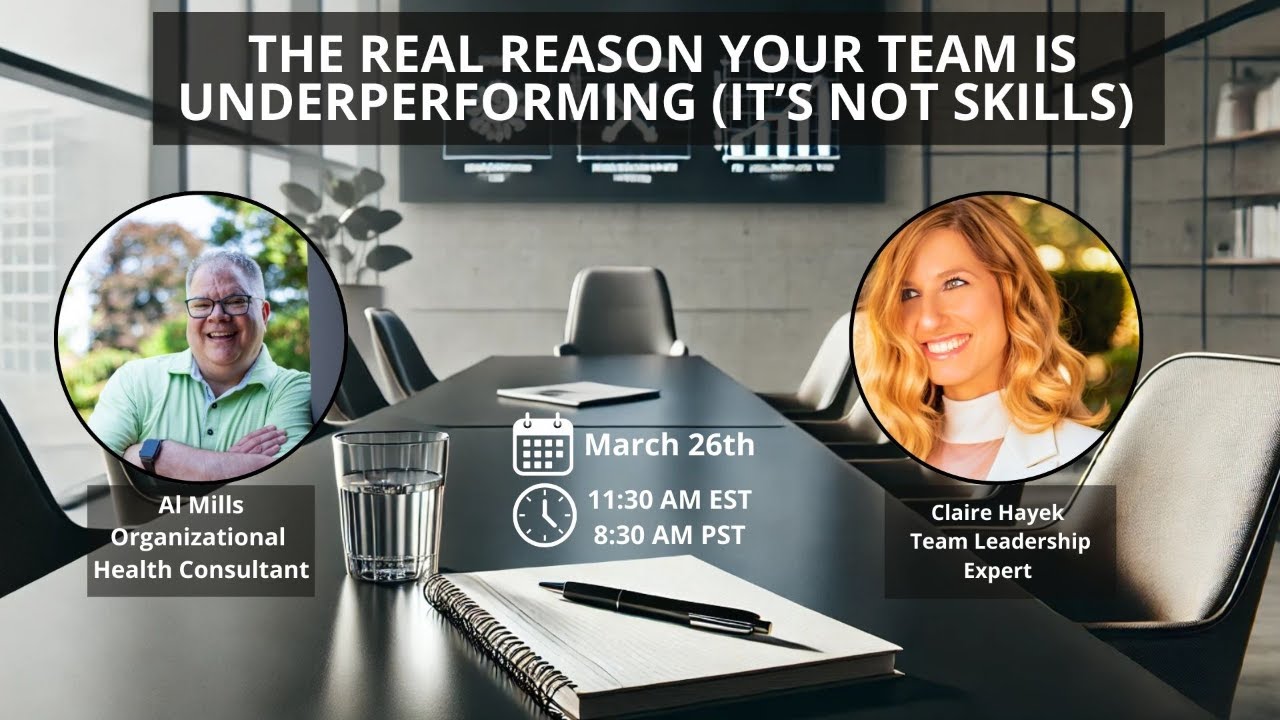
In this live session, leadership strategist and neuroscience expert Claire Hayek is joined by organizational health consultant Al Mills to challenge the common belief that skill gaps cause team underperformance. They argue that the real issue is a "brain gap"—the state of team members' mental fitness and neurochemistry. The conversation weaves together neuroscience (pre‑frontal cortex activation for trust versus amygdala hijack for conflict), Positive Intelligence research (showing a 31 % productivity boost and 37 % sales increase for mentally fit teams), and Patrick Lencioni’s Five Dysfunctions of a Team, linking each dysfunction to hormonal responses such as cortisol spikes for lack of trust and dopamine drops for unclear accountability. They explore how feeling heard activates mirror neurons and dopamine, reducing stress hormones. The dialogue then shifts to the Working Genius model, outlining its six work types (Wonder, Invent, Discern, Galvanize, Enable, Tenacity) and the three zones (Genius, Competency, Frustration). Al explains how aligning people with their Genius zones and moving them out of Frustration zones can raise dopamine, lower cortisol, and improve engagement, retention, and performance. Practical takeaways include assessing mental fitness, using the Working Genius assessment to place people in the right roles, fostering psychological safety, and committing to brain‑training practices. The session ends with a call to action for listeners to identify their own Genius zones and start improving team mental fitness.
Chapters
Hello, hello, hello everyone! Welcome to another live. This week, we're talking about teams and underperformance. And why is that so? Why teams underperform? And a lot of people think it's skills. But we're going to be revealing it's not. It's not skills. So, because if you think about it, if skills alone determine success, Every qualified hire would be a top performer, right? But that's not reality, is it? So, you've probably hired skilled people. You've trained them. You've invested in professional development. And yet, your team is still not performing at its best. But why? Why? The truth is skills don't drive performance. Team dynamics and brain chemistry and mental fitness do. You don't have a skills gap, surprise, surprise, you have a brain gap. So with that, I'm Claire Hayek. I'm a leadership strategist and neuroscience expert specializing in mental fitness and high-performance teams. And I'm joined today by Al Mills. Alan? Al, an organizational health consultant. Hi, Al. How are you?
I'm doing great. How are you, Claire?
I'm good. I'm good. Really good to have you. So today, Al and I, we're going to cut through the noise and we're breaking down why traditional leadership training is failing and how to fix underperforming teams using brain science, positive intelligence, and the Working Genius model. So, I'm gonna ask you where you're joining us from and which part of the world. So, please do drop it in the chat. I always like to be very interactive with our guests. as well as the participants. And we'll be throwing questions your way. So, please do participate. So, let us know in the chat where you're joining us from today. And I also wanted to share what's the biggest frustration— actually not share, ask. What's the biggest frustration you have with your team right now? Is it misalignment, lack of trust, conflict avoidance? Please do let us know. I will drop it here quickly. In the comments. All right. So again, please do share with us where you're joining us from. We'd love to keep it interactive. So here's some truth for you. Your team's brain is working against you. Why? Why? Why? The average brain— actually, sorry, the average human has 60,000 thoughts a day. Can you imagine that? 60,000 thoughts a day. And 80% of them are negative unless, unless you train your brain. So without rewiring the mindset, your mindset, your team's mindset, no amount of skills training will make them perform better. And here's a neuroscience stat for you. Trust activates the prefrontal cortex, the rational thinking. While dysfunction activates the amygdala, Fight or flight response, and who wants that? Right? Who wants that? I don't. I can tell you that. PQ research shows that teams with high mental fitness see a 31% boost in productivity and a 37% increase in sales. This is our source: Shirzad Shamim from Positive Intelligence. So on that, I'm I'm full of facts today, and I'm full of questions. Okay. So with that, I'm going to ask you another poll. Question: How many times have you hired someone skilled only to find they don't perform at their best? So I want you to drop a yes, not sure, just to go you know maybe, and let me know if it's a major problem. So again, I'll be I'll be sharing this in the in the comments. And moving on here, I would like to it's hard to multitask. So here we go, just dropping it in the chat. So um. You got a lot of things going on in the chat. Please do reply and let us know. So here we go. Al, Al, Al, I have a big question for you.
Sure.
Okay. So what are the biggest dysfunctions holding teams back? Let's share this with our audience. And we're gonna talk about these dysfunctions together. And I'll kind of weigh in on how neuroscience ties into that. But I really want you to talk about the 5 dysfunctions of a team.
Yeah, I mean, like, the 5 dysfunctions of a team is something that has been drawn up by Patrick Lencioni. If you haven't read his work or checked out his stuff, you really should check out his stuff. He's a great— and I love hearing him live too. He's hilarious when he speaks live. But so he's developed the 5 dysfunctions of a team. So if you look at them, it kind of starts off with like an absence of trust. And then there's a fear of conflict. And after that, you move into concepts like like accountability and commitment and inattention to results. So those are basically the 5 dysfunctions. It doesn't mean they happen in every team. And just because your team wants to deal with some of these things, it doesn't mean that they're dysfunctional. It just means we have work to do, and we always do. So if you look at, at the first 2, which I think are key, one is, is the absence of trust. So if you don't trust people, then it's very difficult to move on to that second one, which is a fear of conflict, because you're afraid for the, afraid for the results of a conflict. And whether we have an amygdala hijack or whatever the case might be, as Claire's pretty familiar with.
Yeah.
Those two are so fundamental to everything else that goes on. If you don't have those two things going on, you're in real trouble. And you can, you can feel these things, especially the trust thing. Like, do you talk about meetings after you're out of them? Do you wonder what other people's goals are? Are they trying to climb the corporate ladder? Are they trying to get in front of you?
Right.
You know, those kinds of things. Without those 2— and I guess I should say a little something about the conflict side. On the conflict side, I would say that you want your conflict to be passionate and everything goes on the table. But you don't want it to be destructive. So that's why you got to prevent those amygdala moments when you have those hijacks going on. You want to prevent those. But you want to have Very clear, passionate, and fully open conflict, which really helps to develop those things. Because if you're secure relationally, it's better for the company.
Right.
So those are the 2 that I would concentrate on most of all. And the other ones, of course, are Commitment, whether people have buy-in, and, excuse me, and Accountability, whether you can hold a colleague accountable for something that they're letting the team down on, instead of just the, the leader, like the CEO. And of course, the last one is Inattention to Results, because People aren't really paying attention to what's good for the team. They're paying attention to what's good for them. And so that kind of— so that's— those are the 5 dysfunctions and the way they kind of play out with teams and how we kind of try to interact with those and get those things solved when we're working with solving those dysfunctions.
Right. Yes, this is really interesting. So to summarize, there's the absence of trust, fear of conflict, lack of commitment, avoidance of accountability, and inattention to results. So those Those are the five dysfunctions, and as you as you already mentioned, Al, that you know really all of these dysfunctions affect our our body. What what hormones being secreted affects our own body as well as our environment, right? So for instance, absence of trust that that really triggers like a threat response. So obviously the cortisol spikes. Spikes and reduces collaboration. Who wants to collaborate when you're like, you're full-on cortisol, right? It's just normal. It's science, really. It's chemistry.
I'm sorry to interrupt you, Claire. But one of the thoughts I have is we know how our bodies respond to stress and how our minds respond to stress. One of the things that I often ask people is, how do you feel when you drive into the parking lot on a Monday morning? And you see so-and-so's car there. And you know, you don't trust so-and-so and you don't get along. There's that parking lot moment where you're going like, oh rats, they're here.
Right.
So, that kind of I think fits in well with what you're describing about how we respond.
Yeah.
Already, we're not even in the building yet. We're already stressed out.
Exactly. There you go. It's amazing how we're not conscious of these automatic reactions. Like our body, our brain is secreting sending signals and our body's secreting a whole bunch of hormones. We are so involved with our emotions and how we're feeling, we're not aware of it. And we're so— we're kind of unaware of what's happening in our body most of the time because everything is happening unconsciously. It's just like the body's amazing how it just functions without us sending consciously the signal to move our hand or scratch our head.
Right, yeah. It just knows.
Like, I mean, it's automatic, you know. So imagine when we are aware of this and we are able to recognize these triggers and how we could better understand what's going on in our body and why we're reacting a certain way. And this is the whole point, is by pointing out these things, it's not about judging ourselves or judging others. Oh, you know, they're not trustworthy. Or it's not just understanding what's happening in this situation. Why am I feeling this way? And this really helps a lot by anticipating a bit our reaction and being able to be conscious of what's happening with our brainwaves. If we're in the fight or flight status, if we're really being in ease and flow and we're able to control the situation in a more calm way, in a more sage way, what positive intelligence teaches. So, about conflict. I mean, When we're in fear of conflict, basically, the amygdala, it just hijacks. That makes people avoid tough conversations. Just like, I don't want to go there. Lack of commitment. If you don't have emotional buy-in, the brain is not gonna prioritize execution. It's just as simple as that. And again, and it goes on and on. Again, with accountability, dopamine drops when feedback is unclear and inconsistent. And if you're not You know, you're not paying attention to the results and your survival mode is triggered. People prioritize self-preservation, like you said, over team goals. So, extremely interesting. I love the 5 dysfunctions and I love how it summarizes it in 5 distinct dysfunctions.
Right.
Let me just put it here in the chat, my next question here. Sure. Which dysfunctions do you see most on your team? Trust, conflict, commitment, accountability, and attention to results. And maybe, Al, you can just elaborate a little bit more about trust and conflict. I think what you mentioned to me earlier is that that's pretty much a given. It's always there. Yeah, yeah.
If I'm working with the team, then those are going to be the 2 that I'm going to spend a majority of time on. There are some great exercises that we do around it. But the thing is, so much of this ties in so well with what you're talking about when you talk about, look, I've hired somebody who's highly skilled, but it's not working very well. You know, there are some brain function things that are going on that are preventing us from doing those things. And I was just going to ask you a moment ago about the brain's response when we feel heard. And that's something in commitment. We can talk about that in a second if we have time or if it fits in with our agenda. But when we look at trust and commitment to conflict, or sorry, not commitment to conflict, but fear of conflict. Yeah. Those 2 things, Trust is, is kind of a building on those relationships. Now, if you're in a leadership position, it may be very foreign to you or very uncomfortable for you to be a bit vulnerable. And you have to find the right balance. You can't be totally a, you know, a blank sheet of paper to somebody or, or somebody that's very see-through. You still have some leadership goals and qualities that you have to fulfill. But you need to be somewhat vulnerable. And this is something that Brené Brown talks a little bit about.
Yeah.
Some of her work as well. She talks about the rumble of vulnerability. So, on the trust side, there has to be a buildup of the trusting and some vulnerability stuff in there. But it's also a matter of knowing that relationships won't get destroyed. Now, there are moments where maybe you decide that it's time to terminate somebody, or there's an end to a relationship, working relationship, professional, whatever the case is, or personal. But without that trust, that knowing that you are going to have a great discussion. You trust what somebody else says. You trust what they're going to do. You trust that they're not in it for themselves, that they're in it for the team. Without that, you can't build great conflict.
Right.
Great conflict is what brings great results. So, when we look at in terms of, if you have 5 people sitting around the table, but 2 of them don't speak because they're afraid of conflict, there's 2 perspectives, 2 inputs, 2 extra ideas. 2 opinions, things that may radically change what you're trying to do. And they're afraid to because of whatever is going on within their mind because of the fear of conflict. And we know what that's like. We know what it's like to sit there, how our brains and our bodies react when we sit and we think, yeah, I can't say this because I'm afraid that Claire's going to get really mad at me or kick me out of the room or that. Or when we go, well, I'm going to say this, but let's see where it goes because it could turn into a big fight.
Right.
Those kinds of defense mechanisms. So, when you trust people that you're working with, it's easier to get that conflict stuff on the table and to talk about things in passionate ways that are best for the company and best for the team.
Yeah, absolutely. Actually, there's a study done in Harvard Business Review. It says that brain scans show that psychological safety, we're talking about high trust, open feedback, activates the prefrontal cortex, which improves problem-solving innovation. And innovation, I mean, teams that lack Trust literally operate in a constant state of stress, which impairs decision-making. So, I mean—
Absolutely. You never know if you're getting to the bottom. You never know if all the ideas have been exhausted. And one of the things that I tell teams that I work with is when you leave a meeting, don't leave it without having said everything that's on your mind. Now, I mean, within reason, you don't want to tell somebody that they're ugly. But there's— maybe you do. That's not very nice.
That wouldn't be very nice, would it? Yeah. It shouldn't matter.
Geez. Well, when you come out of a meeting and you go, I should have said this.
Right.
Then you think, oh boy, what a— and like, I mean, we move on to those commitments. The commitment's the next one. And you mentioned it. One of the things that I've found, and this is like, I mean, I'm not an original researcher. So I do a lot of reading. I find out from other people what's going on. I try to synthesize that, assimilate it into what I do. But one of the things on the commitment side is that we hear when people are heard, when they have a chance to say what's on their mind, even if a decision goes against their original opinion, they're more likely to be OK with it because they feel heard.
Right.
And that's what I wanted to ask you about, Claire, is in like the brain response and the neurochemistry and that kind of stuff that goes on when you feel heard and why it opens doors to maybe changing your opinion on something? Like, does that— is that a fair question to ask?
Yeah, no, I mean, it all ties into what I said is that when you feel heard, you feel like you're in a psychologically safe environment where the trust is automatically obviously present. Because when you feel heard, it's like people are actually interested in what you're saying. So, that releases dopamine. And then, as well as that mirror neurons, those mirror neurons, they're just amazing. Because when you feel heard, that means automatically your mirror neurons are mirroring what's happening with people around you. If you're feeling heard, if you feel that you're heard, that means they are paying attention to you. That means they are listening. They're practicing active listening. So automatically, their neurons and yours are mirrored, which basically just opens up the whole thing and just lowers all the stress hormones and stuff like that. Because now, we're feeling that they're interested in what we're saying. Again, we're mirroring each other's neurons, right? So like, wow, okay. So, they're listening to me. They're not just pretending they're listening and they're looking at their watch or their phone, right?
Right.
So, you feel the presence. your mirror neurons are activated in a positive way. So automatically, you feel psychologically safe. You feel inspired. You feel happy. Dopamine is being released. So it activates your prefrontal cortex. And so, you're not in your amygdala. It doesn't shoot in your amygdala and shoots the cortisol all over the place. So it's those mirror neurons. So for instance, let's look at the opposite side, right? So if somebody's is not really listening to you or cutting you off or anything like that. You just feel like you're feeling that stress. You're feeling that pressure. You're feeling negativity from the other person. Again, your body's taking all that. It's the mirror neurons which affects how your brain now is going to react. Cortisol starts shooting up. It's amazing like how much influence we have on people around us. So, when you're not in control of yourself, of your own body and you're not self-aware of who you're being in the moment, then automatically, that's going to affect the other person if it's not in a positive state, right? So, I find it fascinating.
It is.
So, it's really just one key takeaway if I can summarize here that dysfunctional teams, people, they're not lazy. They're just operating in fight or flight. They're in survival mode. So, until you fix the brain state, you're not going to fix the behavior. So, it's really— this is like, write it down. Write this down. They're not lazy. They're in survival mode. And you need to fix the brain state. That's not going to fix the behavior otherwise.
Honestly, so much of the battle is just understanding. When those lights come on, you go, oh, I understand I'm looking in the wrong direction here for a fix for my team or something that's going to help us. When you understand a little bit more about brain chemistry and some of the neurology that goes on there, when you have some of those things going a little bit better for you, it's a lot easier to understand. Okay, now I understand at least the direction I need to go.
Yes, yes, exactly, exactly. It's honestly just all about shedding light on the mystery. We ignore— I mean, I'm so happy that we we talk more and more about the brain. There's more brain talk now.
Neuroscience. Yeah.
People are interested in understanding how their brain works. We talk a lot about mental fitness. Everybody goes to the gym, physical fitness. And you know, we talk about mental health. But what is mental health? It's mental fitness. You know, but you need to train it. You need to train your brain. It just doesn't come just by meditating only. There's just so much more. Meditation is part of it or being aware of of being self-aware, etc. But how many of us are being self-aware every single second of the day? We're not. But the more you're mentally fit and the more you interrupt your saboteurs or interrupt or be conscious of certain behaviors or without judging, just like, okay, yeah, my judge is doing that thing again.
Yeah.
I'm being sabotaged now. Yeah, yeah, yeah. Okay, I see it. And you stop it. You take that hand off of the burner. It's like, okay, I just got my signal. I gotta be careful here. Don't fall in the trap. This is what builds your mental fitness. The more mentally fit, the more you can interrupt these behaviors. The more you can be in a positive state. And the happier you are, the more performant you are, more productive. I mean, everything. Just you're joyful. You're appreciative. You're empathetic. I mean, it's wonderful. We should all be talking about mental fitness. I mean, I could talk about this all day. But let's move on because— We have 10 more minutes. I definitely want to pick your brain on how to build a high-performance team leveraging the Working Genius. So, we talked about the dysfunction, right? Also, how do we— once we remove the dysfunction or we deal with the dysfunctions, right? How do we create a team that actually is thriving, happy, clicking? Tell us about the 6 types of Working Genius. Please.
Yeah, excuse me. Sorry about that. I think it was Jim Collins who drew the analogy of having people on the bus. And when you look at the bus, excuse me, it's having people in the right spot. So sometimes it might mean hiring somebody that you don't have the right spot for them, but they're on the bus because you want them there. So when the time comes to move them into the right seat, you can. So the object is to get the right people on your team. And where Working Genius comes in is it helps us get people in the right spot.
Mm-hmm.
Working Genius divides things up into about, there's 6 categories of work that go on in pretty much any project. And they are, I'll just go through very quickly here. They are Wonder. So a Wonderer is somebody who just kind of thinks, how can we do this better? They're big-picture people. They're 30,000 feet above the ground trying to figure out how can the organization do better. Then you have an Inventor. An Inventor is actually going to come up with some of the tools and some of the things that actually implement the idea of doing things better. And this new thing, maybe it's a new market, maybe it's a new campaign, something like that. After you have an inventor, you have somebody who we'd call a discerner. And a discerner is somebody that is able to judge and discern in a project or a tool or a campaign, anything like that.
Right.
Good things and sometimes the things that aren't gonna work so well. So if you're gonna produce a pink Cadillac, They might say it's probably not going to sell. And, well, it wouldn't sell to me, but maybe there are people— that's the Mary Kay world. So, and then after that, you have a Galvanizer. So people that galvanize are people that put people together on teams, and they get them rallied around the vision for the project or the campaign or whatever the case it is. And it might be, if you're starting a new company, it might be rallying 2 or 3 people to come and join you and really get things going. Or it could be just kind of building somebody up around the vision of some particular project. And then after that, you have—
I can totally relate with that one.
Because we've actually done your Working Genius, and it was high for you. And I look at Galvanizers and go, Galvanizers are persuaders. They're people who go, hey, look, let's get together on this thing and get things really going.
Would that be like also motivators in a way?
Absolutely, absolutely a motivator. Rallyer, motivator. And they're, you know, sometimes you look at somebody on a team who's maybe they're not great at certain skills, But if they can rally the team, what a thing to have on your team.
Right.
The next step is an Enabler. So an Enabler is somebody that provides tools and help and encouragement for people that are working on projects. So for me, I worked in IT for a long time. So for me, part of my enablement thing was helping people get stuff to work or fixing or showing them how to use something. And then the last category we have, we call it Tenacity. It's not really about like, you know, how we think of in terms of tenacious, of people that just keep on going on the same thing till it's done. But with the tenacity side of things, those are the people that keep us organized and get things done on time, on spec, and on budget. So there are people that love to live on to-do lists and that kind of stuff.
Right, right. So there's 3 zones. There's 3 zones. Right?
So the first one is called your genius. So, the Working Genius, there's 2 of them that will go in your Working Genius. And those are the places where you really want to live. So, with your Working Genius, those are 2 elements of work, those 2 categories that provide you with a fair bit of joy, a fair bit of energy, lots of fulfillment and that kind of stuff.
Right.
So, things that kind of charge your batteries. The next one category in which 2 fall into is called your Working Competencies.
Right.
Those are things that you can probably do well. They don't give you a lot of energy. They don't take away a whole lot.
Right.
But what I would say with this about working competencies, what I tell everybody is you have to watch out for burnout because working competencies can be sneaky. You don't realize they're draining you out because they're not giving you much, but they're still taking a bit. So, they can surprise you. And then, the last 2 are your working frustrations. Those are areas you still might be okay at them. You might be able to do a good job and you might be able to do them when you have to. But if you live in those, it's really going to be bad for you long-term. And I would say, you want to live in your frustrations about 80% of the time.
Right.
One of the reasons I mentioned the, the bus, the seats on the bus, from Jim Collins' analogy, is because Working Genius helps us see the seats that people will perform best in. So this is, this is a direct way to get to better-functioning teams, like you asked at the very beginning of Working Genius, how do we implement this? Well, we realize that we're asking Claire to do work that's a Tenacity, right, Tenacity world. It's frustrating her; it's draining her of energy. She should be a Wanderer. Maybe we change her role. Maybe we don't. Maybe there's some ways to move things around and find ways to have her perform better in areas where she's great. But those are some of the options of trying to get people in those right seats. Now sometimes you are changing roles, and sometimes you're not. And sometimes it might even mean you have to part ways if you can't provide an opportunity for somebody. But if you really want your team to do well, you're doing what you can, right, to help people get in the right seat. And the other— one thing I wanted to mention is I know of one guy that worked in a company who was super good at his job. And the problem was he was never, ever going to get out of that job because he was too good at it. We couldn't figure out a way to replace it, which is what you don't want because it was a frustration for him.
Oh, wow. Interesting, right? So, so basically, if I put up a question here for everyone, Please do let us know when you think about your own work, where do you feel like you're really thriving? So again, we mentioned the 6 working genius.
Yep.
So tell us which one really applies to— what's your working genius? The 2 working geniuses, your genius zone. So in a nutshell, if we think about it in a neuroscience way, it's obvious when you're in your natural genius zone, Hmm. The brain is happy. It's releasing dopamine. And so, motivation just is all the way up, right? But when you're working in the frustration zone, again, it's not rocket science. Cortisol increases, which leads to disengagement, burnout, and underperformance. So, it's important to kind of recognize and put your finger on where's my working genius? Where do I really thrive? Which ones that I— what's that zone that I'm like, yeah, I can do. It's not great but I can do it. It doesn't doesn't frustrate me, I can get it done. And then, which ones really frustrate me? So, this is again very interesting. Thanks so much, Al. I put all these details in the— did I just miss 2 more here? No, no, I did put the 6 types of working genius.
Okay.
I'm just looking at the comments and making sure that I have everything pasted. So basically, if you look at it, aligning work to your natural genius isn't just smart. It's It's strategic. And it's scientifically proven to drive engagement, retention, and performance. So, please do that. Be aware of that. And I can't believe we're already, you know, time to wrap up here. So, I wanted to thank you, Al, for joining me today and talking about the 5 dysfunctions and our 6 Working Genius. I mean, the Working Genius model. And I hope that what we talked about for anybody listening now was really helpful to you. That there's a lot of gold nuggets that you were able to walk away with and some key takeaways as well that you can maybe just get you thinking. Knowledge is key. Knowledge is the start of action. So now that you know these things exist, now that you know it's not probably just skills that your team is missing, it's just like brain fitness, brain skill more than anything else and trying to put your finger on it, then that would be the best way to where you should start as opposed to just spending time on working on skills that probably are not relevant in certain cases. And this is a big blind spot when it comes to dysfunctions, when it comes to mental fitness, and when it comes to the Working Genius. So, if you do want to have a bit more information about what we talked about today, please do reach out. You can reach out to me on LinkedIn or just type Genius in the comment and I will reach out to you and be happy to answer your questions. Al and I would be. And we'll be looking at the comments later. So now you know why teams fail and how to fix it. So the question is, are you going to take action? That's going to be the big one. So on that, we're going to wrap up. Again, thanks so much, Al, for joining me.
Thank you.
Always a pleasure talking to you. Such interesting conversations. And I also wanted to mention that next week there will not be a live, but there will be one the week after that. So stay tuned on the subject. And please do share in the comments which subjects you'd like me to bring forward on my lives in the upcoming months. Like, it's also really relevant to know what you want to know more about. We know a lot of people that do great things like Al. They're experts in what they do. And I'll be happy also to share my expertise. And that's what we're here for, just for impact, for painting the world positive, and for training that brain. So we're all kind of happier and more zen because otherwise, what are we doing? Why else wouldn't we do that or work toward that, right, Al? It's simple when you put it in these words. So again, Al, thank you so much.
Thank you, Claire.
And, uh, we'll, uh, we'll see you all, uh, in a couple of weeks. Take care. Have a great
More from Claire


25 years in cybersecurity taught her this about staying calm under fire with Jonna Garber

Pause and Assess: The 10-Second Technique to Stop Over-Controlling Under Pressure #shorts


UN Mission Director On What Real Calm Under Fire Looks Like With Fredrik Sandvall





Book Signing at AIFEC Bogotá | What Pressure Does to Leaders and Why I Wrote This Book #shorts