This CFO led billion dollar deals. one HR question broke his blind spot with Paul Allen Thompson
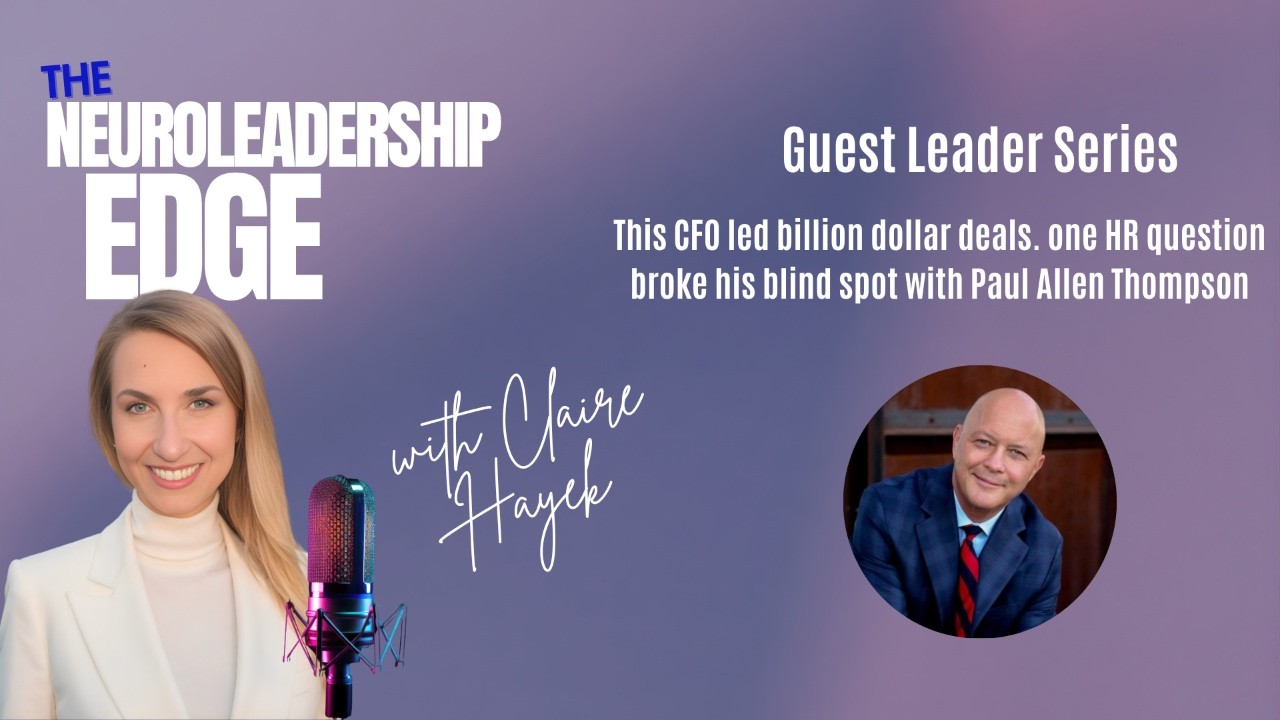
In this NeuroLeadership Edge podcast episode, host Claire Hayek interviews Paul Allen Thompson, CFO of Integro Bank, about a pivotal moment when an HR partner, Margaret Sweeney, asked him whether everyone on his team liked deals. The question shattered Paul’s assumption that his excitement and deal‑making focus aligned with his team’s experience, revealing a blind spot. Paul describes how this insight shifted his leadership from a purely transaction‑centric mindset to a human‑centric one, emphasizing empathy, two‑way communication, and trust. He shares practical strategies for leading under pressure: checking in on team wellbeing, fostering a culture of trust, making decisions with imperfect information while keeping momentum, and avoiding paralysis by focusing on a single clear objective. The conversation also includes a rapid‑fire segment where Paul outlines his approach to effectiveness under pressure, the importance of a growth mindset, and the key question leaders should ask teams before high‑stakes projects: “What do you need to be successful?” Claire promotes her free Pressure & Performance Scorecard, her upcoming book “The Leadership Skill Nobody Taught You: Calm Under Fire in the Age of Disruption,” and encourages listeners to adopt calm authority and human‑focused leadership.
Chapters
You walk into a room fired up, really excited. You've got the deal, the timeline, the vision. You know exactly where you're heading with this project. You tell your team, this is going to be an incredible ride. And you watch their faces and you think, wow, they feel it too. Well, they don't. Today's guest built decades of his career on high-stakes transactions, mergers, spin-offs, deals most executives see once in a lifetime. And it took one sentence from an HR partner to show him that the thing that made him a great dealmaker was also making him miss his own team. Welcome to the NeuroLeadership Edge. I'm Claire Hayek, NeuroLeadership expert. TEDx speaker and founder of Mind Soul Purpose Team Building. I spent more than 20 years leading high-stakes projects and teams under pressure. And this show, this podcast is all about teaching and inspiring you by sharing relevant stories with leaders that have gone through high-stakes projects and environments that bring directly to you what they've learned, and how they learned to show up with calm authority. By the end of this episode, you'll know why your own excitement under pressure can blind you to what your team is actually feeling. You'll know the one question that separates leaders who drive results from leaders who drive people away. And you'll know why real boldness often looks like slowing down. My guest today is Paul Allen Thompson, CFO of Integro Bank. He's led some of the largest, most complex corporate transactions of his career. deals with fixed deadlines and no room for error. He's also one of the contributors to the research behind my upcoming book, The Leadership Skill Nobody Taught You: Calm Under Fire in the Age of Disruption. Paul, welcome to this show. How are you?
Thank you, Claire. It's an honor to be here. I really appreciate it.
I appreciate you being here. It's been great interviewing you for the book. Your wisdom and insights were so, so helpful. And I'm really excited to bring this to our guests through this episode. So much to talk about. So, um, I'm gonna dive right in and I'm gonna ask you this, the question, you know what I'm gonna ask you. I know you've built your career around high-stakes deals, like really mergers, spinoffs, high-stakes environment, and—
Yeah.
With real deadlines, right? Um, now tell me about a moment where the, you know, that That instinct, the thing that makes you good at your job, actually got in your way. Tell me about that day and what happened.
Yeah, so it was with a Dow Jones financial services company. I was in charge of one of the largest spinoffs in the history of the stock market. And I was really fired up about it. I like, I like transactions. I like the newness. I like the you know, the non-routine nature of those extraordinary events. And I guess that's been throughout my career, just how I've grown up. And so I had a team of about 50 people and they didn't know about the transaction yet. So I was really fired up and excited and I had them all in a kind of a classroom-style room, uh, in New York, and, um, we announced the spin-off. And I said, it's just going to be an amazing experience. It's going to, uh, really set the company off on a great path. It is going to require extra work. We're going to have to work probably weekends and nights to get everything done on time and to give ourselves some cushion. And so I think I said, I'll bring the donuts and coffee for everybody.
Perfect.
And so anyways, I was just fired up and I had a great team. And we talked for about an hour and I mapped out some of my thoughts about who the owners were and blah, blah, blah. And so I was in my office on the whiteboard drawing out kind of key milestones of the spinoff. you know, because we'll have to report out our progress to all interested stakeholders. And I had an HR partner, Margaret Sweeney, she was from Australia. She came into my office. And she said, hey, Paul, do you have about 5 or 10 minutes to talk? And I said, sure. And I kept drawing on the whiteboard. And, and she said, well, Paul, how do you How do you think your spinoff announcement meeting went with your team? And I said, I thought it was fantastic. It was really high energy. Everybody's locked in. We're all holding hands. We're going to get it done. And I said, I just love doing deals. And she's— she, with her Australian accent, you know, she said, well, Paul, Not everybody likes doing deals.
So what was going through your head? Let's pause there for a second. Yeah, but once she said that, what was going through your head?
Um, it's like I went through a black hole.
Oh, okay, there we go.
It was like I, I had never thought about that before, and maybe I'm alone in this, but, um, I just get— I was just so excited and These sorts of things are career building, you know, just notches in your belt that you can take with you forever. And so to me, it's all good. But her checking me really changed how I plan, how I think about things, how I communicate.
So it made you stop in that moment. Actually, what you're saying, you know, you said that, you know, I don't know if this happens and I don't know if it's me, but Really, I mean, most of us operate on autopilot. We're excited. We're doing our thing. We know what we're doing. And we're often running on assumptions we've never really examined because we've never really had to because this works for us, right? So, someone that comes in and names the assumption out loud and going, well, it often breaks that pattern.
Yeah.
So, Margaret and the words that she told you. This is basically something that stopped you, which is normal. It really made you think, stop, and rethink what was going on. So continue. Tell us what happened next.
Well, no, I mean, it was a powerful moment for me from a people perspective. None of us are successful alone. I mean, it's just not how it works. It takes a great group of people, a great team to do anything well. And nobody does anything alone successfully. And so I changed, it changed me, I'd say significantly, to the human side of things. That's Maybe wasn't the number one thing for me at that point in my career, but after that, it certainly is.
Mm-hmm.
Just caring for your team and checking in with them. And, you know, if, if they're having challenges outside of work, make accommodations, be as flexible as possible. You know, I'm of the mind that, you know, people want to work remotely, That's totally fine, you know, as long as everything's getting done. And so, um, and what that also taught me that moment was we gotta have communication together, and it has to be collaborative, and it's— it can't be one way. And so you, you have to create an environment where there's two-way engagement. We're all engaged and we're sharing thoughts, and whether it's on a one-to-one basis or one-to-many basis. I just think always having the human factor as a top leadership priority, especially in those big transactions, Is really important because, you know, you don't want— I mean, you'd prefer people don't burn out. They don't, you know, they don't have— you know, sometimes there's a lot of stress that people take on during these sort of transactions. And so you want to minimize that. And again, I just would— I check in a lot more.
Right.
With my team. Not about the project, but about how are they? How are you? How are you feeling? Is there anything I can do to help? So I know I could go on and on, but it was— yeah, when she said, well, Paul, not everybody likes doing deals, that was— I'll never forget that. It took a lot of courage for her.
It did. But you know that This is what being bold is about. This is what this podcast actually is all about. Bold leadership. And it took boldness from her to be able to show up with empathy, calm, but focus.
Yeah.
She was very aligned and she was able to read the room when you were not there. You were just focused on your own level. It was not at everybody else's level. And what she did, I think it was a great gift. And I'm really curious to know, I know you did elaborate a little bit on how that changed how you show up now. If you can give me an example or if we dig deeper, right? I mean, I don't know how long this was ago. It doesn't matter. But right now, when you are— faced in high-pressure environments, high stakes. What is it really? What's going through your mind? Is this moment kind of there hovering in the background going, okay, don't get too excited. Check with the room. Or do you have anything you can share with our listeners, probably leaders and CFOs right now, or project leaders, project managers listening to this and going, but how do you approach this? Because there's always a fine line between caring for people and being mindful of how they are, you know, how they're taking this in, and caring too much to the point of overnurturing and in a way enabling kind of— how would I put this in words— making this a big deal.
Yeah.
When we need to be focused and aligned, we don't want to wallow over, you know, how are we— how am I feeling about this? Am I comfortable? Am I not comfortable? Like, how do you draw the line between we're gonna empower, we're gonna engage, I'm gonna— but at the same time, I want to support without going too much in one direction, which is push, push, push, and the other direction, which is too much kind of pampering or nurturing that people kind of feel like, you know what, I don't have to do this. It's always kind of a struggle that I find with leaders that I speak to.
So I would say trust. Making sure that you're creating a culture of trust.
Can you elaborate a little bit more on that? Maybe give us an example or two.
So People don't want surprises in life. A lot of times inertia is comfortable. And so to the extent you can eliminate those, and it's hard because sometimes stuff comes up and you have to be honest about that, um, you know, uh, things you can't foresee.
Mm-hmm.
So I think trust is important, that people feel trusted and that they feel that, you know, I trust them.
Right.
Then it gives them a sense of, you know, a sense of responsibility.
Ownership.
Yeah. And so I think that's important. I think communication is important. I think also oftentimes as a leader in unusual set of circumstances, you don't always have perfect information 100% of the time. You have to, in order— I think it's good to make decisions, The best you can throughout the process. So, so the wheels keep turning. To the extent people are sitting on their hands, not moving forward to execute the various milestones of a transaction, I think, I think anxiety heightens during that time.
Absolutely. Yeah.
Keeping things moving. I would just also say, even though you don't have perfect information, you may not ever have perfect information, just make the best decisions you can. You can always pivot as things get more complete and more clear, but keep moving.
This is the thing right there, owning the decision and staying aware at the same time of your team. These are not two opposite things. They're the same skill.
Yeah.
And waiting for certainty feels responsible. But the brain under pressure treats that delay as safety when it's actually cost.
Yeah.
Leaders who move things forward, to your point, without having that full consensus while still paying attention to the people carrying it out, are the ones really running both systems at once. And that is the best skill you can have. And it's trainable. And I've mentioned this to you. It's what Pressure Proof Leadership is built to install. It is possible and it keeps things moving forward while getting rid of the noise.
Yeah.
So, we can just stay aligned, stay focused, and show up with calm authority. And you know how that works, right? I mean, If you are doing that, they will mirror that. They will feel that. And I believe the word was trust, what you said. And that really inspires trust around you. And we often take for granted how we show up and how that affects people. But that's all it is. That's what leadership is. And nobody really trains us for that, do they?
You're exactly right. Margaret trained me.
And this is why I'm here. All right. So let's move on to the rapid fire. I'm so fascinated by your story. And I'm so excited to have you in the book.
Thank you.
And there's excerpts about our conversation in the book. And I know you've shared a quote. So leaders listening to this right now, basically, I'm teasing this, if you haven't noticed. You'll get to read it in the book. And of course, look at other quotes that a lot of leaders also shared. By the way, interviewed more than 60 leaders around the globe from 6 different continents, different industries, different levels in the organization. And it's fascinating what the wisdom and so many gold nuggets, just like the one that Paul's sharing here with us. It's very simple. And you might think, Paul, go, ah, what's my story? It is a big deal. And one little moment like this can really change somebody or make somebody reflect over just listening to your story right now.
Yeah.
And I do believe that ripple effect.
I mean, without that moment in my life, I wouldn't, I wouldn't have achieved what I've achieved. No doubt.
Well, that's big. You know, that's really big what you just said.
Wow.
And does Margaret know?
She will after this.
Should we tag her in the episode?
Yeah, we could.
I'll leave that up to you. That's, that's your call. But, uh, but Margaret, you know, hats off, hats off. Margaret, if you're listening to this, uh, you've done something great here. So yeah, so here, let's move to the rapid fires. If I ask you a couple of questions and, uh, you know, just go with the flow. Um, here's my first one. What's one word that describes how you operate under pressure?
Effective.
And how do you stay effective under pressure?
How do I stay effective under pressure is— What's your secret? Again, you got to have a vision, you got to have a great team. I think in any of these situations, you want to overwhelm with talent. And to be effective, Sometimes you have to be a little myopic towards what you're trying to achieve, right, for the best interest of, of the business that you're in. And sometimes you can't consider all potential possibilities or all potential options. You got to pick, you got to pick a horse. You can't ride 2 or 3 horses. Right.
And that's what keeps you moving forward because otherwise you freeze, you're paralyzed, you're overwhelmed. And I think this is what you're saying is that I always talk about get rid of the noise. When you stick to one thing and just go with it, then everything kind of falls in place and you figure out things as you go. And that is so important. Yeah.
And you pivot. It's not like you've made that decision. It's going to last forever. You can Yeah. You can change the play as it's happening.
Exactly. And sometimes, we're paralyzed because we think that we need, as leaders, the whole weight and responsibility is on us for that decision. And we're just waiting to make that perfect decision or perfect path. But there is none. And if you're an entrepreneur listening to this, you know exactly what I'm talking about. You just figure things out. And the only way to do it is to keep moving. It's taking action because what's the alternative? You're in your head with scenarios and you're not moving forward. And that is efficiency. So thanks for saying that. All right, moving to the next question. What's a leadership belief you held early in your career that you've since let go of?
Well, I would say that it's the topic, the story that we just talked about, right? I thought, you know, doing deals was really exciting and career building, and I thought everybody thought the same way. And I got checked on that. So that's something I don't believe anymore, and it's, it's really shaped me as a leader for, yeah, forever.
And from what you, we, you've described and shared with us so far, And really, you do give credit to that moment for the rest of your career and how successful it's been and still is, right?
I'm lucky. I'm lucky that that happened. And I think also, you know, a growth mindset is important, right, in all this. And And, you know, being willing to fail.
Mm-hmm.
Fail and be okay with that, because these things aren't perfect. Like, everything doesn't happen as you expect, and you're going to have to make adjustments. You know, Kobe Bryant, I was listening to an interview of his, and somebody asked him something like, are you a player that hates to lose, or are you a player that loves to win?
Hmm.
And he said, I'm neither. He said, I like to learn. I like to get better. I— it's a process in the game. Like, how can I, how can I affect the game better? He doesn't worry about the outcome. And I think that's a good approach for these sorts of situations that we're talking about. Is just be in the moment. It's, it's, you're being in the process, you're learning. Um, everyone's working towards the same goal and, um, keep moving.
And no matter what's happening, like you said, even if you fail, there's always something to learn.
Exactly.
So if you're focusing on the, the, what, what the win is, because there's always a win, even if you're failing, there's a win, you learn something.
So that's exactly That changes everything. Yes, ma'am.
The 3rd one, what's one thing every leader should ask their team before a high-stakes project begins, for instance?
What I coach is, it's not a good career development situation if you're always saying no or I can't. I would frame it like, what do you need to be successful? And the answer is, here's what I need to be successful.
Exactly.
And I think that's really A basis for embarking on, you know, an initiative or a big deal is what do we need to be successful?
Mm-hmm.
It could be reprioritization of the business as usual work. It would mean to bring in another team to do the day-to-day work, and then your A-team moves on to do the transaction. And just planning out resources, owners, be clear on decision rights. I think that's important. Who can make what decisions?
Yes.
And who the owners of those decisions are. And you got to trust that.
Right.
But then people feel that they're accountable and that they own something.
And that's the best way to get people motivated and engaged. Yeah, you know, as a leader, if you're not trusting your people and giving them a chance to be involved and engaged and accountable, then you're not really empowering them in a way. So that is very, very valuable. Thanks so much for sharing, Paul. If this episode has you wondering where pressure might already be costing your team without you seeing it, and maybe it's a blind spot right now, I built a free 4-minute diagnostic called the Pressure and Performance Scorecard. It maps exactly where pressure is limiting leadership and team performance. And you can find it at clairehayek.com/pp-scorecard. And you'll get the QR code here and you can scan it. Of course, as you already know, I'm writing a book that will be out September 9th. It's called The Leadership Skill Nobody Taught You: Calm Under Fire in the Age of Disruption. And Paul is in it. And it's coming out, like I said, September 9th. If you're interested in joining the 30 Readers Club with exclusive access to the book before it launches. Go to clairehayek.com/book to sign up. I'd love to have you in it. And finally, subscribe to the NeuroLeadership Edge. Basically, subscribing costs nothing and helps everything. That's how simple it is. It's how this show really finds the next leader who needs this conversation. Now, Paul, it was a pleasure having you. I would love to hear any last words you want to share with our audience listeners.
Well, first of all, Claire, thank you for the opportunity to do this. I've enjoyed the whole process. And I think your book will be required reading for all business leaders after it's launched. It's a wonderful book with a lot of great lessons learned in there. One more thing that came to mind to me As we were talking, but Steve Jobs had this quote, we don't hire smart people to tell them what to do. We hire smart people so that they can tell us what to do. I love that. And I think that's important. And when we're talking about all these things, that's kind of, I think that's what I'm getting at. Like, let's hire a great team and let's go.
Absolutely. I mean, I couldn't have said it better. Thanks again for taking the time to meet with me.
No worries.
And you somehow found the time. And I do appreciate it. I don't take that for granted. And I think your insights will help a lot of people listening to this. Paul, it was a pleasure. And as always, everyone listening to this, lead boldly, stay human, and turn every challenge into a win because there's always a win in everything.
That's right.
And again, Paul, glad to see you. Lovely talking to you again. That was a good excuse to have you back and talk to you. Don't be a stranger. And we'll definitely be in touch with the book. For everyone else, see you all next week. Thank you so much.
More from Claire


25 years in cybersecurity taught her this about staying calm under fire with Jonna Garber

Pause and Assess: The 10-Second Technique to Stop Over-Controlling Under Pressure #shorts


UN Mission Director On What Real Calm Under Fire Looks Like With Fredrik Sandvall





Book Signing at AIFEC Bogotá | What Pressure Does to Leaders and Why I Wrote This Book #shorts