What Happens When the Plan Disappears and Everyone Looks at You with Brian Silengo
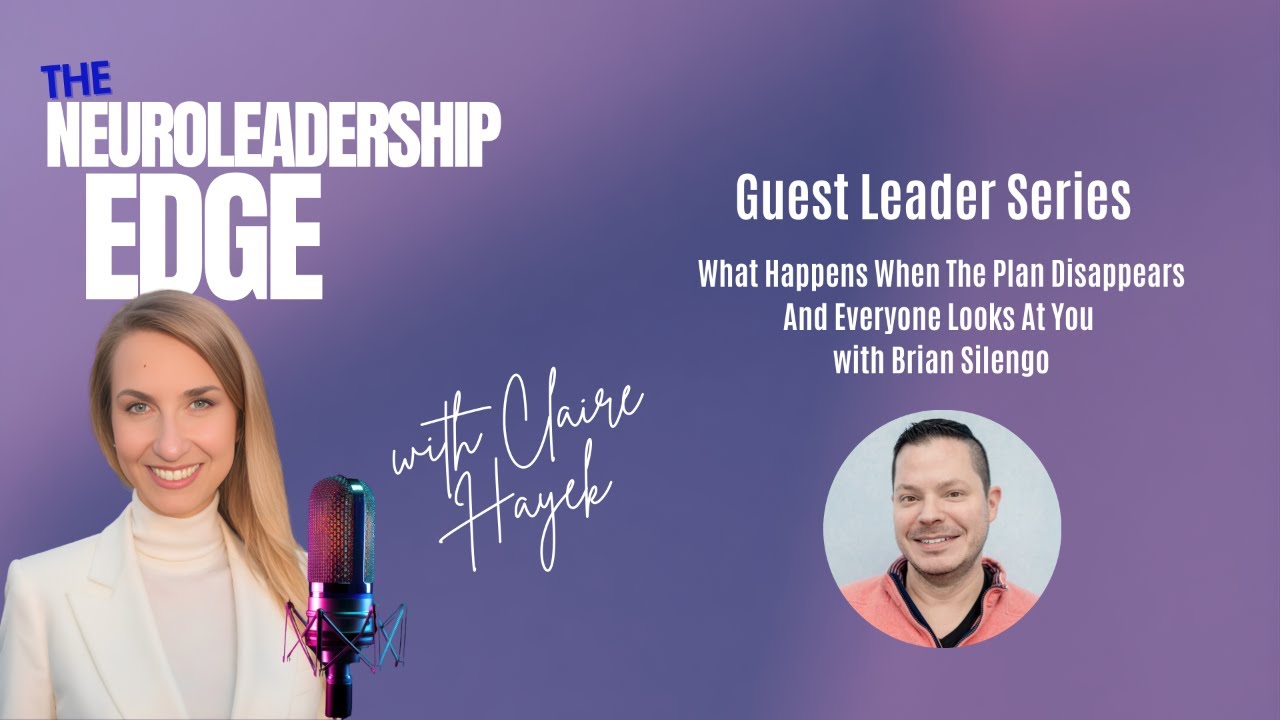
Brian Silengo's hospitality-tech company lost its entire sales pipeline during COVID. He shifted from needing to be the strongest person in the room to leading with vulnerability and empathy, which built trust and improved team safety. He shares how hiring complementary expertise and celebrating wins helped him scale without burning out.
Chapters
There's a moment every leader eventually hits. The plan disappears, the numbers don't make sense, and everyone turns to you waiting. During COVID Brian watched his entire sales pipeline vanish in a single week. Not a bad quarter, not a slow month, a week. What he did next didn't just save the business, It rewired how he leads, how he builds teams, and how he defines strength under pressure. This conversation is about what leadership actually looks like once certainty is gone. Welcome to the NeuroLeadership Edge. This is the podcast for leaders who make real decisions under Real pressure. I'm Claire Hayek, your host. I help executives train their mind to stay clear, decisive, and human when the stakes are high. Well, let's dive right in. In this episode, you'll hear what actually builds trust when leaders don't have the answers. You'll also learn why transparency increases authority instead of weakening it, how empathy becomes a competitive advantage, not a liability, and what it really takes to scale a business without literally losing its soul. My guest today is Brian Selengo, a founder and sales leader who spent his career building revenue engines, leading teams through uncertainty, and helping companies scale without burning people out in the process. Brian has led through collapse, reinvention, and growth. And what makes his leadership story powerful It's not the numbers. It's the humanity behind the decision. Brian, welcome to the NeuroLeadership Edge. How are you?
Wonderful. Thank you. And thank you for having me.
I'm really happy to have you here. Yes, I'm really excited for you to join me on this one. So, tell us. Take us back to that moment when obviously, it was during COVID So, this is when the hospitality industry collapsed. And your entire sales pipeline literally vanished, disappeared. What was happening inside you as a leader, not just around you?
One of the hard— one of the, I would say my anxiety point was really around, we, I have metrics and I have revenue goals and there are a variety and our Obviously the revenue goals pay us all our salaries. I have so many things that I have to hit, right, in order to ensure that the company is sustainable and can, and could continue to grow and move forward. And when I say growth, that could be like, that could be common, like the same. It doesn't have to be exponential growth.
Yes.
But we must be able to keep the lights on.
Yeah.
And it was very hard when all of a sudden All of our clients were closed, and we were a very hotel hospitality-specific technology. And so what do you do? And I definitely stayed up a lot at night and just brainstormed how I can do this differently.
And what was happening inside of you, like, when this happened and you just found out? Literally everything just poof.
Yes.
What was going inside of you? Like, what's going through your head? I mean, I can't just— I can't even imagine.
It was— I'm not going to pretend that it wasn't extremely stressful. I'm not going to pretend that I didn't have moments saying, how am I— how can I help? Or what can I do? I mean, it was a very— it was a stressful time for everyone. So because we're also— many of us were also dealing with family members who had COVID before there were vaccines. And, right, you know, I mean, I lost several loved ones to COVID. And, you know, so there were just a lot of, a lot of components going on that— and sometimes family takes a precedent over work, right? So there were just a lot of, a lot of— A lot going on.
Yeah.
A lot of components. But where I found the resilience was really just taking a step back and saying, you know what, I could handle all of this. I just need to take that step back and look at the big picture.
Okay.
And then, and that big picture was, you know what, we're in a situation where in this country, I can't speak for other places, but at least in the, in the US, there are a lot of people who are struggling coming, like, because of the quarantine, and whatnot, they're struggling with maybe mental health issues, their substance abuse issues, but that maybe they've had, they've been in, that have been in check.
Right.
Now that they're like sequestered into their home, things are a little different. And so I pivoted us to focus on how do we help the person who goes to a place for Let's say drug and alcohol rehabilitation, or like we, we focus specifically in the luxury market. So I was, I focused more on the like high end, right? You know, the high end places. But at the same time, I, this was where I thought the perfect niche was for us at that point in time. And it worked very well.
Right. So you, you were feeling the pressure. Uh, I mean, things were falling apart. Everybody actually, you're right. Everybody was feeling all that. And, um, so you're, you know, even family members, were probably needing your help, etc. You're pretty much under a lot of pressure. And I can't even imagine all this stress. And what do we do? How do we shift? What do we do now? And what you're really describing is sometimes a lot of leaders deal with, but we don't really talk about it. That moment when you're trying to hold it together, you're trying to be confident or show confidence when really everything is falling apart on the inside. You're just trying to hold the fort and practice that resilience and just move forward despite everything going wrong and everything crumbling around you.
Right.
And I don't think we talk enough about that. Now, we're talking about COVID here, but I think this applies to anything. And even today, when you think about it, what's happening in the world. So, you've said that you used to believe leadership meant being the strongest person in the room. I wanted to kind of jump to that right after what I just said. Because we always feel that we need to hold it all together and show up that— show that strength and that confidence. And so this is what you believed, right? What shifted when you finally said out loud, I don't have all the answers? When you actually embrace that, what really shifted within you, around you? How did— what did that look like?
I mean, by the way, it's a very good question. I, you know, for me, I did always feel like I had to have all the answers and I needed to know everything about everything, and, and I felt that I was weak if I didn't know everything. And I, you know, after, especially after the COVID experience and, and just working in that specific segment of an industry in hospitality, I had to learn to be a little more humble.
Right.
And I had to learn to be also more empathetic. And I've always been an empathetic person in my personal life, but I've always— maybe not as much in my business life. And I will say, you know, one of the things that has worked that I've really learned Yeah. Is one, it's a— I'm actually a happier person, which makes me a better leader, to not pretend like I know everything.
Right.
And I, I also hire people who have expertise that I might not have because I don't have it.
And because actually you put your finger on it.
Figure out, I'm like, I'm gonna tap this person to help.
Yeah. You realized that you didn't and you accepted that.
Exactly.
And this is why, right?
Right. That's right. And that's like a— that's— I think that's hard for a lot of leaders because it's almost, am I replacing myself?
Right.
And, and the truth is, the proof is in the pudding, I think is what they say. If the team is productive, it doesn't matter if you have a variety of people who have various individual experiences that you're pulling from. At the end of the day, no one can know everything.
No.
And I mean, I've definitely worked in my experience for leaders who, who have felt they know everything. And I, and no disrespect to them, but it makes it hard for a leader to get a company or an organization to the next level. When you have someone above you that you have to respect who just feels differently. And so, you know, there's an— it's an interesting balance.
Absolutely. And, you know, when we talk about the brain, if we look at this from a brain perspective, that moment matters. You know, you said it, you know, you felt— you learned that you don't have to hold that front all the time, that strong, confident, etc., that it was okay to be humble, or maybe vulnerable is a better word. And more empathetic. And of course you were and you are empathetic, maybe with, with at a personal level, but that, you know, sometimes we have to not pretend but put on some kind of mask because we are forced to hold it all together and that pressure. And the moment you understand that, and you said it, and I applaud the courage. From the brain perspective, this really matters because When you do that, you're self-regulating instead of performing. And the great thing is that your team and your partners and your colleagues, whoever you're working with, they actually feel safer. And they think more clearly when you are self-regulating and you are balancing with resilience, strength, confidence, and vulnerability, empathy, understanding, and just Saying it out loud, you know, hey, I don't have all the answers, but I surely would love to hear your ideas and let's brainstorm together. Or even bring somebody in and say, hey, this one is the expert for— this person is the expert for XYZ. That just shows that's the real strength.
I say this all the time in my one-on-ones with my colleagues, teammates, direct reports, whatever we want to call them. But You know, I often say I'm never going to pretend that I have all the answers, but what I will do is work with you, figure those answers out.
Absolutely.
And so, because at the end of the day, to me, I don't come to work with ego. I come to work with a passion for what I'm doing. And, but, and, and most of what I'm doing is, I mean, I could sell software with any company because I'll be trained. on the technology. It's how do we enable the people who are in the field, and through that it requires that empathy, it requires that collaboration, it requires—
Right.
And there's also, there should never be any surprises. It's all because that collaboration and that relationship should be very spot on, where it's like, where if someone, for example, is working a a poor deal, for example, we know it in advance. It's— and we might try and make it into something better to hit someone's revenue target or whatever. But at the same time, we know, like, no one should ever—
Transparency. Transparency.
All about transparency.
Exactly.
It's not about— it's not— and unfortunately, in the sales world, blindsidedness, right, happens a lot. And so, and, and in many cases, and I live in Virginia, it's an at-will state. Yeah. You know, so we, you know, the companies don't need to give a reason to say we don't want you anymore.
Right.
I believe that no one should be surprised if something's not going well.
Absolutely not. Yeah. Yeah. So how do you balance being human, uh, and being empathetic and being vulnerable and being, you know, the rock? So how do you balance all that while still holding people accountable?
Yeah. And that's a— oh my gosh, that's a really tough question.
It's because it's tough. It is tough. I'm not saying we all have the answers, but I think a lot of leaders deal with it differently. And I'm just curious to know from your perspective and with your team, how do you do that? What's your thing?
And I'm thinking about it too as I'm It is hard. I think one of the things that—
so, because I think in a sales environment, it's not that easy.
No, right?
Because you're— I mean, you know, you— this is what you run on, like performance. You need to perform. It's sales.
That's right.
How do you be empathetic?
Sales, sales can be easier in certain senses where it's black and white, where it's Right. You are not hitting your target or you're not on pace or you haven't done enough phone calls, you haven't had enough meetings. There is definitely— there are KPIs and metrics that are generally very clear. I think what— and as an empath, which I am, which I don't think is a bad thing. I've worked for leaders who think that's a bad thing.
Right.
But I— and again, difference of opinion. No knock on them. But as a, as an empath, I will sit there and be like, okay, you're off track. Is there anything going on that I could be supportive?
Yeah.
It could be out of work, and you don't have to tell me. And like, I'm not trying to get into your personal space, but is some— is anything happening that maybe we could figure out a plan to help you? And so, because, you know, and I've had employees over the years who I had no idea they were Battling with cancer and they were still trying to maintain their—
A front. Yeah.
I'm like, you know what, this is what, like in the US, this is what FMLA can help with, you know, where it's like if you're having a bad day and you just need to rest, first of all, your job is protected. And second of all, you could then take that day and rest. It's, you know, so, you know, I lost my dad to brain cancer and it was a horrible 2 and a half years of watching him in his 60s deteriorate. And, you know, I think about that where it's like I, I put myself in, you know, other people's positions, which is what an empath does.
Mm-hmm.
And, you know, but, but at the same time, through that empathy, I, I will also say, because I will say, if you need this time off or you need to do some you time, That's— I fully support that. However, we need to remember that these are the metrics. These are what I expect from you. And then how do we back that into the time you need for yourself?
Right. What I'm hearing is that empathy isn't about being soft.
No, not at all.
It's about being precise. It's knowing when to clarify certain things, when to push, and when to pause, when to give a chance, and when to re-clarify. and refocus and, and, you know, yeah, yeah, 100%.
It's not about— it's not about softness. I mean, it's— we all have a job to do. And I mean, I've had the conversations where I've also had to say, is this just not the right time for you to be here? And that doesn't mean that I won't bring you back when you're ready. If you're not ready, or you can't for whatever reason, I don't— that's not for me to judge. That's about your— you and what you and your— there's also whatever.
Yeah, you to make a decision, that person needs to make a decision. Like, what do you go from here? You cannot make anybody do anything if they're not intrinsically motivated to. And maybe they're stuck on something. Like you said, sometimes you just have to ask and you'll be surprised what you can find out. And that roadblock will just poof disappear.
You know, just sorry, just to put a cherry on the top of that. Most of my one-on-ones, I spend the majority of the time asking How are you? Good.
Okay.
And what's going on with you? Right. Like, because I, I mean, you know, sometimes in leadership it's a weird, it's a weird relationship because we're not friends, but we're friendly, but we're— Right.
It's a fine line.
Yeah, it's a fine line. And so, but I want to spend more time talking about you than the things I have, because I'll take— I could take 5 minutes and show you your metrics and we could talk through that. But, and I'll look at them in advance if I, and I might have some leading questions, but I do think it's important to really understand what's going on with your employees. I mean, I see it constantly and I still deal with it constantly. Like this market is very unique right now. And I have so many people reaching out to me from a variety of companies just saying, I'm trying so hard to get out of where I am.
So speaking of what you do, You know, and I know you help a lot of companies scale. You've talked a lot also. I know, you know, you and I have talked about this prior to this episode. You talked about the danger of businesses staying founder-dependent. And so, what really needs to change in the mindset, in the leadership mindset, maybe the founder mindset, when companies are trying to grow or trying to scale? Well, I mean, where do founders get stuck?
I, I, I find this happens a lot with like within the founder and CTO sort of realm, especially like in my industry, at least in the, in the software space where they, I mean, there's nothing wrong with them being the face of the brand. I, you know, they, they're the founders.
It is what it is. Yeah, of course.
Use, use the celebrity. Like for the benefit of the company. But I do think that there sometimes can become a disconnect.
Yeah, to the detriment probably, right?
How that actually drives revenue.
Right.
And so, because, you know, some founders, while they might be the smartest person in the room and they might actually say all the right things, they might not have the sales nuance To not— I don't want to say offend people, but they might have that— they might not have that sales nuance to, to really just wonder what their need, the client's needs are.
Right.
And then translate that. Because I don't talk about my product, and I never talk about my product before I know all of the needs of the objectives of my customer. And then all of the positive business outcomes that would come from what we do. Before, like, I would never just jump into a demo, right? I would never just— I just don't. I think it's a— I think that's a really rough way to go.
Because so what you're saying is that founders get stuck on maybe just more of their persona and how they do things, their methodologies, and are not sometimes able to maybe step back and look and like, am I the really— am I the person That really should be leading this? Or should I leave this to somebody else? Am I really saying the right words? Am I— do I have the right systems in place? Do I have the right strategy? Am I the right communicator for this? Being, I guess, that self-awareness sometimes, unfortunately, is not there. Because as a founder, I'm assuming, I mean, I'm a founder and I get it. And I'm always questioning. I'm like, am I the right, you know, should I— somebody else? And it's hard. It's your baby, you know.
Yeah. I have your back.
It's hard because you want to kind of— it's your baby. It's like you want to protect the baby. And learning how to step back is a strength, I think, that leaders, whether they have it or not, something definitely need to develop.
And I do believe that, yes, we all need to learn how to. When I do fractional sales work, it's Hard for me because basically my job is to replace myself. And so that's hard because I, I did, I have all these, you know, I'm building babies and then I have to give them up. I mean, but so I understand and it's not an easy thing to do. And I'm not suggesting that anyone who is a founder is wrong for feeling that way because they should be proud of everything they've done.
Yeah. Absolutely.
And the work that they've done and the investment that they've gotten or given, or it's, but it is something that, that it is a challenge. And I think the best founders that I've worked with are ones who are open-minded and who are, you know, I'm going to say open again, just because it, it is very important to people who have like, who have experience in discipline.
Yeah.
Because I will say sales is not a conversation.
Right.
Sales is a discipline. And that's why we have, we have disciplines like MedPic and the Challenger Sale and force management and all of these different organizations, like organizations that help support and build sales pipeline. And a founder Not because they don't want to, but probably they don't have the time. They're not sitting there in a 3-day class about— Right.
Of course you can't, you can't be doing everything, obviously.
So you need to leave this stuff out there finding new money.
Yeah, exactly.
You know, I mean, so it's, you know, and I understand there are of course different stages of companies.
Yes, of course. So here we are. We need to speed up to rapid fire because I mean, I would love to continue the conversation. But time flies when you're having fun.
It does. I actually just looked at the clock and I'm like, wow.
I mean, we're good. We're good on time. But I just want to make sure that I get to ask you those questions that I really want to ask. And I want people to learn from you. Rapid fire, short answers. I have 3 questions for you. Are you ready?
I'm ready.
All right.
One leadership habit you had to unlearn One, the biggest one was not celebrating wins in the moment because I was too focused on tomorrow.
Oh my God. I love that one. I'm always talking about celebrating wins and it's so good for the brain and releases dopamine. Love it. One thing leaders underestimate under pressure.
I think we underestimate our ability to help people. Because pressure, yes, it comes to us and it can trickle down to the, to our team. I do believe that we, we do underestimate the way we could block that.
Right.
And then, and deliver it beyond us into a more positive experience because employee turnover, especially in sales, is pretty high.
Oh, I bet.
And so, so it's because it is a high-pressure job.
Absolutely.
So I, you know, I think that would be one of the— that would be my biggest.
Okay, and last one, something you believe now that your, you know, younger you didn't.
This is also going to be an interesting one, that I'm good enough.
I love that.
And so, and that's, you know, I've spent many— working in sales, like I said, is a very tough career, and you think sometimes That one minute you're a rock star and the next minute you're not. And, and it's important to just remember that you're good enough.
I know a lot of leaders listening today to this episode needed to hear that one. I really love it. You are good enough. I mean, what a great way to, to wrap up this episode, Brian. I mean, there's so much stuff that stood out from our conversation that Obviously, that you are good enough. But also, that strength comes from— it doesn't always come from control. It really comes from presence, from empathy, and from being humble and reading the room.
Yeah.
I have a final question to you. And then, we're going to wrap up very quickly after that. So, if a leader is listening right now, Brian, and they're going through uncertainty, pressure, reinvention, what do you want them to know? To remember? I know you said you are good enough and it's good enough, but anything else you think you want to add?
Of course the good enough piece, but then also we're— there's a large network of us, you know, and we're all in this together. And so if someone— I'm happy to talk to anyone, collaborate with anyone, brainstorm with anyone. Doesn't mean we all have the answers, but we can probably come together and find them. So find me on LinkedIn and let's do this and have the conversation.
Thank you for being so open and opening yourself up here. You did talk about openness. Please do reach out to Brian Solengo if, you know, I mean, the invitation is open. Of course, you know, you can also reach out to me. This is why I do this podcast. It's all about sharing leaders' experience, you know, leaders out there that's gone through pressure, gone through uncertainty, gone through disruption. And they were, you know, they won. They still won. They're here and they're present and they won. They were able to— they learned a thing or two and they're here on the episode to share it with you. So, Brian, thank you so much for this conversation and for the honesty you brought into it.
And Claire, thank you for having me.
Oh, it's a pleasure. It was a pleasure. And to everyone listening, if this episode resonated, Please share it with a leader who's caring more than they admit or that they're showing. This is the NeuroLeadership Edge. I'm Claire Hayek, and I'll see you next time.
More from Claire


25 years in cybersecurity taught her this about staying calm under fire with Jonna Garber

Pause and Assess: The 10-Second Technique to Stop Over-Controlling Under Pressure #shorts


UN Mission Director On What Real Calm Under Fire Looks Like With Fredrik Sandvall





Book Signing at AIFEC Bogotá | What Pressure Does to Leaders and Why I Wrote This Book #shorts