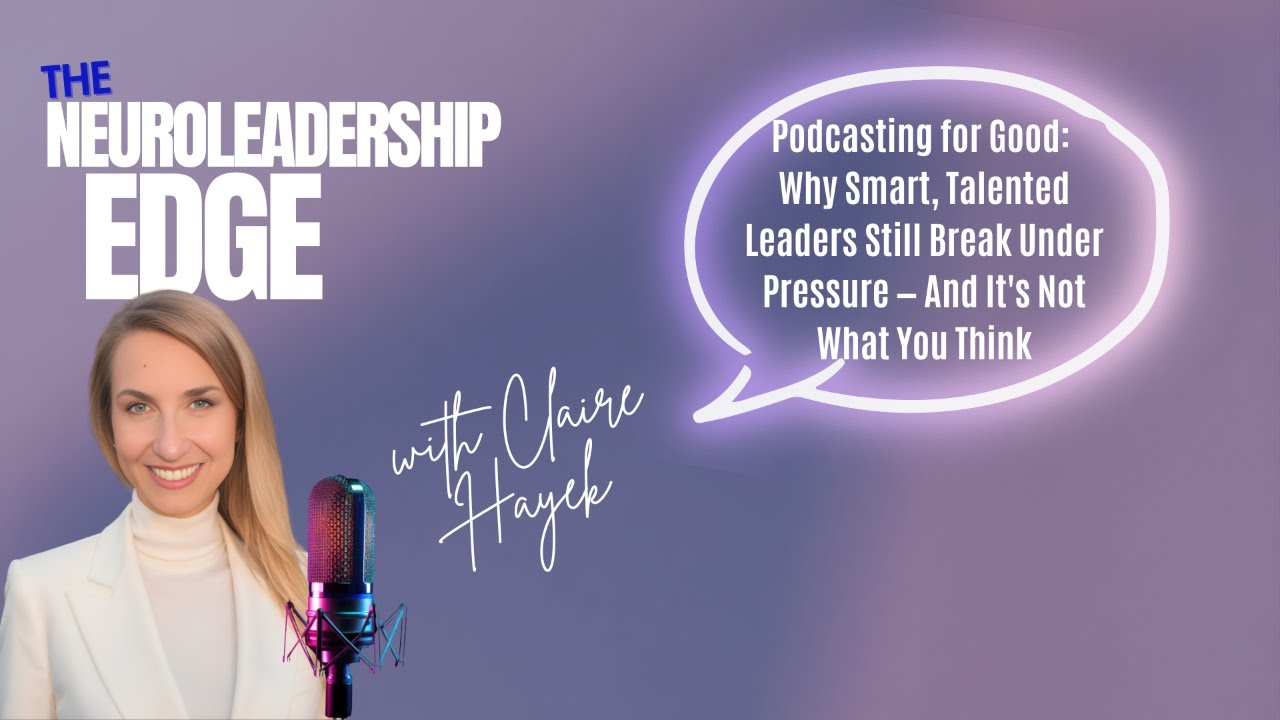
In this solo episode of NeuroLeadership Edge, Claire Hayek explains why even the most capable leaders and teams falter when pressure spikes. She argues that the root cause is not strategy, alignment, or communication, but three neuroscience‑backed, non‑negotiable brain needs: autonomy, competence, and relatedness. When these needs are satisfied, dopamine release strengthens the prefrontal cortex (the brain’s "CEO") and enables clear thinking, decisive action, and high performance. Under pressure, if any of these signals are stripped away, the brain shifts into threat mode, causing decision paralysis, communication breakdowns, execution stalls, and loss of ownership. Hayek defines each need, describes how pressure compromises it, and offers a concrete, immediately applicable action for leaders to restore the signal: (1) delegate a real decision to empower autonomy; (2) surface a recent learning that the team is applying to reinforce competence; (3) give a specific, genuine acknowledgment to a team member to boost relatedness. She also promotes two practical tools—a free Pressure & Performance Scorecard to diagnose where pressure is eroding performance, and Pressure Reset Scripts for quick mental resets before high‑stakes moments. The episode ends with a call to experiment with one of the actions, share results, and use the provided resources to build a pressure‑proof leadership system.
Chapters
You can have the best strategy in the room. You can have the best vision, the strongest team, the most rigorous process, and still watch everything stall the moment that pressure hits. Most leaders assume the problem is in the execution or alignment or the communication. Well, of course, these are factors. But this is not where the problem, the core problem is. The problem is that the brain has 3 non-negotiables. And when those are not met, it doesn't matter how talented you are or how hard you work. Your brain will work against you instead of for you. Today, I'm gonna tell you exactly what those 3 things are and most importantly, what they look like when pressure creeps in. And when pressure actually takes them away inside your organization. Welcome to the NeuroLeadership Edge, the show where we decode what it actually takes to lead under pressure, perform at the highest level, and build the mental architecture and that foundation that holds when everything around you is moving fast and when you're bombarded with a lot of noise. I'm Claire Hayek. I'm a neuroleadership expert, TEDx speaker, and founder of Mind Soul Purpose Team Building. I spent more than 20 years leading high-stakes projects and teams under pressure. I was actually born and raised in the midst of the war back in Lebanon, in Beirut. So I've been forged by pressure. What I learned is this: pressure doesn't build leaders. It reveals the system they're already operating from. And so today, I want to give you the neuroscience behind why some leaders and their teams stay clear. They stay aligned, decisive, and consistent under pressure, while others fall apart. Slow down and quietly just fragment. By the end of this episode, you're gonna walk away with 3 things. One, a clear understanding of the 3 brain needs that determines performance and why most leaders are unknowingly working against all 3. 2, a way to diagnose which of these 3 is getting compromised in your team right now. Because I promise you, there's at least one. And 3, something concrete to try today, something that you can apply right away. I'm going to give you a simple action for each one of them. And I want to hear what happens when you do apply it. All right, let's dive right in. Here's the uncomfortable truth. Over 30 years of neuroscience research points to this same conclusion, that the brain has 3 core needs that are non-negotiable for peak performance. They're not nice-to-haves. They're non-negotiable. When these needs are met, the brain releases dopamine, strengthens the prefrontal cortex, you know, the part what I call the brain CEO, where the part is responsible for clear thinking, sound judgment, decisive action, and operates. Now, when the brain releases this dopamine, it operates the way high performers need it to operate. This is where, again, we're strengthening The prefrontal cortex. Now, when these needs are not met, or worse, when pressure literally strips them away, the brain shifts into threat mode, survival, right? And in threat mode, here's what actually happens inside your leadership team. And tell me which one you recognize. Decisions slow down, or people just avoid making decisions altogether. Communication breaks down or becomes defensive, right? Execution slows down, stalls. Maybe people stop talking. And eventually, basically, they stop taking ownership. It looks like a people problem. But it looks like a culture problem too, right? It looks like maybe a skills gap, right? It's a brain problem. So let me get you right into those 3. Okay, let's name them. The first one is autonomy. The first thing your brain needs is autonomy. I'm not talking about freedom to do whatever you want. Autonomy in the neuroscience sense of things means your brain needs to feel like you are choosing your path. Okay. So, when that signal is present, the brain releases dopamine. Engagement goes up. Ownership goes up. Follow-through goes up. When that signal is not there, when people feel like they are just doing, executing based on instruction, based on someone else's agenda, following rules that maybe they didn't choose or maybe they don't agree with, or they, you know, even if they agree with them, they're just rules they have to follow. Or when they feel like they're being micromanaged into just to comply, that dopamine, well, you guessed it, it shuts off. So, here's what that looks like at the leadership level. You maybe communicated the strategy very well. You've aligned the team and then nothing really moves with the energy you expected. You're like, wow, we're gonna hit the ground running. But nothing is really moving as expected. So, why do you think this actually happens? Ask yourself that question. Well, the answer is not because people disagree with me and they're not really— they don't agree with what we're doing here. It's not that. It's because their brains are not getting the autonomy signal. They're just doing. They're executing. They're not owning. There's a difference. And the brain knows it. Here's what I want you to try this week. Pick one decision that is probably, you know, you haven't made yet. It's currently sitting on your desk in a pileup of things that you need to do. And think of that. Take that decision and see who you can hand it to on your team. You're not delegating the execution. You're really handing them the actual decision. Watch what changes and how they show up around it. Just watch. Try it and come back and tell me what happened. You can drop it in the comments in this episode or send me a message on LinkedIn or any of the social media. I want to hear from you. All right, ready for number 2? Drum roll. Number 2 is competence. That second need. is competence. Your brain is wired to seek growth, okay, to keep evolving. It doesn't want to— it's not actually wired to just stay comfortable. It's wired to grow. So, when your brain perceives that it's stagnating, nothing is really moving, it doesn't like it. It doesn't just feel uncomfortable. It actually also registers the whole thing, the whole signal as a threat. Why am I being stagnant? Why am I not moving? Why am I not evolving? Why am I not growing? This is why the best people leave the organizations that stop challenging them. Even when they have that amazing salary, they leave because it's wiring in the brain. It's biology. And here's what this means inside. Again, inside leadership teams under pressure now, right? When the pressure is high, when the pressure hits and the timeline is tight, this was due yesterday, most organizations do one thing. They narrow. They close. They pull people back to what's safe, what's known, what's already been proven. Well, that feels kind of logical, right, to a certain extent, right? But neurologically, it's the worst thing you can do. Because you've just told your highest performers that this is not a place, this organization, our culture is not a place where they grow. You basically triggered the threat response in them in the exact moment you need them most. So, competence is about creating real moments, especially under pressure, where people feel themselves getting actually sharper, getting better. Growing. And here's your action for this one now. In your next team meeting, ask this question. What's one thing we've learned in the last 30 days that we're actually applying right now? That's it. One question. And what it's going to do, it's going to activate the competence signal. It's going to anchor growth as the real thing. And it shifts the conversation from we're surviving to we're performing. We're not in survival mode. We're in performance mode. All right. So again, the question, what's one thing we've learned in the last 30 days that we're actually applying right now? So like, how are we really growing? Try it again and tell me what comes up. I will. I mean, you see here, some of you watching this on video, you'll see there's a QR code. This is where you can scan it and you can get in touch with me. On all my socials. Otherwise, like I said, you can leave it in the comment in this in this episode, no matter what platform you're on. And if you're listening to this in audio, you can find it through my Linktree. All my socials are on my Linktree. All right, moving along. Are you ready for number three? Number three is relatedness. It's basically the need. That most leaders underestimate, especially under pressure. So, relatedness is the brain's need to feel valued, seen, and genuinely connected. If— let's talk about the neuroscience. When you feel a real sense of connection, when you feel seen, trusted, or that you matter to the people around you, Don't you feel good? This is not a mystery, right? What's happening in your brain, it actually calms the amygdala. That's the brain's threat detection center, which is like an almond shape in the back of the brain. So when the amygdala is calm, your brain CEO, your prefrontal cortex, stays online. And here's where basically you, you can have clear thinking. Smart decisions, sound decisions, and steady execution. So you're not in your fight or flight. You're completely in your brain CEO where everything is working. Okay. When you feel isolated, however, dismissed, or just completely invisible, even subtly, just a subtle feeling of feeling subtle feeling of being invisible, the amygdala fires. That brain threat response, right? The brain shifts from being creative, open, connected into just survival mode. And all the energy that should be going toward performance and, and you're basically to your brain CEO goes toward your amygdala, which goes basically towards protection. It's going to just protect you instead. Now, think about what happens inside teams when there's a high-stakes moment, when pressure peaks. Leaders get heads down. Conversations become transactional. Probably recognition disappears. People stop feeling seen because it's just everything's going to lie on one person. And then leaders wonder why engagement literally drops Why collaboration breaks down, why the team that was killing it on all levels 6 months ago suddenly feels disconnected. The relatedness signal basically got cut off and nobody noticed because everyone was way too busy managing the pressure. So, siloed, right? Your action for this one is simple. It has to be genuine. I cannot stress this enough. Before your next one-on-one, take about 30 seconds. Think of one specific thing that person has done recently that made a difference that you noticed. Name it out loud specifically. And I'm not saying, hey, great job, good job, good work. Be specific what they did. And why it mattered. That goes a long, long way. That's the relatedness signal, and that's what keeps the amygdala— again, it keeps it regulated, and the prefrontal cortex stays engaged, stays online. So do it this week and notice what changes. Notice that shift and do report back to Planet Claire and let me know how this worked for you. This is what I use and I integrate in my pressure-proof leadership infrastructure and design and foundations when I work with executive teams. And trust me, it works. All right. Again, do it this week and let me know what shifts for you. So, here they are, the 3 non-negotiables: autonomy, competence, and relatedness. And here's what I want you to sit with right now. This is not about philosophizing here or leadership philosophy or HR initiatives, or this is a team-building exercise. These 3 non-negotiables are literally biological requirements if you want to get peak performance from your team. When pressure hits, when that strong wave comes in and it Literally crumbles your foundation, the foundation of your team, and it will hit. Promise. These are the three signals. These signals are the first things to get compromised that you want to just go toss away. Like no, we don't have time for this. But when they go, everything else follows: decision quality, execution speed, team cohesion, results. Because you're no longer in your prefrontal cortex. You're no longer operating. From the mothership. You're operating from just survival. You're literally siloed. The leaders and the actual organizations that perform consistently under pressure are the ones who have built, again, like I mentioned earlier, they built systems that protect these 3 signals even when everything is moving fast, even when there's uncertainty, even when there's disruption. Even when a war breaks, even when the whole event is canceled, even when deliverables are all off, even when jobs are lost. I mean, I can name a gazillion ways where pressure hits nowadays. All right. So that is what pressure-proof leadership is built on. Resilience as an operating system, not a theory. Okay. So, here's what I want from you. Pick one of these 3 actions I gave you today. Just one. One action. Try it this week and come back and tell me what happened. Leave a comment. Send me a message. Share this episode maybe with one leader in your life who needs to hear this. Share, follow, subscribe. And if you're leading a team and you want to know exactly where pressure is literally compromising performance right now for you, before it becomes a crisis, I do have something for you. The Pressure and Performance Scorecard. It's a fast, free diagnostic that shows you where your team is losing decision speed, execution quality, and communication, connection, and cohesion when pressure hits. It takes about 5 minutes and it gives you specific results actually gives you the answer. It shows you that gap, that blind spot. And you can find it by scanning the code that is on the screen right now, right here in front of me. Or you can actually also see it in the description if you're listening to this audio. It's the Pressure Performance Scorecard. Do it. Do yourself a favor. And if you want something you can use personally as a leader, the next time you feel pressure literally maybe blinding your thinking before maybe a high stakes meeting, a conversation, or a decision that really matters, I would grab the Pressure Reset Scripts. Do scan it to grab your free copy. Otherwise, the link will be in the description. These are short, specific mental resets that are built for real moments that you can use right away. And even you can apply it at work just before a meeting. They don't require for you to be in a room meditating for 30 minutes. Okay, they're very practical. All right, I'm gonna wrap up here. I hope this episode really served you and added value to you. Do reach out. Let me know how this works out for you. Remember, lead boldly, stay human, and turn every challenge into a gift because there's tons of gifts. And we can always recognize and find 3 gifts out of every single challenge we are faced with. And don't tell me that, what do you mean? I can't even find one. Think about it and get creative. You can find 3, guaranteed. I work with my clients and they always find 5 by the time we're done. All right, see you all next week and have a wonderful week.