You Have a Great Team! Here's How to Make It Better, With AI, in 2024
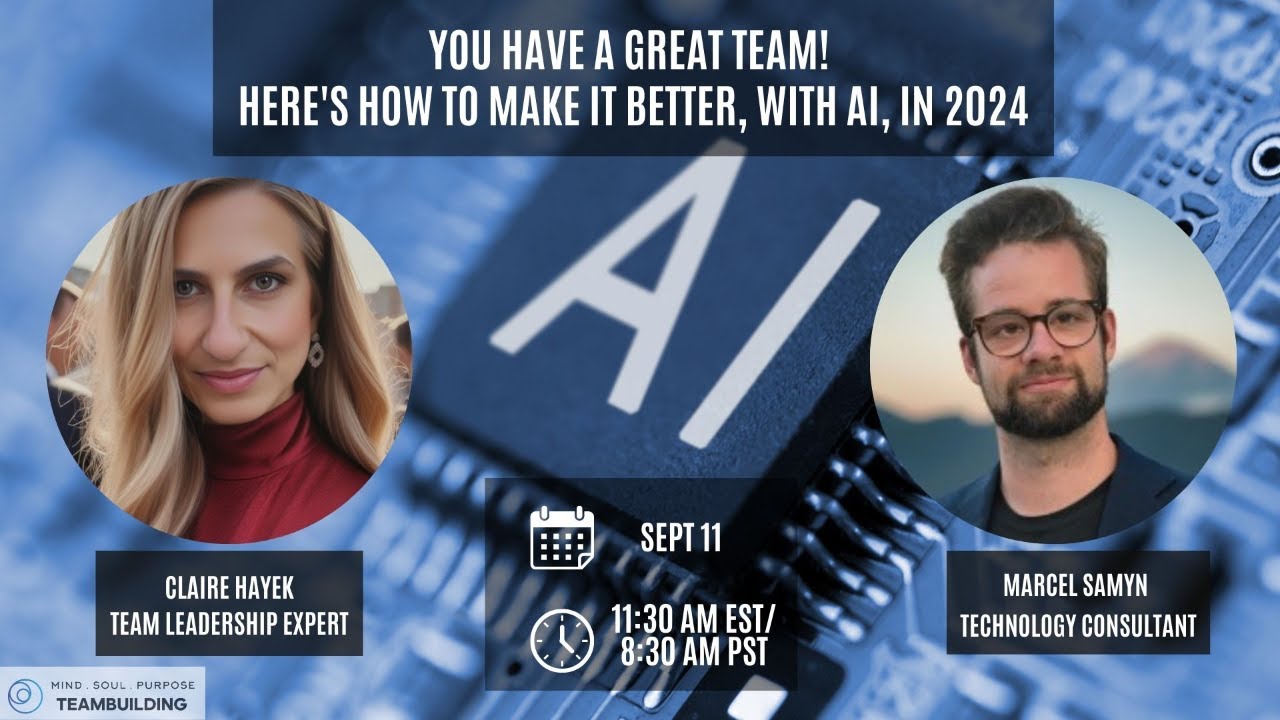
In this 30‑minute LinkedIn Live session, Claire Hayek (founder & CEO of MSP Team Building) and CTO Marcel Seymen (AI/technology expert) discuss how artificial intelligence can boost team productivity, collaboration, and innovation. They begin by framing common misconceptions about AI (job loss, security concerns) and emphasize AI as a tool that frees teams from repetitive tasks. The conversation covers practical prompt engineering, treating AI like a virtual intern, and the importance of giving clear, detailed instructions. They introduce Custom GPTs—tailored AI agents that embed a company’s knowledge, tone, and brand guidelines—to ensure consistent output across marketing, sales, and internal communications. Confidentiality is addressed, highlighting differences between free and paid ChatGPT plans, enterprise‑grade models, and on‑premise large language models. Three high‑impact tools are recommended: ChatGPT (with Custom GPTs), Notion (for organized knowledge bases with AI features), and Fireflies (AI‑driven meeting transcription and summarization integrated via Zapier into CRMs). Emerging trends such as voice‑first interactions, small‑scale specialized AI versus large‑scale models, and the growing ecosystem of AI‑enhanced productivity apps are discussed. The hosts outline an implementation roadmap: leadership decision, appointing a responsible AI champion (CAIO), starting with quick‑win automations (phase zero), and selecting unbiased consultants. They also promote upcoming webinars and resources. Throughout, the tone is instructional, enthusiastic, and supportive, aiming to empower leaders to adopt AI responsibly and efficiently.
Chapters
Hello, hello! How's everybody doing? Welcome to today's live, which is about how you can have a great team and how we can make it better with AI. So, I'm Claire Hayek. You all know who I am. Some of you that don't know who I am, well, I'm your host for today. And I am the founder and CEO of MSP Team Building. I'm a team leadership expert with over 20 years experience with managing teams. And I recently actually got certified as a neuroscience coach. I'm really, really happy to be here with you today.
Congratulations!
And joining me is our CTO Marcel Seymen, a key member of our team at MSP Teambuilding. Marcel is actually an AI and technology expert who helps entrepreneurs, leaders, and their teams harness the power of AI and digital solutions to improve team productivity. Don't we all love that? Hey Marcel.
Hi Claire, nice to be here. Happy to be in the public together.
We've been open together. I know, right? Yeah, Marcel and I met a while back. I think maybe like over a year ago, probably a year and a half.
I think it's almost a year. Yeah, I remember I was in Bali back then when we met.
Yeah, that's true. You were in Bali. And I mean, you know, we start talking and we instantly gelled and we were talking AI. I mean, Those of you who know, I'm an engineer, actually. So all that analytical programming side of me, I just love talking to Marcel about how we're going to be able to improve the process and be more profitable and shave off all this extra time off of our hands. But anyway, here I am getting way too excited here before we start.
I think our conversation started when I sent out an email that was something like 52 ways you can use AI in your business. I think that was the starter of our first conversation.
Absolutely. And then I went, okay, I need to talk to this guy. I need you to help my business. And I'll tell you one thing, all of you joining us today. He didn't only help my business. I mean, where we're at now as opposed to last year is I would have never— we would have never succeeded with the acceleration that we're going with if it wasn't for Marcel's credibility when it comes to automation and architecting and designing All the processes and improving how we work and literally shaving off 20 hours a week of my time. But hold your horses. We're going to get there. We only have 30 minutes. I'm going to remind you again, we only have 30 minutes. But before we start, I always like to know where everybody's joining us from today. So please do put it in the chat. Again, we love for this 30 minutes to be interactive. We don't want to be just talking one way here. Please share in the chat where you're joining us from. Axie Marcel is joining us from from Belgium, Belgium. So how would you say welcome in Dutch or Flemish?
I guess welcome. It's the same word. Welcome of deze live presentatie. Hey, I'm really glad to see you.
Et pour moi, je suis j'appelle en fait du Québec. I'm I'm I'm basically joining you from the province of Quebec, from Lorraine specifically, when we say bienvenue. So, and bienvenidos for our Latin amigos and amigas. So very, very multicultural today. I don't know why I'm feeling it, but hey, why not, right? So please do share in the chat where you're joining us today. Let me just go over here. We have Lucie Côté from Quebec City. Yay, Lucie, thanks for joining us. And Connor from Montreal. Speaking of Connor, he's part of our team and we're really excited excited to have him. He just moved to Montreal from the US, and we're just really ecstatic about him actually being local now. So, here we are. Without further ado, let's talk about today's conference. Okay, today's subject. So, AI, AI, AI. Everybody's talking about it. I mean, we've been talking about that, Marcel, since 2023 when the whole ChatGPT wave came on. And a lot of people are reluctant, especially in business, leaders, C-suite, owners, founders, you know, the whole security thing. There's all these questions like, this is going too fast. This is not legit. There's all these questioning and all this doubt about AI. And there's a lot of entrepreneurs and leaders that actually jumped on AI early on. And they're seeing huge, huge difference in their bottom line and their profitability. They're leveraging it in every single way they can. So, there's kind of like You know, the two sides. And I think people are catching on with how AI can actually— the positive side of AI, responsible AI— how we can use it to enhance productivity and team dynamics. Because that's what we're talking about today, how AI can transform how teams operate, how we can enhance collaboration and drive innovation. So Marcel, Hmm. can you share or explain how AI or the role of AI in teams could be could be relevant in team dynamics and how it is actually helping teams become more productive, agile, and efficient. And while you're at it, like, what are some of the emerging trends, AI trends, that leaders should watch, I guess, should watch out for in 2024?
Yeah, yeah. And I completely agree with the way you— what you see with other people. I mean, what we notice in the world is that Many people know about AI and they know about the power, but they're kind of, they're unsure how to start using it or where to go about it. And they're a little scared about what it can do and all the other implications. So, and then you add all the hype onto it with people telling you it's going to change everything and they're going to kill everyone or something like that.
Or eliminate jobs, right?
Eliminate jobs.
Eliminate jobs. Right? And this is not what we're talking about here. And it's more about freeing up those repetitive tasks so your team members can actually excel better and grow and develop better skills as opposed to repetitive, boring, frustrating skills, tasks that actually cause stress, frustration. And we're trying to actually improve things here. We're not replacing you. Okay.
Yes.
So tell us, what are the emerging trends and how do you feel that AI could really help teams collaborate better?
Yeah. So the way I look at AI is kind of like it's a new tool, but it's a really big tool. It's like we had computers, the invention of computers. Nowadays, nobody uses, writes things on paper anymore. It doesn't make any sense to do your bookkeeping on paper because why? When we had computers, when it was new, There probably was that discussion as well. So the content of our job and what is more valuable and less valuable, that is changing. Something like having someone in a meeting just to take notes about what's happening, it doesn't make that much sense today anymore to have an actual person there because we have AI that can do it almost as good. So it's just the content of our jobs that is changing. And it's a little bit, it takes some practice and intuition to get used to it, to know what it's really good at. Because people, when they start out with this, they see ChatGPT, you get the blank text field and you're like, what, you know, what do I type in here? I don't know. I don't know.
Prompting. Prompt engineering is a thing.
Yes, yes, yeah.
And, you know, if I may jump in here, Marcel, I mean, it really— the way I see it, because when I first started using it, I'm like, I don't know how to talk to this thing. It was like this thing and there's me, you know. And then I understood and I watched a lot of webinars, a lot of people like educating on AI and you're one of them, by the way. It's like really helped me is when I changed my mindset and I said, when I'm ChatGPTing, I don't know if that's a word or verb.
It will be soon.
Right? When I'm ChatGPTing, ChatGPT, think of ChatGPT as a member of your team that is assisting you with a task that you really don't want to do and that could do it really efficiently and quick.
Yeah.
And just speak to, write and speak to ChatGPT. Now, we can actually record our voice and obviously directly. I'm just saying it out loud. I know you know that. But, you know, how would you talk to, you know, somebody on your team? So, it's like, hey, I need you to help me with blah, blah, blah because I need to target blah blah blah, and I need to make it more efficient and, and a bit more exciting and motivating, etc., etc. Um, what do you suggest?
You're actually hinting at the— you're hinting at the real clue of using ChatGPT. So if people are here, maybe there are people here, they're like, I've tried it and it, it's kind of, ah, I don't know, it doesn't, doesn't do what I want, right? The clue here is that you need to realize that ChatGPT, it's like a, it's like a little bit like an intern, but who's very new. They're an intern and they're cheap. I mean, ChatGPT costs nothing compared to a person.
Right.
But they don't know anything about you, about the business, about the situation. So it's very important that you give it a lot of information and you're also very precise about what you want it to do. And that's the biggest thing that you're gonna see that gets you from like 0 to 70, 80% there. But the voice reminded me, that's actually one of the, emerging trends that are coming later this year that I'm super excited about. We have the voice interaction, which I actually do this sometimes. I just, the other day I was just on the bicycle and I put it on my phone with my AirPods in and I was biking. I was just chatting with ChatGPT. Really? Okay. Yes, yes, for sure. I was like, oh, I need to think through this. I want someone to like bounce some ideas off or get some things.
So you're brainstorming while you're cycling to your destination and conversing with ChatGPT. I mean, you know what? If this improves our creativity and stimulates our ideas, why not? One thing I'm going to say, and I don't want to jump too ahead. I mean, obviously, as you would with a person, don't take everything ChatGPT tells you for granted and go, yes, 100%. ChatGPT can be very creative.
Yeah.
And one thing I've learned, and you taught me, Marcel, is to put in there, base it on actual information out there, provide references from these facts that you're sharing with me. And then you kind of like, you need to keep it under control. But anyway, we're like way ahead here. Yeah.
I had a discussion with a client the other day when they were asking to do something. I was like, no, it's not. Technically, it's not possible. And this client was like, yeah, it is. ChatGPT just asked, just told me. I'm like, no, no, no. ChatGPT tends to agree with what you tell it.
So yeah. And then you can tell GPT, don't just agree with me.
Actually, that works a lot.
You know, get those references and make sure you do your research before you answer me. You're literally talking, speaking to a kind of like a fake person. You know, it's not a real person, but obviously it's an AI. But yeah, it's just that I think the more you speak to it in a normal way, the better it is, because then you're not coming up with weird words and conversing in a weird way that confuses this thing. Just, just talk as you would speak normally.
But I do expect that we will see a big change in that, probably this year or early next year, because they're very aware of this, this thing that ChatGPT isn't really capable of, of reasoning like we, like we are.
Yeah.
When I ask you something or when you ask me something, I am in my mind, I first think about it and I think about what I've learned, what references, you know, to make sure that what I'm saying is true. And, and the way ChatGPT works— I'm not gonna explain you the whole technical details— but the way it works is that it's, it's way more focused on making things that make sense grammatically, right, than actual, like, factual. So you can kind of look at it as it's writing— it's like it's writing a screenplay. of a dialogue between you and the robot, but it's in a whole other world where we don't know what's true and what's false, what the laws of physics are, what businesses there are. We don't know. So it makes a lot of sense, that discussion, but it's not necessarily true.
Right.
I hope that kind of makes sense. But they're building on this technology that will actually give it the ability to Have reasoning, yes, in it. And what I do now all the time is I tell it, please write down your reasoning, like give me step by step how you get to the answer. And even though I won't read it, I know that it's kind of smarter that way because I force it to write down how it's thinking.
It has to go through that and say, okay, if he's asking me this, then I, I better watch, I better be a bit more specific. Or basically, I like that. That's, that's a gold nugget right there. If, if you didn't catch on, this is that when you're prompting and when you're talking to ChatGPT or Chatting is is to once it spits out an answer, just to say right like can you show me how you got to this answer?
You gotta you gotta have you gotta say that first because otherwise it'll make up otherwise it'll make up a compelling story about how it got there. Okay, so even though the answer might be wrong, yeah.
Right off the bat when you're asking the question, make sure to share your reasoning.
If I first the reasoning then the answer.
Okay, great. Wonderful. This is really, really useful. Thank you so much. So, I just shared a question here. Please do put it in the chat. Just a little survey. We're gonna have 2 more of these. Is your organization currently using AI to support team collaboration, team productivity? Yes or no? Easy. Yes or no? Please do put it in the chat. We want to just kind of survey, see what's happening out there in the world, in the B2B world, or even if you're a solopreneur. Are you really leveraging it? And I just wanted to mention before, usually I mention it right off the top, is that we will address the questions in the chat at the end of the session. So, it's like in 15 minutes. It's really gonna fly by. So, Lucy, I know you have a question and we might just kind of, you know what? Let's answer that right away because I find it's a really good one.
Absolutely.
And I'm gonna show it right here. On the screen. So Lucy asked, how can we use it efficiently and also maintain the confidentiality of our information? That is so key. That's a great question, Lucy. And that was my first question to Marcel when I started working with him. And anyway, Marcel, go ahead.
Yes. Yes. So I'll assume that you're talking about ChatGPT or similar technologies because, I mean, you can think of AI as a whole world of things, but we'll talk about this. And here the thing is, first of all, what you need to know is that the way these things are built is because they are built to emulate examples. So before, GPT is Generative Pre-trained Transformer, it trains pre-trained beforehand. So it got a lot of examples of what does a conversation look like. That's basically everything they put in. So one of the extremely valuable things for some company like OpenAI who develops ChatGPT is that examples, is the examples of good conversations. And so they want to gobble up as much data as they can, as much examples. So they will want to have your conversation history. And if you deal with confidential information and you paste something in there, then with the default settings, It is going to be used by OpenAI for either— maybe they're just going to check it and see whether you liked it or not. Maybe they're going to put it as one of their examples when they're training the next version of ChatGPT. It doesn't literally end up in the training data, but it's still able to reproduce these things. So like, in any case, it's probably okay for them to use it.
So we don't know. You have no control over how this is going to be used.
Yeah, so don't put in, like, in consumer ChatGPT, don't put any confidential data.
Right.
Now, when you move to using ChatGPT as a developer, or you have the— I think it's from the enterprise, but I'm not sure, it could be at the team level too, in the plan of the paid ChatGPT, then you have the option, or it's by default, again, I don't remember by heart, but you have the ability to tell OpenAI Guys, don't use this data. Like, it's mine. Please don't use it.
Okay.
So that's definitely something to do. You can still be in a situation where you're like, well, we're still sending the data to OpenAI, so we're trusting them that they won't do it. So that could be another layer of trust that you don't want to cross, which could be in certain sectors required. And in that case, you want to have a similar technology to ChatGPT, but bring it inside of your company. So this will be a large language model that you run in-house so that the data doesn't go anywhere.
Okay, so if I understand this correctly, we have the option in ChatGPT, but when you use the free version and/or the paid version, you can go in settings and—
In the free version, there's no ability to turn it on.
There's no ability to do it. So you want to get the paid, and I highly recommend it.
Mm-hmm.
And it's obviously great for confidentiality. So, with the paid version, we can go in and I've done that. I know I went into settings and I turned off like everything. Like, don't share anything. This is confidential. This is mine and mine only. So, there's— that answers your question, Lucie. And when it comes to the organization on an organizational level, what you said, Marcel, is that there's more on the enterprise-level GPT that could be imported into the system. I'm not a tech, so I don't know what the words are, where it's really more proprietary and it just stays confidential. It stays private to the actual development and the developer inside the enterprise. And it's not the public GPT.
You have the ability of not sending it over to OpenAI to do the AI stuff, but instead having literally having the box in your office, right, which would do the same thing. The quality level will not be the same, right? Uh, but you have that ability. Yes.
Okay, so we're good, we're covered, we're good. Okay, that's a great question. I, I love that. Um, so again, I'm, I'm putting the question out, uh, out on the screen here. Please do answer. Is your organization currently using AI to support team collaboration and productivity? Yes or no? And let's move on to the next question. There's so many AI tools. I mean, I use a gazillion ones. But at the beginning, you get all excited and you're like, oh my God, I can do this and I can do this. And, you know, and then you kind of narrow it down to what tools, your own toolbox, and that you usually would help you with your own productivity. And what I'm very interested in knowing, Marcel, is if you can share like 3 tools with us that could instantly take off, I don't know, 2 to 3 hours a week with teams, with leaders, with entrepreneurs that they can use literally after this LinkedIn Live. Can you share 3 with us?
For sure. For sure. So I think with this story that you're telling, I think this is a source of many people's frustrations in AI. There's 100 new apps coming out every day. And that is just the nature of this thing being so new. And I think one of the biggest things that needs to happen for everyone to just confidently use it without thinking every day is building better tools around it that make it easy for us to use.
Right.
Apple had their announcement, I think yesterday or two. I didn't watch it, but where they had it on the phone and that's gonna— I mean, I'm sure that everyone's gonna be using it on their phone and they're barely gonna realize it 'cause that's what Apple does. They've been using AI for years. They just didn't call it AI.
Yeah.
But they've been doing amazing. And that, I love that approach. They're doing it without you noticing. Anyways, given all that, that there's so many things, I tend to just go back to the basics and look at what are the fundamentals? What are the big few that make the biggest difference?
Right.
And so we've talked about—
In a productivity I guess context.
Yeah, for sure.
Right. Yeah.
Yeah. And so we've talked about ChatGPT, but the one of the biggest limitations of ChatGPT, we talked about this before, is information, right? You said that you need to give it a lot of information and be very precise in what you ask it. Now, this is very annoying if you need to do it every single time, if you need to do it over and over and over again. So they built a feature called Custom GPTs. It's in the ChatGPT platform. So if you have ChatGPT, if you have the paid version, You can build these actually. And basically what this is, is we're going to take ChatGPT and we're going to take information and we're going to put this together. So what you would do is you make a custom GPT specifically for your company or specifically for your team or your product. I mean, you can make it as big or as small as you want. You kind of have to play around with what's most useful. And then you put in everything about you in there.
Mm-hmm.
You know, for we, for MSP Team Building, we have custom GPTs that know about all our offers, that know about all the activities, that know about our approach, our target audience, all that stuff. And we really need that to be able to write very specific content. So that might be things external like emails or social media posts that helps us, but also just website copy or I don't know what you use it on.
Yeah, I mean, it's, you know what it does? It sets the tone. What really helps with us is that we have a team. Well, you know, we have marketing, we have sales, we have admin, tech, etc., business development. But when we use our custom GPT that we program with all our information, we put our capability statement in there, the pitch deck, what new services we have, and we just keep feeding it and updating it as we go. Then, if I'm using that GPT just to correct or rewrite an email that I'm kind of like, my head is not working right now and I'm like, I cannot formulate this properly. And I put my email that I wrote in it and say, just improve it. So, what that does, if Connor goes in and does the same or Jackson or you or Anjali, whoever on our team goes in and uses that GPT, I know that we're, you know, it's going to improve it. We're going to speak the same language. There's no confusion about somebody's going to say something else about MSP Team that we don't offer because the GPT knows this is where we are. So, it's kind of like interesting enough. It improves. But also, it's like a safety thing. It's like it's clear. You know, you don't have to overthink like, was it that? Did we actually do this? I can't remember. Let me go back to the pitch deck. Is it on our website? No, no, it's all there. ChatGPT will take care of it. But because we told GPT what we want, we told GPT who we are. I mean, that one, I love that one.
And if you're the leader, this is important for you to set up because, you know, let's say you have a specific brand voice and you don't want to speak in a certain tone of voice.
Right.
Then you put that instruction in the custom GPT and you're sure that it will never output that kind of stuff.
Yeah, yeah.
I know people who use it. There's like, sometimes it just types out very ChatGPT-like things, and then you can add a blacklist of words that it's not allowed to use.
There we go, there we go. You're basically training. It's as if you're training an intern. Say, look, this is how we work, this is what we're about, this is what we don't do, this is what we really do. Et cetera, et cetera. So let's, let's move on. Time is flying by. I mean, yeah, because I'm like, I don't know about you, and you can put it in the chat, whoever's with us here. I mean, who wants to know more about this? Like, 30 minutes is just not enough. I want to take another 30.
But I'm just talking about the general stuff. So this is just like everything I can talk about very quickly, which is—
yeah. We're scratching the surface here, people. So, uh, let's move on. So next one here on screen.
Notion. Yeah, it's one of my favorite tools. It's not necessarily an AI tool per se from the ground up, but it is a tool that lets you organize information. And everything we talked about before with the custom GPTs, that applies here. Like, for me, AI usage and note-taking, it goes hand in hand.
Yes.
Because I need to know what I have to tell GPT. So I start just describing everything I'm doing Because I know that at some point I'll go and ask ChatGPT about it. So I need something to copy paste and I don't want to be talking for 20 minutes when it's like, I don't know, the first time I'm talking about a new product or something like it needs to know that. And with Notion, I can organize that. They have some AI features built in. So if you put all your company information in Notion, you can ask it and it'll go and search through your whole database of all your notes and use that to answer it. You can have your— when you're organizing things like in your personal life, you'd organize books, and professional life, I don't know, meetings or projects. It can also autofill some of the— yeah, yeah, it can also autofill things with AI. So it can help you break down tasks, for example.
Awesome. This is great. Okay. And the third one here, um, we have Fireflies. Fireflies.
So this is— I hinted at this before. If you still have someone A person making notes in the meeting, it's probably not the best use of their time because we have AIs now that can do that. So Fireflies is one that works with just about any video conferencing platform. And basically it's a virtual person that calls into your voice calls or video calls and it just transcribes everything. It knows what's said. And then afterwards it makes a summary of it with action items. So like you can just sit there and talk and be focused and be present. And then afterwards you have a summary of what happened and what's going on. So.
Yeah, I honestly love these tools. Thanks so much, Marcel. I personally use Fireflies, but just to mention, there's a whole bunch now. You can choose whatever one you want. There's Fathom with Zoom. And I know MS Teams has like a standard one that comes with the Microsoft suite. I haven't really used it, but, and they're all good. They're all safe. What I love about that feature is sometimes you could highlight, Right in the meeting and just click on highlight like it's a little icon. And so, when you go back, you're like, okay, you know where the highlight is. You can go back and say, okay, I wanted to pay attention to that part because— and then, what we've done at MSB Team Building with Marcel is that we've automated that all our meetings, we always have our Firefly agent show up. And actually, all my clients go, we have somebody else here? I'm like, yeah, yeah, it's just an AI taking notes for me. And they're like, oh.
Yeah.
So what we do is that automatically the notes from Fireflies are sent through Zapier. It's something we'll talk about another time that basically brings it into our CRM and it's linked to the client file. So then we always know if I miss something, I know I can go back to that and do a little search and see exactly what you told me about your needs or whatever you shared with me. But let me—
You're like, oh, 3 more minutes.
There's so much to talk about and we're running out of time. I'm I'm going to go back to the chat here. If you have any other questions, please drop them in the chat. I did want to, before we run out of time, and we'll probably take extra time, whoever wants to stay with us, I did want to share the fact that we're going to be having— we're going to have a webinar, AI-enhanced team productivity webinar. Okay. And we're going to have that on October 9th, if I'm not mistaken. Yes. October. There's a lot going on, guys.
Yeah.
A lot going on. October 9th at 1 PM EST, 10 AM PST, where we're gonna have Marcel and I for an hour and a half. It's a free webinar. Please do register. Scan this. We're gonna be literally taking an hour and a half and share amazing tools with you that are gonna help you and your team save so much time. So, please do scan that. And on the upper left or right-hand side, not sure, of the screen, another QR code, which is for our I've been talking about this for months now. It's our team leadership webinar. It's actually happening tomorrow where we're going to be sharing again, 90 minutes, 1:00 PM, same time. We're going to be sharing tools about neuroscience-based leadership. How are you going to be able to change your brainwaves in order to get more productivity, innovation, and creativity within your team? We're going to be sharing tools about communication, collaboration, as well as so much more. That's happening tomorrow. And finally, and I'll share this right after, right at the end. So stay with me. I'll share what we're doing, when our next LinkedIn Live is, which is actually going to be in October. But before we leave here, Marcel, I'm just like, I'm looking at all the questions I had for you and I'm trying to like choose one, which is impossible. How can we integrate and leverage AI into organizations, especially when we're not sure where to begin?
Yeah.
Just walk us through quickly again. It's already 12 PM, but I don't care. I'm going to go on. If you're interested, please stay with us and you can watch the replay. Just where do we start? What are the next steps? It's overwhelming, right? So yes, how do we do this? How do we start?
I think the first thing is the decision. This is deciding that.
Good point.
Yes. Okay. This is AI. I see there is something. I also know that I don't understand it. And it's time for us to go into it and learn how to use it in our company. Then I think it's important to have someone that's responsible for this. You can call this a CAIO, a Chief AI Officer or something, you know, or it can just be a random person in the team.
That is interested in AI, that understands AI, right? Yes.
Yeah. Yeah.
You don't have to be an expert. You can become an expert, right?
Oh, for sure. Yeah. It's a new field. Nobody knows what they're doing, you know.
We're all learning. Yeah, absolutely.
Yes. Yeah. And so that is, that is really key that someone goes out there and kind of explores and looks out a little bit what's happening, how can we use it. Of course, you can bring in external people who have the experience and know what's out there. But there, the key thing is really this merger of what do we do in our team, in our business, and what tools are there. Finding where that combines, that is a really big challenge.
Right.
Because you really need someone who understands both of those at the same time. And sometimes in like— we've talked in very general here, but sometimes looking from afar, you miss out on a bunch of things. I remember when I was in corporate, I like— we had to— I'll try to make this story short. We had this little thing where we had these PDFs and we had to draw little red boxes on them with you know, I received this on this date and I received this back from this client.
Yes, I remember that.
Yeah.
Yeah, I remember that, yeah.
And it was, I was like, oh, this is just stupid work. Like, it's already even in the software, but you still— and then my manager was like, yo, Marcel, those boxes, you could align them a little better.
I'm like, goddamn it.
So—
This is what we're talking about, frustration.
Yeah, yeah. I was like, I don't want to do this and this is simple work. I'm paid too much for this stupid task.
Exactly, yeah.
And so I spent the rest of the day on making an automation for that. So I would just have one click and it puts in all the freaking red boxes correctly aligned in there. And so, you know, that is something and it, you know, it spread like wildfire through the company because everyone was sick of doing those red boxes. And that's such an example of something that you only really notice when you're in the weeds. Like I could notice because I had to do this. But if you're sitting there, if you're just watching some, reading some article on the internet about AI productivity, or even if you just have something at just leadership level, maybe you might miss out on these things. But they're hours each week spent. And in this case, this was a big company, it was hundreds of people. So the difference that thing makes is huge.
If you just do the math quickly, I mean, we're talking about hundreds of thousands of dollars saved a year for a small company and millions of dollars saved for Fortune 500.
For sure.
You know, if you're not riding this wave now, I mean, you're really missing out. So, if I summarize quickly, you gotta make the decision to make it happen. So, leadership decision, you know, basically who's gonna make the decision on this because it takes the commitment. It's gonna take the commitment and the desire to do that. And maybe just seek an expert or an outside consultant that could help design the process for you and work with your team and teach them what they could do. The thing that I noticed out there is there's a lot going on and a lot of consultants out there are pushing their own apps, meaning their own apps being affiliated with certain apps. You know, there's nothing wrong with that. I think it's fine. But if you're going to push an app, we want you to just make sure, and this is my advice as a leader and as a business owner, whoever you're going to be working with, make sure that that person is advising you on the right app for your business and not the right app to put tokens and money in his or her pocket or their pocket. Okay. So that's going to be very important. So trust that person. that they're gonna integrate the right tool for you regardless because that's a thing. That's a thing now. So, transparency is important. And you'll see, I think right off the bat, we're presently, I mean, Marcel and I were working with a lot of our clients on improving their processes. And just, we call it phase zero, which is like little things that they can do instantly.
Yeah.
And it just like adds so much value to them. So, I'm gonna wrap this up here, Marcel. I do have a little ticker here at the bottom. at the bottom. If you want to know more about AI tools, if we can help you in any way, please do reach out and type AI tools in the chat and we'll get back to you with some of that. I'm gonna put up the AI-enhanced team productivity QR code here on screen for our upcoming webinar. It's free, 90 minutes of just gold nuggets. This is gonna add so much value for you and your team. Would love to have you. So please scan this and register. And finally, my God, it's so much to talk about. And finally, I do want to remind you that our next LinkedIn Live, I usually have them every week. The next one actually will be in October. And I'm going to be sharing tools about neuroscience hacks that can make you an unstoppable leader. And that's October 2nd. All right. If you didn't catch all these QR codes, like I said, just put it in the chat. We'll send them to you. They're also in the chat, Connor. shared all of them. We love Connor. We love Connor. And yes, we do. We do. Awesome. Hey Connor, a lot of love. Um, and this one, when you know where to find it, it'll be under my events. So, you know, don't, don't say, hey, where is it? It's under my events, people. But please do reach out. I always like to chat with everyone. Again, I'm gonna put this up on screen because we're talking AI, and I'm gonna go over to the chat quickly to see if anybody has other questions. I know we've spilling over, but who cares. So if you're with us, we're gonna address your questions. So Patricia— Patricia, sorry, it's Patricia Angela Kazubulo. I'm sorry if I'm butchering your name. I, I'm trying. How can we use ChatGPT to streamline the process of setting wholesale and retail prices for both B2B and B2C, ensuring easy and efficient pricing across different levels? Love, love that question. And I think it's going to be a long answer, but I know it's doable. Marcel can maybe confirm that. But I don't think we'll have time to answer that one in detail. But if you do want to continue the conversation, Patricia, please do put it in the chat and we'll have maybe Marcel reach out to you. Marcel, do you want to say like a couple of things on that?
Yeah. So, I mean, this is This is a complicated— this is for sure a complicated question, and I don't know anything about like pricing in that sense. So I— it's a little different, difficult for me to imagine, but I can give you some hints there. So if you would just go straight up to ChatGPT and ask it about pricing, it'll come up with numbers and those numbers will not make sense. I've seen people before do things like in the marketing space doing keyword research where it tells you how many searches there are for a specific Google search.
Right.
Like, look, you can do it with ChatGPT. And I look at these numbers and it's like, these are all wrong.
Yes.
You know, like we talked about with the reasoning, it's not— it cannot do that now.
But there are apps. There are actually apps.
Yeah.
So you can, you can do that with— there are more options.
When we go, when we go look more in enterprise, when you want to use AI in those situations, you're quickly going to see that there's a distinction between Big AI and small AI.
Right.
And big AI is something like ChatGPT that we're used to. These are very complicated systems that can answer any kind of question.
Yeah.
But they're also not very specialized and they're kind of expensive when you are using them really at scale. The other side, which many people in the machine learning or AI space find more interesting, is small AI, which is It's a smaller— it's the same technology, but it's much simpler and much smaller, much faster, much cheaper. And what you're going to do is you're going to give it a bunch of examples of your specific information. So it's like, I'm always going to ask you about this. In this case, I'm also going to ask you about pricing. I'm always going to give you information in this format, and then I want you to give me a result in that format.
So we're talking about the customization that we talked about.
Yes. Yeah, so you're gonna take it instead of the big ChatGPT, you're gonna make it— you're gonna take a small one that exists that knows a little bit about how to write a sentence, but that's about it, right? And then you're gonna take your business, your proprietary information, and you're gonna train it on that. Because training on a large thing is also super— it's cumbersome, it doesn't make sense, right? You're gonna do that on that small thing, and that's gonna be able to give you specialized information in this sense that you want. So that is something that you could be doing here where you really are— you're going to make a custom AI that specifically does what you want it to do.
Okay, great. Thank you so much, Marcel. I'm just going to take 2 seconds here out of your time before we wrap this up. Please tell us, what do you think is the biggest barrier to integrating AI into your team right now, your organization, your operation, whatever? Lack of knowledge? Budget constraints or resistant to change? Anything else? You know, obviously, we could go on here. But we focus on these 3. Please do put it in the chat. We want to know which one is right now. I mean, for me, it was the lack of knowledge. And this is why, you know, we teamed up and partnered up with Marcel that really helped us. And there's a lot of very knowledgeable people out there, more and more. You just need to make sure you choose the right people that have that experience. and reasoning and, you know, of how to go about this because it's not just AI, it's all about the reasoning and the strategy. So that business savviness, right? So do put it in the chat. And again, Marcel, I mean, I can't thank you enough. I'm so happy that we took the time to discuss this.
Of course.
And I will— give me a second here. I'm going to put this back up. Please do register for this webinar if you want to know more. Either way, if you didn't catch the QR code, it doesn't matter. Just write to us. Write to me. I'll put it in the chat and we will get back to you. Thanks again. See you tomorrow for the team leadership webinar. And see you October 2nd for some neuroscience tips and tools on LinkedIn. Otherwise, see you for the AI-enhanced team productivity one on October 9th. We're here for you. We're here for growth, education, to add value to our listeners. And we're excited to do it. And if you don't feel that passion coming through the screen, I mean, I don't know what else can I do to show you that passion. But we are very passionate people, our heart in the right place. And we love, absolutely love what we do. And I love the fact that Marcel, you're part of this. Thank you again. Have a wonderful rest of the day or evening, Marcel. And see you very soon.
Thank you.
More from Claire


25 years in cybersecurity taught her this about staying calm under fire with Jonna Garber

Pause and Assess: The 10-Second Technique to Stop Over-Controlling Under Pressure #shorts


UN Mission Director On What Real Calm Under Fire Looks Like With Fredrik Sandvall





Book Signing at AIFEC Bogotá | What Pressure Does to Leaders and Why I Wrote This Book #shorts