Effective Shooting Workouts, Making It To The Next Level, Improving Finishing, and More! - Live Q&A
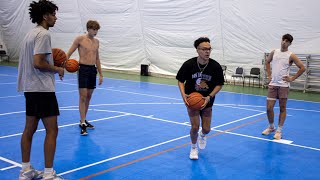
Coach Ethan Khoza answers questions on shooting consistency, finishing through contact, and handle development. He emphasizes high-volume reps with game-like shots, stride-stops and floaters against defenders, and building confidence to handle game pressure.
Chapters
Foreign. What is up everybody? A few guys in here right now. Give a little more time. If you're in here, just let me know how you're doing, let me know where you're from. I'm interested in that. I didn't ask that last time but I want to see where, where, where we got people tuning in from today. Got a few questions for you guys that gotten through DMs. Obviously you guys who are in here now who may have been here last week or saw last week's, feel free to drop in any sort of questions that you have in the chat. And obviously we'll be going there a ton as well. Got here, got a couple minutes here everyday. Erica, how's it going? I'm 16. Is it too late to start practicing for a D3? Definitely not there. There really isn't any such thing as too late to do something because it's all dependent on how good you are. If you're a really good player, then no, it's not, it's not too late. But you won't know until you actually do it. So without having more information, without knowing you personally, I can't tell you if it's too late. Generally I'd say no. Though if you find a place that fits for you a lot of times that'll be. That's really the thing that's the most important, most important part of all of it. Let me go to the DMs here, pull up some of these questions from this past week. Got here. Okay, so here's a question that I got that I talked about a little bit in the video I just dropped this morning. So you guys have not seen my newest video. It basically it's probably going to be one of the most helpful videos that you'll ever watch on shooting. So if you've not watched that, it's 17 minutes long. It literally takes you through important parts of your form to take you through. There's important things to understand when it, when it comes to becoming a better shooter and then it takes you through a full workout that you can do to kind of cement in these foundational pieces. So gonna help you a ton if your goal is to become a great shooter. So go check that out after this live for sure. Just dropped it this morning. But I talked a little bit about how a lot of players struggle with consistency as shooters right where they are. Okay, one minute there or one day, let's say they shoot and they're making everything and then the next day they go and they can't make anything or wave one great game and then one awful game and they can't seem to find a level of consistency. And so the biggest part of that, this is a question that I got is just, hey, coach, I have a common problem constantly changing up my shooting form. Any advice? The biggest part of that, of becoming a consistent shooter is so simple, but I think a lot of players don't understand fully is that you need reps like you need more reps, right? You can have the most perfect form ever and you can spend all your time watching all these videos and working on your form. At some point you have to just get more reps up. And the reason for that is because we can self organize as humans, which all of that means that you are able to take mistakes and mess ups and correct yourself. You don't need somebody to tell you, hey, you missed to the left, like you know that. And eventually when you miss the left enough, you're going to figure out how to adjust and not miss the left anymore. That only happens though through reps. So if you don't get those reps, you never get a chance to do that. So when it comes to building consistency, you're building a consistent level of form. It's literally just a compound effect of doing it more right, Spending more time in the gym, getting up more shots, doing it in different situations. Okay, so also working on it, you know, with some, you know, more variable practice where you're switching up the shot after shot because obviously in the game you're going to shoot from the wing and then from the corner and then from the elbow like you're, it's going to be different every time. So also incorporating that into your practice and when you do that, you're going to be able to build a level of consistency as a shooter. So if you struggle with consistency as a shooter or your form is always different, it's because you haven't gotten enough reps. That's the simple answer. You need to do it way more. And eventually you'll start to figure it out. But it's something that you won't fully understand it until it clicks for you. And eventually it will. But you have to work yourself to that point how to get better at making reads as a guard because a lot of times I turn over the ball too much. Play more first of all. So go play two on two, three on three, five on five, one on one, whatever. Just go play against defense more. So you have to make more reads and work on that more often and then watch more Right. Go watch great guards play, watch, watch full games, you know, like watch, watch basketball. And you'll start to see what different guards do in different situations. That'll start to impact how you make decisions as well. So play, watch more. That's easier to process things better. Do certain tips for big guards or becoming a big guard. So really it's about playing to your strength, I think. I think as a big guard, it gives you a good opportunity to be able to play inside and outside. So getting good at being able to post up, so being able to seal, especially when you have good matchups and being able to just score inside, I think that it's a really helpful thing. And I think it plays to like the way that, that basketball so versatile these days. It's just if you're a big guard, it allows you to do more and it can provide more value to your team too, because if you're a big guard, you can probably guard more positions. So I think that's a big thing is defensively, make sure you're versatile enough that you can guard other guards. If you're just a big guard, but you can only guard forward, you can't guard guards, then you're not a big guard because you can't guard your own position. So make sure you can do that. But then also get comfortable taking advantage of the matchup that you have so you match up on someone who's smaller than you. Take advantage of that by getting comfortable and in those seal situations, those postal situations, and then develop an outside shot and you'll be all right. Hey, bro, love watching your vids. Appreciate that. About to try from our high school varsity team as a freshman. How do I separate myself in the courtroom surrounded by older, more talented players? So I think, I mean, the number one thing, and I said this in the stream last week, if you are, if you're trying out for your varsity team as a first freshmen sophomore and there's a lot of older guys, the simple fact of the matter is that you just have to be better than a lot of guys. It's really what it comes down to. Because there's certain things you're not going to have over those guys. You're not going to have an understanding of the offense or defense. You're not going to have the same sort of familiarity with the coaches where they know you, they know what you are, they know whether or not they can trust you. You don't. You're already coming from a position of having to catch up in that. In that sense. So you have to just be better than a lot of guys. And it's simple as that. If you're more talented. Like when I think about, you know, the teams I've been a part of where freshmen, sophomores get moved up to varsity, it's because they're better than the older guys and they help, they can help us win games. That's ultimately what it comes down to. So from now until then, focus on getting as good as you possibly can, double down on what you do well and get really good at it. So you can go there and feel confident in doing those things. That's the number one thing. But then all the other stuff that, you know, people talk about being super vocal, right? Whether it's vocal on defense, calling things out, just supportive of your teammates. Be a good teammate. First of all, be unselfish. Show that, let's say you're going through something and coaches are, you know, explaining stuff to you or walking you through stuff. Show that you can pick things up quickly. Don't be a person, don't be a player who has to be told something three times before they figure it out. Like, be able to hear something one time and be able to do it. So that to me is another big thing because again, as a, as a younger guy who's trying to earn a spot over an older guy, they're already going to have an understanding of what they're doing. So if you can't pick things up quickly, why would they bring you up? Why would they do that? Because you're just going to be. It's just going to be a struggle for them unless you're way better than everybody else. So get. First thing is be better than other players. Second thing is be somebody who can hear something one time and be able to do it. I'm a good young player who struggles with getting pass to on the wing. So this is, this is an interesting question. I think one thing you can do is work for other players. So go set more screens. Whether it's just down screens, whether it's ball screens, involve yourself in other actions and just see what that creates. Because eventually, you know, people will say, you go set it down screen. Your teammate curls the basket, maybe two guys go with him for whatever reason, and you can pop out. Now you're open and now, now they have to give you the ball, right? I think just not standing there and waiting for the ball. Because unless again, it's probably a situation where they don't, like, they don't respect you on a level where they're Just going to give you the ball. So you've got to work for it. Right. If you don't work for the ball, you're probably not going to get it. I play with a friend. Our goals are much different. I think it makes me quite difficult training of this is the display. Yeah. No circle. That's a, That's a great, That's a great. It's a great point right there. I think it's important to try and find people who are looking to do what you know, have. Have goals that are aligned with what you're trying to do. That won't always be possible though. So in that sense, understand what you're. What you're getting at. Right. If you're able to train with that person and still get the most out of it, for example, maybe you're able to go play one on one with that person and they like doing it so you can use it to get better. Maybe they don't treat it that way, but you can use it to get something out of it. If you, if you're able to do that, then that's fine, but just understand that they're probably not going to view things the same way. You're probably not going to be able to do as much training with that person as you might like to, but get as much as you can out of it. And if that's nothing, then don't train with them. And if it's something, then just go with that in mind. Going to high school soon. October classes like Honors ap. I'm afraid it's going to take my time specifically as when I prioritize education. First I'll just speak to my high school experience and the experience of every player that I've been around for the most part, which is like, as long as you can focus on what you're doing and manage your time decently well, you're gonna be okay. High school and all that. Now there are certainly courses you can take that are a lot, but if you're able to find time to. Okay, hey, maybe during school I have this opportunity to get stuff done. You know, I can get stuff done at this time, before after practice, on bus rides, whatever. Like for the most part you're gonna be alright. How do I get invited to camps or teams like eybl going to my senior year. No one knows me. Okay, so to get. Let's talk about the. I mean to get invited to anything, like you have to be in front of people. So the fact that no one knows you, there's no opportunity for them to invite you to anything because no one knows who you are. So the first thing you got to do is show out where you're at. There are. There are camps that you can go to. I'm sure if you Google it or you talk to players around you who are in your area who are good, you can find places to go when it comes to EYBL teams. Like, are you showing out at the tournaments you're playing at already? With the AAU team that you're already on? Are you the best player on that team? Like, are you dominating right now? Because if you're not doing that, you're not going to get invited. Why would you get invited to that level of basketball if you're not already dominating where you're at? So ask yourself that question first. Are you actually good enough to be there right now? Because if you're not dominating your level, you probably aren't. So focus on getting better so that you are. And that's the first step right there is. Is be good enough to do it. Be good enough that people will start to recognize it. And then if you are, reach out to those teams, like, not everything is just going to fall in your lap. Be willing to reach out and, you know, try and give yourself an opportunity. Should I resort to basic stationary for handles and very short shooting workouts, or should I try to push it in? What? Why? Give me some context on why you do that. What's up? I have a big problem when working on a loan. I get so frustrated and get stuck in my head because I can't focus on doing what I said I'm going to do. And then this affects the way that I play. So I work with a lot of players who have this issue with just getting super frustrated really easily when they work, especially when they work out. And I see it, like, derail workouts all the time, especially younger players, too. So I. I think that's. It's a common issue. Something that I would. I would say a couple things, like, you have to start to recognize this and what I'll do if I'm with a player who I know cannot get themselves at it. Like, there are players who can get frustrated. I can talk to them about it and they're able to, like, collect themselves and we can move on. There are some who can't. Like, they get frustrated and they're done. Or they can get frustrated to a certain point, and once they cross over that line, they're done. So if that's the case, be willing to just change Things like, if we're going through a drill and I see them getting frustrated, I know it's going to ruin them. I just go to the next thing, right? Or we'll be at the end of a workout and we'll be shooting, trying to get to a certain number. Maybe we're trying to get to 20 makes somewhere and they get to 10. And I see them just getting so, like, I'll end the workout right then, right? Because then at that point, like, what's. What are you even doing there? Right? It's a waste of time. So two things. First of all, start to identify when you're getting frustrated and just give yourself a little bit of time. Give yourself 30 seconds of just doing nothing, right? Maybe you're the middle of a drill and you're frustrated, just, like, stop and just stand there or go take a break for 30 seconds and then get back to it. Second thing is, make your drills make your workout shorter. If you find yourself getting super frustrated, then don't work out for as long, right? Or don't do drills for as long. Be able to switch things up quicker. And eventually, as you start to get better at regulating this, maybe you can get back to working out for longer or doing things for longer. But try those things and see if that helps you to just be able to get through things and make it more effective so it's not like a waste of your time where you're just frustrated the whole time. I try assume when I get put in the game, I find myself playing rush and not making good passes. I know I can. This is Vegas, one of the main ball hunters on my team. How do I prepare? So I would. There's a couple things, like, you have to ask yourself, why. Why are you rushing? Is it because you don't feel like you're good enough to be on the court? Because if that's the case, then obviously get better at those. At those things. Get better at handling the ball, get better at making those passes. Get better at scoring so that it opens up those passes. Is it just because you feel, like, nervous about being there or being in that group or whatever? Well, then, you know, when that's the case, be able to just take a deep breath and kind of take everything in. Change the way that you view that nervousness into just being excited. Like, I think what a lot of young players don't understand, and you won't really understand it until you're done playing. Like that feeling of going into a game or a tryout or something where you're nervous. Like that's one of the best feelings ever. And eventually when you're done playing, you don't get to experience that anymore. So you almost want to embrace that. If that's what. If that's how you're feeling, you're feeling nervous about something, understand that, that you. Eventually you'll look back and want that feeling and you won't be able to get it because you're not playing anymore. So change the way you view that from nervousness to just excitement and try and enjoy it. And I think that's just a shift that you can make that's going to make it so that you don't put as much pressure on yourself in those situations. But then on top of that, go find opportunities to be in those situations more. So go play more pickup, go play against other players that you have to make those passes and work on those things. You're going to get more comfortable in those situations. Do you think high school basketball is needed to get to college or is AAU and showcases camps enough? So this is very much player dependent. There's no one path to getting to college. There's not. And I see it enough where there are guys who go D1 who are going D1 because they know somebody, because they have a connection, not because they're better than other players who aren't going D1. Like it can literally be something like that. So there, there are guys that I know on D1 rosters who wouldn't touch the floor on D3 rosters. They wouldn't even. Like they wouldn't be able to even be in a practice because they're not good enough to be. But they know somebody or whatever and so they're there. There's a million different ways to get to the college level. In general, you. I would say you need both because I think that high school basketball is much more. A coach can look at a high school basketball player and look at the high school season and it translates much more to the college level because it's more structured. You're practicing every day. You have a coach who's probably known you for three, four years who can see how you've developed. And that college coach can talk to them and say, hey, how is. How have they developed? What are they like, what do they do in school? What do they do outside of school? And that high school coach probably knows you better than your AAU coach does in a lot of situations. Right? There are obviously instances where maybe that's not the case. But for the, for most players that's how it's going to be. And the game is just much more similar. AAU is very unstructured, and it really is just roll the ball out and play, which is definitely not the way that college basketball is. So high school is just. It gives you a much better look at what they're going to translate to at the college level. So I think that both of them have value. Aau, though, you're going to be playing against generally better players when it comes to just the average dude you're going to see or girl you're going to see. So I think it's important to be able to do both and then mixing the showcases and camps. Have you ever had jumper's knee? If yes, how did you handle it? So that's a good question. I definitely did when I was younger. Middle school, early high school especially. And, you know, for me, it was part of. It was getting older. Like, I had a lot of knee issues just when I was growing. Like, I would just, like, have knee pain, and it. A lot of times it would go away after a few months just because, like, I'd be growing or whatever. Um, you know, for me, I. I became really obsessed with just, like, making sure that I was ready to go, like, priming myself before I was playing. So just doing different stuff to activate myself. I actually did a video way back in the day, probably. Ooh, it had to be 2019. Like, I mean, probably four years ago. I talked about just, like, stuff that I did to get rid of knee pain and just like, to warm myself up. So if you send me a DM on Instagram @ Vision Driven Basketball and just ask me to send you that video, I'll find it and I'll send it to you. I'll link it to you. Um, that's. That. That has a lot of stuff that I did that just helped me a lot to get past it. And it's gonna be different for everybody because everybody has different reasons for, you know, not everyone has different reasons for having knee pain and different solutions for it. And sometimes it's. It can be unavoidable, too, for some players. Like, you know, if you're growing a lot, like, your body is still catching up, and it can be a lot harder to do that to. To be able to get rid of it. But send me a DM if you're interested in that. And that goes for you, Carlo, and whoever else is interested. Just DM me and I'll send that over to you. Hey, man, I'm a grade six Five, seven. But I never get the confidence. Basketball games. I have trouble getting competitive field basketball games. So I don't go to camps. What can I do? Go play more. Simple, simple, simplest thing I can say go find whoever, ideally someone better than you or multiple people better than you, and just go play and force yourself to be aggressive. Mess up and then eventually you're going to figure it out. When you go to college, what are the minimum amount of classes you should have so you can prioritize with basketball in school? I mean, that's very much school dependent. Like it's gonna, it's gonna vary based on the school, but again, it's a lot like high school. It's not hard to do. Like, if you can manage your time decently well, it's not gonna be a problem for you to be able to do class and basketball. It's not like I know so many, I know so many players who are able to do both and they're not like, you know, they're not splitting the atom, right? They're not like, they're not, they're not Rhodes Scholars. They're just people who can manage their time decently well. Josh Smiler, basketball. Shout out Josh Smiler. If you could pick up, if you could pick one. Oh, he did ask, you did ask me this in the, in my Instagram polls today. So hold on. Oh, where'd it go? Okay, if you could pick one basketball Joe to do every day for the rest of your life, what would it be? Why is it beneficial? That's a great, great question. One drill to do every day. I'm probably gonna go, so I'm probably gonna go shooting just because shooting, to me, I mean, it's the most important thing and that's what I do. So like if I'm playing like I'm gonna be a shooter, this is what I do. So for me, I'm probably going with, I'm probably gonna go with threes off the catch, but it's going to be all just variable. So maybe I'll go, I'll go all five spots. Starting the corner. I gotta make 10, 12 shots, but I have to mix up sliding into it and then catch and shoot, just stationary, backpedal into it, the next one, sprint into it. So it's a different type of catch and shoot at, at that same spot. So I make 10 or 12 or 15 or whatever. Then we go to the next spot. It'd be something like that for sure. Good question though. I suck at driving. What do I do? Go play one on One more and force yourself to drive. When I shoot in practice and drills, my shot is always short, but when I shoot in the game, it's too long. What do you think causes. Sure, the game is too long. So this kind of goes back to how I started with it, which is just, if this is your problem, it's because you haven't shot enough in your life. You just haven't, you haven't got enough reps, you haven't done it enough, do it more and eventually you figure it out and you'll start to be able to self organize and adjust and you know, be able to make those shots and not miss long. If you're like, if you're asking this question, it's because you just haven't done it enough. I don't know why you shoot long in games. Don't know why. Because I'm not you. I don't, I don't see you shoot. You can figure that out though. If you go do it more and you start to really ask yourself, okay, why am I missing long? A simple way to adjust is forget like, oh, is it my hand? Is it my, is it my shoulders? Is my, or you know, are my hips too low? Or whatever. Like, don't ask yourself about that stuff. Just tell yourself, okay, I'm gonna not miss it long if you're you. If you, let's say you shoot five shots and they're all long and you tell yourself, hey, I'm not missing this one long. Just see what that does. And maybe that's your adjustment, right? And if you do that more, you're able to flip that switch where you miss a shot a certain way a couple of times and you can get yourself to not miss it that way. And chances are you're going to make the next one. Like I said, I see it all the time in workouts with my players. Like they'll miss long four times in a row and I'll be like, listen, the only thing you have to think about here is not missing long. I don't care if you air ball it short. Like, you just cannot miss it long. And usually they put it a little shorter and they probably make the next one. Like I see it probably 90% of the time where they make the very next shot just because they're not missing that way. So start to view it that way. And that's how you become, that's how you build actual confidence in a shooter or as a shooter. Oscar for sure. My guy. Good question. I'm a younger player going into Ninth, what can I do to develop confidence in my game? I'm good at one on one my driveway, but when I get a game I freeze up. So I would play more one on one is great, right? I've told you guys, I mean probably three times already in just this live stream to play more one on one. But I think a great way that you can, I think an important thing is not just, not just that when you play one on one, it's great because you have the ball in your hands the whole time. You can work on those skills with the ball in your hands, but also understand that in a game, in a five on five game, there's help defenders, there's, you have other teammates, there's way more going on. So one on one doesn't necessarily always translate the best depending on what it is that you're trying to work on. So playing two on two, three on three, where now you have also help defenders too. And I think that is a great way to make it translate even better. So if all you're doing is one on one, go find ways to play two on two, three on three, five on five, if you can. I, um. And that's also going to help you to, you know, do all that. I think ideally you have a mix. So like you're playing one on ones or so you can work on having the ball in your hands all the time. That's great. But then also you're working on playing with help defenders too so that you have to be able to, you learn how to adjust when that's the case too. Some ways I can add more detail into my shooting workouts. So I would say different, incorporated different actions into your workouts. So not just doing catch and shoot where the ball is coming from, a passer underneath the basket or a self toss right directly in front of you, working on pin downs, working on transition shots, working on relocations to the corner, to the wing, from wing to top the key, from top of the key to the wing. If you're someone who uses ball screens or has, you know, the ball off the dribble a lot, be able to, you know, work on those different sorts of shots. So they play under it, hitting that heading, that three. When they go under it, they play over it. You know, being able to get to the mid range to hit that shot, just add making it so that you're working on game shots now you're not just going out and just like shooting around and then expecting that you're going to go into games and have to Shoot out of these actions and you know you're not going to be prepared to do that. So I talked about that in my video. I just put out too, for those of you guys who may have missed it. I talked a lot about these. Like the shooting point I just made, I talked a ton about that in that. So I just dropped that this morning. So after this live, go check it out. 17 minutes. It will probably be one of the most beneficial videos when it comes to shooting that you will ever watch. Right? And I say that with a lot of confidence. So go check that out after. I talk about a lot of that stuff too. But when it comes to detail actions, getting comfortable, getting familiar with those actions, I think is a big thing going into the 10th grade. What training should I do in the gym? What are, like, it depends. What, what, what is it that you're good at? What are you bad at? You gotta ask yourself that first. For sure. Ben, I don't know if you're familiar with the process, the prospects. So I'll be honest with you guys. I don't watch very much. I don't watch a lot of like high school basketball in terms of like, I don't really care about who is in the top 100. I don't. Like, I don't. I used to care when I was in high school. Like, I cared. I probably like a lot of you guys. I watched it all the time. Now I don't care. Like, I care about my own high school players. And other than that, I don't really care at all. So honestly, I don't watch like, I watch like Cooper Flag. I watch Cooper Flag because he's just insane. Like, I watch guys like that, but I'm not watching like, like guy number 50 in the class 2026. I just don't. I don't, I don't. I don't care enough at this point to do that. No offense to whoever guy 50 is in 2026. I want to be a very good point guard, but I lack handles. I. I don't know how to get around my defender. Well, I get lost. Forget all the dribble moves. Maybe you can suggest some handle workouts. So this to me is less about workouts. Well, it is. Okay, so I lack handles. So yeah, go on, like, go on my channel. I've posted over the last month or so, probably two or three workouts. So go check those out and those will help you for sure. But then on top of that, you got to play more. So this is where I would recommend Some more one on one because you just got to have the ball in your hands a lot, right? So go do those workouts, work on building that, those qualities that matter. But then go play against somebody where they're trying to take the ball from you and that's the, the combination that's going to allow you to become a great ball handler. Okay? So to answer your question about just those prospects, how are they still successful and have exposure? So when it comes to high school, and this is how it's always been with rankings, they are projecting. So they're projecting that this guy is going to become this. If you see somebody and they're insanely athletic as a 14, 15, 16 year old, that their ceiling is way higher than a lot of players who might be more skilled than them at the time. Because eventually when you get to the NBA, like the NBA is a league full of dudes who are like aliens. You look at like the guys coming up too. Like if you're a guard and you're not literally an alien, it's, it's going to be very difficult to even get to the league, let alone be effective in the league. So you look at these guys who are insanely athletic. That is what projects the NBA. Because you can, you can get a guy and if they're willing to work at it, you can, you can teach them all the skills, but you can't teach that natural God given athleticism or you know, you can't teach somebody to be 7ft tall, you just can't do it. But you can teach a seven footer how to shoot, how to dribble, how to pass. That is what the, like not only the NBA but high level college basketball. That's what it's about. It's about having guys who have things you can't teach and then teaching them the other things, right? And if you have a guy who has both of those, they're going to be a really good player. That's why you'd have a guy who's, who's ranked that high, who might not have, who might have a lot of weaknesses right now because of what they can be, what they could be. And that's why plenty of guys don't pan out because not everybody reaches that potential. Definitely you can have more of these live videos. Reenter these questions. Definitely. Ben. I'm planning on doing this weekly for now. I actually love doing these lives so I definitely planning on keeping up with it. Some of these types of players are already getting offers and I know so many little players who are better and more athletic. Here's the thing too, with when it comes to college basketball and guys getting offers and all that sort of stuff, it literally like the bet the best players are not always the ones who play at the highest level with the highest level. Yeah. Like the very best guys and like the best players in the world are in the NBA that they are. It all levels out by that point, right. If you're good enough, you're going to be in the NBA because you're going to dominate whatever level you're at in college. And then even if you don't get drafted, you're going to find your way to a training camp and you're going to work your way into a roster because you're good enough to be there. That's how it works there. But what I will say is that when it goes from like high school to college, there are plenty of guys who, again, like I said earlier, there are guys who I know on D1 rosters right now who are not good enough to play D3 basketball at a high level. They could play at a bad D3 school, but at a decent D3, they're not good enough to even touch the court. But they know somebody or they happen to play on a team where someone else is getting recruited. And like, that happens all the time. So it doesn't. It's not. There are plenty of players who could be playing at a higher level who maybe don't deserve to be at a level. And it literally comes down to, they played for this school, they played in this area, they happen to be seen by this coach. This coach happens to like recruiting this city and he doesn't want to recruit that city for whatever reason. And then there are also coaches who just don't. They don't do their homework on. On players either. So they miss guys. It happens all the time. This year I started playing basketball. First time playing basketball. You bring us up a lot. Specifically finishing. Love to hear it. Love to hear it. Magic. Keep working, my guy. What's up, Justin? Do colleges have off seasons, off seasons in terms of, like, not working out at all? Is that what you're asking? Do they have breaks? Do they only train with the teams in the preseason? So it depends what level you're at. So every level has breaks. At the D1 level, you're going to have less of a break than you would at the D2 or D3 level, but you do have. You'll have some time off a little bit. So Dylan Trail team in the preseason and in season. So D1s will train in the off season. I don't, I forget how much time they get, but there's a certain amount of hours that they get per week in the off season where typically guys are on campus maybe doing summer courses or whatever, but they've got workouts and all that sort of stuff. At the D2, D3 level, it's different. Like D3 level, you coaches can only be in the gym with their players from October 15th until the end of the season. So February or March for most teams. So, so they like you have a very set. Like outside of that, you're not working with your team for an April, May, June, July, August, September. Like you, there's no workouts. D3 teams will have like player led stuff in the, in the fall when they get back to campus. So they'll have pickup, they'll have lifts. Some teams will have like a strength and conditioning coach. And that's a way that you can almost bypass that rule because they can be in the gym with those players. So you can kind of start to do stuff early if that's the case since some schools have that. But you really only have your guys from October through February or March at that level. And D2s are a little different because usually by the time you get back to campus in August, you're, you're going and you have your workouts or whatever and then your practice will start up in October. Should we train upper body? If yes, what are some important muscles to develop? So absolutely, you definitely should be training upper body if you want to play at a high level. Because again, like I said, it's not even about like there are so many skilled players out there. There are guys playing in Europe right now who are more skilled than guys in the NBA. Right. I saw Paul Fabriz talk about having a six foot and under league where you know, you just have guys six foot and under. You can play in this league. That league would be so unbelievably skilled if you had just those. But the problem is if you're 6ft tall, you're probably not going to be in the NBA because who are you guarding? Even, even an average. Like think about lamelo ball. Like what six foot guard is guarding him. That that's the team that's the point guard is. Lamelo ball is six, seven. Who what six foot guard is guarding him. So at some point the physical qualities matter a lot. So going back to your question, yes, you absolutely need to have a high level of strength that matters a Lot. So important muscles develop. I would treat it more this way. The ability to push and the ability to pull, that's what matters. So being able to push in, in a horizontal plane. So think about like your bench press, stuff like that and like a horizontal plane. So being able to go with like your shoulder press, those are two, two basic movements that if you can get really strong at those, that's gonna, that's gonna cover you in that. And then when it comes to pulling, it's the same way. So can I pull in a horizontal plane? So think about like a bent over row or a seated row, something like that. And then being able to pull in that vertical plane. So a pull up or a lap pull down if you can focus on that. So being able to push forward, push up and then pull backwards and pull up like you're gonna, that's how you're gonna get strong when it comes to upper body. So just find exercises to target that and that, that, that'll be, you'll be, you'll be all right. So to adding onto that, what are some good exercise for lower body, for dunking and speeding? You don't have a squat rack in a near at a nearby gym. So if you have dumbbells like you can, you can do lunges, you can do goblet squats with those. When it comes to building strength, I think that that's a great thing to do. And then when it comes to dunking, I think the best thing you can do is just like go try and dunk. Go work on jumping. Like if you, if you can grab rim, like work on doing that for 20 minutes a couple times a week or just go try and dunk. Or if you can lower a rim and work on dunking on a hoop that's nine feet tall, do that. And then it's. Once it becomes easy, raise it a little bit and that, that'll be your body just adapting to stress over time. If you force yourself to be right on the edge in terms of how difficult something is, eventually you like your body finds a way to adapt and then once it does, you make it a little harder. And then that's how you start to like be able to progress yourself when it comes to that. My shooting form is, is good, but when I shoot every time it goes a little bit to the left every shot, do I just work more on my shot and shoot more, change my form? So before. So if your form is good, then yeah, just shoot more, shoot more. And if you start to feel yourself shooting to the Left. Figure like don't, don't miss left. Miss any other way. You miss long, short to the right. You can airball it for all you, for all that, all that matters, just can't miss left. And then eventually you won't miss left and you'll figure out why that is and you'll be able to repeat that. See what I'm missing here? I'm in 11th grade. Last school year I tried out for JVU, which is sophomores and freshmen. It was a lot to play on the team. I really haven't played much. Basketball ball is pretty good in middle school. Okay, so I got a couple questions on this and I think this is, I talked about this a little bit last week, but I got a couple DMs about it right after. So how can I get better at scoring around the rim through contact without anyone to guard me? So I think that this is a kind of a twofold thing. First of all, if you don't have anybody to guard you when you're, when you're working on this, what you need to do is make your, your work on finishing as difficult as possible. So what I mean by that is find ways to add challenge to it. You can do that by, okay, you're shooting layups, but you have to make that ball touch as close to the outside of the backboard as possible. So then you get to work on different spin on the basketball. Maybe you work on shooting it really high, maybe you work on, you know, picking it up with, with just one hand and not allowing yourself to gather it with two, like adding difficulty to it, you can add speed into your shots. So starting out of like a crawl or just make yourself go as fast as possible into your, into your finishes, I think that's another way you can do it. So I think from that regard, if you don't have anybody to go against for that, like at least get as good at the qualities around the room that are going to help you like touch and, and then you know, that'll, that'll help you be a better finisher just in general. And then the, the next part to it is like, you're going to have to find a way to apply that because you can't just, you can't just expect yourself to be good at it if you never do it. You know, it just, it's is, it isn't going to be the case, like think about with anything, right? If your goal is to be a great baseball player, you want to be a great hitter, but you never work on hitting against 90 mph fastballs, how do you expect to go play in the mlb? You never worked on what you actually need to be good at, right? It's the same thing here. If you never work on finishing against contact, how are you ever going to be good at it? So go play and force yourself to drive and get to the rim and then figure out how to finish through contact. That's the best way to do it. My former coaching allowed me to play because of my lack of comprehension of plays. Do you have any suggestion learning plays and having better basketball iq? So if you struggle with picking things up in terms of like the plays or whatever, you have to put in extra effort. So once you're done, go write it down. Write down the plays after the practice, when you first learn it or whatever. Write it down, study it, be good at it, like memorize it. You're going to have teammates who don't need to do that. You have teammates who can just pick it up right away. But if you can't, then do extra. Do whatever it takes to figure it out. And maybe you got to go ask your coach or ask a teammate to help you with it. But do what you have to do. As you know, I'm new to basketball, but when I try to do the behind the back move, I can't catch it. What's the problem? Hold on. So I would say, I mean in terms of that there could be a, could be a lot, a lot of problems. I would say work on it more. I was always tall player and so developed craftiness around the paint. But now I want to develop the perimeter game. What should my main focus to work on? Making this transition to the perimeter. So good question. Number one thing is shooting by far. If you can just shoot the ball, you're, you're going to be at least decent on the perimeter. You might never be a great ball handler, you might never be a, a great playmaker, but if you can step out three point line and hit shots, then you're going to be at least decent. And especially if you're taller, like you're probably going to be even more valuable because now you can guard other like bigger players in the team, you can rebound potentially and you can be on the perimeter and make threes like be able to do that first you can shoot the basketball, you're going to be all right. That is definitely the first thing that I would say is become a great shooter. And once you have that, then you know, you work on, I mean you can work on it concurrently with handling and all that sort of stuff. But that number one focus should be on just hitting cash and shoot three. So I talked a little bit. So go check out the video I just posted today about developing your shooting, your three point shooting. That's gonna walk you through all you need to know about that. What are the keys to working out by yourself? So I just posted a podcast on this a couple days ago, but there's a few things. First of all is having a focus on what you're doing. So do you know what it is that you need to be better at? If you don't have a trainer or other players to work out with, it's a lot harder to stay focused. So can I ask you, hey, what are you, what are your goals? Like what are you trying to get better at just in general. And then when it comes to the day to day, how do you know what you're doing every time you go to the court? Because again, if you don't have a trainer who's, who's telling you what you're doing and you show up to the court with no idea what you do, like you're just there, you're probably not going to make as much progress as other people will. So having a focus, first of all, you can say, hey, I kind of come for every minute that I'm going to be at the gym today. I'm going to do this and then this and this and then this. Simple enough, you can just do that. You're going to be in a good spot. So I think that is the first thing is just being able to be focused on that first of all. And then I think going with that too is just like when it comes to working out by them, by yourself, I think a lot of players make a mistake of sticking with things that they are comfortable doing. And for me, I see it all the time. Like they go and they work out by themselves and they're doing something they're already comfortable doing. They're shooting shots they're already good at and there's no sense of pushing themselves or getting better at anything. So chase after improvement, right? Find ways to make things more difficult. It shouldn't just be, hey, I'm going to get my practice in or my work in. Like you should be going to improve there. And go check out my podcast I posted a couple days ago on YouTube that just talks about how to do that and it goes more in depth into that. Is bodybuilding bad for basketball performance? So bodybuilding in the sense of like trying to be A competitor like to be good at that, you have to focus on that, right? So chances are it's probably gonna, it's probably going to conflict with that a little bit. But just bodybuilding and like different bodybuilding lifts in general? No, not necessarily. But it depends on what your main priority is. It's probably gonna be difficult to do both at the same time. Yesterday and today I worked on the veer finish and the Euro step. But other finishes to have my bag be able to get to two feet off a stride stop. So you can get to different shot fakes, different pivots, but just being able to step outside, inside off of two feet and a great way to be able to finish through contact because your momentum is going to take you into that defender so you can handle contact coming towards you. So having that, that stride stop finish is really important. And a floater as well. This sound a little off topic, but I guess attention from girls and the type of stuff I deal with that if any person. Basketball is a personal question. Keep the main thing, the main thing. That's what I tell especially to like my college athletes when you have a lot more freedom and you have a lot more stuff that you can do. Like keep the main thing, the main thing. So whatever you want that main thing to be, it's fine. But understand what comes with it, right? If, if basketball is what you want and especially to like the, like the college athletes like listen, the reason that you're at the place you're at, the reason you're at the school that you're at is because of basketball. So you can't let anything come in front of that. You can do whatever else you want, but none of that can come before that, right? But you got to figure out for you, like what do you, what do you care about? Is mid range bad for short people? I don't know. I don't know. I don't know how to answer that. I, I would say no, but I don't know if I. I don't think it's bad for tall people either. How should I compete with taller people since I'm a freshman this year, be able to shoot. That's the first thing I've talked about the stride up a little bit on my channel. So especially on some of my finishing workouts. So go check those out and you'll find that in there. And then for any of you guys who are in the permanent score system, we talk about two foot finishing, that sort of stuff. Let me see if I missed anything on Instagram. Here, go with a couple more questions here, guys. You guys have anything else? I think I definitely had something that I'm missing here. Finish the contact better. Oh, okay. So, yo, man, I was just in the stream. I've been struggling with a mismatch jump shot, and I've been doing a lot of form shooting, and it's been really inconsistent. I used to have a fluid jump shot with everything, but. With everything. Right. But now everything's changed. So I would ask, like, what. What is it that feels different now? Does it feel more like. Does it. Does it not feel fluid anymore? Does it feel. Do you feel. If you say inconsistent. So, I mean, it feels different every time if that's the case. Like, you've got to continue to shoot until you build a level of consistency with. With what works. I think when it comes to developing shooting, guys, you have to, like, you can't be mindless about it. You have to constantly be, like, thinking about things and, like, evaluating what's working for you, what's not working for you. But before you can get to a point where it can be mindless. So if you're building something, continue to ask yourself, okay, do I like this? Do I not like this? Does this help me? Is it not helping me? And be willing to change things when you need to. I have a question. See, we got here. How to improve confidence in my game. So I think when it comes to building confidence, it's about understanding that you have what it takes to be successful in a situation. So if I've driven my car down the street to the gas station 10,000 times in my life, I'm going to be pretty confident on the 10,000 and first time that I can probably make that drive because I've done it a lot. In the same way, if you want to be confident in a game, you. You have to prove. You have to know that you can be successful in that game, and you will get that. You get to that point by doing it right. So go put yourself in situations and find success in it. Go play more and find ways to be successful, and that's how you're going to build confidence. How to improve my IQ for the game. Watch a ton of basketball. Watch a ton of it and play a ton of basketball. Do you recommend heavy basketballs? I don't necessarily think that heavy basketballs are bad. I think it can be useful for some things. I just. I don't use them very often. But certainly if you're trying to be able to move the ball quicker, then, yeah, other than your program, of course. What is the best ball handling routine? So in terms of routines, I don't know if there's a certain routine that I would say that I would that would say is the best. There are other guys who I think are really, really good when it comes to their thought behind ball handling. Like Coleman from By Enemies Basketball. Like the way that he, he does ball handling, he's, he's incredible at it too. So I love his stuff when it comes to ball handling as well. When I shoot, my shooting hand is always off, but I used to have a good jump shot. How do you improve footwork? Keeping durable Live and Amazon all right. But appreciate you for answering my questions. Of course my guy. You gave great answers for me and I got to get a quick dribble workout in how I would love to check back in after the stream will be up. I mean I'm leaving them up so whenever it processes and posts again like you can check the live tab my channel and it'll be there so you can check it out after for sure. What are some shooting tools to do by yourself? Go check my YouTube channel. Just posted a workout on that this week. Okay, that's a good question probably. And on this maybe one or two more questions. How do I know when to attack? When staying my team's offense and not being selfish? That's.
More from Ethan

Stop Using One Dribble When You Drive To The Rim! (How To Become A Better Finisher)









