Everything That Happens On The Court is Your Fault
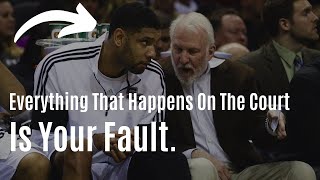
A motivational basketball talk by Ethan Khoza explaining the leadership principle that players should take personal responsibility for everything that occurs on the court. Using examples of Geno Auriemma, Sue Bird, Tim Duncan, Steve Kerr, Trae Young, and LeBron James, Khoza contrasts responsibility (self-directed action) with accountability (external) and argues that taking responsibility empowers action, improves performance, and builds trust among teammates.
Chapters
Quick story I want to tell you guys about Geno Aremma and Sue Bird. So two legends in basketball. Geno Arelama, obviously the head coach of UConn women's basketball, probably the. I mean, maybe the best college basketball coach ever. I mean, in that conversation, for sure, just has built an absolute monopoly on women's college basketball. It's really remarkable, the program that he's built there and. And the players that have come from UConn. So Sue Bird, obviously, also an incredible, incredible player. NCAA champion, FIBA champion, WNBA champion. Like, a lot of things that she's. That she has accomplished in her life. And this is a conversation that they had when she was a freshman at UConn, and this is just over 20 years ago. Geno called Sue Bird into his office, and they set a quick meeting, and he was like, listen, anything that happens, anything bad that happens in the court is your fault. And she was like, well, what do you mean by that? And he was like, listen, if you turn the ball over, that's your fault. If your teammate turns the ball over, that's your fault. And she was like, what does that mean? And he was like, listen, you need to take responsibility for every single thing that happens to this team. Doesn't matter whether it's your fault or not. It's your fault. Your turnover, your fault, her turnover, also your fault. And after that meeting, that helped her to understand that she had to take personal responsibility for everything that happens to her team, every single thing that happens. So let's talk about responsibility real quick. Okay? Responsibility is done by you, right? You take responsibility. That's an action that you can take, okay? Accountability is done to you by somebody else. Your coach is going to hold you accountable to do your job on the. On the. On the court. Your teammates are going to hold you accountable for doing your job. Responsibility is something that you have control over. You don't have control over accountability. You control over responsibility, okay? Everybody loves to hold other people accountable, and that's what I talked about. Like, people love saying, hey, you know, I'm going to hold this guy accountable for doing this and do that. People love to do that, but they do not like to hold themselves responsible for. For things that maybe they should hold themselves responsible for. Okay? You need to hold yourself responsible first before you start to hold people accountable. That's really the sense you need to make right here. When you take responsibility, you have the power to respond to that. Okay? You're taking a situation, and you're taking ownership of it. You're saying, you Know what? This is happening. I'm going to find a way to fix it. When you hold other people accountable or you push away responsibility, you blame other people. The opposite of responsibility is blame, okay? Instead of taking responsibility, you blame other people. You're giving away any power you have to change that, that, that, that situation. Okay? So you're saying, you know what? Not my problem if we lose games, their fault, not my fault, nothing I can do about it. And then you're gonna go along and if, if you're cool with that, if you're cool just saying, you know what? I don't care if I can't change anything. I don't care if I don't have any, any say in what happens in my life. Cool. That's, that's fine. That's fine. Probably not the video for you then, but if you think to yourself, hey, like, you know, I want to be able to have control. I want to be able to affect my team. I want to be able to, to be a person who helps my team win, then the number one step is you need to be able to take responsibility for things that aren't your fault. So when we exclude ourselves from the problem, then we also slow ourselves in the situation. We say, I'm not part of the problem. We also, that also is inferring we can't help fix it. So again, we're gonna have to sit back and let what happens happen. And that's not a great way to live. It's not a great way to approach the game of basketball either. It's just not a fun way to be able to do that, okay? Responsibility leads to action and blame never leads to action. Blame is a cop out answer. It's very, very mentally weak. Responsibility is going to look in the mirror and is going to say, what can I do better? How can I fix this? Because responsibility is your ability to respond to that situation, okay? Blame says it's not my fault and there's nothing I can do. So let's say one of your teammates is a bad passer, right? They just can't make good passes. They always are throwing the ball high, low, whatever. And the average player is going to say, like, hey, you know what? That's his fault. Nothing I can do about it. If I miss shots, it's because it was a bad pass. Like, coach, like, I'm missing a lot of shots, but I'm getting a bad pass every time. Nothing I can do about it, right? A great player, an above average player, a leader is going to say, you Know what? How can I take responsibility for this to make sure that even if I get a bad pass, I'm still gonna hit the shot. There's a video I'll play right now of Trae Young working on his ability to hit shots off of bad passes. So his trainers rolling the ball, throwing high passes, and Trey Young's catching it and shooting it. That's a great example of taking responsibility where he could say, you know what? It was a bad pass. Not my fault, I missed it. Now he's saying, you know what? No, I'm going to work on shooting off of bad passes. That if I do get a bad pass, I can still make the shot. That goes from blaming and not having any action to saying responsibility. Okay, what is my next action now? What can I do to make this situation better? There's an example where he's saying, you know what? It's my fault if I miss the shot. If I miss the shot now, it's my fault. It's my fault because I. I got to work harder on making shots off of bad passes. That's ultimately what it comes down to. So that's. That's really responsibility embodied right there. If you want to be a leader on your team, then you need to internalize this mindset that everything that happens is your fault. Everything that happens because other players love having a leader who takes responsibility because they know that they're never going to get thrown under the bus, and they. There's never going to be a situation where their teammate is going to come off the floor and say, hey, you know what? You were terrible tonight. This is your fault. That's not going to happen. They're going to get in the locker room, they're going to say, hey, you know what? I could have done that better. Like, there's a couple of shots I missed. I should have made those shots. And here's what I mean by that. If you. Let's say you score 24 points, right? You score 24 points and your team loses by six, maybe your next closest teammate only scores eight points, right? So you didn't really have much help offensively, but you scored 24 points, right? It'd be easy for you to go in the locker room, say, hey, you know what? Someone else want to show up on offense for me, but you lost by six points. Maybe you missed four threes. So if you would hit all four threes, there's 12 points right there, and you would have won the game. There's responsibility right there. Okay, well, next time I got to make every shot. Like, I got to get in the gym and work and get some more shots up because clearly I'm not shooting the ball well enough because we still lost. That's taking responsibility for something that a lot of players say, you know, I had 24 points. Not my fault we lost. No, you can say, you know what? I should have had 36. I missed those shots that were open, and that's on me. That's my fault. Okay, Your. Your ability to take responsibility is going to take you from being an average player to being a great player, to being a player who people respect and want to follow. They want you to be the leader if you're willing to take responsibility for things that go wrong. Okay, so Steve Kerr was talking about Tim Duncan, and he basically, you know, described him the same way where he'd say, you know, tim Duncan would come to the locker room and after a loss, and he'd say, you know, guys, this is my fault. And you look at the stats, and he'd have 38 points and 24 rebounds. And. But he's still coming in the locker room saying, hey, you know, guys, this is. I could have done better. This is my fault. Right? There's a leader right there. And what were the spurs, one of the best dynasties in. In NBA history. Okay, and there's another clip I'll show you guys right now of. Of LeBron where he is talking about. This is back in 2017 where the Cavs had. The Cavs lost to the Pacers. And this is kind of in November, early season, and they had turned the ball over a bunch of times, like, I think 20 times as a team, and LeBron turned the ball over eight times. So I want you guys to listen to how he responds to the reporter bringing up this question to him, Some.
Of my turnovers are trying to make the right play and just not just not working out. And obviously, you know, eight for myself. That's. That's way too many, you know, in a 3 or 4 range, but, you know, when you double that, that's not a. It's not good ingredients for your team to be successful. So, you know, I'll take that for sure. You know, I have the ball in my hands a lot, so I have to be very careful, you know, with my decision making. So I take full responsibility for all our turnover tonight because it starts with me.
So notice what he said at the end right there. He said, I take responsibility for all of our turnovers tonight because it starts with me. This is despite him having 33 points and 11 rebounds that night, and his team not at full strength. No one else really did great offensively for him. He's still saying, you know what? Today it's my fault today, okay? I'm the. I'm the player that these guys look to. I did a poor job. It starts with me that's taking responsibility for something, okay? And then there's another clip that I'll play of LeBron talking about Game 2, 2016 NBA Finals, when they got blown up by the Warriors. LeBron didn't play well. And another situation where you got to take responsibility as the best player on your team.
I just had a lot of turn. I had a lot of uncharacteristic, unforced turnovers, which resulted in Those guys getting 26 points off turnovers. So always, you know, I'm one of the guys who kind of always want to shoulder the blame and take the blame when we don't play as well as we should. It's just who I am, and I got to be better.
And so obviously, we know what happened that series. The Cavs came back and they won it, right? First ever team to come back from a three one right there. Taking responsibility is such an important part to your teammates believing in you and believing in themselves. So we think about the series, right? He could have said, oh, you know what? Like, we're down three one. This team's. This team's 73 nine. Like, what are we supposed to do? They're the best team ever. Like, what are we supposed to do? And I also believe the warriors are the best defensive team in the NBA that year, too. So he could say, you know, they're great defense. Like, what are we supposed to do? They're the best team ever. But instead of that, it's taking responsibility. What can we control? What can we do better? And his teammates rallied behind that, and they ultimately came back and ended up winning. Winning the. Winning the series. So if your teammate doesn't know the play, if your teammate is out of position on defense, if your team as a whole has a bad practice where the effort's not there, the intensity is not there, it's a bad practice overall. If someone keeps turning the ball over, if your teammate gets scored in every possession, if the ref makes a bad call, no matter what the situation is that happens, it's your fault. It's 100% on you. You need to take responsibility and make the situation better as best as you can, okay? Choose to make it your responsibility to fix. And if you aren't Willing to take responsibility for everything that happens to your team, then you aren't a true leader. You can't be a true leader, because true leaders take responsibility for the good things and the bad things, okay? They're willing to do both. They want to say, you know what? We turn the ball over a lot. I got to do better. Okay? I turn the ball over four times tonight. That's not good enough. Okay? You know, we lost by three points tonight. Yeah, I might had 27, but I missed four threes. I got to hit those and we win the game. That's on me, right? My teammate was out of position on defense. I got to make sure that I look around the court next time and I tell him where to go, okay? My teammate messed the play up. I got to make sure I get him to the right spot next time. I got to be better. My teammate threw a bad pass to me. I got to make sure I'm more ready to get the ball next time, so. So that I can catch it and then go into my shot. So there's some situations where you need to spin it to say, what can I do to make this better? What can I do as a leader to take responsibility and fix this? That's really where true leadership starts, okay? And not only will this help you and your team be better, but it's going to make the game a lot more fun as well. No longer are there things that are out of your control. No longer is it just where you're just going along with the wind. Now you won't feel helpless, because there's always something more that you understand you can do. You can always do something more. There's always something you can do to help your team be better, okay? Every loss is your fault. It doesn't matter how well you play. Every loss is your fault. You've got to find a way to win next time. So the question becomes, ultimately, do you. Do you really want to be a leader? Right. Are you willing to do that? Because if you are, it's your fault. And you have to take responsibility for everything that happens to your team. If your team doesn't measure up, it's your fault. If your team is out of position, it's your fault. So ask yourself, listen, is that worth it to me? Okay? Because like I'm telling you guys, trust me, the game becomes a lot more fun when you're willing to do that. Right? It might sound like, oh, I don't want everything to be my fault, but if you're that guy, we don't have those characteristics of guys who can be leaders, right? That's gonna make your team a lot better, okay? And winning again, all goes back to it. It's all about winning, right? Winning makes it more fun. It's fun to win games. It's fun to go far in the playoffs. It's fun to do all. It's fun to have a banner hung up in your gym. And that starts with, are you willing to be a leader? Okay, so question you gotta ask yourself.
More from Ethan

Stop Using One Dribble When You Drive To The Rim! (How To Become A Better Finisher)









