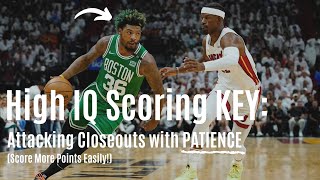
Ethan Khoza breaks down how to attack closeouts by reading defender momentum. Use shot and pass fakes like Marcus Smart does to get defenders out of stance, then attack. The key is knowing when to go immediately and when to wait for the defender to overcommit.
Chapters
One of the most important areas when it comes to being a great offensive player is being able to read and attack closeouts. In a typical offensive possession, there's a good chance that a team will see multiple closeouts. Over the course of a game, a team might face hundreds of closeouts, and each individual player might see dozens of closeouts themselves. These are the moments when defenders are most vulnerable because there's so much that goes into effectively closing out. Obviously, the first thought is to take away the shot, but then you also have to worry about containing a drive going either direction. And all of this while your momentum is taking you away from the back basket and towards that offensive player. And a lot of people talk about this concept of attacking closeouts, but not a lot of people talk about the nuance that's involved in these situations. And when you understand the nuance of these situations and how to create advantages for yourself, you become very hard to contain, and you'll be able to score way more points in these situations. Let's get into it. There's a couple big areas I want to key in on. The first is the timing of the attack. I've made videos talking about the concept of 0.5 decisions, or making decisions very, very quickly when you catch the basketball, because obviously, if you catch the ball and you wait for a long time, that defender is going to have time to close out, get themselves set, and then you can't exploit their momentum at all. So we obviously don't want to take that long to attack, but that doesn't mean that we want to go right as soon as we catch the ball every single time. It's not just about exploiting their momentum, but it's about doing it at the right time in the right way. So when do we want to attack? Right away we catch the ball. The first situation would be when you have a clear angle to the basket. You'll see in these clips, as soon as they catch the ball, there's a clear line to the basket, and that requires them to take advantage of that right away. The other situation is when they're already where you want them in terms of positioning and momentum. So they may be close enough to you that you can attack them. They may be slower than you, or they may be already raised up and not in a position that to actually play good defense, if you drive. And those situations certainly happen frequently, so it's important to be able to identify them and then be able to make the right decision as to how quickly your attack needs to happen. But there's Also situations where the opposite is the case and we actually need to be a little bit more patient before we attack that closeout. If you attack too early against a good defender, they may be in a better position to recover because they have more space between you and them. But if you catch the ball and you wait a little bit longer for them to get a little bit closer to you, a lot of times if you attack, then they don't have the angle or the time to react in order to cut you off and play defense. And that's going to put you in a much better position to beat them. This is what I mean when I say that there's nuance to these situations. I think this is where a lot of players struggle is understanding when to go quickly and when to be patient. But having an understanding of what you're trying to do and how to best exploit your defender's momentum is really key to becoming great in these situations. And I think going along with this understanding of when to be quick and when to be patient is also having an understanding of the power of utilizing shot fakes and pass fakes. Marcus Smart is really good in these closeout situations. And if you watch his film in these situations, he probably uses a shot fake 90% of the time. Time. So why are shot fakes so effective in these situations? Basically, a shot fake or a pass fake exploits the defender's momentum even more. A good shot fake forces them to raise up out of a low, athletic stance, which makes it much more difficult for them to recover and effectively defend a drive. But notice that I said good shot fake because a lot of players don't understand how to use a shot fake effectively. So it's not something that's actually going to help them in those situations. The first key to an effective shot fake is not rushing it. You want to be patient with your shot fit because ultimately it needs to be believable. You should treat it exactly like your jump shot until you get to the actual jump. And there's plenty of nuance with this. Sometimes a shot fake needs to be long and drawn out. Sometimes it can just be a look at the rim and a slight lift of the ball. It's all just situation dependent. Foreign shot fate creates an advantage for you as an offensive player. And the best offensive players are able to consistently create advantages for themselves. So for you, becoming great in these situations means understanding when to go quick and when to be patient, using shot fixing, using past stakes to create advantages for yourself. And one of the best ways you can get better at understanding these areas is just by watching the game, watching players who are good in these situations and seeing how they exploit that defender's momentum momentum to create opportunities for themselves. If you guys enjoyed this video, make sure you drop a like and subscribe. If you're new, click the top link in my description below to get my free Elite Perimeter score workout. I'll talk to you guys soon. Peace.