How To Balance School and Basketball - Podcast Episode 23
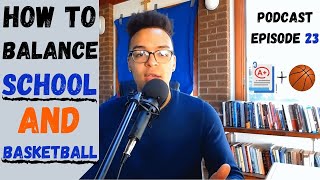
Ethan Khoza answers a DM about balancing school, sleep, and daily basketball practice. He emphasizes sleep and recovery (aiming for ~7+ hours nightly, making up deficits on weekends, and the performance/illness risks of chronic sleep loss) and argues that academics must be the priority because grades affect eligibility and long-term opportunities. Practical time-management themes include doing required tasks first, keeping a grade buffer to tolerate disruptions (e.g., travel/games), and avoiding a bare-minimum mindset. The episode mixes prescriptive tips with personal anecdotes and a quoted coach's remark relating GPA to basketball commitment.
Chapters
Welcome to the Vision Dream Basketball training podcast. Appreciate you guys for tuning in. Whether you're listening Apple Podcasts or Spotify or you're watching on YouTube, I appreciate every single one of you guys today answering a question that I got in a dm. Like I always say, guys, I'm always answering questions from my DMs. That's honestly when I don't have an idea of what my topic is going to be for the week. A lot of times it's just me going through my DMs and seeing, you know, kind of what questions. That's usually where I'll find something. So shout out to you guys who are always asking me questions. Today's question's a really, really good one. And this comes from my guy, Aaron. So shout out to Aaron. He asked, hey Coach, I have a question about school basketball. The thing is, I have a lot of schoolwork and stuff I have to get done, but I also want to practice basketball every day. So my first question is, how can I balance school and basketball? Should my priority be school or basketball? Then. Then we come to my second question and it has something to do with the first one. See, because my schoolwork takes my free time, I decided to wake up before school at 6am and work out before. I did this so I could get an advantage over others, but mostly because I wanted to catch up with loss of my own skill work. But usually I get to bed at 10 o' clock and fall asleep at 11 and I'm told that I need 8, 10 hours of sleep. So my question is, should I sacrifice two, three hours to sleep or one to two hours of basketball? Much love and keep up the great work. So this is a really, really good question. It is a topic that actually I get a good amount of questions on just kind of balancing school and basketball and all those things. And I think it's an important topic to really be able to dive into a little bit. So we're all kind of clear and you guys have kind of a good baseline of how to kind of handle this. I think two really good questions right there. The first thing is we'll go back to the first point, which is about sleep. And I think sleep is such a, such a major thing. And this is also going to kind of tie in with time management, which is going to be kind of a big theme of today's episode as well. But you know, if you're going to bed, so in Aaron's situation, you're going to bed at 11, right? And you got to wake up at 6, that. That would mean if you're asleep by 11, you're up at 6. That's about seven hours right there. And depending on, you know, where you get your information from, you're going to hear people say, oh, you need between seven to nine hours of sleep or eight to 10 hours. Somewhere in that range is typically where people say you're good. So if you're able to consistently hit that schedule, then your sleep schedule is probably fine. The one thing I will say is that I understand not every day is gonna be perfect. There's gonna be some days where you might not get to bed till midnight, right? And you're still getting up at 6 or maybe even later than that. So at that point, it becomes about being able to. To kind of map out your days. So, for example, let's say that you miss. You say on Thursday night you don't get to bed till midnight and you wake up at six. So it's only six hours right there. You want to try and make sure that you can make that up on the back end of the week. So, for example, let's say on that Thursday night you don't get to bed till 12:30, okay? So you only have five and a half hours of sleep when you get up. You want to try and get it, you know, an extra hour or so over the weekend. So, you know, if you're only sleeping, you know, between six and seven hours a day, you know, Monday through Friday, you know, when you get to the weekend, try your best to get nine or ten, right? Just so you can kind of catch up on the. On the back end of your week. That being said, what I'm not advocating for is I'm not saying that you can, you know, sleep for three hours a night the whole entire week and then asleep for 15 hours on Saturday night. That's not what I'm. That's not what I'm advocating for. What I'm saying is that, you know, if you. If you lose an hour here or there, try and make it up at some point during the week. And I think that that in itself is gonna help you and you'll be able to, you know, for the most part, stay on track. Because sleep is. Sleep is so important. And it's not just about like, oh, you know, you gotta sleep. Because here's the thing, you know, if you. If you only sleep for five hours a night, eventually your body's going to adjust. The human body is fantastic at adjusting to things. So eventually you'll adjust and you Won't feel tired anymore. Okay. If you're used to sleeping only five hours a night, especially if you throw in like, you know, caffeine or coffee or anything like that in the morning when you get up, which hopefully you aren't doing, but maybe, maybe that's what you do. You know, nothing against coffee necessarily, but if you're using it because you only sleep for four or five hours a night, that's a problem then. Okay. But, you know, so if that'sif that's the case, if you're sleeping five hours a night over a long period of time, you're gonna start to get used to it. Your body's gonna feel semi normal. But the one thing that I'll say is that, you know, your body might feel normal, but it does not mean that you're actually going to be performing at your most optimal level. Okay. What I mean by that is that, you know, you might feel like you're pretty close to 100%, but your body's probably only performing at like 70%. Okay. In terms of your workouts. So, like, are you really getting the most out of your workouts? It all goes back to really, how are you recovering, how's your sleep? Are you priming your body to be at its best? You know, kind of going along with that also. And we're moving farther into the closer to the season. Um, so we can kind of bring this up, but you know, making sure you don't, you know, you don't get sick. You're able to overcome getting sick during, especially during the season. You know, I remember in high school, my junior year and my senior year, I was basically sick my junior year. I was sick for like the entire last two months of the season. And my senior year I was basically sick the entire year. My junior year was so bad that I actually missed probably a week and a half of games in practice because I was sick senior year. I didn't miss any games or any practices, but I was still sick the whole time. And a lot of that was because, you know, I didn't do a good enough, good enough job getting sleep. Okay? So, you know, in, you know, practice is at, you know, 3:30, go till 5:30, and I'm getting to school at 8, I gotta wake up at 6:30, get everything done, go through school, practice till 5:30. Maybe I have something else I have to do after school until 6:30, get home at 7, take a shower, eat. Now all of a sudden we're getting, we're approaching 8:30. And so at this point, like, I have to make sure, like, oh, now I have an hour and a half of homework to do. So if I am distracted at all, and you know, maybe there's an NBA game on that I want to watch or a football game that I want to watch. And all of a sudden it's. Next thing I know, I look up and it's midnight. I got to be up at 6:30. So I'm already going to be in kind of a deficit going off of that. So I probably won't be able to be at my, at my peak, at my, at my best performance level. And that's gonna leave me susceptible to getting sick. Okay. And that was, that was something that I didn't do a great job of then looking back, you know, making sure that I made time to get in 7, 8, 9, 10 hours of sleep a night, if at all possible. And so that, that again, kind of leads to the, to the point of how important sleep is, okay? So you want to make sure that you're making time for that. So that was kind of my thing is like, listen, if you're getting that seven hours of sleep a night, you're probably solid. But do your best to kind of still get, get a little extra on the weekends if you can. But we can kind of go into the next question from there, and that's kind of, you know, or his first question, which was, you know, school basketball, which is my priority, right? And you know, the cliche answer, right, Is like, oh, school academics, like, that's, that comes first. That's the most important thing. And, you know, I'm going to tell you why that is true. Like, why, why it is true that school has to be the priority. You know, another theme that we can think about throughout this episode is you have to do the things that you don't want to do, right? You have to take care of things that you have to do so that you can do the things that you want to do. You have to take care of those things that you have to do. You might not want to do them, but you have to do them so that you can do things that you do want to do, right? You have to go to school, okay? You have to get sleep. You want to play basketball, you don't have to play basketball, okay? So take care of those things that you have to, you have to do. And you know, being a coach and obviously as a player is the same thing. But, you know, if you don't show up to school, then you, you can't play in the game, okay? So it doesn't matter if your game is at 7:00'. Clock. If you don't go to school that day, you. You're not allowed to play, right? A lot of times if you go show up to school late, sometimes you won't even be able to play. And obviously grades too. If you, if you're failing a bunch of classes, you're not able to play, okay? So you have to take care of those things you have to take care of so that you can do the things that you want to do. Okay? So that's part number one. Like, that's why school is the priority. Because if you don't have that part, basketball doesn't exist. Okay? So there's that. But also you have to think about. It's not. It goes kind of deeper than that because it also is kind of a mindset you have to have. You know, there is a podcast that I listened to with an interview with a coach, a college coach. I don't remember where. I don't remember where this coach was from. Man, I wish I remembered his name. But it was a couple months ago. I listened to this and this is something that I've been saying for a little bit now when I heard him, ever since I heard him say that. But he basically said, if you have a 2.5 GPA, you don't care about basketball. That was what he said on the podcast. And that's what he tells us his players. I believe he's a coach at a junior college. And he said, he's like, yeah, listen, like, if I tell my guys, if they have a 2.5 GPA, they don't really care about basketball. And here's what I mean by that. Here's how I took it. If you, first of all, if there's any questions surrounding your grades in terms of your eligibility to play, you don't care. Like you, you just flat out, if you cared more, you take care of things you have to do. You, you would take care of your schoolwork, you'd be responsible, you get it all done. But if you don't really care all that much, then you're going to be okay letting your grades kind of slip. If you fail class, you're not going to be worried about it because it's not that big of a deal to you, okay? So that's something to consider. But also, it's really a mindset too. If, let's say, for example, you're taking. You do the bare minimum, you do the bare minimum of school to get by. Okay? You say, you know what, I want to make sure that, you know, I'm getting all Cs right now. If you have a 71 in your class, right? And you know, let's say one day you have a game and you have an away game. It's two hours away, you're playing at seven. So you know, you guys are leaving the school at 4. You know, you get up at 3:30, you got to basically grab something to eat and you get on the bus, leave at 4, you know, you go play your game or whatever and you get back pretty late. And then you realize, oh man, I have a test tomorrow that I completely forgot about. And you go and fail that test and now you're failing the class and then now you can't play, okay? All because you were kind of hanging on the edge right there. Whereas opposed to that, if you had had an 85 in the class and then you wouldn't still fail that test, you might have only had, you know, you might had an 80 or 79 still. So you're still passing, okay? So you have to give yourself some sort of buffer so that when things happen, it's not going to affect you, okay? So that's why you don't want to be the person who just is on the doing the bare minimum. Like I got to just got to scrape by because if something unforeseen happens to you, it's going to be a problem. And that can affect your ability to get on the court. And listen, there's already so many things you have to worry about in terms of playing. Like, okay, I got to worry about knowing the plays, I got to worry about running the right defense. I got to worry about making the right calls. I got to worry about hitting this shot, being ready for this, making sure my leg feels okay. You have all these things to worry about on the court, so don't let.
More from Ethan

Stop Using One Dribble When You Drive To The Rim! (How To Become A Better Finisher)









