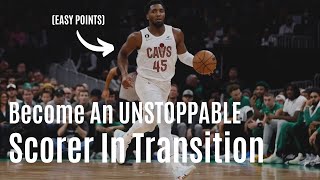
Ethan Khoza explains practical tactics to become an effective transition scorer in basketball. He situates the advice in a broader trend of rising NBA scoring and pace, then breaks down transition offense (especially as the ball-handler: control your pace, use change-of-speed to create pull-ups or blow-bys) and off-ball transition movement (run your lane, maintain spacing, win the first three steps, and use post/seal opportunities). The video closes with a CTA to download a free perimeter scoring workout.
Chapters
Being an effective player in transition is not just something that's super valuable for the team that you play on, but it's also something that's going to get you a lot of opportunities to score and make plays. If we look at trends in the NBA, scoring has gone up pretty consistently for the past couple decades, reaching the highest level that it's been at since the 60s this season. And along with that rise of scoring has been a rise of pace or possessions per game. And not only is this true in the NBA, but it's mirrored in many other levels as well as because the more possessions that you get, the more opportunities that your team has to score. So having players that are capable of playing in a high paced offense gives you more opportunity to score the basketball. In this video, we're going to break down three main areas to focus on if you want to be a great player in transition. So no matter what position you play, you're going to see where you can fit in and how you can maximize your role to be the best player in transition that you can be. Let's get into it. The first thing we're going to talk about is transition offense with the ball in your hands. So this is being the point guard or just the ball handler in general in these transition opportunities. The first thing I'll mention is that when you can advance the ball off the floor to an open teammate, that's going to be the best thing for your team. But I want to look specifically at when that's not the case. So I know I've already mentioned the word pace when it comes to the amount of possession the team gets in a game. But now I want to use the word pace in a different context, which is the speed that you're traveling with the ball if you want to score more points in transition, that you have to control your pace when you have the ball, meaning you can't just be going at your fastest speed the entire time. Transition defense is difficult, but you make it a lot easier when you go at your top speed right away. The best players who handle the ball in transition are able to start off slow and then they hit that top gear when they need to to get by that defender who's used to that slower speed at that point. The other thing that this is going to do is that it's going to open up more shot opportunities for you because that defender is eventually going to understand that you are playing with pace and they're going to give you a little bit of a cushion, expecting that you might change that pace and try and beat them, meaning that a lot of times they're going to offer you pull up jump shots in transition in order to protect themselves from getting beat. Now, that's definitely not to say that there's not a time and place for going as fast as you can, especially when you have that advantage. But when you don't have that advantage, you've got to understand the best way to create an opportunity for you is to slow yourself down, have the defense relax, and then you decide when you want to go to catch them off guard. Obviously, a big part of transition is when you don't have the ball in your hands. So let's talk about a couple keys that are important for when you're running in transition. One thing that's important to keep in mind is that you want to run your lane. If the ball is in the middle and you're on the side, it means running as close to the sideline as possible. Ideally outside of the advertisements or the logos, whichever you have on the side of your court. When you keep good spacing, it puts a lot of pressure on the defense, especially if they're at a disadvantage like a 3 on 1 or 3 on 2, and it makes it much more difficult for one guy to guard two. Another tip here is to try and win the first three steps, meaning that as soon as that ball is rebounded by your teammate, the first three steps you take in transition, you're making sure that those three steps are faster than anybody else on the court. And many times by doing this, you're going to get yourself an advantage that's going to allow you to be open to advance the ball in transition. An area that a lot of players don't even consider is the incredible opportunity that they have to post up or seal in transition too. This obviously applies if you play the five and you're sprinting to the block already in transition. But even if you're a guard and you have a good matchup, there's a great chance that you can get down the floor and beat the help defense there. So if you can do a good job of holding off your defender with the seal, you can a lot of times create an open opportunity for yourself to score at the basket. Let me know in the comments below if you guys got anything from this video. Make sure you click the top link in my description below to get my free elite Perimeter score workout and drop a Like and subscribe if you're new. I'll talk to you guys soon. Peace.