How To Fix Your Shooting Form - Become A Better Shooter
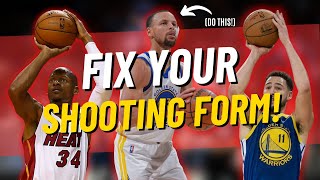
Ethan Khoza breaks down five shooting mistakes: hand position on the ball, finger spread on release, elbow extension and wrist snap, elbow height above eye level for arc, and adding a dip. He pairs each fix with drills and stresses high-volume reps to build the habit.
Chapters
Right now, I'm going to go through five mistakes that players make when it comes to their shooting form. And if you fix these things, you're going to start making more shots. Now, I also want to say that shooting is not a one size fits all sort of thing. There are plenty of shooters, some of who are the best ever, who have broken plenty of rules when it comes to shooting. But there are also a lot of universal truths when it comes to shooting. So what I want you to do is try these out, see if it helps your shot, makes it feel better, and if it does, continue to use it. If not, do what works at the end of the day. If it's not broke, don't fix it. But these are five mistakes that I see all the time with players that I work with. And I guarantee there's going to be something in here that's going to help you out. Let's get into it. The first mistake that I see a lot of players make with their shot is they don't keep their shooting hand flat on the basketball. Now, a point that a lot of coaches will make to players, especially when they're young, is that you want to have a gap between your hand and the ball where you can see through that gap. The problem is, a lot of players have way too big of a gap, and it limits their actual control over the basketball. The more of your hand that you have touching the ball, the more control you actually have of not just where the ball goes, but also the spin that you're going to put on the basketball. The general rule of thumb for this is that you want your hand to be pretty much flat against the ball. There's going to be a little bit of a pocket there that you might be able to see through, but for the most part, that hand is going to be flat on that basketball, and it's not going to be raised up on your fingertips. I think the idea that the ball should be on your fingertips is maybe the biggest myth in shooting. But the ball should be on your entire hand if you really want to have good control of the ball. Again, it's not just going to help you in terms of where the ball goes, which it will help you with that. A lot of times when players don't have their full hand on the ball, they miss a lot, short, long, or to the side because they don't have great control over the ball. But also a big issue is that if they don't have that whole hand on the ball, they can't control the backspin of it so they get a lot of weird spin or they don't get any spin on it at all. And obviously it's not what we want. So the first thing you should do to fix your shot is make sure that that shooting hand is. It's flat on that basketball. You want to think about splitting the air hole, right? So find the hole in the ball where you pump air into. And you want to take those first two fingers and kind of split it right in half. That way you'll know, hey, I'm in the middle of the basketball. And then get that hand nice and flat on that ball. And then you're going to have a good control of the ball. You're going to be able to push right through the middle of that ball and make it go straight where you want it to go. And you're also going to be able to control the spin way better. Now we're going to keep it with hands right here. Because I think the hands, the number one area that players struggle with and the number one thing that keeps players from being able to shoot the ball at a high level. The second thing that's really important is keeping your fingers spread wide enough on the ball. A lot of players have an issue where they might start off with their fingers really close together in the ball. So again, we don't have a lot of control. This is where the ball might come off to the side much more easily. And now you're missing to the side or getting weird spin on the ball. But a lot of times two players struggle with getting their hands too close together on their release too. So they might shoot the ball and their hands are like that, where all those fingers are together. So again, we lose a lot of the control in the basketball. I think an important thing to do here is keep those fingers spread, especially on that release. So when I shoot that ball, making sure that those fingers are nice and wide right there. If you can see, I'll walk this in even closer. See my hands nice and. Or my fingers nice and spread out here so that again, I have maximum control over that basketball. Now, me personally, I like to have almost an ascending order in terms of like my first finger to my pinky finger in terms of how far down they're going. I almost have my pointer finger, my thumb touching, and then I kind of have the rest of my fingers again a little bit higher than the one in front of it. That's kind of tweaked to their own. I know players who like to have it the opposite way. You got to figure out, again, what works best for you, what feels most comfortable. But it's really important that, again, on that shot, we keep that hand, those fingers, nice and spread apart. So again, we keep maximum control of the basketball. Just a quick point going along with that. It's really important that you finish your shot on your release, right? So we talked about the fingers and keeping those fingers spread in that relief, but also just make sure that there's full extension, right? So I have my elbow extending, and I completely snap that wrist to. A lot of players stop short. And that's another issue that players have, is that they stop themselves short so they're almost aiming the ball instead of actually shooting it, getting the right backspin, and lose maybe a little bit of control in that ball, too, because a lot of times it coincides with them keeping the ball up on that, on those fingertips instead of on that hand where it should be. We want to make sure that some of all that stuff, we're finishing that shot and letting that wrist snap the whole way. And that leads me to the third tip, which plays along, right with that release, making sure that we get high enough on our shot, get enough arc on that shot. And a really simple way to think about doing this is making sure that your elbow level finishes above your eye. All that means is that when I shoot that ball, I want where my elbow is to be above my eye level. So I have to look up at my elbow. If I get that here and it's at eye level or below, then I'm probably going to shoot too flat of a shot. If I can generally make sure that I'm keeping that elbow above my eye level on my shot, it's generally going to ensure that I have enough arc on my shot. So if you struggle with shooting the ball too flat, this is a really, really important thing for you to think about, for you to correct with your shot. If you recognize that, hey, I'm shooting flat a lot, a lot of times, because players are there with it and that elbow isn't above that eye level. If we can just, again, be really simple about it and say, hey, I want that elbow to be above that eye level, generally, it's going to mean that you're going to put enough arc on the ball and you're going to start making more shots. And the fourth thing that I want to talk about here that's going to help you have a better shot is adding a dip to your shot. One probably the worst myths in basketball and shooting is that you're supposed to catch the ball, keep it high, shoot it right away. Nobody does that. None of the great shooters. You can watch anybody that you want. Every single great shooter catches the ball and dips it. Some of them are good enough where they don't have to, but 95% of the time, they're still going to because it's how you shoot a ball. And it allows us to do a couple of things. First of all, it allows us to get rhythm. I might catch a pass here, and it allows me to go a little bit of a rhythm so I can go back to what I'm doing know and I'm comfortable with. But it also allows us to transfer energy effectively, meaning I have to be able to get energy from where I'm at into the ball so that it gets to the basket. I do that by transferring it from the ground through my body into the ball. I can really do this effectively by dipping the basketball and allows me to bring that energy up with me. Okay. And then into the ball so I can shoot it far enough to get into the basket. So especially if you struggle with not being able to shoot the ball from farther distances, making sure that you have a dip in your jump shot is really, really important, even if you know you can shoot it. And a lot of times will allow you to again, have more rhythm and just become a better shooter overall. So what I mean by a dip is that when I catch the ball, I'm kind of bringing it down before I go up with it. Coaches will say, oh, well, that makes the shot slower. Doesn't actually. Again, if you look at the person with the fastest jump shot in the world, who's Steph Curry, he dips on every single shot he shoots, right? So that's a myth that it makes your shot slower. It just allows you to have more rhythm and transfer energy more effectively. If we can transfer energy quickly and effectively through a dip, it's going to be faster than if we're here and we have to set ourselves up before we can shoot the ball. And that's typically what's going to happen. Again, all that a dip is is when I catch the ball, not feel like I have to go straight up with it from there, but being able to catch it, go down with it first and then go up. So if you find that you catch the ball and you're constantly just kind of setting it up right there to shoot it, it's probably actually slowing down your shot, and you're probably not able to shoot from as far back as you would like. To so instead of doing that, catching that ball, breaking it down first, then up, I think is really important and a great drill that I like for this. I'll start with the ball out in front of me, hands kind of set how I want. So we talked about finding the air hole earlier. So I'm going to do that, find that air hole. All I'm going to do is stand straight up super tall and then I'm just going to drop myself down to that shooting position and then just right up with my shot. So I might be here and this is almost like I'm reaching out to get a pass to bring it to me. I'm here, bring that ball to me and then up with it, right? We can even work that off like a self talk. So I might toss it to myself, catch it, bring it down, and then I'm going to go up with my shot right there. Now, the fifth thing that I want to talk about isn't a physical fix to your form or anything like that. It's the idea that if you aren't where you want to be as a shooter, more than likely the number one reason is because you just haven't gotten enough reps. There are plenty of shooters out there who don't have the perfect form, who are still really good shooters because they spend a ton of time getting shots up, working on their jump shot and they found ways to make it work again. Everybody's shot is going to be a little bit different and nobody out there really has the perfect jump shot. Everybody does things that somebody might say is wrong or somebody might say it could be better. But the shooters who are the best, the ones who put the most time into it, the most reps into what they do. If you want to be a better shooter, and I know it's very simple, but this is where all the a lot of players are lacking is just you have to go get more reps. And now if you take these fixes and fix the things that are wrong and then you go and get those reps on top of it, that's how you become a great shooter or an elite level shooter. So it's a combination of both finding ways to improve on your form and the way that your shot looks and feels, but also making sure that above all you are spending a ton of time, a ton of effort getting shots up and working on becoming a better shooter. And when you do those two things again, that's how you become elite. I'll link a video above with a full shooting workout that's going to help you out a ton. You want to make more shots, go check that out. If you need a way to get up more reps, but commit to doing that, commit to putting in the time and you're going to become great. Hopefully these five tips helped you out. Make sure you click the top link in my description down below to get my free Elite Perimeter Score program, which is going to help you not only become a better shooter, but take your ball handling and your finishing and just your overall scoring ability to the next level. Completely free. Check that out top link in the description. I appreciate you for watching. Drop a like subscribe if you're new. I'll talk to you soon. Peace.
More from Ethan

Stop Using One Dribble When You Drive To The Rim! (How To Become A Better Finisher)









