How To Handle HIGH PRESSURE Defense and Avoid Turnovers (FULL Breakdown + Workout)
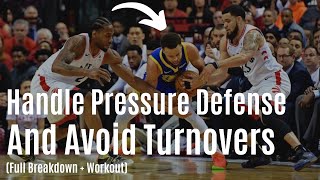
Coach Ethan Khoza breaks down how to beat full-court and trapping defenses without turning the ball over. Attack the weak side, use pass fakes to create space, and keep your dribble alive with retreat moves and pace changes. The workout covers V dribbles, crossovers, and speed drills to build the handles you need under pressure.
Chapters
Being able to stay composed and make good decisions when facing pressure is one of the most important skills for players to have. And in this video, we're going to break down exactly how you can develop those skills. And at the end, I'll give you guys a workout so you can drill in some of the stuff that we're talking about in this video. Let's get into it. I'll go through everything step by step. But let's start off talking about traps. One of the worst things you can do when you're getting trapped is hesitate. When you hesitate and you don't do something when the trap is coming to you, you give the defense the opportunity to get set up and put you in a position that they want, that's going to be ultimately very difficult for you to get out of. As you see in this clip right here, Buffalo inbounds the basketball and he catches it and doesn't make a quick decision, which allows Kentucky to trap him and ultimately forces a turnover. Now, here's a look at the same situation. Without the hesitation, the Buffalo player catches it and then immediately passes the ball back to inbounder and they're able to get a break going down the floor. Here's another situation that I'm sure a lot of you guys have experienced before, because I know that I for sure, as a younger player found myself in this position often. And it really illustrates how dangerous it is to hesitate and to not be confident in making the right decision. Buffalo is facing this 2 1, 2 press against Kentucky now, and they do a good job in the backcourt of getting the ball across half court to an open player. But then when the player catches it, instead of turning to go middle, he stops and he waits for that trap. When he catches his ball, the trap is nowhere near him yet, and he has all the room in the world to be able to get to the middle and either get to the rim and make a play or make a pass right away and have his team be in a good position to get something set up. It's pretty clear in this clip that this entire mistake was made just because he lacked the confidence to put the ball on the floor and go to the middle. But you have to be willing to do that at times. When the best decision is to put the ball on the floor and get somewhere. You have to be willing to do that, especially if you're a ball handler playing as depressed. Obviously, it's easy for us to break this down in slow motion, but these plays happen so quickly that you have to be able to be quick, but obviously you don't want to let the defense rush you. Getting good at this becomes much easier once you start to recognize patterns so you start to notice who the defense traps. You start to notice which weak side defenders leave and where they end up going. So you know where you can go with that ball if you do get trapped. If you're able to watch film with the teams you're playing before you play them, that's obviously an easy way for you to recognize what opportunity is going to be there for you. But also it can be as simple as learning after you experience it throughout a game, saying, hey, you know what? This time they trapped me and that guy wasn't open. Chances are the next time the other guy is going to be open, you'll be able to pick that up as you go. When it comes to facing traps or aggressive defense, there's two words I need you to remember. Pass fakes. Aggressive traps and defenses are very, very susceptible to pass fakes, and it's the most powerful that you have. In this clip right here, the Oklahoma State player gets the ball and is trapped by West Virginia and he doesn't have a great angle to pass because of this trap, but when he uses his pass take right here, he gets the defender to leave his feet, which allows him to take a dribble and then make a pass to the open inbounder. Then we see it again in the same possession where that inbounder dribbles the ball at the floor. The trap comes again so he has that little look off pass fake across the court to get both defenders to commit with their hands up, and then he makes the easy pass across half court. There are also opportunities for you to exploit traps when they come at you with a defender who might be slower than you. In this clip right here, the Oklahoma State player catches the ball and that trap comes immediately. The player on the left side of the trap is a guard and can probably do a good job trying to contain him, but the guy on the right side is a big and Yokoma State player knows he can beat the trap if he attacks that side. Trae Young is able to do something similar right here where he catches that outside defender off guard because he's expecting Trey to go right back to the inbounder. Instead, he catches it and explodes by him and ends up getting all the way to the rim and getting fouled. When it comes down to it. So much of beating traps and not turning the ball over is about not hesitating using the defender's aggression against them with pass fakes and and making the simple play. Trae Young does a great job of this in these clips here. Oklahoma is playing as West Virginia who is known for their commitment to aggressive defense and full court trapping and they ramped up the defensive intensity even more when they played against him. But despite that, he does a great job of not being rushed and making the simple play. Most of the time when you're getting full court pressure, the simple play is going to be to make a pass. The ball comes into Trae right here. He makes the pass right back to the inbounder and and the press is beaten very, very easily. But in some situations, sometimes the right read is to put the ball on the floor and make a play. As you see right here, you want to avoid over dribbling as much as possible, though it is important that you're able to put the ball on the floor if you need to. Your first look should always be to pass the ball, but you should be confident enough that you can put the ball down if you need to. The retreat dribble is a powerful tool to use as well. When you see a trap coming in this clip, the ball handler sees a trap coming. He's that retreat dribble to buy himself some time and some space as well. So he's able to survey the floor. His teammate then cuts across to his side of the floor and he's able to make a pass easily beating the trap. When it comes to handling one on one pressure defense, this is where change of pace is so valuable, especially if you're facing a defender who might be quicker than you or is a really good defender. You as the offensive player are able to dictate the pace that you play at, meaning that you can be unpredictable and difficult for him to guard. In this clip, Trae Young is playing as Javon Carter who is a really, really good defender. But Trayon beats him easily because he changes his pace and it's difficult for Carter to be able to predict what he's going to do. Being able to go from fast to slow to fast again makes your defender's task of staying in front of you full court very, very challenging. And if you have good control over the basketball and you're able to change pace then full court one on one pressure won't be an issue for you. Now we'll get to some drills you can do to target some of those skills that we've talked about. You can use this as more of a warm up or you can use it as a Quick ball handling workout. Let's get into it. We're going to start off with wide V dribbles. To get warmed up for the first variation. You're just going to have the ball in your hand and you're going to go wide v dribble, trying to go from knee to knee with that ball, making sure you get the ball nice and wide outside of your frame. And as you start to get it down, pick up the speed you do it at as well as how hard you dribble the basketball. Next, we'll get into V dribbles into a crossover. As you see right here. Again, I'm keeping that ball nice and wide, dribbling the ball as hard as I can when I make that V dribble, then quickly into a crossover. Next we'll go same thing except between the legs. And we'll finish it out with V dribble behind the back. And now we'll get into doubles doing the same thing. Start with that V dribble with the ball in your right hand. Go into a double crossover here. After you do those reps, you're going to switch and go left hand. Next we'll go V dribble into between cross and V dribble into between behind. Now we're going to go with this five slow, five fast series. This is where really it's going to start to warm up. That ability to go from slow to fast, fast to slow and play with pace. You're going to start off with five slow crossover dribbles. You see, my feet are nice and wide. And then after those five slow dribbles, I'm going to go to five really, really quick crossovers and then right back to five slow, five slow, and then five fast counts as one rep. Next we do the same thing, five slow, five fast, except between the legs dribble. And we'll end it with five slow, five fast behind the backs. Next we're going to go with this explosive doubles drill. So you'll start at the baseline, take a dribble, and then go low and explosive into a double cross. As you see, I'm going from high, slow, raised up to now, boom, low and explosive into that double crossover. I really want to be going for 25% to 100% effort throughout this drill. You'll do that with both hands. And then we'll go on to between cross. Next we're going to go this between cross fast to slow series. So I'm going to start with a fast and explosive between cross. And then I'm Going to raise up and then I'm going to go into an explosive push cross. And then I'm going to slow down again right back into that between cross, slow down, push cross. And I'm going to continue that full court and back for the next variation. I'm going to go explosive between cross, slow down, raise up, and then I'm going to go in and out, dribble into a speed stop. Then I'll go again between cross. Now going the opposite direction into an in and out speed stop, stop. And we'll finish this series out with the same thing, except this time after the speed stop behind the back, you're going to go into any sort of double move that you want to. And then right after the double move, you go back into that between cross, repeating the same thing. Full court and back to finish it out. We're going to go with this line touch creativity drill. So I'm starting in the middle of the paint, but you can use any area that's about the same as this. You could use a circle at half court, you could use cones to set up something, you could use chalk, or you can use your imagination, whatever it might be. You just want to have an area that's about the same size. So I'm going to start in the middle of the paint and I'm being creative with my dribbling and I'm trying to touch each line. Every time I touch a line, I'm retreating back to the middle. So working on that ability to again, retreat like we talked about during the video. But then I'm working on my ability to actually be able to attack out of that retreat dribble again. We don't want to over dribble in a game, but right here we're working on your ability and your confidence to put the ball on the floor. If you need to, you'll know that you're able to put the ball on the floor and handle it. If you guys enjoyed this video, make sure you click the top link in my description below to get my free elite perimeter score workout where you hit a ton of skills that you need to have if you want to be a great player in the perimeter. If you guys enjoy this video, make sure you drop a like and if you're new, hit that subscribe button, turn that notification bell on as well and drop a comment. Let me know what you think. Talk to you guys soon. Peace, Sam.
More from Ethan

Stop Using One Dribble When You Drive To The Rim! (How To Become A Better Finisher)









