How To SCORE MORE As An Undersized Guard (Full Breakdown + Quiz)
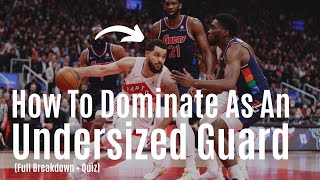
Ethan Khoza breaks down how undersized guards like Fred VanVleet score more by controlling space, using extra dribbles for balance, and making smart reads in pick-and-rolls. Key moves: shot fakes, same-foot finishes, and developing midrange and pull-up threes.
Questions this video answers
July 19, 2023
Three-year, $130 million max contract
Ethan Khoza
Chapters
I want you to watch these two clips right here and figure out what the main difference is between the two of them. That needless right to start the year, but boy, what a change when he's right physically. Drop a comment now with your answer. We'll talk about it later on in the video. Being successful as an undersized guard is one of the toughest things to do in the game of basketball. For the most part, the players we see in the NBA who are under 6 foot 3 are are generally freak athletes. But there are a few exceptions of players who are undersized and not freak athletes who are still very successful in the league. And Fred Van Fleet is a great example. And considering all the factors working against him, he still signed for a three year, $130 million max contract this offseason. So let's take a deep dive into his game and see what makes him so successful as an undersized guard. The first place I want to start is with his finishing. Now when you look at the advanced statistics and you see where he ranks on synergy, Fred Van Fleet is not a good finisher. But it's rare that you see undersized guards who aren't freak athletes are great finishers. So let's take a look at why he struggles as a finisher and find some takeaways that you can add to your game to become better around the rim. Now, the first thing I want to point out is his decision making and this is where a lot of undersized guards can get themselves into trouble. You're already at a disadvantage playing against players who are much taller and longer than you are. So you need to change your mindset when you get to the paint. If you're a 7 footer or a 6A with a 40 inch vertical, your first thought in the paint should be to score. But if you're 6 foot or shorter, everything becomes significantly harder and and almost any shot you shoot in the paint is going to be heavily contested. So you need to attack the basket with the understanding that you're going to have to kick the ball out a lot of the time. You can't get tunnel vision when you drive to the basket and only think about the scoring aspect. You have to understand that it's all about making the right play. And one of the best ways to be inefficient and ineffective as an undersized guard is to get up into the paint and force up tough shots. Getting into the pain is a great skill to have, and it's really important that you can do that. But it becomes even more important that once you get to the paint, you understand that a lot of times the right decision is to kick the ball out to an open a teammate or dump it down to a big. Just because you're in the paint doesn't mean that you're open and doesn't mean that you have the best shot currently. This is a big mindset shift that you have to make if you want to be a successful undersized guard. So on the flip side, let's talk about what he does well as a finisher that you can take and add to your game to score more around the rim. The first ability you want to have as an undersized guard is the ability to control space. What you'll see in these clips is that Fred Van Fleet makes contact with his defenders so that he can slow them down, which prevents them from having the momentum to jump and block a shot and going along with that. What you see in a clip like this is not just that ability to stop that defender, control the space, but then the ability to extend that finish out really wide to make the most of the leg that he does have, which makes it almost impossible for that defender to contest that shot. So working on your ability to extend out wide on your finishes is very important as well. Now back to the question that I asked you to start off the video. What's the difference between these two clips right here? And the two big things I want to point out are the number of dribbles and having control of the defender's momentum in space. In the clip where he misses, we see that he only takes one dribble inside the three point line on his drive. And he fails to control that defender's space or momentum at all, meaning he does nothing to control the space or throw off that defender's timing. So he's basically just having to chuck up a shot over seven footer. But in this clip, it's very different. We see that he takes two dribbles inside the three point line, which allows him to be more on balance and under control in his drive. And by doing this, he can get to two feet and get to a shot fake, which gets that defender out of the way, thus controlling the space and the defender's momentum. And then he's able to go up for an uncontested layup. So getting to an extra dribble on your drive can allow you to be stronger and more under control, which is a big part of being a great finisher and then being sure to Use that to control your defender's momentum is how you finish effectively around the and while being under control is really important, it's also important that you're able to finish in different creative ways that are going to throw off the timing of defenders for their contest. A big part of this is being able to finish off of that opposite foot, so that same side finish. So if it's a right hand finish, it's with your right foot, left hand with your left foot. This is a great way to throw off timing of defenders. So being able to do this is an essential skill for every undersized guard. And then being able to do this in a creative way where sometimes you need to place the ball a little bit higher up on the backboard. Sometimes you may not even be able to use the backboard. Sometimes you have to extend it out or go with a reverse. But practicing being creative, working off of these same foot finishes is a great way to become better and more efficient around the rim. Now let's talk about the main area that earned Fred Van Fleet $130 million, and that's his ability to play in the pick and roll. We're going to take a look at his passing right here. Because as an undersized guard, if you can't create advantages for your teammates through actions like ball screens, you're going to struggle to have any real value to your team. The first important part of this is kind of what we talked about already, and that's just decision making. So hitting the open guy and not forcing and trying to do too much, being okay with the fact that you might not be the one who scores. Every time you're in an action like this, you have to have the mindset that you're going to take what the defense gives you in these actions. And if you do that, you can be great in this area. A great example is the difference between these two clips right here. Fred Van Fleet hits that kick out on the left guy for an open 3, but then right here, he forces up a contested layup instead of kicking the ball out to the corner. So decision making is a huge aspect of being successful as a ball screen player. But on top of that, it's also crucially important that you can control your pace as well. Right here in all these clips, he's hitting the roll man, but he's doing it in different ways at different times. And this is because he's able to be patient and essentially force the defense to choose when and how he's going to make that pass. This also allows him to sometimes come off of that ball screen and control that defender, which is important, much like it's important when we talk about finishing as well. And he puts himself in the driver's seat by doing this the majority of the time. This is some that I think every guard should be studying a lot, watching as much as possible and then putting yourself in these situations as much as you can, learning how to control your pace, how to wait for that defense to make a decision for you and then to act accordingly. And then as you continue to also work on those type of passes that you need to make and your IQ increases, you're going to be really, really hard to stop and you're going to be able to set up your teammates with advantages all the time in ball screen situations. Now, when it comes to scoring in ball screen situations, the similar concept of taking what the defense gives you and getting really good at making those reads and then once you're able to do that and make the right decisions of when it should be you and when it should be your teammates, then actually having the physical ability to be able to knock down these sorts of shots. So getting to the rim, making those layups like we've talked about with the different finishing options, being able to hit those mid range pull ups, being able to hit those pull up threes as well. If you're able to hit those shots and you're able to make good decisions when you're in these situations, you're going to be an unstoppable player in those ball screen situations you're going to find yourself in. Now if you guys want workouts to help you master ball screen situations, being able to knock down the different shots that you're going to have to hit if you want to play this at an elite level, as well as workouts that are going to help you work on the ability to extend on your finishes and make these more difficult layups, then check out the Perimeter Score system which has workouts targeting all these are going to help take you to the next level. That'll be linked in the description below. If you want to check, check it out. If you guys enjoyed this video, drop a Like and subscribe. Make sure you click the link in my description below to get my free Leap Remer Score workout. I'll talk to you guys soon. Peace.
More from Ethan

Stop Using One Dribble When You Drive To The Rim! (How To Become A Better Finisher)









