How To Succeed At The Next Level, Training With NBA Players, and more with Danny Cooper (Episode 47)
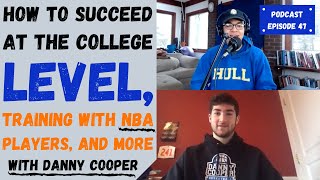
Podcast episode (Vision During Battle Training) featuring host Ethan Khoza and guest Danny Cooper (Danny Cooper Basketball). They cover Cooper's basketball journey (Plymouth-White Marsh HS; tried out at Penn State; plays at Moravian College), how COVID disrupted season timing and practice, and how Cooper launched training content (Instagram live ball-handling). The conversation emphasizes practical training lessons learned from working with NBA players (purposeful practice, planning, professionalism), coaching/trainer growth (film study, psychology of learning), and player development advice: pick 1–3 focused goals for the offseason, prioritize playing live against better competition, and combine trainer sessions with heavy individual practice.
Chapters
Real quick. Before we get into the podcast, I want to go through the reviews that we got this week. Like I said guys, if you want me to read your review on the show, all you've got to do go to Apple Podcast, scroll down the bottom of the page and leave a review. Let me know what you think about the show. We've got two this week to read, so first one comes from Ty Puzzle says a helpful source for serious basketball players. Hey Ethan, I've been following this podcast for a good while now, but I wanted to thank you for your helpful information. I have goals in basketball and these podcasts help help. These podcasts you make help me in a big way. Thank you again for helping me so much. Keep it up. Appreciate that. Thai Puzzle. And then our second comes from Emmett. Shout out to my guy Emmett. I see Emmett commenting on my videos all the time and he says love it. I began listening to this podcast around June 2020. Let me say that they've been marvelous. The podcast can teach you so much about the game on the physical and mental sides. Coaching covers a wide variety of topics in basketball so you can learn something new every week in the podcast drops. Want to learn about how to be a leader on your team? Check the podcast. Want to learn about how to train during the season? Check the podcast. Want to learn about the mindsets for basketball? Check the podcast. Thank you Coach Ethan for everything you do and continue to do for the basketball community. Vision your basketball family. Again, shout out to EMT my guy. Appreciate the review. Like I said guys, you want to be featured as well. Go to Apple Podcast, scroll on the bottom of the page, leave a review, let me know what you think about the show and and I'll read it on the show. Let's get into the podcast. Welcome to the Vision During Battle Training podcast. Appreciate all of you guys for tuning in today. Everybody who's listening on Apple Podcasts, Spotify or wherever you listen to your podcast and of course everybody who's watching on YouTube. Make sure you guys if you're new subscribe, drop a like as well. Very special episode today. Got my guy Danny Cooper here from Danny Cooper Basketball. And I've known Danny for about a little over a year now and he's really been doing some good things when it comes to training. He's got a real unique perspective being a player and a trainer as well and I think that's going to be really valuable for you guys to hear about and I'm excited to be able to get his some of his takes, his Input on training in general, and I think there's a lot of cool things that we'll be able to cover today. So, like I kind of mentioned already, Danny's got a unique perspective being a college basketball player and a skills trainer. So I'll let him kind of give you guys an intro on who he is and kind of how he got his start in training, where he's at now. And Daniel, Danny, welcome to the show.
Sure, man. Thanks for having me on. So, yeah, I could start all the way back in high school. So I played for Plymouth White Marsh High School, a pretty storied program, and I was a key contributor on a team that was ranked 19th in the country. So that was really cool. And then simultaneously, I'd say junior year, I started getting into training because there were a bunch of kids around the area who I knew. So I really enjoyed, you know, teaching the game. I always have kind of been like a coach on the floor because I've been a point guard, so that's kind of how I got into training. And then I was kind of your typical, like, undersized guy. So I had, like, all the Division 3 offers, but I was always, like, kind of headstrong where I was D1 or bust. So I ended up choosing Penn State, and that's actually where we met. So fast forward a couple years. I tried out for Penn State and didn't go well. So I decided I wanted to play, and I ended up at Moravian College, and that's kind of where I'm at today, to make a long story short.
Yeah, yeah. No, and that. That's. But that's also why. Because I kind of want to get into your journey to Moravian because I. I think it's so interesting. So a couple of things that you mentioned right there, I'll kind of jump around, but. So you said you tried out for. For the Penn State team. What, like, what was that process like? Because actually, it's funny, I get DMS about that. People tell me, like, oh, I want to try out for a D1 team. Like, coach, would I be able to walk on to a D1 team? And I think a lot of times, and this is kind of a thing in general, I don't think players understand, like, what that level of. Especially you talk about, like, high major, like, Big Ten basketball. I don't think people quite understand what, like, what exactly they're saying when they say that. So give us a little insight to. To what that was like.
Yeah. So, I mean, I say the number one thing for sure Obviously is athleticism and just strength in general. So the tryout actually was against other potential walk ons, not the players. So that obviously was my kind of caliber of player and it actually went really well. But I guess it's tough year to year when they decide if they're going to take anybody because they don't really need any of us to be honest, like, because you kind of be on the end of the bench. So if they already have their roster, it's kind of, they're not going to take you. So that was, that was tough. I mean I, I really just, I took the approach of it's going to be a good experience, I'm going to make connections with the coaches and if I, if I make it, I make it. If I don't, I don't. So that was kind of, it was a good experience. Looking back on it.
Yeah, yeah, I know there's a kid who went to my high school and he was two years older than me and he actually, he ended up walking onto Penn State's team. But I don't think he, I think his first year on was as a senior and I know he did like, he was one of their practice guys for like, I want to say either his sophomore and junior year, maybe just his junior year. But he kind of had to work his way up to that because like he kind of put in those hours with the team and the coaches knew him. So at that point, when a spot opened up his senior year, he ended up being able to take advantage of that. So I think there's kind of multiple ways to get into that. But yeah, like you said, that's, that's the thing when you, when you're around guys who can play at a high level, it's just like, and you can even speak to this, but like the skill level, when you talk about across the different levels of college basketball, everybody's really, really good. Like everybody and every team has a lot of guys who can put the ball in the basket. Like they got guys who can shoot the ball, guys who can handle the ball, guys who can get the ball to the, to the rim. And I think where those differences come in is like you talk like size, strength, athleticism, like, would you say that's a accurate kind of difference? Yeah.
So I would say from my experience at Moravian, like everybody has your general skills and can score. But looking at my team, Moravian, and looking at the Penn State team, the main thing, obviously size, I mean, Penn State has a couple six, nine guys, six, seven. So we don't really have anybody above six four. So that's, I'd say the main, the main difference. You don't. Because you don't find, especially in my league, in the landmark, you don't really find many, like, athletic big men.
Yeah.
So.
Yeah, yeah. So that's kind of another thing that you mentioned right there that I also think is something that players that, like, I know, players that I've worked with, and I think to an extent, everybody kind of has this mentality, at least at some point. But for you, you know, as you know, you're playing with a real storied high school program. And I know you had that, the one dude on your team, he's like 7:3, right?
Yep, yep.
Yeah. Yeah. So you got, you had some like that. And you're playing. You guys are 6A, right?
Yeah, so we. Well, yeah, we were 6A.
Okay. So, yeah, you guys are playing like some of the toughest basketball in the state and Probably, I mean, 6A over in, over towards Philadelphia, it's probably the toughest place to play. You're playing against, you know, dudes every night. And so for you, like, your mentality of kind of, oh, do you want to bust? Do you want to bust? Do you want to bust? That led you to Penn State. And then the cool thing is that last year actually when I met you was at a club basketball tournament because you're playing on the club team. So explain that transition from playing club basketball to then deciding, oh, I think I actually want to go play like college basketball.
Yeah. So just to give a little background. So I've always loved a serious program. Like, everyone has a crazy work ethic. All we want to do is win. So transitioning from Plymouth White Marsh to then not playing number one was very difficult for me because I've always been competitive and like being part of a team. So fast forward to sophomore year when I didn't make it. I started getting involved with the club team and I was kind of one of the best players and it was, it was fun to be playing again, but I was missing that sort of like team and coaching and camaraderie. So, yeah, I mean, it was fun to play, but I think if you, if you really love the game and you have that drive, don't be like me and say D1 or bust, because you'll really get a good experience any level, because people kind of poo poo, like, oh, Division 3, Division 2. But like any level, you're. It's pretty high level competition, especially if you're around other guys who love the game and are gonna. You know, you'll make great friends and you'll. You'll be studying the game. You'll be still getting better as a player. So I would just say my transition from club to Moravian was that I was just really missing that competitive feel and that kind of realness feel of, like, a real league. So that's where I said to myself, all right, I gotta go play.
Right? Yeah, that's. That's the thing, man. And, you know, from my perspective, whenever I see players who kind of. Again, like, we'll talk down on, like, Division three, or, like, oh, it's Division one. Or like, when I look. When I look back on, like, the. So I played it. My AAU team, my. Going into my junior year was. I mean, everybody on that team is playing some. So at some sport, at some level of college right now. And there was a dude on that team who, you know, I always say, like, the top three players that I played with or against are all Division 1 guys, but then number four on that list is a D3 player, and he's above a lot of Division 1 players that I've also played against. Like, what about when I was back in high school? So, like, there are dudes who can really play basketball who are playing at the Division 3 level right now. I think people need to have a little bit more, like, perspective on what. What exactly that is. I know you and I had kind of talked a little bit earlier, before we started recording about, you know, kind of how your season went this year, and, you know, you kind of had an injury that prevented you from being able to go compete, but obviously you got to go through. Now, I don't know how it was with COVID and all that this year in terms of, like, what you guys could do in the summer and then how it was like, in the. In the fall. So actually, before we even get into it, like, what was it like with COVID and all that sort of stuff.
Yeah, so Covid was. Made it really interesting. So when I started reaching out to schools, the main thing that Covid didn't allow me to do was visit and kind of get to know the guy. So when I first picked the school, I didn't really know anybody, so that was the first thing. Then in the summer, instead of having workouts like normal, we would have zooms and kind of just have team meetings. And then we started practice, I think mid October. So we actually practiced for, like, a month. And then our school got shut down and we went home for two months, so practicing for a month, then went home for two months, Then we came back, and this is when they had this shortened season for all the listeners out there. We had. I think it was eight league games scheduled. And we came back, practiced for a week. Then somebody got Covid, so we had to quarantine for a week, and then we had one more week before we started playing games. So to give you an idea, it was kind of like a chaotic process where, like, you're practicing, then you get shut down, then you're practicing again. So it was a really. It was great. We were all very grateful that we were able to play, because a lot of places weren't. But at the same time, like, mentally, it was really draining on a lot of us because one point you're playing, the next moment you're told you have to sit in a room for 10 days. So, yeah, it was tough.
Yeah. Yeah, no doubt. That's. That is. That is. That is the thing. I mean, you kind of look at it that way. Like, yeah, I mean, at least we got to play. But also, it's like, man, you lose out on. I mean, you're talking about the whole summer. Like, you guys don't get to actually be together in the gym, and you're new. You don't get to be in the gym with those guys until October, which is. Yeah, that's crazy. Like, that's. You guys are trying to go out and win a championship.
Yeah, we would be able to get in there and get shots of. But, like, in September, October, but we get to be on the. Like, on the court with everybody and with the coach until mid October. So, I mean, every team was in the same boat. So that's kind of the approach that we were trying to take. Like, don't make excuses, because every team was in it, but the same time, it was just. It was definitely difficult, so.
Right, right. So kind of kind of transitioning into, you know, training as well. You know, I know that, and at least from my perspective, I know that you really kind of started up with a lot of, you know, you're like Danny Cooper basketball about a year ago, probably. Probably pretty close to that. And that was kind of right when you also made that. Yeah, that was also probably right when you made that decision to go play college basketball. So how have those two things, like, kind of like, intertwined? Like, how have they mentioned how. How has each kind of helped you?
Yeah, so I started doing. Actually right when Covid hit, I think, in early April, I did Instagram, live ball handling workouts. And that's kind of the first thing that. I mean, I've been training since high school, but that's kind of the first thing I really started doing as my official Danny Cooper basketball business. So as I was doing that, I was. I was trying to play college. And I think really teaching myself how to be a great trainer comes with watching a ton of film, studying the game all the time. So just. That has drastically increased my basketball IQ and just really understanding the game. So, you know, like, all the terms and training, all that stuff. So, like, it's funny because players will do moves now and, like, I'll just, like, know what the moves are, whereas, like, the typical player, like, wouldn't kind of say, like. Like, if a player does, like, a same foot, stop, I'm like, oh, I know what that is. Like, a typical player, like, isn't thinking that. So I feel like it's almost expanded my, like, basketball brain in the sense where I'm, like, thinking as a trainer, but I'm on the court as a player. So it's a unique experience.
Yeah. Yeah. No, that's. It's funny you say that because I. It, like.
Yeah.
So I'm not playing competitively, but I'm playing pickup. Yeah, pretty often. Not as much now just because of coaching and all that, but, like, back in the summer, fall, like, I was playing pickup pretty often. And it's funny because, like, just like you said, basically I'm watching a ton of film and I'm just, like, learning stuff from other trainers. Like, that's kind of, like. So I'm just kind of expanding myself that way. And then I'm also playing a ton of. I'm not really doing a ton of, like, individual skill work myself, but, like, like now compared to when I was, like, a senior in high school and, like, I was, you know, playing competitively and practicing every day and, you know, with all that sort of stuff that comes with it, like, the. I'm significantly better now just because I'm.
Yeah.
All the time. And, like, I'm watching so much film. So, like, I understand the game better, too. It's kind of a funny thing on. That works. So I think that definitely kind of goes hand in hand. Like, you as a player, you just understand the game a lot more because you're probably watching a lot more film than anybody else on your team. Anybody else, probably in your conference, if you're trying to be great at what you're doing.
And what's interesting about that is, like, I would highly recommend any young player watching this to start watching film, because it almost gets to the point where not to say you don't need to practice it, but it's kind of like you're watching so much film that you can get out on court and almost do the move and you haven't even done before, just because in your mind you've seen it so many times. So I guess that's some sort of learning thing where you kind of pick it up. I've been trying to, like, dive deep into the psychology of learning and all that stuff, so I'm still getting better at that. But it's. It's crazy. Like, I'll watch a move and then go out on the court, and I'll be like, how can I do this? I never even practice it. So that's. That's cool, too.
Yeah, absolutely. That's. That's literally, like, I can use that example, like, with ball screens. Like, I can go out and play pickup, and, like, I'll. I've been watching just ton of film on ball screens. Maybe that's as an example. And then I go out and then it's like some sort of pass that comes off that screen or whatever that, like, I might not have specifically practiced, but, like, I'm looking for that now because, like, I'm going off. Okay, what do I have right here? And. But no, it's. It's. It is. That's definitely something that I've noticed for sure. And also to your point, you know, with. When it comes to learning, I think that's such a big. Such a big key. Like. And it's funny, as. As I get more into it. I don't know if you felt this way too, but, like, I think when I started, like, when I really started getting into training, because, like, kind of like you. I was doing it, like, back in high school. I was, you know, running my teammates through stuff, and my younger brother was with me all the time, too. So, like, that was kind of my thing. Like, I was always like, we're all. I was always the guy who's kind of, you know, get that guys to go go get shots up or go work out in the summer, all that sort of stuff. And then when I got to, like, actually, my focus is training now, you know, after high school. And the. The thing is, like, I felt like then, like, I knew a lot. And as I keep on going and I keep on learning more, I'm just like, man, I know less and less and less. Like, I have so much more that I have to.
I always feel I'm like, I literally know 1% of what I need to know. But I think that's the really cool part about our industry. Like, you can always get better. Like there's, you can know every basketball skill there is, but now you got to learn, like, now you got to learn the psychology of basketball and how people learn this way, and then you got to learn the strength and conditioning and all. You got to put it all together. So it's, that's what I think is so cool about it, that there's always just room for growth and. Yeah, that's, that's what I love about it.
Yeah. Yeah. And I know that you've had kind of a unique experience because you've been able to work with a lot of like, high level players. I know you've got to work with some NBA guys over the summer. And, you know, I know for, for you, I'm sure that kind of expands the way that you can view things. You get to look at guys who are like the absolute best in the world at, at what they do. You could see how their approaches and so kind of run me through what that was, like, how that experience, like, came about and, you know, overall kind of what you took away from it.
Yeah. So the first thing I'll say is whenever I'm like, away or on a trip or something, the first thing I do is I look up basketball trainers in the area and I'll DM them. I'll be like, hey, I'll come rebound, work for you for free, whatever. So I kind of pick that up. Are you familiar with Gary V. Yeah.
Yeah.
So a big thing he always talks about is kind of just like, DM people go work for free, stuff like that. So that's kind of been like something that I do for the past couple years. So when I was in Florida, actually over Thanksgiving break. Do you know Scoop Jardine from Syracuse?
I think, I think I've seen you, like, I think you might have tagged him on Instagram or something like that. So I'm sure. I think I have.
He was, he was a great point guard at Syracuse, I think, like seven or eight years ago. So I had come across his page on Instagram and he's in Boca Raton, Florida. So I'm like, I'm going to reach out to Scoop. So I sent him a dm, hey, I'll come rebound, work out, or help you work them out for free. And I didn't even know who he was with. Like, I was Just reaching out, going to help with basketball. So he's like, yeah, come by the gym. So not to get into too much detail, but I show up the next day and I'm looking in, I'm kind of lost. I'm trying to find the gym. And I look inside and it's Marquis Morris. So I'm like, wow. Like, this is like, obviously never really worked with NBA players before. Like, initially, you're kind of starstruck. Like, just to give you my point of view. So you walk in, you're like trying to play it cool. You're like, how you doing? And then I walked in and Scoop was like, yo, you're going to run the workout. And it was the both Morris brothers and then a couple other guys. So that was. That was really cool to kind of be thrown in the. Like, just thrown on the spot. Be like, hey, you're running this NBA workout. And I think I did a decent job looking back on it. But also what's really cool for me is like, that showed me I have so much to get better at. Because it's like now you're working out these guys who are worth $70 million, right? So it's like, you can't not know what you're doing or else they're not gonna, one, respect you, two, listen to you, and three, like, obviously you want to have those opportunities again. So it's like I've retraced back in my mind a bunch of times. I'm like, did I do that right? Was I good? So it's just been an eye opening experience for me to. Even though I might never work with them again, specifically, it's like, the next time I get that experience to work with an NBA player, I want to be like, okay, I'm great. I know what I'm doing. So. Yeah. To give you the rundown.
Yeah, yeah. No, that's, that's, that's. I actually didn't even know that was the story I just saw. Because the thing is, like, those two guys, I think they're both Philly guys, right?
Yeah, they are.
So I just assume that, like, you somehow had a connection in Philly and then you, like, went to, like, you were down with us. Oh, that's cool. That's pretty cool. But you went down there and it's like you just have to walk into the gym and it's like, yeah, well.
So I didn't even even know Scoop before. And I think one of the biggest things that we can do in. When you're in whatever industry you're trying to grow in is just not be afraid. I really learned this a couple years ago just not being afraid to reach out to people who are like, higher in the industry. Like, number one, you have to be willing to work for free. That's, that's my philosophy. You're not gonna, like, really get anywhere high, I feel like, unless obviously you grind out, grind it out yourself for a long time. But if you're trying to essentially skip like some steps and you want to really get access to high level people, you have to be willing to grind and work for free. So, I mean, to give you, like, I was. That experience was like, it was, it was really cool.
Yeah.
And if I hadn't had the balls to reach out and say, hey, I'll come work for free, and I didn't have the humility to do that, it wouldn't have happened.
Yeah, no, that's a, that's a, that's a great point. And yeah, that's for sure. I'll have, I'll have, like, people who want to get into training will DM me. And I was like, hey, what should I do? And like, hey, how do I get started? And I'm like, you know, you just got to find players to train. And if that means that you got to work out some guys for free until people starts to, you know, know who you are, then, like, that's what you got to do. And like, here's the thing, like, to this day, like, I'll still work out guys for free just because, like, that's, first of all, it's experience for me. Like, I get to become better, I get to try out new things, all that sort of stuff. But also, if you help players get results, then you have other players coming to you saying, hey, you know, can we work? And like, that's how you start to grow. I think the, the best way to do that, it's like, everybody wants to be like, oh, should I, should I run Instagram ads or should I do this or do that? It's like, no, you should just go help somebody get results. And then if you're good at what you do, then more people are going to want to work with you. And I think, like, what you said, you can kind of speed that process up by, you know, were you just like down in Florida on like a vacation?
Yeah, so I was visiting my family and I DMed, I think, like seven different trainers that I knew were in like, Florida, the Miami area. Right. And he was the only one who responded. So that's that's another thing. Like, you might reach out to 10 guys and only one response.
Yeah.
So that's why a lot of people, I think, get discouraged, though, even for jobs. Like in the corporate world. Like, you'll interview for a couple jobs and not get it, and then you might give up or you might be discouraged. But I think it's important to just keep going because you never know that next caller or person you're reaching out to could be your opportunity.
Yeah, absolutely. Yeah, that's. That's for sure. Something to. Something to take. And I think going back to, you know, your whole process with those. Those with the. The Morris brothers. And I know you were. There was a couple other dudes there, a couple high school guys, I think, who were the. Who's the one. The one kid from Massive Sciences. Right? He was there.
Yeah.
I'm forgetting his name.
He's going Miami.
Yeah, yeah, yeah, yeah. So, yeah, I know, because he played. So my brother's school, they played them in the state championship a couple of years ago, and I saw he was down there, too, so I was like, oh, that's a bunch of Philly guys down there. And then, you know, kind of. What I also want to hear your perspective on is what. What you see when it comes to differences in. When you're working with those NBA guys and then when you're working with just, like, a high school guy, like, what's the difference in the way that they approach things? The way that they. And I. Because I've kind of got my own take on this, but I want to hear from you, because I. I'm not. I haven't worked with anybody. Like, I worked with an NBA champion. Like, I haven't done that. So I want to hear how that is from your perspective.
So I'd say the number one thing is it's very diligent. So, like, everything has a purpose. I think what a lot of. Myself included, what a lot of high school and college players will do is they'll be like, all right, I'm going to outwork everybody this summer by getting in the gym two to three times a day, getting shots up, blah, blah, blah. So I think you actually do a great job talking about this on your tube is players don't really have a purpose, and they don't really have, like. Like goals. And I know you're familiar with D.J. sackman, so he. He talks about this a lot. Like, players really developing habits and setting specific goals. So I think what my thing. My whole career has been, I just Try to get in the gym. And I'm a complete gym rat, but I'm there two, three times a day, and I'm not really that focused. So I think what the NBA guys do is. Everything they do is at least for. For the most part, most of them, they're getting in there and they have a specific goal of, okay, I want to get better. It's not all right, I'm just gonna go in and I'm gonna work on this random move and hope to get better. It's every day they're on court work, they're strength and conditioning work, they're eating. Everything is planned out. So going into. After coming off my injury this year, I'm definitely gonna apply that to my game this summer, too.
Yeah. Yeah.
I'd say the number one thing is just everything has a. It has a purpose, and if it doesn't have a purpose and it's not going to get you better, then they won't do it.
Such a. Yeah, that's. That's such a key right there is your. Your focus when you're going, like, players be like, oh, you know what? I just got out work people. And if I. So if I spend five hours a day working out, that means I'd be better than everybody. And that's just not how it works at all. It's. It's much more important that the time you spend in the gym is spent, like, actually doing stuff that's going to translate to a game for you. I think. You know, I've only. I've only worked with one guy who's a pro, and this was last year. And the. The, like, it's. It's funny to me, like, how it was. How different his approach was compared to most, like, the high school, even, like, the college players that I work with, like, when he. When he's in the gym, it's like, it just. The way that he talks to himself the whole time was really, really interesting to me because it was like, anytime that he missed, like, a shot or two, it was like, come on, pro, you got to hit him. And he was like. It was like, that's your. Like, that's your job. Like, that's like. That's what you do to eat, like, to feed your family.
It's a little different when money's on the line.
Yeah, yeah, yeah. So that family. So, yeah, so, like, going back to your point on focus, like, the focus that those guys have to have, because, you know, if you're. If you're playing in the NBA, there's I mean, there's three, you know, 450 spots and you got 450 million basketball players in the world. So like, there are so many guys who could come take your spot if you don't, like, if you, if you aren't really focused on what you're doing. And I think that goes back to your point too about you kind of stepping in there and being like, oh man, like I got to, I got to make sure that like what I'm doing is to help these guys because, you know, these guys, again, like they got this how they feed their family, so they feed their kids. I've got to make sure that I'm, I'm facilitating a, some growth for them right here. Like, I want to make sure that, that you know, I'm, I'm helping them when you know, this is their, like this is what they do. This is, this is their, their bread and butter. So yeah, I think, you know, that kind of, that, that kind of to your last point, the hard work versus smart work, where it's like, are you just like out there getting a sweat? Because if that's what you want to do, you can just go run on a treadmill for a couple hours and you also get a sweat. But then it becomes like, are you actually developing? This kind of a point that I want to bring up with you is kind of what your approach is in the, when it comes to development in the off season. Because I think that there's kind of a more all encompassing look when you talk about like actually developing instead of just like, oh, going out and just, you know, going to workout. Like when you talk about actually wanting to progress forward, I think that there's an approach that. And kind of a long term approach the players should kind of view that with. So what's your kind of approach? And you can even, you know, because I wanted to ask you too about what your personal. Like how, how are you going to approach this off season from your, your perspective, trying to get yourself ready for, for next year as a player?
Yeah. So I'd say my approach to helping other players, the number one thing I look at is film. So if they're a high school player, I watch all their film. Yeah, well, yeah, so younger guys don't really have. So if they're a high school guy, I'll dissect their film, I'll make them a film edit, kind of showing them what I see, what we can improve on. And then what I'll do is I'll try to figure out one to three things that we should work on for the summer. So say that's decision making, finishing and shooting. Right? Because I don't, I'm a big fan of like, I mean I'm a big like proponent of like depth over width. So I think you should really dive deep into one to three things instead of just a bunch of random things. And like I said before, I'm guilty of doing this growing up where I would kind of show up and do a bunch of different things. Like I used to do like I used to do two ball dribbling for like an hour. And like not to say two ball dribbling is not good, but like now looking at it like I rarely have my players do it because I just think there's so many more efficient ways that you can work on ball handling. So just like that efficiency and then picking those one to three things and specifically catering them to, to that player and the system that they're going to be in. So that's something I'm still working to improve on because it's not, it's not easy. It's not easy creating a plan for a player and getting them to buy in. And it's a whole process that I'm still working on. But yeah, that's, that's my main thing that I'm, I'm working on for the off season is really developing specific plans for players and having them be focused the way that I wasn't growing up. So to go to, to my training this summer, I'm really going to take that same approach and you know, take a deep dive and say what are one to three things I can do better this off season? So for me specifically in my offense we do a lot of pick and rolls and DHOs. So that's something I should be working on. Every day I'm going to have to bring the ball up so handling pressure is another thing. And then maybe my defense. So like I really shouldn't be working on anything besides picking rolls. My decision making and handling pressure and my defense, that's kind of my approach.
Yeah. So you personally, do you work out your like by yourself or do you have like you work with somebody or.
I have, I have a couple trainers but I also do a lot of work on myself. So I think that's, that's also something that's really important for players is you can't expect to go to a trainer and like, like that's the only work that you're gonna do. And I know you, you touch on this too. Like A trainer's only gonna give you, and he's gonna give you a lot of stuff, but you need to then take that, use it on your own, and figure out ways to get better on your own. Because that's really. That's really where the growth happens and where you. Where you find new skills and find different ways to get better. So, yeah, I'd say I mix it up. I have a trainer a couple times a week, and then I work by myself the other days.
Yeah, that. That's the thing. When I just saw a quote and I posted on my story the other day, and basically part of it was like, the best trainers have the best clients. So you could say in basketball terms, the best trainers have the best players. So as. As great of a trainer as, you know, anybody might want to think that they are, you're only as good as your players are, really. So you. You got to have guys who are really about it. And it can't just be a situation where it's like, oh, yeah, I go see my trainer once a week, two times a week. And that's what I do. Because if that's, if that's what. Like, if you expect that to be what takes you to the, you know, that next level you want to get to, it's just not going to be the case. Like, the players who I work with, who are the most successful, like, I'll work with them, you know, maybe it's even only once or twice a week, but on those other days they're in the gym, like, they're finding ways to get shots up and do other things. Like, when I'm with them, we can work on, like, some more specific things. And then so I don't have to spend, you know, the whole time working on them shooting. Because I always talk about how I think shooting is the most important skill because it opens up everything else. Like, if you can shoot the basketball, the defense is to play you differently. The help is now going to be different when it's. When it comes to your guy, and it just opens things up for you and your teammates. So with it being that important of a skill, it can't be something that you're only working on two times a week with your trainer. Because first of all, as a trainer, there are other things you can do that are not shooting. Shooting is kind of straightforward. You can go work on your shot by yourself the other five days of the week. And the players who are the most successful are those guys. The guys who are not like, oh, I just do the I go to my team, you know, workouts three times a week, and then I go to my trainer once a week and then that's it. Like that, that, that shouldn't be your approach to things. Yeah.
And to add on to your point, if, if I have a player and he's not kind of, I know he's not working out when, when he's not with me, like, I don't even really want any part in him. I want a player who's going to be like, he's with me a couple of times a week, but I know he's working and getting better because then he caught. If he's coming to me only once or twice a week, we're kind of at the same spot that he was the week before. So if you're not a player who really loves the game, that's kind of a prerequisite for me anyway, to work with you. So I don't really want any part in that anyway.
Yeah. Yeah. I think kind of adding on to that too. One of the big things that I see with players I work with is it's, it's so important. And this is something that, like, I'm done diving more and more into is just how important it is to play. Like, we can do all the drills, we can do all that sort of stuff, which is great. Like, you need to do. Like, that stuff's important, but you also have to make sure that you're actually playing. Like learning how to play, like being able to just play basketball like that in itself is a skill. Knowing when to cut, when to relocate, when to make the extra pass, when to do all those sort of things, like that is something that you, that's, that's playing. Like, we can do ball handling drills, but there's nothing like actually handling the ball against a live defender. Yeah. And so, like, my thing is like, listen, we can, we can be working out. Even if we're going to work out three, four times a week and even if it's with a group, so we're going to do live stuff in the workout. You've got to make sure that you're, you know, going to your team workouts and playing 5 on 5, or you're going to the Y and play 5 on 5, or you're just calling up some of your teammates, playing three on three, like as often as you possibly can because that's where the, the transition happens. I'm sure that you, you probably would share that. Yeah.
Yeah. So to touch on that, growing up, as I've I've touched on, I did a lot of on air drills, right? So I'm in the gym two, three times a day and just shots, shots, shots on air. But what I noticed was like, especially in high school when, when it came to game time, it's very hard to translate those skills because now when you have a defender on you, you're uncomfortable. Right? So like you, like you were saying, I was a, I was a good high school player, but I think I'm a lot better now because I've played so much more over the last few years. So this past summer actually we did, we did some drills, but the majority of my training was two on two, full court twice a day. So we would get in the gym with my trainer and a couple other pros and literally I'll get my ass busted every day. So like that's the like for any young guys out there. Like not like if you could take away anything from how to develop in the off season, I wouldn't really say any drills or any of that stuff. I would say go try to be the worst player and go find a gym where you'll be the worst player. Get destroyed the whole summer, you will get so much better. Like when I'm telling you, like, I would lose, like, so we'd go like games to seven. Like first one to seven wins. Like there were, we'd go like 6am so like imagine waking up at 6am and you're going to seven.
Nothing.
Like that sucks.
Yeah.
But like what it does is it like puts a drive in your like mind. You're like, I need to get better so, so that I can beat these guys. So now like I'm working extra on my own at home and then finally like you're beating them a couple times and just over a couple months, the improvement of playing against bigger, stronger and better guys, it's, it's invaluable. So that's the number one thing. I don't know if I'd say I regret, but I wish I had done differently in high school is cause I used to not like to play like, like you're saying, like live drills and pickup. I used to hate it. And I think the hidden truth of why I hated it is because I would have been uncomfortable and probably failed. So that's, that's a big takeaway from what you said. It's. I think it's so important.
Yeah, I completely agree with that. That was me in high school too. I was all, I mean, I was the on air guy. Like there was not a. There was not a player that I knew in. In my city that was in the gym working harder, working more consistently than I was. But then where the difference comes in is, like, cool, you have that stuff, but are you also playing? And that was where the disconnect was for me. I think that another point that you just made right there is one that I've made a couple of times, and, like, I think is so important. But there will be times even now, where I'll walk into a gym and I'll know that, like, going in there, there's going to be a lot of really good players, and there's a good chance I'm going to be the worst player in the gym. And that, like, I love that. Like, I love walking into a gym looking, I'll be like, yeah, man, I'm the worst player in this gym. Because that means that I've got to elevate myself. Like, I've got to step myself up right here because I don't want to be in a situation where I'm on somebody's team and I'm the weak link. Like, maybe it. Maybe I am, but I'm not going to let that be the case. So I have to. I have to be better. And that forces me to. To again, have to elevate myself. So, like, I might be able to go play against guys who are. You know, I'm like, I. I can. I can go. I can put together a group of nine of the guys that I can knit myself. Guy number one or number two. Like, I can do that if I wanted to, but ultimately, if you do that, like, you don't really. You don't learn a lot from that. You can go out there. Yeah, and. And, like. But if you are in a gym and you're like, listen, I'm gonna seek out opportunities.
More from Ethan

Stop Using One Dribble When You Drive To The Rim! (How To Become A Better Finisher)









