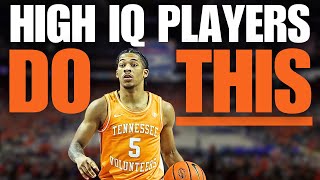
Ethan Khoza breaks down 17 March Madness plays that punish defensive mistakes. Learn the slip, backdoor cuts, dribble handoffs, and stacked screens that create easy finishes. Each play shows exactly when and how to attack overhelp, early switches, and aggressive defense.
Chapters
Most people watch March Madness for the flashy plays, the game winners, the dunks, the buzzer beaters, and those moments are awesome. But if that's all you're watching, you're missing what actually makes these teams and these players great. I watched hours of March Madness and these are 17 of my favorite plays, not because they're flashy, but because they show next level basketball iq. And these are things you can take and add to your game right now, and they'll help you to make an impact immediately, no matter your role or what level you're at. And if you start to hunt these opportunities when you play, scoring and playmaking is going to become simple for you. Let's break them down. Now, these first six plays all have something in common. They involve one of the most underrated actions in basketball, the slip. A lot of players set a screen and just stand there or roll without reading the defense. But the best teams in March Madness use slips to punish defenders for overhelping, switching too early, or miscommunicating. Let's check out how smart timing and awareness led to easy buckets in all six of these clips. Now, in this first clip, Isaiah Evans recognizes that the defense is going to switch this pin down, which many times leaves them vulnerable for a slip. Now, in clip, they don't switch it, but Justin Bailey recognizes that the paint is completely open and his defender is slightly trailing him as he goes to set the screen. So that means that the slip is going to be wide open. Here's the same exact situation happening in a game for the high school team that I coach. Right here we see Andrew Carr get to a slip to a dunk by following the one to perimeter, one to basket concept. This just means that if you're the one setting the screen, you want to do the opposite of the guy that you set the screen for. So if they go to the perimeter, you're going to slip to the basket. That puts a lot of pressure on the defense to guard two different areas. A lot of times going to lead to open opportunities like this here we see Lamont Butler get more of a backdoor cut off of this here just by setting up his defender like he's going to sprint off for the handoff. And then the last clip that I want to show to illustrate the power of the slip is this. Tyrese Proctor 3. We again see the one to perimeter, one to basket concept here as Sean James dives after he sets this screen. Now, Mark Steers for Alabama wants to switch this action, but because Sion James dives immediately and seals him off, putting himself in a position to get a post feed and likely either get fouled or score. It forces two defenders to stay with him, which leads to Tyrese Proctor being wide open for a three on the perimeter. And while we're on the topic of screens, here's Tyrese Brocker doing a beautiful job of reading his defender and how he plays him. Coming over the screen, he decides to curl and get downhill because anytime your defender chases you over a screen, the right decision is to curl because they're going to be trailing you. He then sees possible help in the paint, so he stops for the open mid range pull up. Before we move on, let me preface what you're about to see with this clip from Step Curry.
The last thing we can do out here, the last thing we can do is try to get open and then I don't get it. Begging, begging, begging for the ball. All right? I don't care where you are on the court, that's the last thing we can do. Every other decision is the right one. You got plenty to choose from. Every decision. Screen away, front cut, back cut.
We saw a ton of physical aggressive defense, so knowing when and how to backdoor cut effectively is such a critical thing and one of my favorite things that I watched on over these past few games. Right here we see Kentucky want to get to a dribble handoff here, but Owen notices that his defender is really playing high up in the lane trying to pressure that handoff. So he sets his defender up first and then takes advantage of that aggression by going with the backdoor cut to a tough finish for an an one. Same thing here with Trent Noah on the receiving end of that pass, sets his defender up for that handoff and then takes advantage of that aggression for an open layup. And here we see Cooper flag take advantage of this too with his quick action that Duke got to called Blind Pig. As soon as that is about to get to the high post, he immediately backdoor cuts to the basket for a wide open dunk. One of the best times to look to score is when your teammate gets the ball in the post because all the defense potential turns to them, which opens up opportunities to cut from the weak side. Here we see the ball get entered into a little beyond the mid post for Drake and then they get to a 45 cut, which just means a cut from the opposite wing. Now this was pretty bad off ball defense by Texas Tech, but you'd be surprised how often this 45 cut is open even against good defense. Just because the defense turns look at the ball and and it opens up a weakness for them. Right here we see another cutting opportunity that Kentucky got off of a low post touch. There's a big size mismatch in the post. So Andrew Carr sees his defender turn to go and help, which immediately signals to him that he needs to cut to the basket. Now he does and he gets a dunk off of it. One of the most important ballstream needs you can make is knowing when to flip the screen. A lot of players and bigs just set the screen and hope that it works. But smart players make adjustments in real time when the defense tries to cheat. Watch how in both of these clips, the on ball defender gets over top the screen a little early. And instead of forcing the original angle, Ziggler and his screener just flip the screen to go the other direction. That slight adjustment recreates the advantage and allows Ziggler to get downhill and create. And this clip right here, it's a definition of elite work as a point guard. They flip the screen twice and Ziggler decides to reject it after the second one. Then he snakes back through as his screener seals off that help defender gets himself to the basket for and gets fouled. All right, this last clip might be my favorite one. It's a quick hitter that Duke ran to get Cooper flag a layup. And it's a masterclass in stacking multiple actions to confuse the defense. It starts with a pin down on one side of the floor, but instead of using it, he decides to go back door on the other side of the floor. Cooper is going to set what looks like a pin down for his teammate, but he slips it and his teammate who went back door on that pin down runs across to set him what's called a rip screen, which gets Cooper flag a wide open layup. This is beautiful high IQ basketball. And it works because it's not just one action, it's multiple layered together. The movement is constant, the reads are sharp and the timing is perfect. And most defenses at the high school and in the college level struggle to guard multiple actions in a row, especially when they're disguised like this. If you want to keep building your basketball iq, I put together a free masterclass that dives even deeper into the exact concepts that we just talked about. Cutting, screening, decision making, off ball movement and way more. It's called the basketball IQ masterclass and like I said, you can watch for free using the top link in the description down below. If you're serious about becoming a high IQ player that coaches trust. Someone who makes the right plays, gets more minutes and more opportunities and impacts the game without always leading the ball. That's exactly what we train inside of Basketball IQ Academy. What is? Our full basketball IQ development program. That'll be linked down below if you're interested. Appreciate you for watching. I'll talk to you soon. Peace.