If You’re A Young Player Who Lacks Confidence, Watch This
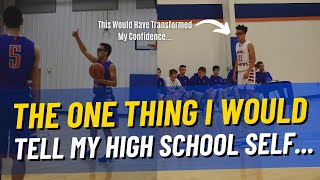
Ethan Khoza breaks down how young basketball players build real confidence: define what it means, find the specific situations where you doubt yourself, then practice those moments in low-stakes games until failure stops feeling like failure. Skip the affirmations. Repetition in real scenarios is what works.
Chapters
I was recently on a podcast and I was asked if I could go back in time and give my high school self one piece of advice, what would it be? So I want to talk about exactly what I would tell my high school self to do in order to become a super confident player. As a young player, that was the number one question I would always ask myself. I feel like I'm putting in way more work than my teammates or the people who are ahead of me, even though they don't care about it as much as me and they're seeing better results than I am, despite the fact that I care more and I'm putting in more work. And yet they would play with a different level of confidence than I had. And so I was always so focused on, okay, how to, how do I become more confident? How do I translate the work that I'm putting into confidence to perform well in games consistently asking the question, how do I become confident? A lot of times is where I know that I got caught up in looking for a quick fix, looking for, okay, if I just write this on my bathroom mirror and you know, say these, these mantras to myself every morning when I wake up, I'm going to start to play with confidence. And that's a shortcut. Not that those things can't help. Affirmations can be a really good thing. Positive self talk, obviously, can be really, really good supplements to it. But when we come, when we talk about building true, lasting confidence, the most important thing is understanding what confidence actually is and then we can figure out how to actually build it. Confidence, all that that is, is the belief that you have what it takes to be successful in a given situation. So the example that I use all the time is if I. There's a gas station half a mile from my house and I ride my bike there every single day for a year, I'm going to be really confident in my ability to successfully make that trip on my bike the next day. Because I've done it so many times, I'm very confident that I have what it takes to be successful in that situation. But if you say, hey, you need to make this same trip, but now you need to drive this 18 wheeler, this massive semi truck, and by the way, there's a full load in the back. If I've never done that before, I'm going to be way less confident driving that thing that I would be riding my bike that I do all the time. I'm going to be way less sure that I have what it takes to be successful in that situation, that is the difference between having confidence and not having confidence is how sure are you that you can be successful in the situation that you're in. For me, I can pinpoint specific situations as a younger player that I wasn't confident in. And for example, one of those situations would be handling the ball as pressure. I, especially as a younger player, didn't really feel confident doing that. And so I was constantly looking for what's, what's the fix for this. In reality, the most important thing you can do as a player is identify those situations where you don't feel confident. Ultimately, what that means is those situations where you aren't sure that you have what it takes to be successful consistently, and you need to place yourself in those situations over and over again. You need to fail in those situations over and over again until eventually you figure it out and you start to succeed, and then you build that level of confidence that says, hey, I can. I know that I have what it takes to consistently be successful in this situation. So, for example, if we were to look at the, the situation of handling pressure one on one, maybe it means that someone's pressuring you full court, you got to handle the ball for me. I spent so much time thinking about, okay, well, like I said, can I use different affirmations? Can I speak to myself and say, hey, I'm going to write down on my bathroom mirror something that says, you are a great ball handler. You can handle pressure with ease, all those sorts of things. Those can be helpful. But that's just one little, little part. And then I spent all this time doing stationary ball handling drills and ball hand drills in general. That was, that was my, that was my. What I deemed was the fix to that. Okay, I'm going to become more confident by spending two hours a day working on my handles. Those things are all well and good, right? And there's absolutely a need for ball handling drills and workouts and all that sort of stuff. That stuff matters for sure. But at the end of the day, if I want to become more confident in that situation, well, I need to recreate that situation as much as I possibly can until I become confident in my ability to do it. Because there's a difference between going and doing ball handling drills and then actually applying your ball handling skills to a game situation. We got to put ourselves in that situation as much as we can. So the way you would do that is through your meaningless games, meaning pick up games. One on one, two on two, three on three, whatever games that you know don't really matter. They aren't counting for anything. No one's going to remember them the next day. When you're in those situations, you have to go in there with a purpose. You have to go in there with understanding, saying, hey, I want to be better at this. And for example, with that, that handling pressure scenario, I need to go into my pickup game saying, hey, I need to try and put myself in a situation where I have to handle pressure as much as I possibly can. Even though it's probably not something that I naturally do because I've avoided it because I don't feel confident doing it, I've got to force myself to do it. That's going to be my purp. You also have to change the way that you view success in those situations. You can't say success is never turn the ball over, because what that probably means that you avoided the situation that you really are uncomfortable in. What you have to say is, hey, if I didn't make any mistakes today in this, in this meaningless game, then that was a failure of a day. But if I put myself in a situation and I turned the ball over, I lost it, I was uncomfortable, I looked bad. That's a successful day. Because what's going to happen is that the first few times you do it going to fail, you're going to lose the ball, you're going to get it taken from you, you're going to look bad, people on your team might be upset with you, whatever, but eventually you're going to succeed one time and then you're going to fail again and another time, but then you're going to succeed again, and then you're going to fail again, and then you're going to succeed again, and then next thing you know, it's going to become way more consistent for you because you're willing to kind of go through the fire. And that was the. The step that I didn't understand that I was skipping as a younger player is I was doing everything to try and fix the problem of not having confidence, except for the one thing that I wasn't confident doing. And the problem is also the solution. In this instance, your problem is that you aren't confident handling the basketball. The solution is go handle the basketball in that exact situation or in a very, very similar situation as often as you possibly can. And eventually, as you fail more and you figure out, oh, this worked for me, that didn't work for me. I need to make sure I do more of that, less of that. Okay, this also works for me. Okay, when I play against this guy who's smaller than me. I can use, you know, my size a little bit, or I play against this guy's bigger than me, I can get a little bit lower than him, and that's how I can beat that specific defender. Those are all little nuanced things that you don't gain from drills. You don't gain from, you know, writing things down and affirmations. You gain that through putting yourself in that situation and gaining the experience necessary to be successful. So if I had done that, if I had said, hey, you're going to identify three scenarios that you feel unconfident. And maybe that is handling pressure one on one. Maybe it's driving to the basket against contact, maybe it's finishing gets contact. And I say to myself, hey, I need to put myself in these three situations as often as I possibly can. And the there is no. I don't care about the outcome. I don't care if I'm successful, if I score, if I don't score. All that matters is that I get reps at those things. And eventually, as I do them over and over and over again, I'm going to be successful. I'm going to fail a lot, and I'm probably going to fail a lot early, but I'm going to slowly and surely get better. And eventually I'm going to recognize the fact that, hey, I have what it takes to be successful in these situations. I'm going to be confident, and that confidence is going to, is going to turn into result on the court. So if you want to develop a high level of confidence, don't look for the shortcut. Identify those situations that you know that you are not confident in, and make it your goal, your mission, to put yourself in those situations as often as you possibly can. Understanding the fact that you, you should fail, you should want to fail, because when you fail, those are. The reps are going to teach you the most. And the more that you do it, the more that you press into that, the better you're going to get, the more confident you're going to get. And this is the reason why a lot of players never improve their confidence, because this is a really hard thing to do. And it takes a player who's really purposeful, really dedicated, really willing to do what it takes to be successful to follow these things. And this is how you truly build that confidence. So I can go back to my high school self and give him one piece of advice to maximizing who I was as a basketball player. It would be this it would be develop confidence the right way. Hopefully that speaks to you as well. Go to the top, like my description down below to get my free basketball IQ masterclass where we dive into all the skills, all of the understanding you're going to need to be as successful as possible on the court to score more points, to make more plays for your teammates, diving way deeper into building confidence and things that you need to understand, things you need to know. I think it's a really easy way to be able to add six to eight points per game to your average right now. So like I said, completely free top link down below an hour long. Go check that out. I appreciate you for watching. Talk soon. Peace.
More from Ethan

Stop Using One Dribble When You Drive To The Rim! (How To Become A Better Finisher)









