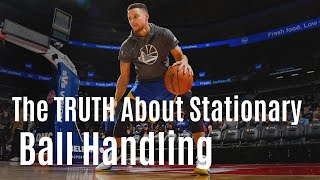
Ethan Khoza argues stationary ball-handling drills aren't useless if they're purposeful. You can build pound, hand speed, and ball manipulation this way, but most practice should move and look like games. He suggests a 10-minute daily routine mixing both.
Chapters
From my guy, Josh Smiler. Shout out to Josh. He said, stationary ball handling versus moving ball handling, and kind of comparing the two. So I think there's a lot of. Especially recently, there's a lot of demonization of stationary ball handling when it comes to basketball training. And for me, I almost had an epiphany like, this is, like, not that long, maybe a couple weeks ago, where I look at it, and I'm like, I think that in some ways, we may have gone too far down. The stationary ball handling is bad. End of the spectrum. I don't think that it's bad. I think that it has its place. I think it becomes bad when it's all that you do. And there's probably drills out there that maybe aren't the best use of time. But I think there's also value in certain types of stationary ball handling. So it really. What it comes down to is what your goal is. So if you're just doing stationary ball handling, because that's what you do, I don't think that's the right reason to do it. I think if you have a specific quality you're trying to train, then it can be beneficial. For example, if you're trying to work on pounding the basketball and the speed that the ball is going from hand to floor, back to hand, then you can get a lot out of ball handling. You can work on just that strength of that dribble, right? And I talked about earlier being able to, you know, having the strength to be able to handle pressure. That's part of it, right? There is how quickly you can get the ball from the hand to the floor, back to your hand, because the faster you do that, the harder it is for the defender to have time to reach in and steal it. Okay. So we can build that quality through working those different pounds, right? And again, there's ways that we can. We can even make that more difficult. So from my guy, Paul Fabriz, PGI Performance, he talks about a few ways he likes to do that where he'll, like, have his guys on grass so that the energy return is not quite as much. They have to really put more into that pound or on carpet, or he'll have to, like, be up on, like, a elevated platform, maybe 6 or 12 inches off the ground. And now there's just more distance that they have to get that bolt out of the ground, so they have to put more into it. Or you can take the air out of the ball. And now you have to put more into that ball to get that energy Return back to your hand. So we can work on that quality in those sorts of ways or even just normally with, with different pounds and working on trying to break the floor, that's like what you're thinking about right there. And again you can work on stationary ball handling, working on, on manipulating the ball, cuffing the basketball over a cone, whatever. There's elements that you can build, you can work on really effectively, I think through that stationary ball handling. And there's even more hand speed. Whatever the speed of the crossovers and getting the ball from right hand to left hand, back to right, as quick as you can. When you have a focus, I think that you can get benefits out of that stationary handling. The problem becomes when we do stationary ball handling, just because that's what you do, you know, I think there needs to be a purpose behind it and you need to be able to say, hey, we're doing this because it's working on this quality. And so that's part of it. Now I would say that you need to have them like you definitely can't be doing all stationary stuff like you play basketball moving. So it's not just about your hands, right? Your hands, your arms are a part of ball handling, but your feet and how well you move, your ability to change pace, change height, move laterally, move backwards, be unpredictable, change your pace, change the speed that you're playing at, that all is just as, if not more important to how great of a ball handler that you are. So I think it's important that, that the movement aspect of it is, is a, is at the forefront of ball handling. For sure, like that should be the majority of it. But I think you can definitely supplement with stationary ball handling to work on those different sorts of qualities. I'd say find time for both. Let's say if you were going to do a 10 minute routine every day or whatever, which I think is a video I'm probably going to make at some point where, or at least I'll put it on you on Instagram or something. Just talking about, like if you're gonna attempt, if you're new, 10 minutes of ball handling every day, right. What would you get the most benefit out of? Because I think they're actually, I think you actually really can, I think if you had 10 minutes of ball handling, if you like use that 10 minutes efficiently, you can really get a lot better just by 10 minutes. And I think that honestly, if you approach it the right way, those 10 minutes can be more beneficial than like an hour long workout. Doing stuff that isn't quite as focused or you don't have that same sort of understanding of. Okay, we're working on this specifically, but again, I'll. That's a video that. That I'll make in the future. But if I have 10 minutes, I'm probably going to spend maybe a minute or two of that working on a specific quality. So maybe working on manipulating the ball or working on those pounds, whatever. Then we're going to move and we're probably going to. It's going to be a lot of freestyling, a lot of just. Okay, working on getting to whatever. Imagining that somebody's guarding me. Okay, now I'm going from baseline court. Imagine like there's somebody on me, but I have to change my pace all the time. So sometimes I'm going 20% speed. Boom. Now I'm getting up to 80% speed. Okay, back down to 40. Boom. At 100 for a little bit. Okay, now I'm back to 20, back to 80. Changing up speed, being unpredictable. And that would be how I would spend the majority of my time, because I think that's the most beneficial for most players out there. So, again, it's a mix, but I would lean more so towards ball handling on the move because I think it's just so much more translatable to the game.