Should You Only Work On One Skill At A Time? (Podcast Episode 52)
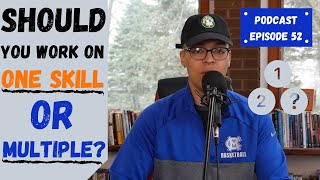
Ethan Khoza breaks down when to focus on one skill versus many. Younger players train holistically, but advanced college and pro players can narrow to a few micro-skills. His plan: pick 3-4 focus areas per off-season, blend them in workouts to stay game-like, and tighten focus as your role solidifies.
Chapters
Foreign training podcast. Appreciate every single one of you guys who's tuned in right now, all of you in Apple Podcasts or Spotify, shout out to you guys and of course everybody who's watching on YouTube. If you're on YouTube, make sure you drop a like subscribe. If you're new, new podcast coming every Sunday. And if you're out listening on Apple Podcasts right now, I really would appreciate if you scroll down, leave a review for me, let me know what you think of the show. And if you anytime I get a new review, I read it at the beginning of the show. So if you want me to do that, go ahead and leave a review. Let me know what you think today. Good answer. Question that I've gotten pretty semi often and it kind of came back up again. So I wanted to kind of talk about this a little bit. So I'll read the DM that I got. This kind of encapsulates the question pretty well. So he says, hey, I have a few questions for the podcast. I recently watched the PJF Performance podcast and they had NBA trainer Drew Hanlon on the show. Drew talked about how players don't spend enough time on one specific area. They try to work on everything. For example, the first week he trained a young Jayson Tatum, he only worked on jab variations and nothing else. Is this a safe approach to train, specifying on one skill for a long period of time, or should I be working on everything? The second question is, if I do choose to work on a specific skill for a long period of time, will my other prior skills begin to decrease because I'm ignoring them for a long period of time? So it's a great question. I first of all shout out to PGF performance Paul Fabriz and then Drew Hanlon, of course, two guys who are really, really good at what they do. And I learned a lot from both those guys. So shout out to both of them. And I also did listen to this, the podcast that this question's referring to as well. And I think it's a very interesting discussion. So kind of some backstory on that. When Drew Hanlon first started training Jason Tatum, Jason I think he was 13, so probably seventh or eighth grade. And the first, I don't remember if it was a couple weeks. A couple. I think it was like the first two weeks that they were working together. Maybe it might even be the first two months. But he said that they literally did nothing except work on jab variations, right? They didn't shoot, they didn't work on Ball handling, they didn't like, they just worked on jab variations for that for that entire time. And so that was kind of how we said, kind of the. How we preface, like, yeah, you know, a lot of players don't spend enough time working on one specific area, so they don't ever master a specific area. And with, with Jason, he recognized that, hey, if Jason get good with off, you know, off the jab, then it's going to be able to create a bunch of stuff for him offensively. So that was his focus there. And I think it's a very interesting discussion as well, because the question becomes, should you only be focusing on one. One skill or one area at a time? And is this the best way to approach things to get the maximum amount of results for the time that you put in? And I think that the answer to this question varies depending on a bunch of different factors. And I think the fine balance between doing too much, trying to do too much at once and not doing enough, I think you can kind of be on either end of the spectrum. So it's about finding that kind of happy medium right in the middle there. So we'll hop into exactly what variables you have to account for here and kind of my, my own take on it. Now, again, I want to preface this by saying, like, this is my take on it. So again, it might be in disagreement with somebody else or with or, you know, somebody else must say, oh, I think it should be this instead. This is just from my own personal experience from the players that I've worked with, how I like to go about approaching things. So the first thing you have to take into account for yourself when you talk about, okay, what should I be working on? How much should I be working on is your age and specifically your overall skill level, your ability currently, and then the experience that you have, because it's going to be different if you're kind of a newer player, maybe you're younger, maybe you're just new to the game and you don't have a ton of skill yet in that situation, the usually a more holistic approach is going to be better. Okay. Obviously, you know, Jason, by the time Jason Tatum was a freshman in high school, he was, he had offers from everywhere. Right. So you. We can assume that when he was 13, he was already pretty good. Right. And probably as a 13 year old, he's probably already one of the best in the country if you're getting an offer from Kentucky as a freshman in high school. Okay. So that's something to consider all already is that, you know, he's, he's already at a certain level. So when Drew's working with him, you can be a much more, much more specific because he can already walk on a court and dominate, right? He can already walk on a court and be the best player easily. So now it's about kind of fine tuning those tiny micro skills, as Drew Hannah likes to call them, and now taking his game to an elite level, which is what obviously has happened with Jason Tatum. So I think it depends on that. Now, if Jason Tatum was the worst 13 year old on his team, the worst 13 year old in St. Louis, then you're probably going to take a different approach. It probably isn't going to be, you know, you probably aren't going to spend every, you know, every workout for the first two weeks or two months, whatever it was, you're probably spend every single workout just working on jab variations. You're probably going to say, okay, you know, we got to work some ball handling, we got to work some finishing, maybe at least some form stuff when it comes to shooting, okay? Because you're at a place where you don't have the prerequisite skills for us to say, oh, okay, we're just going to, you know, target this tiny little detail of your game or this one part of your offense, okay? We have to be able to put you on the basketball court and you can't be a liability, right? You have to be able to handle the ball well enough that we can put you on the court, finish well enough that you're not, you know, blowing layups and be able to hit open shots. That's kind of step one. So if I'm working with a player who's at that point where they're not already one of the best players, then you're gonna have to approach it more holistically. And that's typically how it's going to be for players who are either younger, less experienced, or just aren't at the, at the talent or the ability level where they are already one of the best players, okay? So that's kind of how you need to approach things. So generally when it comes to that, that's where you're going to have more of a holistic approach. And you have to understand that, you know, for, honestly, for the majority of players at the high school level, really, regardless of where you're at, a more holistic approach is going to be better for the majority of players. Now, again, this can vary, right? You might have certain times, maybe you, you, you spend A whole month working on a specific area of your game, right? Maybe you really want to work on using ball screens, right? So you spend, you know, entire month, and your one focus is primarily on getting better using ball screens, okay? So that's obviously something. But usually at that point, you already have a pretty good grasp on your ball handling, you have a pretty good grasp on your shooting if you're able to progress to that point. So again, what we don't want to do is just take what somebody else does and say that it automatically applies to you as well. What Jason Tatum does doesn't necessarily apply to, you know, player X, because player X might be in a completely different circumstance, completely different situation than Jason Tatum was. And that goes for literally anything. Okay? So that's one thing to consider as well. You know, when it comes to basketball, there's so many moving pieces during the game, right? So there's obviously your coaches, there's your teammates, and then there's defenders, right? But then you also think about there's a clock for some of you guys, maybe a shot clock as well. And at the end of the day, there's so many things that go into it, right? You know, plays, defense, remember scouting reports. So basketball, there's so many moving pieces. A lot of times players who aren't that experienced yet have to find out, have to be able to put those pieces together, okay? You're usually during the context of possession, going to be using multiple skills, right? You catch the ball, shot fake, drive to the basket, and then you finish off two feet. Well, that's, that's different skills that you're working right there, okay? You working off of, you know, a attacking, a closeout, for example, with that shot fake, okay? Then you've got to be able to get to the basket downhill, and then you're working on finishing off of two feet. So you have, you have a couple of different skills that you're kind of meshing together. And I think that's really how the majority of players should take it, is how can I make my training as game like as possible and kind of mesh these skills together, right? I've been harping on a lot the importance of playing, and that's why, because you learn how to mesh those skills together. You learn how to mesh finishing with driving to the basket, okay? When there's a defender on you, you learn, you know, when to shoot the ball, when to shot fake, and then what to do after the shot fake, okay? So there's a bunch of different areas where that, that applies. And where you have to consider that there's again, more than one option and there's multiple pieces that you have to be able to put together. So that's why it's in general at the high school level, the better thing to do is to focus on a couple areas. I'm not saying to focus on everything. That's not what I'm saying. I'm saying three to four areas. Generally throughout an off season, if that's your focus, you're going to be able to make good improvement and also be able to see those skills kind of mesh together and make you a more complete player as well. So that's kind of my thought when it comes to that, you know, because a lot of times isolating that skill doesn't allow you to be able to work that together. Okay. So that's, you know, adding on to that. It also is going to depend a little bit on your role. And this is going to, this is usually not going to be. Until you're probably a college level player. So, you know, any collegiate players listening, usually, you know, you're more defined into your role at that level. Right? At the college level, your coach probably recruits you for a specific role, right? They're saying, okay, you know what, this guy's a shooter, so we need shooters on our team. So that's what this guy's going to do for us. Okay? This guy's a, you know, a point guard. We need him to play off ball screens. That's what he's going to do for our team. Okay? This guy is a, you know, kind of a stretch big, right? So we need him to be able to pick and pop and, you know, hit threes as the trail guy and do that. We've got, we're recruiting a big guy. We need him to be able to set screens and rebound and, you know, play out of the post. Okay. Typically, a coach is going to try and put together a team and he's going to bring you in to do a role, okay. That's where being more focused on a couple specific things becomes really important because you have to excel in your role. Right? You're coming in to do a job and at that point, as a college player, you're pretty defined in what you are. You kind of are what you are. Okay? Not to say your role won't expand right from the time you're a fresh into. When you're a senior, usually that's not the case. Right. Usually you're going to expand your role a little bit as you get better and as you get more experienced, but ultimately you're coming in, you got to be able to do your role. So that's where, you know, if you're a shooter, you're coming in as a shooter, then maybe that's where you say, okay, you know, my focus for this offseason leading up to this is I want to be able to shoot better coming off of pin downs. I want to be able to shoot better coming off driving kicks, working on that, you know, the extra pass into the corner, can I make that shot at a very high percentage. So when I get into, you know, practice, when we get to the season, you know, those shots that I know I'm going to have that I know I'm going to have to hit if I want to play. I. I'm. I've mastered those shots. So now I'm on the floor, right? My coach is saying, okay, you know, he does his role, so I'm going to play him. So you get playing time now you have the opportunity to expand that role a little bit, okay? But it first of all comes down to you having to be, you know, excel in that role. And at the college level especially, that's where that starts. The high school level, you're not necessarily defined now. You. Not. That's not to say you don't have a role at the high school level. But, you know, a lot of times players, they. They grow late. They might not grow till they're a junior, right? They might not develop until they're like, you know, there's. There's a bunch of variables that go into that. But by the time you're at the college level, typically, you mostly are what you are, okay? And obviously at the professional level, it's just a step up from that. You really are going in to be a role player again. You know, 98% of players in the NBA are, are in there to do a role. They're in there to play defense or shoot. They're in there to set screens, right? They're in there to set up the offense, okay? And that's where it becomes, like, working on maybe one thing during the off season really becomes, like, the way to go. And it makes a lot of sense because at that point, you're already a great basketball player, right? You're already one of the best in the world. And all those kind of foundational pieces, you already have those, right? That's, that's, that's a given. Like, you've made it to that level, so you're already there at that point. It's about working those micro skills, right? Those little details and adding little pieces to it. So maybe if you're a point guard, you specifically work that offseason on, you know, using a high ball screen, right? Playing off a high ball screen. Maybe that's literally what you spend your entire offseason doing, because maybe that's what you're the system that your team runs, okay? And you know, for. If you're a, you know, if you're a wing player, maybe you come in as a shooter, right? And then maybe that, that first offseason you work on being able to get to a shot, fake one, drill, pull up, okay? So now you add a little bit of a layer to your game. And, you know, every offseason you're kind of able to add another little piece to that. But you spend that entire offseason working on that one area because it allows you to get up a ton of reps and get very, very comfortable doing that skill in the context of an NBA game. Okay? So that's kind of the progression as we go forward. A lot of times it gets more and more focus, focus as your role solidifies more. Okay. But again, at the high school level, which is the majority of you guys, the. You can approach it more holistically. So, you know, what does that mean specifically for you? What's the solution? Well, my approach to this is usually let's focus on. For an off season, right? Let's focus on three to four areas and usually we're going to split this. You know, it could be two strengths, two weaknesses, could be one strength, three weaknesses, could be one strength, two weaknesses or two strengths and one weakness. It really, again, it's not. There's not a specific thing, right? There's not a specific. You have to do it this way. But in general, that's usually what my focus is going to be. I'm working with a player, right? There's going to be three main focuses. So, like, you know, I'm thinking of a player right now that I work with. And, you know, we're going to focus this offseason on being able to hit, catch the shoot, threes off of relocations off a driving kick, and you hit that drift down to the corner or that lift up onto the wing. That's area number one that we're going to focus on. Number two is being able to handle the basketball against pressure, okay? Being able to play and being able to get to your different counters, right? If someone cuts you off, what do you do at that point? Being comfortable with the ball in your hands, essentially. And then number three is being able to finish effectively around the rim. So those are our three areas that every workout is going to target. Right? And that might not mean every workout is going to equally target all three, but it's all going to mesh together. So one workout might be really focused on that catch and shoot. Okay. The next work I might be really focused on, you know, mostly ball handling. Okay. Or again, it could be a combination of the two, but in general that's what it's going to be. So you want to think about what are a couple strengths that you, that get you playing time right now, okay? If I'm a shooter and my role is to shoot the basketball right now, and I know that, okay, if I shoot the ball at a high level or maybe I already do, that's what gets me playing time. So I'm going to make sure that I become even better at that, right? I'm going to be great at that. So I can take my role to the next level next year. Maybe though I'm not a great ball handler right now, so I'm going to add, you know, I'm going to work on that weakness as well. And then by the time the next season gets here, I'm already going to be better at my role, but I might be, I might be capable of doing something else. Additionally, I may be able to take on more responsibility within our offense because now I've added another piece to it. Okay. And that's just a focus on two things right there. So let's say, for example, maybe you're, maybe you're already a great catch and shoot player, okay? But maybe, you know, you're not great shooting off the dribble. You're not great as a ball handler. So those are your, those are your focuses. Okay? You want to become even better at the catch shoe player, but also you want to get better at your counter to your three point shot, which is your pull up, basically. So you're working on, you know, your pull off of a shot fake or off of a jab off attacking a closeout, okay. And then your third area is your ball handling. So those are the three things that you're focused on for that offseason, okay. And if you're able to, to maximize that and get better at that, then it's going to allow you to again, excel in the role you already have and be able to add different layers to it. And that's where you're going to start to see that, that success. So the point that Drew Hamlin makes, right? But not trying to focus on everything is very, very true. You don't have to become LeBron James in one off season. I think I did a whole podcast episode on that talking about, you don't have to be LeBron James. You don't have to be great at everything. You don't have to work on everything. A lot of times players will DM me and send me examples of their workouts and like, hey, coach, is this a good workout? Should I be doing this? And a lot of times they just, they throw everything into one workout, right? I'm like, you don't have to do everything at once. You're not going to get good at, at anything if you try and do everything. This is not, it's not how it works, okay? Especially not in one off season. It's just not, it's just not going to be, not going to work for you. So the better thing to do is to, to kind of narrow that down and focus on three to four main areas for yourself. And again, that's kind of the format that I like to use is like three or four things ideally. And then when it comes to the actual workouts you do, that's where you become, you can become as focused as you want to be. So you might have a workout where the, you know, the first 20 minutes are kind of like a finishing and ball handling sort of thing, right? So maybe your first 10 minutes are like a finishing warm up and then your next 10 are working ball handling maybe out of like, you know, working different moves, whatever it might be. And then maybe the next 30 minutes you're working on pull ups, coming off of a shot fate or coming off of a jab step or just working on attacking a closeout, getting to your pull up, right? So now we've hit, you know, that, that the ball handling already. Okay. We've been able to do a little bit of finishing as well and maybe we even met like we meshed the ball handling and the finishing as well. So maybe we're working on, you know, different dribble moves into a finish. So we're kind of able to, to kill two or two, kill two birds with one stone. I don't know why I wanted to flip that. And after that we get to our pull ups and then we have 10 minutes left. We'll say we want to work out for an hour though, that last 10 minutes, maybe we work on catch and shoot, right? Spot up, spot up threes. Okay. So we're able to hit though that area right there. So a lot of times players want to take an all or nothing approach to things and it's, it doesn't have to be all or nothing. Right? You don't have to just do this and never do that. So the answer to the second question in the DM that I got, like, you don't have to. Just because you focus on three things doesn't mean you can never focus on your finishing. Doesn't mean you can never do finishing your workouts. That's. That's not how it has to be. Okay. Don't. Don't feel like you have to kind of box yourself into something. But in general, you want to limit your focuses so that the majority of time that you spend is on those three or four things. And that's where you're going to see the most progress happen in your game. So that's something to think about. And again, there's not one way to do things right. You might have a workout where things are a little more balanced, right? Where maybe it's 20 minutes working ball handling, 20 minutes working pull ups and 20 minutes working catch and shoot. You might have workouts where you don't even hit all three. You might have workouts where it's literally just shooting off the dribble and cash and shoots. That's fine, right? That's fine as well. Okay. The end of the day, the quality of your work is what matters. I have a video on my YouTube channel that it's about 27 minutes and it breaks down this step by step in really a lot of detail. But I go through exactly how your workout schedule should look and I go through how you can structure your individual workouts so you know exactly how to make it. And ultimately I think it's gonna be really, really helpful for you guys. So if you've not watched that, make sure you go check that out. The video give you a format to follow and somebody examples as well. So again, I highly recommend you guys check that out. If you've not already. Appreciate you guys for tuning in. Make sure you guys give me a follow on Instagram. If you have any questions, go ahead and DM me at Vision Driven Basketball. Again, this is a dm. A lot of times that you know, the, the topics that I make or that I create my pockets on are from questions that I get from you guys. So make sure you guys do that. If not, just go ahead and throw me a follow. Anyway, like I said, drop a review on Apple podcasts if you. That's where you're listening at and and YouTube. Make sure you like subscribe. Give a comment down below. Let me know what you think. You have any suggestions as well? I'll talk to you guys soon. Peace.
More from Ethan

Stop Using One Dribble When You Drive To The Rim! (How To Become A Better Finisher)









