The 3 Steps to Becoming an ELITE Ball Handler (Avoid Useless Drills)
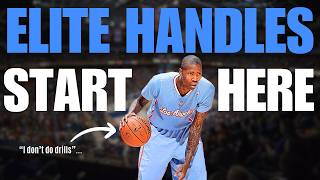
Ethan Khoza argues elite ball handling comes from constant casual dribbling and creative freestyles, not stationary drills. He uses Jamal Crawford as his example and recommends drills like "kill the grass" to train keeping the ball up with your body, treating traditional drills as backup tools for control.
Questions this video answers
Ethan Khoza
July 17, 2025
Jamal Crawford
Chapters
So if you don't know who this guy is right here, his name's Jamal Crawford. He's a former NBA player and he's widely known as maybe the best ball handler of all time. There's a million different highlights of him doing things with the basketball that you really haven't seen from anybody else. And he was in a documentary a couple years ago, and I just read the article on it where they asked him, what did you do? Like what kind of drills did you do to develop your handles? And he talked about how he didn't do any drills, he didn't use chairs, didn't use cones, because he felt like that wasn't going to prepare him to handle the basketball against 6, 5, 6, 667 athletic defenders, the type of things that he was actually going to see in games. Now, obviously, that goes against pretty much all of the conventional things that you've been told. If you want to become a great ball handler, you got to go do your 10 minutes of stationary ball handle. Then you got to do your 10 minutes of on the move, Then you got to work on this move and that move. And if you do that consistently every single day, then you'll develop elite level handles. But meanwhile, we have a guy who is one of the best ball handlers of all time, who talks about how he didn't do any drills. So in this video, we're going to talk about whether you should be doing drills, whether you shouldn't be doing drills. What's actually the best way to become an elite level ball handler? Let's talk about it. So Jamal Crawford was huge on the point that he didn't have any drills. There's no drills that he can give. You didn't grow up doing drills. He grew up having a ball in his hands a ton, working on moves against real defenders, working on stuff by himself, just building creativity. And he also talked about how growing up in Seattle, he always had a ball with him and Seattle in it's rainy, it's snowy all the time. And so he was constantly dribbling a basketball that was slippery and it was hard to control. And that also led to him developing his high level handle because he's consistently dribbling a ball that was less than ideal. When you look at the best ball handlers in the world, you look at guys like Jamal Crawford, you look at Kyrie Irving, you look at Steph Curry. The way that we can categorize the way that they handle the ball is it's instinctual. The ball is literally an extension of Their hand, no matter what they do with the basketball, they're going to have it with them. They can make any sort of move. They can go anywhere that they want. The ball is always there. So when we think about the main limiting factor or the main thing that prevents players from being able to handle the basketball at a high level, it's the inability to keep the ball up with their body. Which just means that, you know, you make a certain move or you try and go too fast, or you try and go this direction or change direction. That way you can't keep the ball up with you. You lose the ball. But. But the best ball handlers in the world are the ones who can literally move any which way they want to. High, low, changes direction, right hand, left hand, forwards, backwards, doesn't matter. And the ball is going to be stuck to their hand like it's glue. So I think the first thing is, if you want to be a great ball handler, reframe the way you even look at it. You want to go from thinking about, how do I become a better ball handler, how do I become a great ball handler? To how do I become an instinctual ball handler? I can move however I want to move, and I know the ball is going to be sticking to my hand every single time. That's where there's so much validity in what Jamal Crawford said here. A quick example of this is when I started training a little over six years ago, I was in the gym for three, four hours a day. I had a ball in my hands. I'd be dribbling around, whatever. And I start to notice after a few days of that that my handles just feel so much better. And it wasn't as if I was doing any drills. I just had the ball with me. I was just dribbling the ball around a ton and just doing that. Just having a ball in my hand and just messing around with it, whatever, for a few hours a day. Did so much for my ball handling because the ball started to feel like it was extension of my hand. I could move, however, and the ball was just there. You learn so many things instinctually just by having the ball a ton. So the first part of this is that if you want to become a great ball handler, dribble the ball more. And I don't mean do more drills. I mean when you go outside to get the mail, take the trash out, dribble ball with you, you walk down the street to go to your friend's house or, you know, to go and do whatever, dribble A ball with you. If you're just, you know, out and about and you're just hanging out, dribble a basketball, have a basketball in your hands at the very least. And just by doing it's going to become an extension of your hands and you're going to become a way better ball handler. This is something that I think a lot of players overlook because they think, I did my workout, it, did my ball handling drills, that's it, that's that, that's all I need to do. When in reality, if you want that ball to feel natural, it's really got to become a part of you. So I think that is one thing you can do. But then I think the other aspect of this is so important as well. Jamal Crawford talks about how he didn't do drills. He wasn't dribbling through cones, dribbling through chairs, he was dribbling against other players. He was just working on, on different moves, different freestyles, different combinations by himself. What that did is it developed creativity. You'll see the crazy in and out behind the backs that he does. Like the sort of stuff that nobody else is doing. That stuff he developed just by working on random things and doing different freestyles and trying out different things and imagining that he has a defender in front of him and exploring. That's how you build a level of creativity that's going to lead to you being able to get into games. And no matter how a defender guards you, you have a counter for it, they reach for it and you hit them with between the legs and then they recover and then it's a spin move. And you might not plan out that move that is simply a reaction to what the defense does. But you're able to react that way because you've built the ability to be creative and be a problem solver. And by utilizing different freestyles, you develop that problem solving ability that leads to having instinctual handles. I think that freestyles, if we think about drills, if we want to even call it that, I think are probably the most important thing that you can do to build a high level handle. There's a bunch of different ways you can freestyle. It can be super simple. It can just be a full court freestyle. You're just dribbling down the court, trying out different moves, stringing different moves together. I love a freestyle called kill the grass where you give a yourself a select area. So it could be like the paint could be the half circle above the free throw line and you're imagining that there's a blade there's blades of grass all throughout that area and you've got a dribble or step on every blade of grass while changing up your move, changing up your directions, changing up your speeds, doing that for 10, 15 seconds, three, four times and there you go, there's your freestyle or there's that freestyle for you. And doing that consistently is how you build that creativity and that ability to solve problems and to be able to react to whatever the defense throws at you. I also love crawl start freestyles and the reason that I love these is because we are directly training the ability to keep the ball up with your body. So we start in that crawl position where you, you're thinking about almost falling forward. Like if the ball were just magically vanish, you would face plant because that's how much of your body weight is leaning forward. And we're thinking when we get up to get into that freestyle, we're literally falling into it. You're trying to fall forward and catch yourself as you go. And we might start at the baseline and we're going to do that cross start freestyle all the way to half court where we're thinking about stringing different moves together but trying to go as fast as we possibly can to get to half court. When you do this, you're going to lose the basketball a bunch of times, you're going to mess up, you're going to look bad, but eventually when you do it enough, that's how you develop that ability to no matter how fast you're going, no matter what move you're doing, what hand the ball is in, you can keep the ball up with your body. And that is what it takes to be an elite level, instinctual ball handler. So I think those things are so important when it comes to becoming great. So just having the ball in your hands a ton, as much as you can be dribbling a basketball do, it doesn't be drills, it can just be literally you dribbling the ball around, making an extension of your hand, but then building creativity, building adaptability, building problem solving, building the ability to keep the ball up with your body by doing different freestyles every single day is a great way to be able to do those things. Now that being said, I don't think that we need to throw drills away because I use drills in my workouts with my players all the time because it's a great way for you to be able to build ball control. One thing I love doing are dribble manipulations where we're dribbling over a cone and that way we're working on literally being able to pick the ball up and place it wherever we want to place it. And that's a really crucial skill to be able to have. You want to be a high level ball handler, we'll work on getting to pocket poles off of that. We could pass out of it, change direction, whatever. But in my opinion, I think the most important progress you're going to make is going to be when it comes to the freestyles, when it comes to just having the ball in your hands a ton, making it a part of who you are, and then you supplement it by also doing some of those more traditional drills that you might have. So like it is with most things, I think the answer to this question lies somewhere in the middle. And if you want a step by step guide on how to become an elite ball handler, check out this video above right here. Let me know your take on this. What do you think about the whole drills non drills? What works best for you? Let me know down in the comments. Make sure you check out that video above. Appreciate you for watching. Talk soon. Peace.
More from Ethan

Stop Using One Dribble When You Drive To The Rim! (How To Become A Better Finisher)









