The KEY To Being A Great Player: Attacking Closeouts
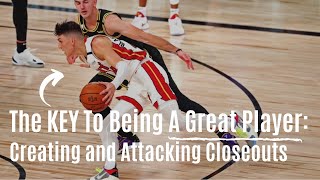
Ethan Khoza breaks down attacking closeouts: the split-second decisions players make when defenders rush them on the catch (shoot, fake, drive, or rip-through). The key is moving off the ball after kick-outs to corners and relocating to keep defenses scrambling, a habit that separates high-IQ players from the rest.
Chapters
Like knowing what I know now about creating closeouts, attacking them, going into open spaces, off the ball again, I think I would have been able to ascend into that role much quicker.
Yeah, I think going with that, like the concept of attacking closeouts, it's so funny to me how like I never heard that concept explicitly said one time in high school, like not one time did I hear any coach, any, any trainer ever mention to me, like, hey, the goal here is to create closeouts, find closeouts to attack. Like not only. So I didn't even hear the concept nor did I, like, I didn't hear it so I didn't consciously understand it. So I didn't. I missed so many opportunities. And it's so funny to like, I'll go back and like watch some of my high school films sometimes I'll be like, wow, could have scored there, could have scored there, could have drove right there, could have created a shot for my teammate right there. Like it's so funny. I'll go through, I'll look at like 5, 3 possessions where like I just, there'd be a closeout or if I, if I make one more pass, I create a close up for my teammate and they're going to have something to attack.
It's so true.
It's, it's so funny and it's like the, the understanding of like, I think that's where like to become a mature basketball player is understanding like how what, how, how one thing affects the next. So I might not be able to drive and get to the, get to the basket, right? I might drive and there's a dude who's six, eight in the paint. I might not be able to get all the way for a layup, but when I do that, that might cause that weak side health defender to collapse in. And then I create, I create a kick for my teammate right there. Either they have a shot or that's a close up for them to attack.
Right there and then boom, they're scrambling.
Exactly.
That's the thing about it is it's not just like, I'm sure I did have an understand I was still a knowledgeable like basket. I did still have a good amount of knowledge about basketball at the time. And definitely like senior year is what is when I started is when I ascended into that role, like being the ball dominant guy on my team and creating for others. So I did have some understanding of how to create closeouts and attack them. But, but what I understand now is it's not just about like what happens when you Attack the closeout like directly. It's what that, it's what, like the pat. You talk about the kick out pass or when the help side defender comes over, you kick it out to them. They, they also may not score, but like their guy has to close out, presumably very hard if they're, if they're even remotely a good shooter. And now they, they close out. You can relocate you. That's what people miss is you like a possession really like fizzles out when you've created a closeout, you attack it, you kick it out because you don't have a scoring opportunity. And the guy that you passed it to, like didn't create more opportunities for themselves or for other teammates. But you, after you kicked it out, you just kind of like walked back to the three point line, like, just not even. And then like the possession just kind of like dies, you know. Yeah, but what I started doing recently in pickup is I'm playing club basketball this year and we had a team practice a few days ago and we went 5 on 5 at one point and at the end of practice. And what I'm really good at, I'm honestly, my ball handling has gotten a lot better over time, but I still leverage my strengths. I still try and leverage my strengths. And I would say it's not a top strength of mine. My strength has always been my three point shooting. And so I need to leverage that. I'm a smart player, I know how to move off the ball. And so instead of, you know, go back into that situation where you kicked it out, let's say the weak side corner, or now the strong side corner is open. The guy that was guarding you that is trailing you because he closed out to you if you kick it like he's running. But once you kick it out, he, he often gets really relaxed. And so that's a really good opportunity for you to sprint your ass over to the corner. And hey, if the guy you kicked it out to doesn't end up scoring or doing anything with it, hey, now he has you in the corner wide open.
That's, that's the, yeah, that's the Steph Curry technique.
That's the Steph, like, that's literally what Steph is doing. And you don't have to be as good of a shooter as Steph is to take advantage of this. You can just be like a good shooter and everything else on your team can be a good shooter and you end up creating really good opportunities for each other.
One of the things that I'm big on now and this is like I first started talking about this concept with the high school team that I coach with now and but now something that I talk about with like all my players is 0.5 decisions. So this kind of goes with attack and close, green closes. Some people call it like zero second decision. But like how I just initially heard it was 0.5 decisions where when you catch the ball, like that's when you have to, you have to do something with the ball at that point. Like if you catch and you hold it for two seconds, then you, the advantage that you would get off of that closeout is gone for them. Unless it's a really, really bad defender or you're way more athletic than they are. So when I get that pass, when someone, my teammate drives and kicks out to me, I either number one is shot. Like you have to be at a point where you could hit that three, because you can't hit the three. No one's closing out to take away that three. So you limit yourself. So number one is that three, but then what? Okay, well if you don't have enough, quite enough space for it, then you have that a little shot fake which a lot of times going to get you that three or a mid range pull up or you might have a jab coming off it, or it might just be a catch and rip through right there. But it's like that's four options for you right there. And getting good at just understanding when to do that. Like that one situation when I have a closeout coming at me and I have those four options, can I get good at understanding when to do what? And that's something that I've been big on with with my players like playing that we can play it out of a one on one out of a two on two out of a little bit out of a three on three as well, where we're just like working on creating close ups to attack, right? And then eventually like again, I might not get the shot right here. I might, they might do a great job closing out on me. They take away the three. So I might immediately rip through and go and they might recover and the help might be there so I can't score. But if the help is there, that means somebody had to rotate, meaning somebody's open on the floor right now. So I might kick it out to the corner and that, that top defender might do a great job as that next like rotational defender. And then it's just swing, swing. And now my teammate at the top of the key as a wide Open three. And it's, it's again like you said, like understanding how one thing leads to the next and it's not always just going to be, you know, your shot. It's like, how can you create the best looks for your teammates and in response you, because maybe that, that pass happens at the top of the key. They don't have the three right away, so they drive again. Your defender has to help off. And now you have a wide open three. It's just like it's a cycle. It's a cycle.
I mean, let's say, let's say you kicked it out and the guy like the guy that is guarding the guy that you kicked it out to, he's just a really fricking good defender and he closes out really fast and he recovers. What are you going to do? Just let the possession fizzle out and like walk your ass back to the three point line from where you, from where you started? No, get your ass into open space. I didn't see this stuff like four years ago. And then I brought up the practice because, because a few days ago at the end, the guy that was guarding me was like, holy shit, dude, you're fast as hell. And I was like, dude, I'm not that fast. Like I, I in, in, in a. Say in the same way that guys that handle the, that, you know, ball dominant guys change speeds and, and change direction and change their heights in the same way that they do that shit. You can do the same shit off the ball. Like you can, like, how do you think J.J. redick gets all of his looks? He's not fast, but he does, he applies. Like, and it's a good thing we talked about movement because like you can there. Functionally. There's no real difference between like juking your defender with the ball versus without the ball.
Yeah.
If it ends in a wide open layup, it ended in a wide open layup. If it ended in a wide open three, ended in a wide open three. So, so you can do some of the same stuff off the ball. Like for example, you can kick the ball out and then like act like you're super relaxed and like you're just going to jog back to the, or backpedal back to the spot that you came from. And then you can. And then as soon as you sense that your defender is relaxed, immediately sprint your ass to the corner. Sprint your ass to an open space on the three point line. And that keeps the possession going in search for the best possible look that your team can get.
Yeah, I think, I think for players, that's one thing that they can do. Like, and immediately if you just start to become conscious of this, you're going to become like, so much more effective as a player. And it's not necessarily going to be, like we mentioned that you're going to score a lot more, but what it's going to make, it probably will lead to that, but it's also going to make you just a way better team player. So going back to the point of like, selfish versus unselfish player, players who understand this concept are unselfish players because they understand that, like, okay, the ball moves, it gets back to me. I create for my teammate, they create for me. When things are flowing, when things are moving, everybody gets touches, everybody gets shots, assuming that, you know, they can hit those shots. So one thing for players to do is just like, if you have access to your film, just look at opportunities. When closeouts come at you, like, go back and look and watch and see, okay, when my teammate kicked the ball out to me and that closeout came, like, did I make the right decision there? What could I have had? Maybe I didn't look to attack that closeout and had I done that, maybe the help would have been late. I probably would have got to the basket. Maybe the help was there, but it was really heavy help and I could have skipped it over to the corner. And once you start to really start to dissect things and like, try and project forward, like, okay, if I would have done that here, what, what, what, what would that have created? That's going to take the IQ that you play with to just a whole different level. And every coach wants players like that. So kind of talking, I think maybe, I don't know if you mentioned this in our conversation now or just through DMs, like, if you're, I guess, kind of to your, your point, like, when you're trying to just get established on your team and like, for me, definitely, like coaching a high school team, like, I can say this for certain, if you play the game of basketball the right way, there's going to be a spot for you, right? There's going to be an opportunity for you if I can put you on the floor. And I know that you're not going out there trying to ISO yourself and shoot up all these shots because you feel like that's what you have to do to make a difference. But you understand how to attack closeouts. You understand, you know, how to, you know, or why you should be looking to not Just score every time. Maybe your teammate is going to be open if you understand the concept of creating a long close up for your teammate to have as well. Like, you're going to make my entire team better. You're going to elevate everybody else on the floor. So now, regardless of whether or not you're the best athlete or you're the biggest or you're the fastest or whatever, you make my other players better. You make my point guard better. You make my, my big man better. You make my. At my, my player who is the best athlete. You make him better because of your understanding of the game of basketball. So just my challenge for players is just go look through your film and like, look at opportunities that you might have missed. Maybe look at opportunities if you did it well and see what you're able to create just by looking at those closeouts that you can attack. And I think that is just a game changer. Like, had I done that, I would have had, I would have recognized so many more opportunities when I was playing. And I'm, I'm, I'm sure that you, you feel the same way.
Look, it's crazy. Like, one thing that happens in high, this is specific to high school. So for any high school players that are listening to this, there's no defensive three seconds. So what often happens is the second line of defense, you know, the help defenders that are farther away, farthest away from you. Let's say you're on the top, at the top of the key and you guys are five out. What will happen is at least, at least one of the guys that are in that second line will creep way in. The guy in the corner is 15ft away from his guy. So if you even remotely have any ability to skip the ball to the corner, and if that guy is even remotely a good shooter, again, that you didn't have to do anything, you didn't have to set up any offense. You just passed it to them and boom, they're scrambling. Like, I go back and watch my film from high school and I cringe every time players like, don't see that. It's crazy sometimes, I'll admit, sometimes I did that. But I was a pretty conscientious player. Like I said, especially in my senior year. It'd be really confusing. Like, why the hell is the guy like, you just, you just crossed half court, dude, what the hell? You already skipping the ball to the corner. But, like, if you saw where his defender was when I did that, like, you'd be like, oh, my God. Holy Shit, obviously you do that if your goal is to. Because we do, we do have the goal of becoming the guy on our team. Let's just, I mean, let's just be real. Not to say that like you're just going to abandon moving off the ball and attacking closeouts completely, but you want to, you want to eventually ascend into the role of having the ball, you know, doing a little bit of isolation, going through some ball, going through ball screens. But part of doing that is getting. You have teammates. And especially if you're not the guy yet, and other people think they are, they're gonna. If you all of a sudden try to be the guy and like, try and chuck up a bunch of shots in isolation, you're immediately, I mean, you're losing credibility. But what you can do is do all the stuff we've been talking, Ethan and I have been talking about with, with regard to closeouts and moving off the ball. And now all of a sudden people will see that like, you're not you, you could shoot in those situations. It's not, but it's not going to come across the same way that shooting in, in, in isolations and like shooting heavily contested shots will, because at least you're making an effort to cooperate with your teammates, move off the ball and such and such. And so people, over time, the more you do that will believe you that you can become the guy. Because it's all about building credibility when we're talking about ascending into a bigger role. And so if you can start to apply that, if you're in high school, if you're. Or if you're even in middle school or something, man, you're going to shorten the amount of time that it takes you to actually put, put the things that you've been doing and training into games. The vast majority of people are working on their isolation skills and stuff like that.
More from Ethan

Stop Using One Dribble When You Drive To The Rim! (How To Become A Better Finisher)









