Tired of Training With No Results? Here’s the 90-Day Fix
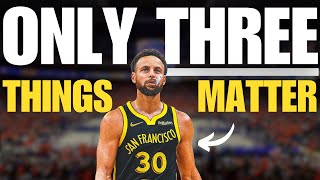
YouTube coaching video (Ethan Khoza) giving a 90-day roadmap to transform basketball performance by focusing on three pillars: (1) Strength & athleticism — get stronger via compound lifts, progressive overload, and deliberate jump/sprint work; (2) Shooting — spend ~80% of on-court training on shot-making with 45–60 minute focused workouts (100–250 makes) emphasizing quality, progressive challenge, and constraints to transfer to games; (3) Basketball IQ & mental toughness — daily study (10–15 minutes), film study and mental rehearsal to improve decision-making and emotional intelligence. The video also promotes paid programs (Elite Shooter System; Basketball IQ Academy / Basketball EQ Academy) as full curricula that extend the advice.
Questions this video answers
Ethan Khoza
April 12, 2025
Chapters
Right now, I'm going to give you the exact roadmap that you should follow for the next 90 days if you want to completely transform your game. But first, I want to give you some background and tell you exactly why you should follow this if you want to stand out and reach your goals. It's never been harder to make it as a basketball player than it is now. Make it can mean a whole bunch of different things. Whether your goal is to play professionally or make it to the college level or even the high school level, or your goal is just to get a bigger role at the level that you're at. You want to earn certain accolades or certain awards or achieve different things. This is the most competitive of the era of basketball at every level. And it's not just because of the sheer number of basketball players out there and the sheer amount of talent that there is, but it's also because there's never been a greater amount of high level training information and guidance available to you all the time. The problem with all that access, though, is that sometimes it can be really overwhelming and you can almost suffer from a paralysis. By analysis. I hear from players all the time who feel like they're being pulled in a million different directions. They'll see somebody say, do this drill, don't do this drill, and then see somebody else say that this is the best drill, and somebody else will say, no, that's the worst drill. Try this workout, do this program, follow this, don't do that. There's a million different things that you hear that are all conflicting advice. There's a quote from hall of Fame baseball player Derek Jeter where he says, I attribute much of my success in New York to my ability to understand and avoid unnecessary distractions. Reaching your goals isn't about just doing the right things. It's also about avoiding doing the wrong things and avoiding all the different distractions that are going to pop up and pull you away from doing what you should be doing. And that's why I want to give you this 90 day road map to follow to make sure that you're focused on the right things. You can eliminate distractions that are going to be roadblocks for you. And I wanted to make this as simple as possible. So I'm going to talk about the only three things that you need to be doing. If you want to make sure that you're making progress and you're not feeling overwhelmed with all the options, just make sure that the three things that we talk about are staples of everything that you do and it's going to guarantee that you're going to be successful and you're going to get a lot better and going with that. I'll tell you exactly how to implement this stuff throughout the next 90 days as well. The first thing you need to do is get stronger and get more athletic. If you can't match up physically, then you're not going to be successful on the court. And it doesn't matter how skilled you are, you're not going to be able to play if you aren't strong enough or you aren't athletic enough. A lot of people will push back on this and try and give examples of guys who aren't that strong or aren't that athletic. A lot of times people will throw the name Steph Curry around. Steph Curry is very, very strong. He's very quick. It may not be the traditional above the rim athleticism, but he is very athletic. And on top of that, it's also the best shooter of all time. So he' not an example that we're going to use. You've got to make sure you focus on getting stronger and getting more athletic. The best example of why this is important is if you look at the way that college basketball is going today, a lot of these coaches don't want to recruit high school players. They would rather recruit a 20, 21, 22, 23 year old player because they are more physically developed. They're also more mentally developed, which we'll talk about here in a second as well. But those coaches understand that your ability to physically handle yourself on the court matters so much. And that's why the game is skewing towards older players. So it's so important that you make sure that this is not a limiting factor for you. Now you can't do anything about your height or your natural athleticism, but if you're focused and you you do the right things, you can absolutely get way stronger and way more athletic. Now first of all, if you've access to a personal trainer or a strength coach, that's great. Make sure you make that a main priority for you and you really lock in focus on that. And if you don't have that, I'm going to make it super simple for you and tell you exactly how you should be training by yourself to make sure that you get stronger and you get more athletic and it ultimately impacts your on court success at a high level. I'll give you examples. If you have access to weights or even if you don't have access to weights, I'll give You an example of what you should do for that as well. If you do have access to weights or weight room, the number one thing that you should be doing is focusing on getting really strong at the compound lifts. These are just lifts involving multiple joints at once over upper body. It'd be like bench press, it could be shoulder press, pull ups, bent over rows, anything like that. Big movements incorporating multiple joints at once. And we want to get as strong as possible at those. For lower body, that could be like squats, it could be rdls, it could be lunges, and then focusing on a couple of isolation movements, which are just single joint exercises, to kind of supplement that as well. So for upper body, that could be like bicep curls, lateral raises, tricep push downs. For the lower body, that could be hamstring curls or calf raises or leg extensions. A pretty good schedule to follow is to lift upper body twice a week and lower body twice a week. So it could be upper body on Monday, Wednesday, and then and lower on Tuesday, Thursday. Obviously, you can adjust this depending on what works best for your schedule, but the general framework that I recommend would be about two times per week for both. Now, once you're pretty confident in your form in these compound lifts, you want to start to try and challenge yourself with the weight you use or the reps that you have. So every week you want to try and lift a little bit heavier, add five more pounds to your lift, or two and a half more pounds or whatever it might be, or you can try and do one more rep at that same weight. Because we want to put ourselves in progressive overload, which just means that you're forcing your muscles to adapt and get stronger because you're challenging them with a new stimulus, which would be more weight or more reps. Along with that kind of throwing core into the mix, I love using like an exercise ball and doing rollouts, or you can use an ab wheel and do roll outs with that. That's a really good way to train your core as well. And I would do this probably two or three times a week at the end of any of these workouts. Now, that covers our base when it comes to getting stronger and when it comes to building athleticism, keeping it super simple. Two to three times a week, you want to work on jumping as high as you can and running as fast as you can. Now, we want to do this in a smart, purposeful way, though. So what I would say for jumping is you want to spend probably about 10 minutes working on jumping as high as you can. This could be off of one foot, off of two feet, it doesn't really matter. The simplest way to do it would be go and work on dunking. If you can't dunk and you can lower a rim to 9ft, 8ft, go work on dunking on that rim for 10 minutes and go do a dunk. Give yourself 20, 30, 40 seconds to recover enough time that you feel like you can jump about as high again. And then go and just work on jumping as high as you can. And it's even better if you can use it, Duncan, because it translates a lot to basketball. Another simple way you could do this would be if you don't have an access to a hoop that you can lower, is just working on running up with the ball and getting as high up as you can on your layups. All that you're worried about is jumping with max effort. You can also do this without a basketball and just work on jumping and trying to touch as high as you can and then every week trying to touch a little bit higher. So like I said, doing that for about 10 minutes, you do a jump. Give yourself 20, 30, 40 seconds of a break in between. Go your next one, 10 minutes or over. You'll probably get through anywhere from 10 to 15ish jumps in that time. That's good. Do that two times a week. And then you also can work on your sprinting. Take about the distance between the baseline and half court, and all you want to do is focus on getting to your top end speed. So sprinting at 100% speed from baseline to half court, and then you want to give yourself a long break. We're not sprinting as if it was basketball practice. And you're trying to work on conditioning, we're trying to work on your top end speed. To do that, you need to give yourself time to recover in between each. So you give yourself a sprint. Maybe you give yourself 45, 60 seconds as a break. Again, once you feel like you can get back to that top speed and you want to go through maybe five or six sprints, and that can be your sprint training. You do this consistently week after week, you're going to be able to jump higher, you're going to be able to run faster, you're going to be a better athlete, and on top of that, you're going to be stronger as well, and that's going to translate to better performance on the court. Now, the second thing you need to do over the next 90 days if you want to transform your game and move closer towards being the Player that you want to be is spend 80% of your on court training time focusing on shooting. Now, this might seem like a hot take, but I really don't think that it should be. For probably 90 to 95% of players, the majority of the time that they spend training needs to be on shot making. If you get really, really good at making catch and shoot threes, you're going to be valuable on the basketball court. Now, on top of that, we can work on catch and shoot threes, we can work on one to two dribble pull ups, and then we can work on making shots in transition. Anything else that you might want to deviate and add to that is fine. Depending on what position you play, what shots you normally get in a game, you can feel free to tailor that to you. But the game, basketball is putting the ball in the basket and it's about shot making. So this needs to be the biggest priority for you. My general recommendation is that if you're really focusing and you want to get better at ball handling, you want to get better at finishing, that's great. That should be probably 10, 15, maybe 20% of your workouts. And then if you really want to get good at those things, like I talk about all the time, go play more, play more, one on one, more five on five, more three on three, and then focus on doing those things. So focus on driving to the rim more and working on your finishes. Focus on handling the basketball more and trying different moves and handling pressure or whatever. That's how you get way better at that stuff. And then the bulk of your time though, when you're training should be on putting the ball in the basket. Now let me give you just a couple tips for training your shooting to make sure that you get the most out of it, and then it translates to you actually making more shots in games. Number one is that there's no magic number when it comes to the amount of makes or the amount of shots that you should be shooting in a workout. A lot of players will throw around 500 shots or a thousand shots. And so they go to the gym for four hours and try and make their thousand shots. And then they wonder why they get into games and they start shooting any better or they start shooting with any sort of consistency. And that's because a huge mistake that you make is placing quantity over quality. The quality of your shooting workouts, of your shooting drills matters way more than the quantity of shots that you get up. In my experience, the best shooting workouts are about 45 minutes to an hour long. And a general rule of thumb is that a solid shooting workout is going to have anywhere from 100 to 250 makes in it. The reason for this is because you can go hard for 45 minutes to an hour. The problem is that when players are the court shooting for three to four hours, you're not going hard for all that time. So a lot of those shots you're shooting are just wasted reps that aren't going to translate into the game. So keeping your shooting workouts to generally about 45 minutes to an hour, 100 makes to 250 makes, is going to make sure that all the reps that you get, all the shots you take are purposeful, therefore, are going to translate way better to games. And the second tip I have to make sure that you're shooting workouts transfer into games is to make sure that you're challenging yourself. If you want to see improvement in any skill shooting for sure, that you need to force your brain to adapt. Much like we talked about in the getting stronger part of it, where we're trying to add weight or reps every single week, we want to add challenge to our shooting drills, to our shooting workout, so that once your brain gets accustomed to a certain thing, you give it another challenge, you make it a little bit harder, and that forces adaptation, which is the entire process of building skill. Now, what that could mean practically is that simple as it gets, you need to make a certain amount of shots in a row. Now all of a sudden, you're putting pressure on yourself to make shots, and that adds a layer of difficulty. Or you could say you have to go three for five or four for six or five for six, whatever. But giving yourself a challenge to have to meet adds pressure, adds challenge. But it's going to allow your shooting work to translate way better into games. We can also add challenge by using what's called constraints, which is just a fancy word for saying that you're going to add purposeful challenges to your shooting drills. You can do this by working on shooting shots where your feet are a little bit off or they're not perfect. Maybe you shoot a little faster than you normally do, or you shoot from farther away, or you shoot off of a bad pass. There's a bunch of different ways you can add constraints to your shooting drills to force yourself to improve, to give yourself challenge. Challenge. Generally, we want to put ourselves in the goldilocks zone, which just means that we only want to be succeeding about 30 to 70% of the time. So if all of Your shooting drills and workouts have you making 80, 90, 95% of your shots. There's not enough challenge there to really force adaptation and you're not going to be getting better at the rate that you probably could be. But if you were to add some of these things to your workouts and you maybe miss more shots because there's more challenge, that's actually going to help you to improve more and it's going to help that work to actually translate way better into games. Now, if you want a full shooting program that checks both these boxes for you, gives you really purposeful shooting workouts, helps you to add challenge, and ultimately gives you the exact steps to follow, that's going to help you to see this work translate into in game, shot making, consistency, confidence. Check out the Elite Shooter System, which is my full shooting program. That's going to be linked down in the description below. And the third thing you need to do over these next 90 days if you want to transform your game and you want to reach your goals, is you need to become smarter and more mentally tough. The number one thing that separates the players who make it from the players who don't is basketball iq, decision making instincts and mental toughness. And none of what we've talked about so far even matters if you don't have this down. Back to what I mentioned a little earlier about college coaches choosing to recruit older players instead of kids out of high school. A big part of that is because they're proven, they're proven mentally, they're going to have a higher basketball IQ because they've done it more. They've proven that they can handle tough coaching, they can handle practices, games, workouts, all the stress that comes along with that. And so it's much easier to trust players and give them opportunities when they have basketball IQ and they've proven that they have the mental toughness to handle what comes along with the game. And those coaches know that those things matter way more than just the physical abilities do. So they give those players scholarships, they give them playing time as opposed to a younger player or an unproven player who they don't know that about. Rick Pitino from St. John's even talked about how he probably wouldn't take a five star kid at a high school this year because they aren't going to be able to replace what he's lost in some of his older players. And this is a huge part of that. Now the good thing is developing your basketball IQ is actually quicker and a lot simpler than developing the physical skills that we've talked about. The first thing is you need to study the game. So watch a ton of basketball. I recommend watching college basketball in the euroleague primarily because I think you're going to get get the most pure basketball out of that. But watching the NBA can be really good as well, especially if you're watching specific players or specific situations. You have to study and learn the actions and the concepts that the game is built on. You need to study and learn the decision making that takes place within those actions and concepts. Watch how the best players maneuver themselves in different situations, watch their decision making, and then mentally rehearse how you would respond in those similar situations. Now, even spending 10 to 15 minutes a day doing these things right here is going to set you apart from 99 of players who don't do that. All they do is their physical work and then they go home and don't even think about it. And then they wonder why they struggle on the court when it comes to understanding the game and having a good feel and making good decisions and being able to play with consistency. And it's because they're lacking this part, which is why I said already, if you don't have this, the other stuff, the physical stuff doesn't really even matter. Now. The best part about all this is that developing basketball iq, great decision making and mental toughness is the most controllable thing that you have. And it's going to get you on court results the fastest. Scoring is going to become second nature for you. You don't have to go out there hoping that you play well or hoping that you have opportunities, because you're going to be able to recognize opportunities and you're going to know exactly what decision to make to take advantage of it. So you're going to be a way more consistent player. You're going to start to attack every situation with aggression, with confidence, because you've studied it, you understand it, and you know the right decision to make. And you're not only going to create more for yourself in terms of scoring and opportunities, but you're going to create more from your teammates by being a high IQ player. And that's how you become a player that coaches have to have on the floor, they have to have on their team. And if you're trying to make it to that next level, that's how you become a player that coaches need to recruit and need to find a way to get on their team. And then maybe the most underrated part of all that is that it's going to teach you exactly how you need to train and what you need to focus on in order to make sure that you can perform like a high level player. So like I said, spending 10, 15 minutes every day just studying different actions and concepts, steps, Studying decision making of great players in different situations is a great way to set yourself apart. And it's a super simple habit that you can adopt over these next 90 days that's going to completely transform the way that you think about the game. When you transform the way that you think about the game, your results and the way that you play are going to be completely different. And you're going to be really glad that you spent time and built that habit over the last 90 days. And if you really want to take this to the next level, I have a resource that's super simple and it's going to help you to transform your game even more. I created Basketball IQ Academy and Basketball IQ Academy is my full program that's going to help you develop an elite level of basketball IQ that you need to be a successful player. I made it because I saw a huge lack of this and there really isn't anything else out there that is built for players to walk them step by step, how to read the game, how to make better decisions and helps give them the deep rooted understanding the best players have. And not only is going to help you learn the details of the game, but it's going to help you to become an elite level decision maker and a confident playmaker on both ends of the floor. And on top of that, Basketball IQ Academy comes with two bonuses. We have a full program that's built just to help you develop the confidence needed to step on the court and have an unshakable level of self belief every single time. It helps you develop that belief that you're not going out there just hoping to be successful. You go out there and you know that you are going to be successful because you know the right things to do and you know exactly how to respond when things get difficult or when you don't succeed right away. It'll transform your confidence and help you to play under pressure at a really high level. And then the second bonus is called Basketball EQ Academy. And this is a full program on how to develop the necessary emotional intelligence to handle yourself on the court. In this day and age, emotional intelligence is lacking, especially among basketball players. If you develop this, you completely set yourself apart. It's going to help you to become a better competitor. It's going to help you to be able to handle adversity better, you're going to be a better teammate, and that's going to translate directly to on court success. It's everything that you need to dominate on the court and reach those goals that you have for yourself. So click the top link down below if you're interested in that. Like I said, today, I want to just give you a roadmap of three things to focus on the next 90 days. Eliminate all the distractions that are getting thrown at you every single day. And like I said, I promise you, if you just focus on these three things consistently every single day, you make it a habit. You're going to look back in 90 days and you're going to be a completely different player. So hopefully this helps. Like I said, if you're interested in BasketballQ Academy or the Elite Shooter System, you can check those out right down in the description. Appreciate you for watching. Talk soon. Peace.
More from Ethan

Stop Using One Dribble When You Drive To The Rim! (How To Become A Better Finisher)









