Why Basketball Players Should Play Capture The Flag To Improve Their Ball Handling
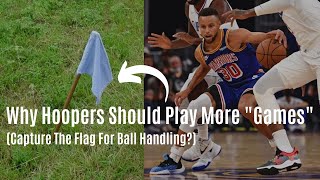
Ethan Khoza and Cole argue that capture the flag and tag build the deceleration and change-of-direction skills that transfer to basketball ball-handling. They critique early specialization and point to Kyrie Irving and Steph Curry as players whose movement quality enables advanced ball skills.
Chapters
There was a tweet that you tweeted, I think it was last week, but it kind of goes with this and actually something that I wanted to ask you about, and you said, you guys ever play capture the flag and feel yourself making moves and reacting in ways you've never done before? I believe this has legit implications for ball handling training. And so this is like. I kind of want to get your, like, your thoughts on. On this, because I definitely have my own. But I think this also goes back to, like, this whole. It's so funny because it's like a. It's like a whole wormhole you can go down where, like, it starts with, like, oh, it's just bad. Like, okay, I want to get better at basketball. Well, what does that actually entail? And what can you actually do to. To move yourself in the right direction? What matters? Right. So kind of talking about how, you know, those other games, other sports, working, other movements, how do you see that kind of impacting basketball players, specifically?
Yeah, the. The. So that's one thing that Cole has been talking about a lot on his. On his. On his Instagram. For anybody that's not familiar, it's by any means basketball. And he's talking about, you know, getting understanding the individual puzzle pieces that go into forming the whole puzzle. These are. These could be, you know, physical qualities or perceptual cognitive abilities. Anything that encompasses a skill that we can pretty easily define. So, like, if we talk about ball handling, you know, since you mentioned ball handling in my tweet, we could be talking about, you know, I mean, it's so many different things. Ankle mobility, hip mobility. These are physical qualities. Being able to produce force horizontally, so being able to access, you know, steep shin angles. There are all these physical qualities. But then there's like, as a ball handler, reading how. How heavy the defense is helping, where the help defenders are, and that can inform a lot of decision, a lot of your decisions. As a ball handler, am I going to drive, or does it make more sense to create an outside shot? I came up with capture the flag, and I'll talk more about what I was thinking about in a bit. But, yeah, just using all these games and different sports to develop general physical literacy that once applied to basketball and actually, like, explored with, will eventually translate, hopefully, to basketball games, real basketball games. And. And there's nuance. Like, we could talk about how much, you know, certain physical qualities, how much transfer certain physical qualities have over others. There's definitely a spectrum, but in that way, I found Cole's Presentation really interesting. But the capture the flag thing, I mean, I was just thinking about it, like, I'm sure you've done this. You've played capture the flag, and you're waiting for a little bit to seize an opportunity, and then you finally decide, boom, I'm going to go. And like, you know, you run and you have a little bit of open space, but then eventually defenders see you, right? Everybody sees you and they're trying to get you. And you don't have a ball or anything. You don't have anything limiting you from moving. It's just you, your body, and the people that are trying to stop you from getting to the flag. And you end up doing the craziest shit with your body.
Like.
Like, just like changing speeds, like, being super deceptive, like, using your eyes to deceive people into thinking you're doing one thing and doing another thing. These are all qualities that we need within the game of basketball that, like, I feel like if we went back to a little bit, players would find it engaging and fun, but we're actually building qualities that are applicable to the game of basketball.
Man, bring me back to those middle school days. Do we used to play capture the flag, like, at the end. At the end of every day? And it's exactly what you're talking about. It's like you don't realize, like. Like how almost how limited players have. Like, a lot of players have become because of how early they specialize in things. You got kids who are, like, by the time they get to, like, fifth grade, they're just basketball players. And they're not really out there. Like, they're not out playing with their friends every day, right? They're not out. And I think. I think Covet definitely made that worse where you weren't out just like, you know, with your friends every day playing, you know, football, playing capture the flag, playing, you know, know, whatever. Whatever sport you might play in your neighborhood. Like, that was stuff that I always remember doing growing up. And it has such an impact. And I think, like, one of the things that. One of the connections that I think players should make when they took. When they think about, like, okay, how do I actually become the best player I can be? And I think, especially for coaches, like, if I'm going to be teaching somebody, like, let's take ball handling, for example, right? If we're going to work on ball handling, it's. We're working movement because we're gonna have to. We're gonna work some different stops, right? If we. If we Work like a snatch between the legs. That. That can be considered ball handling. Right. But it's more so a movement. Right. I'm learning how to stop, how to. How to accelerate, and then decelerate. And then maybe out of that, I have to learn how to decelerate, change directions, and then accelerate again. Right. That's all movement right there. So, like, one thing that. That. That Mike G. At the conference was showing us was tag and tags. Like, my new favorite thing now, like, because it's literally working those exact same things where we're working a bunch of different stops, right? They don't even understand, like, I put, you know, I put two players in. Like, I give them a circle to chase each other around. One of them is. One of them is it. One of them is not like, they're chasing each other and they're working those different stops. They're changing directions, decelerating. And again, especially if you don't have a ball, there's nothing limiting them. So they're just be able to work on those movements over and over and over again, um, and get comfortable with them. And then at the same time, we can talk about. Okay, now we're working in curved angles as well. So you're able to work that. That puzzle piece, which isn't something that players work on a ton. It's usually. It's just straightforward or maybe straight to the side, but it's never at that curve. So now we're working a couple of really underdeveloped areas, especially with my players that I work with who are just basketball players who are just doing the same exact movements over and over and getting really good at some of them, but neglecting a lot that they don't get because they don't play football, they don't play, you know, baseball and play soccer. Right. And so I think that's something that's. That's really crucial to understand is like, as a skills coach, like, you teach movement. Like, you also are a movement coach. Whether or not you. You recognize that, like, that's what you are. If you do anything where your players are movement, you teach movement. So you should understand how to effectively do that. I think. I think doing that through games is a really, really great way of applying that. I just started. It's actually funny, I was thinking about this when I saw your tweet. I just started up a clinic series for some middle schoolers in my area, and I was actually talking to my mom about it last week. She was asking me, like, oh, you know, what are you guys going to do for the first week. And she, like, my mom is not. She's not like a big basketball player. She's not. She'll show. She's at every game growing up, but she doesn't really, like, know the game or understand, like, the details of or anything like that. And certainly nothing when it comes to the training side of it. Like, that's not her wheelhouse at all. Like, not at all. And she. She had mentioned something just like, kind of as a joke. She was like, oh, so what are you guys going to do today? You guys going to play soccer or something? And I was like, probably not today, but maybe next week. Like, we might play soccer next week. Because it's literally like those are like that. Especially at that age, I think, just working different movements and then building that engagement. Especially if we start off and it's like, hey, guys, only five minutes of soccer right now. All of a sudden, the monotony of, like a normal training session, like, that's gone. Because they're like, oh, we're playing soccer now, right? So that, I think, is another element to that. And that was why I loved Mike G's presentation at the conference where he talked about prime time and just being able to build engagement through different games. Because that actually makes it a more effective session if you take 5 minutes to play a game. But it's going to make the remaining 55 minutes of your session really, really high quality. And also that those five minutes are going to work movement patterns that are going to make your players better. And move is a. Probably never going to hit anytime else. Well, why would you not do it? And so that was something that I really, really got from that. And I think when you look at players like Kyrie Irving or, you know, anybody else who moves well, we look at these guys with the handle the ball. Steph Curry is another one, or like, whoever that you can think of that, like, is crossing people up and finishing with all these acrobatic ways. Like, I think a lot of people overemphasize the basketball side of that, and they say, oh, he's so skilled. He's so. There's. He's so good with the ball. But they don't look at the movements that allow him to actually be able to do that. Like, if Kyrie Irving couldn't. Didn't have his ability to decelerate the way that he does that, if he couldn't play at those, at those angles, at those shin angles that he plays at, then he wouldn't be nearly as effective. It wouldn't matter how. How tight the ball was, how tight his handle was, exactly how much spin he could put on his layups, it wouldn't matter because he doesn't have those general qualities first. So I think, again, going back to, like, kind of the first one that I brought up is, like, as a skills coach, understanding the performance side and movement side, like, that's, that's the future because that's where you can really start to build the player as a whole.
Exactly.
More from Ethan

Stop Using One Dribble When You Drive To The Rim! (How To Become A Better Finisher)









