Why Hard Work Always Pays Off, Athleticism vs. Skill, and More with Juice Made Hoops - Podcast 31
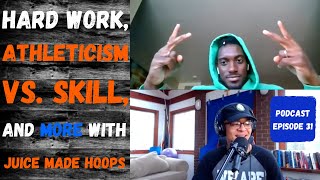
Transcript of a YouTube podcast episode (episode ~31) featuring Ethan Khoza interviewing Hassan (Juice Made Hoops). The conversation covers Hassan’s background (Fort Worth, track runner, college experience and injuries), his YouTube channel, and an extended discussion about the benefits of multi-sport participation (especially track) for basketball athleticism, injury prevention, and training approaches.
Chapters
Foreign. Welcome to the Visenger Battle training podcast. Thank you guys all for tuning in. Very special episode today. I think this is episode 31 if I'm. If I'm not mistaken. And today we have our first guest. Super excited to get him going. Actually. I learned about his channel a couple weeks ago. He commented one of my videos, so I went over it, checked out his, his channel, thought it was dope, really cool what he was doing, the type of content he's talking about. He talks about a lot of stuff that I've kind of touched on, but I haven't gone quite as in depth as he has with it. And so I wanted to, you know, reach out, kind of try and get him on, just to kind of get his view on a couple of things. And you know, obviously this being mostly a solo podcast, I think there's a lot of times I'm always kind of focused on that basketball training sort of, sort of, sort of category. But I think there's a lot of stuff outside of that too that, that we can talk. Today's episode be a little bit different, but I still think very, very valuable. So I want to welcome my guy Hassan from Juice Made Hoops to the podcast. Appreciate you being on, bro.
Thanks for having me, man. This is definitely cool. Like I, I found your channel about a couple weeks ago too, and then I was like, he kind of talks about and looks at the same things that I look at when I'm looking at players and stuff. And I was like, got a collab or something, man, you know.
Yeah, for sure, for sure. Yeah. So first of all, guys, and I'll of course I'll mentions too as well if you guys are on YouTube. I'm have a link to Hasan's channel as well. Juice Made Hoops. And so his, his focus is really a lot on like the high school game, like, and kind of highlighting those players and which again is something that I've talked about a ton of you guys watching in high school or will be in high school. And so of course I'll link down to that. So go ahead and check him out. But there's a lot of stuff I want to talk about, but before we get into that, you know, we were talking a little before, but how about you give them a quick kind of intro on you, you know, your kind of background, basketball, athletic related, and then obviously, you know, kind of what you're doing now, your channel and all that stuff.
That's the pretty much my channel called Juice Made Hoops. It sucks on basketball. I Started about like last. Last year of 2019, February. And since then I've just been grinding doing that. But just like a little bit about myself. Like I said, I'm from Fort Worth, Texas. Grew up in Fort Worth my whole life. I grew up playing basketball. But once I got to like middle school, high school, that's when I started focusing more on track. Just cause like I'm shorter and I just know how harder it is, like if you're a shorter basketball player, like trying to make it to college, NBA, stuff like that. And then once I got to around 11th grade, that's when I just. I just completely stopped playing basketball and that's when I just started focusing on track. I ended up going to state my senior year. But like I was saying in my Q and A, like I honestly regret quitting basketball just. Cause like, you know you're never gonna get those memories like ever again. You know you're never gonna get those memories like ever again. You can't go back and make memories and stuff like that. So yeah, I wish I went to play basketball again. But then once I got to college, that's when I started focusing more on YouTube and then just been grinding. Now here I am.
Yep, gotcha. Yeah, no, you're right. Like there's. There's nothing like high school basketball like college basketball. It's fun. Like so you know, I'm out in State college, so I go to Penn State basketball games now. We're not really the cream of the crop in the Big ten, so like we don't get that many people at our games. But like even still, like, the atmosphere is awesome. And NBA games too, like they're awesome. But like high school games where like you're packed into a small gym, obviously with COVID like that. Not anymore. But when you're all packed into a small gym and it's like, you know, you're just playing like all your friends are in the. On the stands, this your whole community that, you know, like, it's just something real special about that.
Yeah, but you got your team, your classmates just cheering you on.
Yeah, yeah.
Like, there's just something about the atmosphere. People just. I don't know, it's just cool. Going to away games and setting the crowd up and stuff. It's just like so much better, honestly. Like.
Yeah, yeah, no, I. I'm with you on that one. So kind of going along with that. And I mentioned this before we started recording here, but. So you said. So you. You were a big tracker. So what did you. What did you run in track?
I was a 400 meter runner, so pretty much just like one lap around the track. That's what I did. And then I ended up going to. Like I said, I made it to state my senior year and then I ended up going to run at Tarleton State. I don't know if you guys heard of it. It's a D2 school in Texas. Ran there, ran my freshman year and then after, once I started my sophomore year, that's my. Tore both my hamstrings. And then I transferred to the school. I'm unt right here. Transferred there. And then first I was going to practice stuff like that and then I kept getting hurt and I just had to just stop, bro. I just had to stop. I couldn't do it anymore because that was just too much on my body.
Yeah, no, it's, it's. Yeah, it's, it's weird how all that stuff works out too. Like, you know, with like, for me. So I wasn't. My sore. Wasn't as much injuries, like, you're. Obviously you had that injury. But for me, like, basketball was like my whole entire. All I did throughout high school. My first year after I was. I was gonna play Division 3 basketball going into my. My freshman year of college. Ended up just taking a gap year because that whole thing sort of fell through. And then I was trained that whole year to get back the next year. And I had actually, by the end of that year I had more offers to play at the D3 level and I had some juco opportunities. And then that ended up just being not an avenue I was going to take. And then at that point it's like, man, what are you going to do? But then like, you know, I was training a couple guys just like, you know, I was coaching a basketball team. So I had a couple parents asked if I could train their kids. I was doing that and then I had someone tell me. They were like, hey man, you should like, you should start posting stuff like on Instagram or on YouTube. Like, that's like, you know, you might be able to get more people to train with you. That was originally how I started it. And then I was like, wait a minute, I can reach so much, like so many more people doing YouTube and Instagram. Like, I can, I can literally have thousands of people watch my stuff, millions of people watch my stuff. And I can reach, I can reach everybody through that. So it was, it was cool. It goes from like, you have your first dream, right, of like doing this. I'm sure you Were like, you wanted to go to. You want to go to the national? Yeah, of course. You want to reach the highest level. But then it's like that, like, things change and like, I look at where I'm at now, I'm like, different. Yeah, yeah, exactly, exactly. So, you know, that's kind of. That's kind of, you know, where I'm at. So you're still in school right now?
No, I actually just graduated from unt. About my degree and everything.
Okay, got you. Gotcha.
But just touching up on, like, what you're saying, like, that's why I just always look at everything as a blessing, you know, everything happens for a reason. Now if I got hurt, you know, I can be mad about it, but I know that God has like a better plan for me in the future. So that's just how I look at everything. So I'm not really, like tripping on getting injured and stuff like that. Of course I wanted to reach those goals, but, you know, I'm happy where I'm at now, honestly.
Yeah, yeah. That's facts, man. So kind of touching on. On track, which. So would you say, like, would you say that running track? So obviously you said you didn't play, like for your team in high school, but just, you know, when you're out playing, you know, pickup or whatever, like, do you feel like your experience training for track, doing that, do you feel like that affects you basketball wise, like, positively or negatively?
Yeah, I think it affects you positively. Like, I genuinely believe every single basketball player should run, should run track. Like, if you don't want, if you don't want to go to the meets, running meets, at least go to the practices because it helps you with your footwork like this, the stuff that we train for helps you with your jumps. We work on explosiveness to come out the blocks, which allows you to jump higher. In basketball, it increases your stamina. Like track, I feel like, is something that everybody should run. Not even if you're just basketball, like football, gymnastics, softball, like any sport, like track is only going to benefit you. I don't know how it would impact you negatively. So, yeah, I definitely feel like it helps me a ton. Like I'm. Every time I play pickup basketball, like I open gyms or anything, I'm always someone that's like, just never tired. I'm faster than everybody, I'm quick. So, yeah, I would definitely, I feel like everybody should definitely, definitely run track. For sure.
Yeah. Yeah, that's, that's. And that was onto what I expected you to say. About that. Um, and I feel like with. With track, there's a lot of people. There's a lot of studies that are done on, like, athletes kind of specializing in a sport really early. Uh, so, like, a lot of kids, especially now because things are so competitive, like, everyone's playing AAU by the time they're 10, 11 years old, so everyone's playing basketball year round. So a lot of kids will just not play other sports. Like, for me, like, I played football until I was. I. I think I was like eighth or ninth grade. And like, so I was playing a couple of different things. And once I got to high school, then I really stopped. And I do kind of wish that I would have done some other stuff, but I just. For me, it was like, I was just so basketball focused that, like, I couldn't commit to doing anything else. But, like, I know there's a lot of players who all get questions from. They're like, hey, like, is it bad if I play football too? I'm like, no, like, it's not bad.
I think people, kids should do multiple sports. Like, I feel like each sport helps you in a different spot in a specific sport that you're trying to focus on. Yeah, I would definitely recommend everybody to just do as much sports as you can. Be smart about it at the same time, like, make sure you're still focusing on your main sport, but just trying out different things. You know, like, at the end of the day, it's going to help you out.
Right. I think too, like, a lot of times people talk about, like, overuse injuries and stuff like that, because kids will play especially at a young age, like, they'll be playing the same sport from the time that they're 10 years old. And that's all they do. So all they do is train for that sport. All they do is play that sport. So kids are like having these major injuries when they're 16 years old, like 15, 16 years old, because all they do is one sport. So their body is taking that same stress over and over and over again. So kids are, you know, have these major injuries really, really early on when they're barely even in high school. And it's like, is it possible that that can be avoided by, you know, playing a different sport? Or I think if you're, if you work with a good, like, performance trainer, like a guy who knows what he's doing, who's like, okay, how can we, how can we switch up your training to make sure that we hit a ton of different injury prevention stuff a lot of people ask me like, and it's so funny because people ask me about vertical jump all the time. And like, I'm like, guys, like I probably, honestly, probably multiple times a week I'm like, guys, you've never seen me jump. Like you don't know if I can jump or not. Like I might be the worst jumper on earth. You just do. So I'm a basketball guy, right? So he has to go to dunk. No, that's, that's not how it works. So I always recommend a guy, PGF performance. I don't know if you've heard of him before.
Um, I don't think so.
Paul Fabric, he's like one of the, like, he's probably one of the main guys with like performance training with basketball. And he's like, in my opinion, he's, he's maybe the best at it.
Um, and like the vertical stuff.
Yeah, yeah. But it's like. So he has a program called the vert code and it's called that, but it's really more of like an overall athleticism sort of thing. So like you're working on force, absorption, deceleration, the obviously your vertical is impacted, but it's more so like all the other aspects of it because kids will just think like, oh, I'll just go jump as much as I possibly can and that'll just make a better jumper. For some people that works, but for other people it's like, that's one aspect of basketball, right? Like you also have to be able to move like change directions quickly. You have to be able to take impact. People talk about like Derrick Rose when he, when he kept getting hurt. It was like, it wasn't even about his, his cuts or like his jumping, but it was about how he landed from those jumps. So like, are you able to absorb that force when you land as well? So that's why it's a really all encompassing thing which actually I'm doing right now. So when play players ask about that, I'm like, I just refer them to him because I think there's so much that goes into being a good athlete and it's, you can't have like a small, like a narrow sighted focus on what it actually takes. But oh, I want to jump higher. So I'll just, you know, I'll do a million depth jumps every single day. But, but it's like, is that, is that really going to be the healthiest going, going forward for you? That's, that's always kind of my, my thought on that.
But so yeah, I look at the same thing. But I will say, like, I would only focus on one sport if, like, you're really, really good at it, honestly. Like, if you're like, maybe top 100 in the nation or something, that's the only time I would say focus on one sport. Honestly, other than that, then I think you should just play other sports, too.
Yeah, yeah, yeah, yeah.
It all goes back to training, too. Like, what you're saying with jumps and stuff. Like, at the end of the day, like. Like, you just have to focus on. Focus, make practice, game. Like, you know, like, maybe Derrick Rose did get hurt because he wasn't training hard enough on landing the right way. You know, doing those power, clean, specific things that will make him, you know, be able to take the contact whenever he's falling down. But there's just different things you can do. I feel like.
Yeah, yeah, absolutely. Yeah, I think. I think that's a major thing. But that was. That was. So when I watched your video about, about track, I was like, this is awesome because, you know, guys are so focused, and, like, I was like, this guy's so focused on basketball, basketball, basketball. But it's like, there are other ways that you can develop yourself and. And become better player. Because I think athleticism has such a major impact on basketball and like, all. So, like, when I'll listen to coaches talking, like, I'll talk to other coaches, and they'll be like, listen, like, you know, there are guys who are really, really skilled, but the first thing we have to make sure of is, is he a good enough athlete to compete at our level. Like, if you aren't a. If you aren't the D1. And there's so many kids I know like this that I played with. Like, I'll even say, like, of the top five players I've played with in my life with or against, the top three of them are playing D1 right now. So one's at Princeton, one's at Delaware, and one's at St. Francis. Then the next two are both D3 guys, and there are D1 guys that I played against that are lower on the line.
More from Ethan

Stop Using One Dribble When You Drive To The Rim! (How To Become A Better Finisher)









