Why I’m Better at Basketball Now—Even Though I Don’t Play Anymore
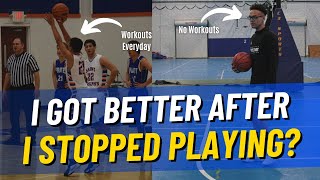
Ethan Khoza hasn't played competitive basketball in years but says he's better now. He credits a pressure-free mindset, mental reps from watching film, and teaching others, which forces deeper mastery of the game.
Chapters
I've gotten so much better at basketball, even though I haven't played competitively in almost six years at this point. I say this to people all the time. I say it to my players all the time. And every time that this comes up and I mention it, I get this puzzled look. Today I'm going to talk about exactly why that is and how you can take some of these same principles that have allowed me to get better without really even fully focusing on getting better. That's going to allow you to take your game to the next level. If I were still training the way that I used to train when I was playing and doing these things, I. My progress, my results would be insane and I would get so much better. And so I want to give you these things today. If you're a player who's currently training, focusing on being the best player you can be, if you take these three things we're going to talk about and apply them to what you're doing, it's going to completely change who you are as a player. Now, when I say I'm better at basketball, really, I go back and I'll watch like my, some of my high school films and my high school clips and I'll compare it to now, right? Back then I was working out every single day, year round. You know, the summers I was, you know, in the gym, lifting, getting shots up, having another workout, a team practice, all this sort of stuff. And I was again doing that sort of stuff all year round for years and years and years. And I go back and I watch myself then and I just compare it now to whether it's clips I have or just me playing now. And I'm just, I have so much more ability on the court. I see the game so much differently and ultimately I'm just a way better player, even though I'm putting in way less time than I used to. So I want to talk about exactly why that is and again, how you can take the things that, the lessons that we can draw from that and apply it to what you're doing. And you have the best of both worlds. You have these tips as well as the work you're putting in. Let's hop into it now. The first reason that I'm better at basketball now than I was back when I played is because there's less pressure. Now, obviously you understand as a player you have all this pressure to perform, right? Whether it's. You feel pressured to not go out there and, you know, make a mistake because you don't want to get pulled out of the game or you want to protect your starting spot, you want to win the game, you're. There's, you know, people watching you in the stands, whether it's friends, whether it's your family, you want them to see you do well. There's so much pressure on you to perform and to play well, especially if you're someone who puts in a lot of work and so you have a certain expectation for yourself. Hey, I put in this amount of work. I feel like I should see these results. I feel like I should do be able to do this on the floor. And so there's pressure right? When you have expectations and you know, when you have all these different factors going into you wanted to perform well, there's inherent pressure comes with that. So obviously I felt that a ton as a player and so that every player feels to a certain extent, especially for me, like I said, I put in so much work and I cared so much about it that I felt like if I didn't play well, then like the world was over or I was, you know, disappointing everybody who supported me because they all saw how hard I worked. And yet I get out there and I might not play as well as I feel like I should or I might have a disappointing season. And. And that's hard. It's really hard to deal with that and the pressure and the weight of that. So now that I'm not playing anymore, I don't have those same sort of expectations. It's a lot easier. It's a lot more. There's a lot more freedom when I play on the court because, you know, again, I'm not weighed down by that pressure, by that weight that goes with all that sort of stuff right there. So I think something in a mindset shift that players can have when it comes to dealing with pressure is understanding that there's so much more that you're going to gain from the game of basketball than like the surface level on court success. The best thing that you're going to get out of your basketball career is the life lessons and just the human lessons you're going to learn, which I know sounds very, very cliche. Again, as I've been kind of distanced from being a player and from that mindset. It's so true. I just to name a few, right? Learning how to overcome adversity. Learning how to be confident, how to play with confidence, how to, how to carry yourself confidently. The ability to work hard is massive. Goal setting communication. Learning how to study and learn things, learning what it means to care about something. Those are all skills that are vital to being a successful human being in general. And so that's something that I've really learned is that you can go through your entire career, your whole basketball career, right? You can work super hard every single day, you can outwork everybody. There's always a chance that you're not going to play well or you're not going to accomplish the goals that you set for yourself. Right? There's always a chance that that's the case. Case for a lot of players, that's going to be the case. But I think the way that I look at it now, and the mindset shift that I, that I wish I would have had as a player is that there really is no way to fail. You might say, hey, if I don't accomplish this goal, that means that I failed. And I used to feel that way too. But I think the important thing to understand is that again, when I look at what I gained from being a player, I learned how to work hard, I learned how to set goals, I learned how to have a question, how do I get better at this? And I learned how to figure it out and how to find information and find people that could help me with it. I learned how to overcome adversity, how to have a really bad practice and be able to show up the next day and be better. How to have a game where I shoot over eight and show up the next day and still go at it. Right. And still play with confidence. Those things translated so much to everything else that I did outside of basketball. And it's one of the most important factors for any sort of success that I've had outside of basketball. Right. Thing to understand is that even if you go to the NBA and you have a 20 year career, you're still only playing until, you know, at the Latest, your early 40s, right. Late 30s, early 40s is how long you're going to play and then think about how much life you potentially have left after that. So the life lessons that you take away are going to matter so much more than any sort of on court success. Everything that I've accomplished at this point in my life I owe to the skills that I developed as a player. Right. And the things that I do now as a trainer, as a coach. I'm so much more passionate about it than I was about playing. Even though I loved playing basketball. Right. It was all that I cared about, you know, every day it was my number one priority is I got to get better. All that mattered to me in high school, ended up transferring schools because I wanted to play basketball. Like, that was. That was how much it mattered to me. Like, I will leave all my friends at this school and go play this other school because I care about basketball. That was. That was number one for me. But now I care so much more about training, about coaching, about the stuff that I'm doing and the skills that I take to, that I learned by being a player, by working hard, by failing consistently, learning how to overcome that sort of stuff. So the takeaways and the lessons are going to be so much more valuable than anything that you're going to accomplish on the court. And the second thing that goes with that is that the relationships that you build through the game of basketball are so priceless. The second you stop playing, nobody is going to care about how many points you scored. Nobody's going to care about how many teams. How many games your team won. Nobody's going to care about the records that you set. Right? People might hear. Hear about it, oh, that's cool. Or, hey, you know, I remember when you were, you know, you did this or whatever you might have. You might reminisce about it all that sort of stu. That, that's cool. But at the end of the day, you're going to realize, like, oh, man, that game where I went off, no one really cares. Like, yeah, if you bring it up, people will say it's cool, but nobody really cares. It doesn't really affect my life at all. What will affect your life is the relationships and the friendships that you build through the game of basketball. Again, going back to. To where I'm at now, all the stuff that I have. Right. This whole channel wouldn't exist if not for the relationships that I built at the high school I played at. Right? Because that led to me getting a job coaching at a school. And then that led to players, you know, asking me to train them, which got me into training. And the next thing you know, I have a, you know, through my high school coach, I get a job with another high school. And that opened a lot of doors for me to do what I'm doing now. And now I'm a varsity head coach. And all that stemmed from the relationships that I built as a high school basketball player. Right. I wouldn't have any of this sort of stuff if not for the relationships that matters so much more than how many shots I made on a certain day or how many games I started or how many wins my teams had. Right? That stuff doesn't matter in comparison to the relationships that you build right there. And when you really approach it that way, where you say to yourself, hey, the things that I'm really going to care about five years after I'm done playing are the skills that I developed in terms of being a human being and life skills and the relationships that I formed. Those are the really the two things that you're going to care about. It takes so much pressure off of you, feeling like you have to play well, feeling like you have to live up to a certain expectation. Whether it's expectations for yourself or expectations that someone else puts on you. You're going to realize that that doesn't, that's not really going to matter in the moment. It does, but eventually you're going to look back and say, man, I'm so glad I developed the ability to overcome adversity, the ability to work hard, because it's helped me so much in life. And the thing that, that you know, you'll understand that I didn't get back then is that if you really focus on developing those important life skills, it's going to put you ahead of 95% of other people who haven't developed them, who haven't been put in the positions where they've needed to have those skills right there. The takeaway for you is focus on doing the right things. Focus on, on developing those important skills. Focus on working hard, focusing, focus on learning how to overcome adversity. Focus on learning how to be positive in the face of failure or adversity or challenge. Learn how to be a great teammate and learn how to, how to communicate positively with your teammates. And then focus on building great relationships with your teammates, with your, with your coaches. Focus on building even with the players that you play against. Like, focus on building connections, building, you know, relationships with all those different people that you come across. Then you're going to realize that the on court success that you may or may not have is going to be an added bonus to that because again, that's the stuff that feels most important now. But it's going to be the shortest lasting because eventually no one's going to care. You won't even care, but you will care about the life skills that you built and the people that you know, you have relationships with. Now that's the stuff that'll matter, that stuff that will truly change your life long term. Okay? So understand that the actual encore success is like the third best thing you can get out of basketball. And when you look at it that way, all of a sudden you look at it and you say, hey, did I work hard today? Did I overcome adversity today? Did I play with confidence in, you know, in spite of failure? When I look at it and I say, yes, that that's a successful day, and doesn't matter how many shots I made or how many turnovers I had or whether I started this game or whatever the case may be, you did the most important things today, which was develop those skills. And looking at it that way takes so much pressure off of you. So I really challenge you to think of things that way. The best part about that is that when you do it that way, because there's less pressure on you, you're going to play better. So now all of a sudden, what you want so desperately, which is play well, that's going to be so much, so much more easy do, because you have your priorities in the right order. So that's the first reason why I'm so much better as a player now than I was back then is because my. My priorities are in the right place and I understand now, and there's less pressure on me because of that. The second thing that makes me better now than I was back when I played is the concept of mirror neurons and mental reps. Paul George talked about in his podcast when he broke his leg. The transformation that he made mentally because.
Of that didn't happen until after I got injured and I broke my leg and I set out and watched the game from the sideline. And, you know, crazy enough, I used to put myself in situations watching the team play, like, oh, I would have done that differently, or had I slowed, slow down right here, or I was just running through so many. It was almost like I was playing mentally while watching from the sideline. Right. And so when I came back, that applied to me now because, you know, it took some time for me to gain trust in my body to gain how to move and jump and all of this stuff, but I was still out there practicing and playing. So that's when I realized, like, all right, I gotta be a little bit more smarter because I don't have that burst right now. I don't have that quick step. I don't have that athleticism right now. So the game literally slowed down for me. And I think that's kind of when I realized, like, changing the tempo, like, you know, how to play fast and then slow down, catch my defender off guard, and then now speed up like, it was learning my cadence, you know? And I would say that was the biggest jump for me on understanding how to play at my pace, I don't ever look at the person in front of me guarding. You know what I mean? It's always seeing the next play, who's behind him. Where's the help gonna come from? Where's the low man at? Where's the nail help? And so it was always reading that person. And once I realized that, then I started to understand, like, all right, I could fake this way, and then quick snatch, go back the other way, because that's where I'm really trying to go. So to answer that question, that all started to develop after the. The big injury, and, you know, I was sidelined and had to just watch from, you know, from a boot and with a suit on.
So he talks about one of the biggest transformations for his basketball iq, his overall understanding of the game, was the fact that when he was hurt, all that he could do was sit there and watch other players play. And he got to really, like, sit and observe the different situations that they were in, the different decisions that they made. And he was able to really see, like, oh, was that a good decision? Was that a bad decision? What would I do differently? What did they miss there? You know, what could maybe I have done better in that situation there? And because he was able to get all these mental reps, when he came back, he was. He understood the game at a much deeper level because he was forced to watch and observe and pick it apart and almost put himself in the position of his teammates, of the players that he was watching, so that he was still getting those mental reps right there. Something I talk about a lot is mirror neurons, where your brain is able to watch somebody else do something and essentially mirror that same action in your own mind. So by watching somebody and your brain going through that process, it's actually similar to you yourself doing the process, going through that. That process. And it's why visualization is such a powerful tool that you can use. And I've made videos where I talk about the power of visualization before games. Like visualizing yourself doing well, visualizing yourself making shots, visualizing yourself in a certain play. You know that you're going to run, being successful in it. And when you can, like, literally sit there and think about that, your brain is firing. And those. Those. Those neural patterns are just strengthened and reinforced, right? And it's the same concept when we talk about watching somebody else do something and almost putting ourselves in their shoes. We have an amazing ability of empathy where I can look at somebody and I can, like, put myself in their shoes and, like, feel what they're feeling, right? That's what we as humans have, and that's what's really powerful about mirror neurons. So the first thing to understand is that you want to watch other players and. And use their reps as your own mental reps right there. And that's when that's going to really help to accelerate your progress. Something that I've realized myself is that I spend so much time watching players now, right? Whether it's players in my workouts, my practices, or just watching the game in general, whether it be on, you know, TV or on Synergy or on Second Spectrum or on YouTube. Like, I'm watching the game all the time. Something that actually happened to me this past year. I had a player on my AAU team who uses the move called the Pinoy Step all the time, and he was the first player that I really coached that, like, used it a lot. Every day in practice, like, I'd watch him use this move when he finished, and he was really, really good at it. And fast forward maybe a couple months after that, I was playing pickup with, with some of my college guys and high school guys. And I've mind you, I've never worked on the Pinoy Step myself. Like, it wasn't even something at a time that I had really, like, demonstrated in workouts at all. It's just something that I'd watched one of my players do kind of frequently. And we get into a fast break and there's someone who's, like, chasing me down, and I go to that Pinoy Step, get them to jump early. And it opened the finish up for me. And it was the first time I had ever done that move. Had never even considered it before, but because I had watched my player do it all the time, and I started to recognize, okay, why does he get to that? Okay, how does he do it when the defender's there? You know, how does he, like, why does he use that move or what? You know, what's the tempo that he goes at right there? I watched that so many times that it just kind of instinctively happened for me without even working on it. That's the power of mirror neurons, of watching, of really just being around the game and learning from the reps of other people. It's so powerful. And that's just one example of that working. So the thing that kind of like the takeaway for you in this area here is, number one, you want to spend time watching film, studying the game, right? That's such a powerful thing. Top link down below, I have a Free basketball IQ masterclass where we go through like a bunch of different things. How to, how to score more points in different situations, learning, you know, when to drive, when to shoot, when to pass, different finishes for different situations, different mindsets you need to have. But really diving into the game. It's an hour long, completely free. So if you want it to get started with just studying the game, that's a really good resource for you. Like I said, completely free. It's top link down below. I'll mention that again a little bit later. But spending time watching film, studying the game is so important. Watch, watch, watch, watch, watch. I can't say that word enough. Whether it's NBA games, college games, high school games, other like professional games, whatever, it doesn't matter. Spend time watching the game of basketball like every single day if you really want to be great. Because not only are you going to be out there doing your own workouts, playing your own games, learning that way, but when you watch, you learn from everybody else's reps. Think about the max amount of time you could be on the court, working out every day or playing every day, like effectively, right? Maybe if you do it twice, maybe four hours maybe. And that's probably tough to do every single day. If you have a two hour workout and then a two hour, you know, pickup run at the end of the day, like maybe you could do that, right? Probably for most players, probably more like three hours. So if that's the case, think about how many hours you have left in the day, right? If you can have three hours on the court to yourself, but then you spend an extra two hours watching a game or watching film or watching clips of your favorite player. Think about how many more reps you're getting than someone who just plays, someone who just does their own thing and doesn't get reps from other people. Like you could theoretically get, you know, almost 2/3 the amount of, two thirds more the, the amount of reps that someone else is getting who isn't watching. Okay? So that's the power of using other people's reps as your own by watching them and going with that. When you're in practices, when you're in games, when you're in workouts and you're with other players, take note of their reps, use their reps as your reps, right? Think of it like, okay, I'm going to watch every rep that they do too. And I'm going to, I'm going to try and take away the things that I can take away from it okay, why did they do that move right there? Why did they finish like that? Why did they take that shot? Why did they make that pass? Why did they make that drill move move right? Start to really care about the reps of other people as well. That's going to help you a ton. And then take time and really dive deep into watching your favorite players, right? Going on YouTube and just looking at, hey, you know, maybe if you play similar to Trey young. Going on YouTube and looking at Trey Young highlights Trae Young against the, you know, Pacers from, you know, a random game in February, like, that's a great way to be able to learn and really get those mental reps by doing that as well. You can use YouTube as a resource for sure. Like, there's so many different trainers out there who talk about this sort of stuff. There's so many breakdowns, all that sort of stuff. Like use the, the resources that you have at your disposal. Like I said, that hour long master class top link down below is for sure going to help you instantly be better and, and, and learn how to break down and watch the game right there. So something else for you to check out right there. Be obsessed with learning. And when you do that, that's another life skill you're going to develop. Going back to our, our earlier point. And again, that's the most important stuff you can take away from this. And then the last thing that has made me so much better at basketball now than I was when I played is the idea, the understanding that to teach us to learn twice. So as a trainer and a coach, I need to be capable and confident of showing my players different things and explaining and teaching different things to my players. When I create a video, for example, like, I need to be very sure the things that I'm saying are accurate and, and helpful. And so I have to, I have to really like check myself and be like, hey, do I. Is this, what is what I'm saying true? Is what I'm saying helpful? Did I do enough research into this topic? Do I have enough examples of this topic that it makes sense that I know that it's going to be helpful? I have to really critique myself and force myself to bring my best because otherwise, you know, everyone, it's not gonna help anybody, right? And then no one's gonna want to watch anything because it's not helpful. So I have to think of things that way. When I create my programs, I need to make sure that the content that I put in there, the workouts, the videos, all that Sort of stuff that I put in there is transformative, is helpful, is going to help players see results and improve at whatever, you know, the. The focus is. And so I also have to make sure that I give them that sort of stuff and I help them apply it in a way that they can actually use, right? In a way that's actually efficient and useful for them. And so all of that requires me to not just learn something, but to master it, because I need to have a mastery of it in order to be able to teach it to somebody else in a way that they can consume and understand and be able to use themselves. Right there. That's why the saying is to teach us to learn twice, because you have to learn something yourself, but you have to almost learn it again in order to be able to explain it or teach it effectively to somebody else. The best way to become a master of something, in my opinion, is to teach it to somebody else, because it's going to force you to really critique yourself and say, hey, how well do I really know this? Do I know it well enough where I can explain it? Answer any questions somebody may have, be able to give different nuanced details about it as well. And when I first started coaching, especially with the first high school team that I was at, you know, my head coach was like, throw me into the fire. Sometimes it felt like where, like, I'd go and I'd lead a drill or I'd lead a workout or a segment of practice, and I felt at first like, man, this is a lot for me. And because of that, like, sometimes it was like I felt like I wasn't going to be able to do it. But what happened to me and when I realized is that it forced me to be better. It was like a sink or swim sort of thing where it's like, hey, I need to know how to teach this. I know I'm coming to practice today and I have to be able to demonstrate this or show this. Like, I better know how to. How to do this, and I better know how to do it really, really well. And that understanding and that approach right there allowed me to be so much better at that skill or at that concept. And that applied to me, like going and playing now, having to be in those situations where, you know, I'm teaching something, I'm so much more confident doing it. I talk a ton about the different actions that are a part of the game, whether it's ball screens or pin downs or handoffs or, you know, closeouts that you're attacking, whatever Those are things that I talk about a ton of my videos, in my programs, in my workouts with players and. And I'm so much better in those situations because of that. Going back to the film aspect, I watch a lot of film on it and that's a part of it. But also the fact that I have to be able to teach these things makes me a lot better when I actually go and play at using them and being successful in those situations consistently. So as a player, can you find opportunities to share the game with other players? Like with your teammates? Like, can you show them something? Can you demonstrate something, explain something interesting, introduce something to them? This is going to help them, obviously, but it's also going to help you as much, if not more, because you're going to have to develop a certain level of mastery over the things that you're trying to demonstrate, whether it's a skill, whether it's a, you know, a concept or a play or something that you're doing. Whatever it is, you're going to develop another level of understanding and you're going to take that ability to, you know, the next level for you by being the one who's actually teaching it. So finding these opportunities is going to help you immensely with your abilities, like we mentioned, right. You're going to become better at it, but also it's going to help you with your confidence as well. Both your confidence in your abilities to execute, but it's your confidence to be able to teach, to be able to help somebody. And again, going back to our first point, that is such a valuable life skill to have that's going to make you successful in everything that you do. So it kind of all ties full circle right there. So again, going back through it real quick, the number one reason why I play better like now than I did when I was a player is because there's just way less pressure on me, because I understand the fact that the on court success is not even close to the most important aspect, the biggest takeaway. When you're done playing, no one's going to care about how good you were. No one's going to care about how many points you scored. Nobody's going to care about where you played. They're going to care about the skills that you have as a person. Right? What can you do? For me now, that's what people will care about. And the other thing that will matter is the relationships with your teammates, with your, with your coaches, with the people that you played against, with the people that you were just around. Those are the things that will last and that will matter. And when I approach it that way, I'm focused on being a good human being and developing those important life skills, learning how to work hard, overcome adversity, deal with failure, deal with challenge, play with confidence, deal with things not going my way, all that sort of stuff. And then I'm also focused on just building good relationships with my coaches, with my teammates, with the people I'm around, because that's going to last, it's going to matter. And because of that, there's less pressure on me to play well. And because of that, I actually play way better because of the lack of pressure, the lack of expectation. And not that there's a lack of expectation, right. If you're a player, there's going to be expectations on you, but the expectations don't, we don't weigh as much on you. Right. They're still there, but they don't, they don't impact you as much because you understand that, hey, I can fail, I can have a horrible game, I can have a horrible career, everything go wrong. But if I develop those life skills and I develop good relationships with my team, with my teammates and my coaches, that will be, that will be enough, right? And it may not feel like that in the moment, but it will when you're done because that's what people will care about, which you're going to care about. So that's that first thing. The second thing is understanding that using other people's reps is such an impactful way for you to get better. Okay? So taking time and really watching the game and breaking the game down, studying the game, studying those players that maybe you play similar to or that you want to be better at a certain situation that maybe they're good at and using other people's reps as your, your own. Like I mentioned earlier, top link in the description down below, free hour long basketball cube masterclass where we dive even deeper into how to watch the game, into learning some most important things. I mentioned some of those actions. Ball screens, pin downs, closeout, those sorts of things. This is stuff that's going to help you to instantly add points per game to your average, instantly make more plays on the court and just be a way more successful player. So like I said, top link down below, make sure you check out that master class. And the third thing that goes into me being way better at basketball now than I was back when I played is the understanding that the teachers learn twice. I have to become a master at things because I need to teach them. And when I force myself to do that, it makes me so much better at actually applying and executing that skill or that concept myself. So all those three things will go into you being a way better player. Hopefully this this helps you, and this gives you an idea of how to kind of approach becoming the best player possible going forward. Like I mentioned, check out that free Basketball IQ masterclass down below top link. I appreciate you for watching. Talk soon. Peace.
More from Ethan

Stop Using One Dribble When You Drive To The Rim! (How To Become A Better Finisher)









