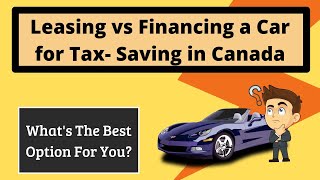
In this instructional video, the presenter guides self‑employed Canadians and owners of Canadian corporations through the tax implications of leasing versus buying (or financing) a vehicle. He first clarifies three key terms – a purchased car (bought outright), a financed car (owned after a loan is repaid), and a leased car (used while the dealer retains ownership). The core of the content is the Canada Revenue Agency (CRA) limits that dictate how much of a vehicle’s cost can be claimed for tax purposes. For non‑electric passenger cars the claimable purchase/finance limit is C$34,000 (excluding GST/HST); for zero‑emission (electric) cars the limit is C$59,000. For any leased vehicle, regardless of type, the deductible lease payment is capped at C$900 per month. The presenter then walks through a decision‑making table for non‑electric cars, outlining four scenarios based on whether the purchase price is above or below the C$34,000 threshold and whether the monthly lease payment is above or below C$900. He recommends financing when the lease exceeds the cap, leasing when the purchase price exceeds the cap but the lease stays under the cap, and a mixed approach (short‑term lease followed by buy‑out) when both thresholds are exceeded. The video concludes with similar guidance for electric cars (though the transcript cuts off). The overall aim is to enable viewers to select the financing structure that maximizes their deductible vehicle expenses and thus their tax benefit.
Chapters
Leasing versus buying a car for maximum tax claim in Canada. Welcome everyone. In this video, we'll take a look at whether you should lease or finance your next car, mainly from the tax perspective. We will cover the following: Major factor affecting this decision. CRA rules for both lease and financing of a car. Example table you can use to make a smart decision. If you are self-employed in Canada or own a Canadian corporation, This will help you to decide whether you should lease or finance your car so that you can claim maximum expense and get a maximum tax benefit for your car. Before going ahead, let's understand 3 terms. When we say car purchased, it means car bought outrightly. When we say car finance, it means you took a loan and you own the car, and each month you pay a certain amount as loan repayment. So at the end of the payment period, the car will be yours. When we say leasing a car, it means you are paying monthly payments to use a car. Technically, car dealer still owns the car, and at the end of the contract period, either you can buy it or end the contract. Now, the major decision would depend on mainly 3 factors: type of your car, whether your car is electric or not, price of total car when purchased, monthly lease payment. I will explain CRA rules and then give you 2 to 3 examples so you can take the best decision. CRA rules: 1. Let's talk about non-electric cars like Honda, Toyota, Mercedes, Audi, etc. For the purchase or finance of non-electric cars, the limit is now $34,000 Canadian. So if your car price is less than $34,000 excluding GST or HST, you can claim it fully over the period of time. But if the price is more than $34,000, you cannot claim an excess amount over $34,000 and the HST portion on it, so it would be a loss. 2. For the purchase or finance of zero-emission passenger vehicles like electric cars, the same limit is $59,000. So again, if the purchase price is less than $59,000 excluding GST or HST, you can claim it fully. If more than that, you can claim a maximum of $59,000 and HSD. So here you lose tax benefit over the excess price paid. 3. But when it comes to leasing a car, only one limit is for both types of cars. The limit is $900 per month. So you can claim a maximum of $900 lease payment per month irrespective of the car price. So now let's talk about the best part. How can you make some smart decisions? See the following table for your guidance. Let's start with non-electric cars. Situation 1: If the price is below $34,000 and lease is also less than $900, you can select any option because you can claim fully in both situations. Then choose the option considering other factors such as interest rate, repayment terms, etc. Situation 2: If the price is below $34,000 and lease is coming to be greater than $900, I would go for financing because you can claim the full amount. Situation 3: If the price is above $34,000 and lease is less than $900, I would go for the lease and buy out at the end. Why? Because you can claim full car price. Smart thing, because if you take a lease for 3 years and repay it at the end of 3 years, if the price is below $34,000 for purchasing, you can still claim the full purchase price from the 4th year onwards. So full benefit. Situation 4: if the price is above $34,000 and lease is coming to be greater than $900, take 2 to 3 years lease first and then buy out for best tax benefit claim. Now when it comes to electric cars, everything will be the