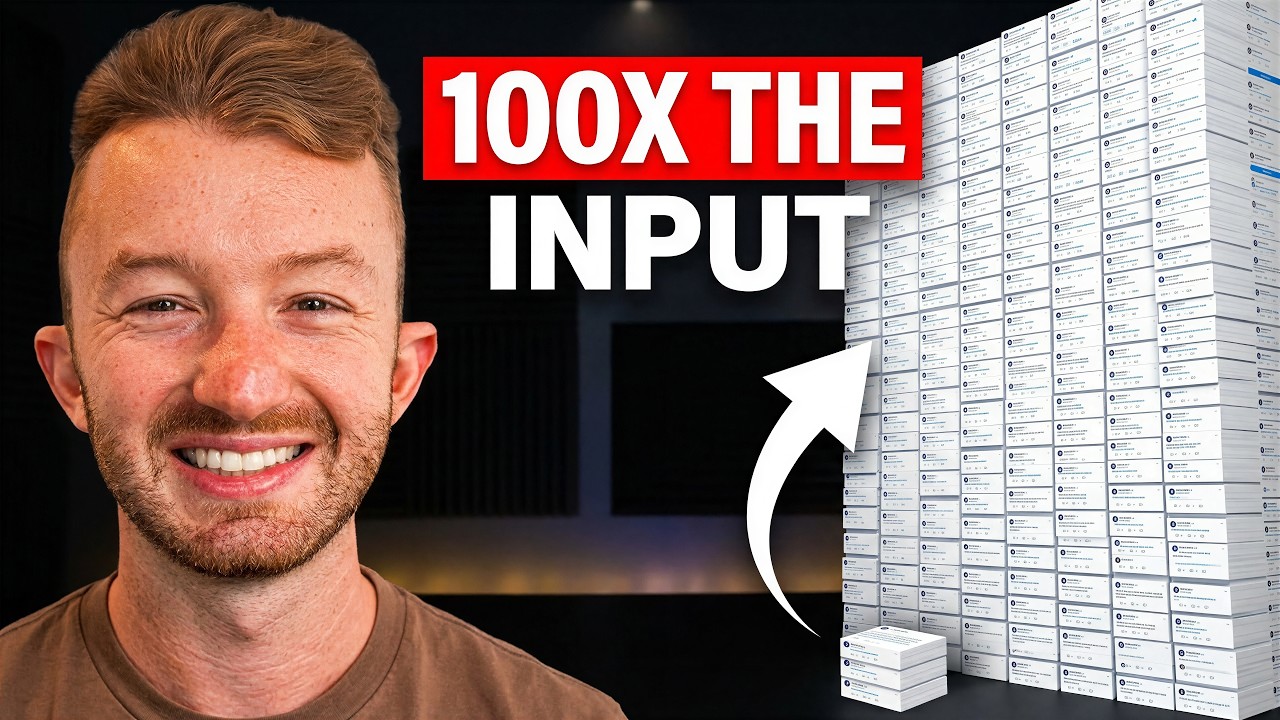
In this solo presentation, Daniel Fazio explains how to scale an agency or service‑based business from a handful of clients to thousands. He frames any business as three core functions—client acquisition, sales, and fulfillment—and argues that moving from 10 to 1,000 clients requires building repeatable, high‑volume systems within each function. For acquisition he contrasts hyper‑personalized cold outreach (sending a custom AI‑generated ad as a deliverable) with high‑volume cold email, detailing how his ListKit platform automates domain and inbox distribution to avoid spam blocks and achieve massive daily send volumes. He then discusses content creation, noting that top performers like Alex Hormozi publish roughly 100× more pieces than he does, and that scaling content volume correlates with revenue growth. In advertising, he introduces the concept of “pocket audiences” and horizontal scaling: creating hundreds of ad variations and landing pages, each targeting a specific audience segment, and scaling spend only up to the audience’s cost‑per‑call equilibrium. He shows how content, ads, and outreach synergize, multiplying results rather than adding them linearly. For sales, he outlines the need to hire dedicated closers (≈5 calls/day) and setters, and explains “availability variance” – the impact of limited calendar slots on no‑show rates. He quantifies staffing needs (e.g., 6 closers for 30 slots) and highlights the Pareto principle in hiring. In fulfillment, he describes pod structures for agencies and student‑success teams for info‑products, detailing manager‑to‑client ratios and the role of AI in automating steps of the delivery pipeline. He references the book The Algorithm to illustrate bottleneck‑focused efficiency, sharing examples from Tesla and Alex Hormozi. Throughout, he emphasizes that scaling is essentially multiplying every input (outreach volume, content pieces, ad variations, staff capacity) by 100× while continuously removing friction. The video concludes with a promotion for a live 5‑day AI Client Acquisition Challenge, offering tickets for $50 with later price tiers.
Chapters
This right here is a graph showing we have signed 1,673 clients at Client Ascension, but we have two businesses. So here's another one showing we've signed 9,438 total subscribers over at ListKit, and that's for either a SaaS or done-for-you offers that we've sold over there. Here also are some screenshots showing we've made $34.5 million in cash collected. So it's safe to say that we have scaled not only past our first 10 clients, but are also our first 11,000. So what I want to talk to you about in this video is what needs to change, what got you to 10 clients is not what's gonna be that takes you to 1,000 or 10,000. Now structurally, it kind of is actually the same on the fundamental level. This is how a business is constructed. You have client acquisition, you have sales, and you have fulfillment. And basically scaling a business is literally just systems that are encased within one of those 3. And that's it. That's, that's literally the entirety of any kind of business whatsoever. Now, quick note before I get into this, we are doing a live 5-day AI Client Acquisition Challenge. Tickets are only $50, and if you want more info on that, go to the first link in the description. But more on that at the end of the video. So what you got to do in order to go from signing 10 clients to 1,000 is you have to really build systems behind each one of these. So we're going to go through them one by one inside of this video. So let's start with client acquisition. And what I want to talk about here first is normally where most agency owners or service providers are kind of like getting their stuff off the ground, and that is Cold outreach. So you could you could pretty much categorize cold outreach into two buckets. Bucket number one is highly personalized, and bucket number two is high volume. Now realistically, in real life, this is actually a spectrum, and any you can land at any point on this graph where it's to some degree personalized or to some degree high volume, right? But generally, what you might do on this personalized side is let me talk through this first. You only have two resources in your life. You have either time or you have money, and to do. Do anything at all, whether that's get clients, fulfill for clients, sell, like you have to spend either time or money. Like one, one of these resources must be spent. There exists nothing else on the planet beyond these 2. Anything you embark upon, one of these needs to be spent. So if we're looking at this spectrum right here, what we're effectively saying is, well, on this one over here, the highly personalized one is using more time and this high volume one is generally using more money. That's pretty much how you could think of it. However, obviously you can augment these with AI. And kind of like make this more on the money side than it is actually the time side and all sorts of fuckery like that. But what I want to get into is like walking through the actual strategies between these two. So let's let's start with the personalized side. Generally, what will happen here is a strategy where I just call it hyper-personalized outreach, and this is where you send a deliverable upfront. Now, as an example of this, imagine that you sell AI ad creatives as a service. Like you just make AI ad creatives where it's like the claymation or the animated type stuff. You sell that to I don't know e-commerce brands. Well, what you'd probably do is you'd go find the email address or the DMs of somebody who owns an e-commerce brand. You would make an ad, like one of those AI ads for them upfront, and then you would straight up just send it to them. Like, hey, this is what I can do for you. That's an example of hyper-personalized outreach where it's on the personalized side. And yes, that's gonna require some amount of money or some amount of time, but you can equate that to ad spend because let's say for instance, it cost you like $5 to create one of those ads for one of them. Now let's say that for every, I don't know, 100 that you send, which would mean that you spent $500. So this is times 100 that you're able to sign a client for every 100 of those you send, you're able to sign a client. Now, what that would effectively mean is that you have a $500 CAC, which means cost to acquire a customer. You know what I'm saying? So now what you might be thinking, if you're more on the beginner side of your business and you're like, you're not at 7 figures a year yet, is you may be thinking, oh yeah, cool. I'll go spend $500. And The difference between a 7-figure business owner, somebody who's going to sign 1,000 clients versus somebody who's going to sign 10, is that they would see this and be like, okay, let's spend $50,000, literally 100 times more than you. This is how I would conceive of it. And the difference between staying at 10 clients versus 1,000 is that thought process there. Because it's like, if you look at it, it's really like, say, say the clients are paying like, I don't know, like $3,000 a month or something. It's like you're cash flow positive, like immediately. So like, You know what I'm saying? Okay, so you get that premise right now. Let's, let's go back over here and let's go to the high volume side. So this is where you'd send high volume, like really just blitz ramming of like a fucking tremendous amount of outreach. Now my software company listkit.io is specifically for this. It works. So let me explain how high volume cold outreach works. The reason why cold email may not have worked for you before, or like all your shit goes to spam or whatever, is because you didn't set up the actual tech behind it correctly. What you need to do is if you're going to send like 1,000 cold emails per day, you need to disperse all of that sending volume among a shit ton of different inboxes that are under different domains. That's because they're all protected from one another. And if one gets burned, the others don't get burned and they're all segmented out. That's how you do high volume cold outreach. Now, the problem with doing that like manually, for instance, or if you go use some like cheap sequencer that's like— they'll be like, for $97 a month, you can send 100,000 cold emails and they conveniently don't tell you that you need to go buy a shit ton of domains and inboxes. So what that means is you connect your inbox to that and you go send your first 1,000 emails and then it goes straight to spam, you burn the domain, and now every single one of them goes to spam forever and you get zero results. That's generally why people don't get results with cold email. Now, if you use something like ListKit, what it does is if you want to send 1,000 cold emails per day, what this does is it automatically spins up 20 domains and then 40 inboxes under those domains. And then this 1,000 cold emails, these 1,000 cold emails are automatically dispersed among those 40 inboxes. And what that means is that all of them are protected from one another. And if one burns, then it doesn't burn everything. You get what I'm saying? They generally don't burn in the first place if you're doing that low of volume, but that's why it works. Just plug listkit.io. I'll leave it in the description if you want to go buy it. It works amazingly well. But the problem again, like if we, if we were to disperse this out, let's say, let's say 1,000 cold emails per day. So it's roughly 30,000 cold emails per month. Which is generally, 'cause you have follow-ups. So it's generally gonna be to 10,000 prospects per month. Now let's say for instance that this books you, I don't know, 10 calls. Now it depends on the offer. If you could have an offer that only books 3 calls from that, you can have an offer that books 20 calls for that. Just depends on the offer. It depends on a whole ton of things, your case studies, how good the offer is. You get the point. But you might be thinking, well, like if I spend $597 and I book 10 calls, what that means is one call equals $59.70. So you might think to yourself, well, $597 is a lot. Okay, just just to give you context, at some points in time we will send 100,000 cold emails per day. So okay, so like take this multiply by 100, and that's the difference between signing 10 clients and 1,000 clients. You know what I'm saying? Like if you want to do something that is 100 times more than what you have, then the input must also be 100 times more than you've ever done. That is literally how it always works. It is like that for absolutely anything. Now if we move on and we talk about content, which you're watching from me right now. If you're on this video and you probably subscribe to me on YouTube, and if you're not, you should. Maybe you've seen my Instagram or my Twitter or something like that and you consume content from me. And roughly at about like I normally post anywhere from 1 to 2 YouTube videos per week. I generally also send between 3 to 7 newsletter emails per week. And I think my Instagram is something like 14 posts per week. Twitter ends up being like, I don't know, maybe like 20 tweets per week, something like that. Now, I read somewhere on— I think it was Twitter or somewhere— that Alex Hormozi posts 400 unique pieces per week, and that's across all of his secondary YouTube channels, his main YouTube channel, his Instagram. And when I say unique, I mean it's not like clipped from something else he's already done. It's unique. It's like new, like literally new stuff. So if we count what I'm doing over here and like generally my newsletter and my Instagram are like stuff that I talk about on YouTube. And like a lot of the Instagram stuff is clicked from YouTube. And it's like, realistically, Alex Hormozi is probably posting roughly 100 times more than me. Now, this is interesting because if I'm doing, say, $12 to maybe $17 million per year, what you could possibly conclude from that is Alex may be doing $120 to $170 mil per year. Now, if you watched his book launch last year, you could see that he did $100 million in a single weekend, right? But I would suspect that acquisition.com is probably somewhere in this range. Now it's interesting because the input is literally 100 times more than me. So therefore what exactly happens tends to be exactly 100 times more of a result than me. What I'm trying to convey here is just how like retardedly simple this ends up actually being. Like it isn't that confusing. So if you're ever wondering like Why is it that this guy over here makes so much more money than me? It's just that they don't post all the backend fuckery that they're doing all day where they're sitting on the computer for 12 hours per day because that's not something you film. It's— they could be tired, they could be sick. It's on a weekend. Like, for instance, just this last weekend on Saturday, I worked for like 10 hours on a Saturday. It's like, I'm not saying that to be like, oh yeah, look at me. Like, I fucking work so much and yeah, yeah, yeah. Like, no, obviously, like, I want to go enjoy my life and I like, I go out and I do fun things. I go on vacations, I hang out with my friends. and I get fucked up and I do, I do all that shit, right? That's why I'm here and not here. Like, let's not confuse ourselves about like, like what the fuck the reasoning is behind that. Like, it's very clear. It's just that he literally works more than likely produces 100 times more shit than me. It's really just that simple. Okay, so now let's talk about ads. So as much as it may seem like ads are just like easily scalable where it's like, okay, well, I have, I have, I have this campaign And what's happening with this campaign is for every $100 I spend, I get one call booked right now. The way this is actually constructed is you have an ad set and then you have an ad, say ad 1, ad 2, ad 3. And like a lot of times under an ad set, I may have 10, I may have 30 ads under a specific ad set. What's actually happening is that like this one right here is at like $130. This one's at $80. This one's at fucking $210. I don't know. And it's different. And what actually works in reality is that it tends to be like if you had a shit ton of these or it's like ad 5. They tend to sequence where it's like this ad shows to this person, then after that this one shows, and after that this one shows. And then like you get— you end up getting a blended result of this. Maybe this, this is like 80, and maybe this is, I don't know, 70, and then you have a blended result of 100. Get what I'm saying? That's generally how it works right now. It's— and say you've got this campaign at like this, this whole thing, right? And this is at— you've, you've got this at, I don't know, say, uh, $300 per Now you may think that, so that's, that's which is getting you 3 calls, right? Cool. 3 calls. Now you may think that if I put this to $3,000 per day, I will simply get 30 calls. But unfortunately that's exactly the fucking opposite of what happens. So sometimes what happens is you have your cost per result. So let's just say you have your cost per result and this is a graph, right? And you have your cost per result and then you have spend right here. What generally happens with a finite amount of ads is the more you spend, the higher Your cost, say you were right here, this is $300 a day right here. So your cost per result was $100. This was $300 per day. Then you go over here to $3,000 and maybe it's like, maybe the cost per result is $300 now. So it's not that like if the cost per result goes up to $300, what that means is going from $300 a day to $3,000 a day, it's actually 10 calls, right? So you 10x the budget, but you only increase the calls by 3x or like 3.333x. That's a problem. So how do you get that to not happen? And the answer is you have to take all of these ads and you have to make a fucking shit ton of them. Like you have to literally make like, like I'm talking like perhaps like hundreds of different ads. Well, the reason why is imagine that ad 1, ad 2, ad 3, they're all using a different angle. And a different angle could be considered targeting a different pocket audience. So if I say something, for instance, like let's, let's say I'm advertising for you to join Client Ascension, you're an agency owner, and we help you build AI client acquisition systems and scale the fuck out of that. There may be one angle where I'm actually seeing some kind of results with this where I say, do you feel like every time you— do you feel like you don't even want to sign more clients because signing more clients just means more work for yourself and you don't want to work more? That's one angle. Who is that going to apply to? It's going to apply to people who literally feel exactly that. Now, you may have another angle that says something like, are you sending a bunch of cold email and none of it's working right? So who's that going to target? That's going to target people who actively do cold email but aren't getting results with it. Now, I could flip that same exact one and be like, do you want to learn how you can send 1,000 cold emails per day and sign a bunch of clients just from doing that in a completely automated system? And that's going to target people who do not actively do cold email but have an interest in starting cold email. And such is also the nature. I can do the same thing with content, the same thing with ads, the same thing with, with anything at all. I could say another angle where it's like, do you need help hiring sales reps or do you want to see how we manage a sales team of 8 people and make $1 million a month or something like that. You know what I'm saying? It's everything you say, every different angle is gonna target a different pocket audience. So what that means is, say one specific pocket audience may only be able to sustain a $100 cost per call at like, I don't know, maybe 500 per day. And what you'll find is like, okay, well, every time I have this campaign right here and this ad set right here, and every time I get it above 500 per day, the cost per result goes high as fuck. So what should you do? The answer is leave it at $500 a day. Don't keep pushing it up to where the cost per result is no longer profitable. You hit the equilibrium of what that pocket audience allows you. Now you can obviously make more variations of the ads to also target that pocket audience, and you may be able to squeak out some more of that, and it's totally a plausible thing for you to do. But the way you actually do it— and this is just, this is just what I've anecdotally found myself. A bunch of people do a bunch of different fucking things and that's fine and they can do all that. What I find is like if we say pocket audience 1, then we have pocket audience 2, pocket audience 3, and you gotta imagine you could conceivably come up with like fucking 30 or like 100 of these depending on your exact product you're selling. But it's like, well, maybe this one can be at $500 a day profitably and that's fine. Pocket audience 1, every time you get to get that above $500 a day, It doesn't work. So what have I done in that situation? I just leave it at $500 a day. That's it, right? Okay. Pocket audience 2 may only get $100 per day, and every time you go above that doesn't really work too well. So what do I do? I leave that one at $100 a day. This one, however, you may be able to get to like $3,000 a day, right? Okay, cool. Well then you keep pushing the ad spend up for ads that target that specific pocket audience until you get to the diminishing results as you put the budget up. That's how you do it, right? So when we talk about how to go from signing 10 clients to 1,000 clients, what I functionally mean by that is not just increasing your ad spend, because that's, that's not correct. It's horizontally scaling into shit tons of different pocket audiences and learning how to segment all these people. Because not only is it like pocket audience 1, you're gonna have ad 1, ad 2, All the way to like, you could, you could have like 100 ads for pocket audience 1, get what I'm saying? And then those will probably go to landing page 1, perhaps landing page 2, landing page 3 that are all congruent with what is saying in the ad. Such as also the nature over here, right? You have a bunch of ads like all the, all the way to like ad, I don't know, fucking 30 or 300. And then you have landing page 1, landing page 2, landing page 10. If you wanna scale ads, it's not just spending more money. It's making hundreds of different ads, perhaps dozens of different landing pages concurrently running split tests and all of those and horizontally scaling it. And that's how you do it at an efficient cost per result. Now, this also can apply to different funnels. So you might have like, say, all of these right here, all everything we were just talking about. I was just assuming that it's a VSL funnel right now. You can also replicate that exact same thing in a webinar funnel. You could also replicate that exact same thing in a low-ticket funnel. So not only do you have pocket audience 1, pocket audience 2, pocket audience 3, and all their ads and all their landing pages here, it's also here in the webinar and it's also here in the low ticket. And you have like a whole tremendous amount of shit concurrently running at once. And what I've personally found is when I run all these different types of funnels across all these different landing pages and all these different ads, I find that it's hyper-efficient to actually get profit because generally any campaign was going to get a very good cost per result at low spend. So I've just always thought to myself, like, let me just horizontally scale among a shit ton of them so I never hit a cost per diminishing result, which seems to be exactly what happens. Let's put this all together. So we talked about cold outreach, we talked about content, and then we talked about ads. Now what's very interesting is you get large enough is these are not independent. They actually end up working very cohesively together and they all make each other work better. So there's a lot of situations where you send a cold outreach message to somebody and then they look you up on YouTube and they watch a YouTube video from you. And then what you might find is you'll get people who come from, like, if you run a shit ton of ads, you'll get people who come from an ad and then they will self-report that, yeah, I watch you on YouTube. But then you go and you look in Hyros and you see that their first click was from an ad. They don't even remember that they came from an ad. They think they came from YouTube, but that result would not have occurred if either of these didn't exist. So what that's telling me is that, well, which one gets the attribution then? Was it the content? Was it the ads? And the answer is it's both, because if both didn't exist, the sale probably wouldn't have occurred. So what we could assume here is, say for instance that you only do content, and then you may get like, I don't know, let's take a random number. Your result is 100. That's just— we're just gonna assume like revenue as 100, 100 whatever the fuck, right? And then somebody else only does ads and they also get 100, whatever the fuck it is. But then somebody does both of them and they're not additive to 200. It tends to multiply. So it might go to 500, it might go to 1,000. And then such also is the nature if you're doing outreach. And then you multiply all these together and it tends to be something like, I don't know, 3,000. So you go from 300 to 3,000. It's literally fucking 10 times more than independently doing each one because people who come from here go here and then they go here and then they cross between all of them and it ends up getting so much better and everything works exponentially well for yourself. So we're talking about the 3 sections of a company, right? So we talked about client acquisition, which could also just be expressed as marketing, right? So it's like we covered marketing, Right. And then we have sales and then we have fulfillment, right? So marketing generates sales opportunities and sales opportunity generate clients to be fulfilled upon. So how does the— how's the sales team generally work? Well, this is, this is very simple. So if it's just you and you are involved in the client acquisition, you're involved in the marketing yourself, and you're also the one taking the sales calls, like realistically, maybe you can take like 3 calls per day. But even that, you add on the marketing and you add on the fulfillment to that, like that's enough for like 10-hour days, like straight up. Like you just add the calls on top top of that. And then that's just gonna like totally gas you out and everything else is actually gonna suffer if you end up doing that. So what this obviously means is that you need to hire closers, right? I know this may seem simple to you, but it's like, keep it stupid simple. I don't know who says this where it's like, keep it simple stupid, where it's like, stop being stupid. It's very clear that if you start sending a shit ton more outreach, posting some content, doing some ads, you're gonna have a fucking ton of people who wanna book calls. And if they go to your calendar and there's like no events, availability, then you're clearly not going to be able to scale. Like it's, it's, it's really just that simple. Now, realistically, a closer can handle 5 calls per day. Why? Because like if there's an 8-hour workday and assume each one is an hour, then they could do 8, but not really. Because what ends up happening is if they're fully booked out for 8 hours, they're going to do exactly zero follow-up. It's just, it's just not going to happen. Right. So in order to get the maximum efficiency, We normally like them to be at about 5, cuz then they can actually do CRM work and then they got follow-up calls scheduled and shit. So like the number's generally 5. You wanna keep them at 5 right now. We also have setters. And the reason why is because I send a lot of my traffic to opt-in pages. Now I've talked about this in a previous video, so I'm not gonna go too deep into it, but if I have ads and I have content, I generally send it to an opt-in page because then I'm getting name, email, And phone numbers. And I send the emails to newsletter. This is my newsletter that I send to, and I send the phone to setters. And the setters call to set appointments for the closers. Ads and content are generally sending to that, right? And then also you have super old leads that they can go and call. And then, and the people who booked a call and then didn't end up buying, who this was like 3 months ago. So then you call them back again and see if they want to set, and they're interested now and all that fucker. You get the point. But what I'm getting at here is at a certain point you've done enough content and enough outreach and enough ads to where you need to have, say this is availability and you have Monday, Tuesday, Wednesday, Thursday, Friday, right? Then you have this slot, this slot, this slot, this slot, this slot, this slot, this slot. You have this slot, this one, this one, nothing on Thursday. And then you have this one. I want you to imagine your own schedule, like your own life right now. I'm sure you do specific things on Tuesday. You do specific things on Monday. Maybe you batch all your fucking meetings Meetings on Monday or something like that. And then you're interested in buying something. And then this is the availability you see. And like, I don't know, say like you can't do Monday and it's like, wow, I really wish I could do Thursday because that's when I like to do shit like this. And then, well, like I have this thing planned on Friday, but that's the most convenient time that's going to work for me. So I'm going to pick this slot on Friday right here. Right. So it's an inconvenient time for you, but you pick Friday anyway because it's all that's there. Okay. What does that mean? It means that your probability of no-showing is extremely high. Now compare that to if you went to go buy something and this is what the availability looked Like shit ton of times across every single day. What are you going to do? You're going to pick the one that is most highly convenient for you and say you're right here right now and you're like, well, I can talk in an hour. So you pick that one, right? It's convenient for you. And then you show up to the call, right? If this is barren, this is something called availability variance. When you have a low availability variance, what that means is that every single slot that is taken becomes progressively more likely to be an inconvenient time for the prospect. The more inconvenient the time is, the higher the probability they're gonna no-show. If your no-show rate goes up, your cost per showed-up call also goes up. That's a problem because now your ads are less efficient, your content is less efficient, and your outreach is less efficient, and you're wondering what the fuck is going on. And the answer is that you have low availability variance. Now again, we just talked about how you're scaling up the content and the ads and the outreach by 10 times more than you're used to. What that also means is that, guess what? You need 10 times more availability. If you personally only have 3 slots available per day, what does that mean? You're gonna need 30. What does that mean? It means if each closer can have a maximum of 5 per day, you're gonna need 6 closers. Math! Right? Okay, now, now, now this is interesting because it's, it's not as simple as I just hire a closer, because what ends up happening is that just like a Pareto principle, like literally anything in life, 20% will get 80% of results. Now this is, this is actually an interesting concept. Um, somebody was asking me one time, they go, Daniel, like sometimes I get really, really good clients and sometimes I get like just like fucking shitty clients. Not shitty, but like they're, they're just like more work. But some— there's like a select few clients I get that are just Oh good, I wish I could just only get them. And I was like, yeah, well, the cost to get those 20% of clients who are— who get 80% of results is signing the 80% of clients who get 20% of results and just churning through them. It's the same thing when you hire people. If you have— if you sign— if you hire 10 closers, and obviously you can like interview better and get recommendations and these numbers can morph, but generally 2 of them Are going to be A players. Why? Because two is twenty percent. Two people will get will be eighty percent of the sales skill, right? So what does that mean? Like if you want if you want six A players, what that's going to mean is that you're going to need to hire forty closers and churn through forty of them. And then the day-to-day management is also such that you have to be doing call review. You got to be doing training. You got to be doing standups, right? This is what it takes to manage a team like this. Now if you're at that point in their business. I'll talk about this again later on at the end of this, but we're doing a live 5-day AI client acquisition challenge where we'll be talking about managing closers and hiring closers as well, and actually making a cold traffic sales process. So again, if you're interested in that, that's at the link in the description. If you're watching this video after that has already started, you can instead just join AI Assisted Agency or Olympia. I'm going to leave links in those in the description as well. Now let's talk about client fulfillment, because you're now doing 10 times more marketing You now have 10 times more slots available. What this means is that you're gonna sign 10 times more clients, right? Now that's an issue because clients need to be fulfilled upon. Like, as much as I wish I could sell something and do fucking exactly zero fulfillment at all, which would be awesome by the way, uh, that's why I would like to own a parking garage because the cars just fucking park and you don't do anything, right? That would be sick. So what does this mean? What I'm gonna do here is explain the general structure of how you fulfill upon clients. Now, if it's an agency offer, you will normally work in pods. So imagine this is like a pod and like depending on what it is. So like, I don't know, let's say it's like a content agency or something like that. You're gonna have somebody for scripts, an editor, you're gonna have thumbnail guy. What would generally happen is you're gonna have either, they're either called client success managers, or if you run an info product or coaching program, they're called student success managers. Now, if it's a client success manager, it's an agency offer, normally you'll find they can It depends on what exactly it is you're selling, but generally they can have like 10 to 15 clients or something like that. It depends how high touch it is because there's some situations where they could have 50 just depending on the offer. Now you can have it either so that a client success manager owns a pod, works like that pod only works for the clients that are under that client success manager, or you can have client success managers that rent different pods. So you have, you have, you have pod 1, pod 2, and then you got like fucking pod 3. Over here and they kind of like rent from the other pods. And like the pods, the pod will have like a pod manager that just manages coordinating with the client success managers to like kind of rent them out. Now generally with an info product or coaching, what you'll have with student success managers is normally they can handle 55 to like 65 students. This also again depends on the type of thing that is being coached upon, but it can be a lot more because there isn't direct fulfillment work. It also depends Off whether you have something called— so there's student success coaches, and then we also have something called expert coaches. And expert coaches are the people who are like the actual people running 6 or 7-figure agencies who are teaching inside of the program on like calls and inside the community and whatnot. And a student success coach kind of like will get answers on behalf of their student from the expert coaches and like send them to specific calls to do specific things. The student success coach is not expected to be an expert. They're just like a coordinator among the experts and the students. You get what I'm saying? That it kind of, it kind of ends up working like that. What I'm trying to get at here is if you're still stuck where it's like you got 10 clients and it's you only, and you want to pull your fucking hair out, what's like, what that means is that you need to offload this work to other people. And we talked about this in another video, but I'm going to refresh you real quick. Every system in your business, literally anything at all, is like a manufacturing facility. It works on what I call a contingency system. So like anything gets done. And this, this is also the case for marketing systems. This is also the case for fulfillment. It's like, say, Hey, when a client signs on, you have to do this first thing, then this second thing, then this third thing, then this fourth thing, and then this fifth thing. And that's how, like, how you produce the deliverable for a client. And the input of system 2 is the output of step 1. The input of step 3 is the output of step 2, such on and, and so forth. And each box can either be done through AI or a human. So what you need to do is audit how each person is being fulfilled upon and you need to assign either, okay, this is gonna be done through AI, this is gonna be done through a human, this is gonna be done through a human. This is going to be done through AI, and then this is going to be done through AI. And then you need somebody else to manage that AI system and like oversee this whole thing for a specific like set of either fucking 5 to up to 60 clients. And then you have another person who can handle it for another 5 to 60 clients. Again, this just, this just depends on the type of thing you're selling. It is highly variable depending on like the exact offer you're selling. Now there's one more thing I want to talk about. There's a book called The Algorithm, and it's a really good book by a guy who worked with Elon Musk at Tesla. Basically, the entire thing is about making everything extremely hyper-efficient and also generally about finding a bottleneck. So there was one example where Tesla was having a tough time selling enough of their stuff, and this guy came in and what he decided to do was, well, let me go take a test drive of a Tesla in a store. And this is like, I think this is maybe like 2015 or something like that. So he goes in the store, he takes a test drive, yada yada, and then he notices that I never got a call from a salesperson to follow up with me if I want to buy a Tesla. And that was very interesting to him because that was one of the first things that he implemented when he went to work at Tesla, and that alone something like tripled the amount of sales. Now there was also another thing where they wanted to make it so that you could buy a car online, right? I've bought 3 Teslas in my life. I actually have I have a Model S Plaid right now. I had another Model S Plaid before this, but it got completely flooded in a hurricane and destroyed. So I bought a second Model S Plaid. But when you buy a Tesla online, it used to take— and he sat and counted it. They sat down. This was like 2016 or something like that. It took something like hundreds of clicks to be able to complete the purchase of a Tesla. And they got it down to, I think it was like 20 clicks. Wow. To be able to buy a Tesla. What did that do? It literally 10x the amount of sales that they made online just from reducing the clicks that it takes. Because you gotta imagine, every additional click that it takes is additional friction that shouldn't be there, and it's just going to reduce the conversion rate and, and reduce the total amount of sales that are made. Now, I also heard Alex Hormozi talk about another thing that he did where— and I think this is actually where I originally got the recommendation to read the algorithm. And it was basically as follows. He was talking with his content team and he was analyzing this whole system, by the way, that we were just talking about, this whole contingency system. One of these was like color grading. And he was— and like he couldn't get enough content out because they were busy talking about like it takes time to color grade. And he told them, he was like, just stop color grading. Who gives a shit if the colors look like this? Like it doesn't fucking matter, right? So, and that was on one of his like basically unedited videos that he, that he posted on his main channel as well. And then he talked about how you should read the algorithm in that book. So that's why I wanted to, I ended up reading it. It's such a good book, by the way, and you really should go listen to it. But that's the premise of everything I'm talking about. If, if you want to go from 10 clients to 1,000, it literally means just taking every singular thing that is occurring inside the business and multiplying it by 100, all the inputs. And then all of the things that occur because of the increased amount of inputs, that's really it. Now I wanna show you something. We are hosting a live 5-day AI client acquisition challenge on November 16th, a Monday at 5:00 PM EST. So we're gonna go over building cold traffic optimized offers, building AI client acquisition systems, sales closing and hiring salespeople, fulfilling for clients and AI processes, and then AI funnels, ads, content, and marketing systems. The link to buy that is at aiclients.com/challenge. Or it's the first link in the description down below. The standard ticket pricing is $50. That includes the recordings. You will get the recordings. If you wait to join until the start day on November 16th, the price goes from $50 to $250. And then if you wait to buy the recordings after it's fully finished, it's $1,000. So if you're interested at all, you might as well go right now while the tickets are $50 so you don't have to pay $250 or $1,000. My friends, thank you for watching this video. If you got any value, subscribe, like it, share it, leave a comment on what you want to see next, and I will see you in the next one. Peace.