6 Uncommon Strategies For Developing Greater Gratitude
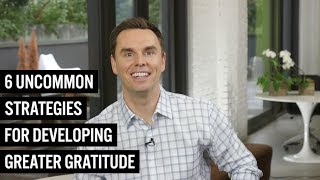
Brendon Burchard shares six ways to build gratitude that actually stick: cut complaints and gossip, read biographies for perspective, volunteer, talk about luck, notice beauty, and write handwritten love letters. He includes a 10-day no-complaint challenge to start.
Chapters
Hey, guys, it's Brendon Burchard. And welcome to another episode of the Brendon show. Hey. In this one, I'm really excited to share with you a conversation about developing a higher level of gratitude and positivity in your life and how to do that in uncommon ways. Look, I know you already know you should have a gratitude journal and you should be thankful and the world is good. But how do you really develop that so that it sticks? Is the conversation of this week's episode. So I've got six strategies, and we're gonna jump into these, and I really want you to write these down. So make sure you have a journal and you just write it across the top of it. Six uncommon strategies for developing greater gratitude. Right. Six uncommon strategies for developing greater gratitude. Hopefully, some of these are common sense. But I'm going to ask you to do something today, and that is to rate yourself on how well you've been doing at these things. And when I ask you to rate yourself, I'm going to ask you to rate yourself on a scale of 1 to 10. 1. You suck at these things. You're terrible, and you know it. 10. You're so good at this. Other people see you as a role model. They're like, wow, this person's really figured out this part of their life. And so that's how I want you to rate yourself on each of these. We're going to jump into the very first uncommon strategy for developing greater gratitude right now. And here it is. Notice your complaints. Now. It's hard to be grateful for something and complaining at the same time. I know you know that, but what you'll also see is that it's easy today to get trapped in. Into this cycle that everybody's in of complaining, right? We complain about our leaders. We complain about our team. We complain about social media. We complain about television. We complain about the media. We complain about the traffic. We complain about the goals. We complain about the things not working. We complain about the inconveniences. And if you actually listen, and I want to really encourage you to do this, if you actually start listening for how often people complain, think you'll be stunned. And I think if you'll start listening to how often you complained, you'll be disparaged. You'll start going, I never realized I complained so much. And I'm not. I know it's making an assumption because I don't know you, and maybe you actually are some one of those people who. You score a 10. Here you go. Look, I'M very aware of my complaining. I don't complain. I keep a positive mindset. But I'm curious about how often you complain. Speaking it out loud, but also internal, right? We, a lot of us complain all day long in our brain. We might not say it to our spouse or our team, but we like, we think someone's talking to us and our mind goes, oh, here we go again. She's gonna say it again. I know it. I cannot believe it. And maybe we're not expressing it to her, but our mind's like, I can't believe this person here. And the complaint is inside. Those count. Notice you're complaining. It might not be what you're just saying. We always think of complaining as just the verbiage going out. It's also the thoughts spinning inside. So how often do you complain about your boss in your mind? How often do you complain about your work in your mind? How often do you complain about your spouse? How about those kids? How about the inconveniences that you have to face every day? How many times have you actually complained incessantly about politics in the last 12 months? My guess is it's been a lot because most of society is there. And, you know, I'm one of those people probably like you, who really loves human behavior. And so I'm one of those guys who I just love to sit and watch people at the airport or love to sit and watch people at cafes. And it is amazing how many people look and they're talking like this, this, that's their life. They look like that all the time. That's a complaining positive. You just know that is their complaining physiology. And I want to know what do you look like throughout the day? Do you look like you're complaining or that you look like you're happy? Because it's hard to do both at the same time. And so you need to notice your complaints. And when I say this, here's what I want you to do. Write down what are the three things you complain the most about? Is it traffic, politicians, your work? Garbage spouse. Garbage spouse. What is it? I want you to write it down. Just write it down like, these are the three things I complain the most about. And then I want you to set yourself a 10 day challenge. You don't get to complain about any of those things at all in the next 10 days. And if you do, if you hear yourself complaining about any of those things in the next 10 days, you need a consequence. And if you don't have one, a very popular one in Behavioral dynamics or in behavioral change is to make you donate something to somebody you don't like. So let's say you are a staunch Republican. Then, okay, you have to donate $100 per complaint to the Democratic Party if you're a staunch Democrat, $100 for each complaint to the Republican Party. If you just absolutely hate eating kale, you just hate kale. Every single time you complain. Bowl of kale right down your throat. You got to eat it. You don't get a choice. You need a negative consequence for all this complaining in your life. And the best thing is if you're watching this with family or friend members or family or team members for them to keep you accountable for this. Because, look, how easy is it to slip into complaining? But it's a slippery slope. You know it. There is a fine line between, you know, complaining once or twice a week to now complaining once or twice per day to complaining once or twice per morning to complaining once or twice per hour. Complaining is a very scary thing. It's kind of like if you start saying the F word a lot. Have you ever noticed, like, if you start. If you're around someone, they say the F word, they swear a lot, and now you do it so. So, like, casually. Well, complaining says like that. Number two. I like this one. Oh, it's so hard. Ready? Don't gossip. You got to stop. Gossip is a little bit different than complaining, right?
Complaining can just be negative.
Blah, blah, blah. Gossip is speaking about other people. And usually when we're gossiping, we're speaking about other people with an element of drama. Did you see what this celebrity did? Oh, my God. Did you hear that? You know, these co workers did this in the closet. Did you hear that? This happened over there. And we start saying all these things about other people. You know what? That happens. It starts. That is a slippery slope from gossip to complaining. It is such a fine line. And I've seen so many good people turn into bad people through gossip because gossip quickly tilts over to negativity. If you've been around me, you know, I rarely ever speak about other people at all unless it's a compliment. Very rarely do I talk about anything other people in my marketplace, other people in the major news or the media. I'm not a person that talks about other people unless I'm championing them. And I chose to do that because that was not what I was experiencing when I was first starting my career. There was so much gossip about other people in my industry. And I mean, from what they eat to where they're going out, to who they're hanging out with, to what they wear, to just the stupidest stuff. And listen, if you spend a lot of your time on stupid, you miss life's blessings. Isn't it true the more time you spend on stupid, meaningless things, the less time for noticing meaningful things isn't true. That's why we need you to get rid of gossip. Gossip is filler. And if there's filler of stupid in your life, of stupid conversations, of stupid gossip about other people, of reading those dumb magazines that add no value to your life or no value to education, and you're reading all the gossip rags and all the gossip tweeting and all the gossip, social media, every little thing that you're pulling from that, it is feeding your heart and your soul and it is a meal. And so if you're eating junk food all day, you have no room for health food. Make sense? And if you have no room for health food, you're never going to get healthier until you remove the unhealthy food. We can say all day long, cram kale down your throat. It's not going to make you healthier if you're still consuming the bad stuff. Well, this is what's happening for people. They're not feeling grateful and alive. They say, brendan, I just want to feel alive. And I say, well, then stop gossiping. Because gossip is junk food, right? It's filler. The more filler, the less room. So you got to think about it. Gossip is meaningless conversation about others, meaningless diatribes, conversations, interests about things that don't matter. The more things in your life that don't matter, the less room for those that do. Okay, number three, ladies and gentlemen. Such an uncommon strategy for developing greater gratitude. Maybe one of my favorite one, and this is something that, gosh, I wish more people would do, and that is read historical biographies of great leaders. Read historical biographies. You're like, wow, Brendan, this is really heating up. This is exciting stuff right here, buddy. But listen, listen. Do you know the number one reason I believe people aren't more grateful? What do you think it is? What's yours? What's the number one reason most people aren't grateful? Why don't you take a few minutes, a few moments, just think about it. My answer, if you ask me, is one simple word. Perspective. We lack gratitude because we lack perspective, right? We get caught in our comfortable lives. We where things aren't so dire for most people. Most people are getting through their day going by just fine. They might be struggling, but maybe they're not suffering at levels other people are. And what I have found in being deeply connected to history is how far we've come. It's pretty hard to complain about the world when you read history specifically. I like to read historical biographies of people because it shows you how far they came, how difficult of circumstances they were challenged with, and they kept rising up over and over and over again. It shows you their perspective of what they appreciated, what they fought and battled against. And it makes you realize that, you know, the traffic that you're facing in your nice, you know, relatively new SUV as you're taking the kids to a nice school ain't such a big deal. It shows you that, like, oh, you know, that tiny apartment that maybe you don't like, or you're not in love with that boy. It's a whole lot better than living in a tent city in a refugee camp. History gives us sort of perspective. It's, yeah, gosh, today was really stressful. We're not in war. There's not bombs dropping on our head. Right? There's so many. Gratitude gets deep with perspective. So here's another one. This will make you the happiest you've ever been in your entire life, and you're probably not doing it as much as you could. And that's this one. Volunteer. Americans used to volunteer a lot. Now very little. And outside of donations, you know, giving campaigns, Americans are volunteering less and less hours year after year after year after year. Now, some studies, by the way, would dispute that, but we do know that volunteer membership is down, right? Junior Achievement, Kiwanis, ymca, Rotary, Lions, all experiencing dramatic drops in membership over the last decades. And it's too bad, because community service and hours out in the community will make you happy. And so for you, you have to find what is something you can do in your community that allows you to volunteer for those who are less fortunate. Now, I'm not saying I want you to really listen to that. Volunteer for those less fortunate. I know that we can say, well, Brendan, I volunteered at the Modern Museum of Art to admit people. And I'm like, so you waited in. You help people, rich people, get admittance to a fancy museum. I don't diminish that in terms of volunteer experience, but I'm not sure that's going to make you that much more of a grateful person. I think you need to get in a soup kitchen, and you need to get around really poor people who are hungry and displaced and scared. Because when you get around that you appreciate your secure life. And I'm not saying everybody watching this, that we're all rich and everything's great and we're all privileged. Because I know a lot of people watch this. We're in personal development. We're trying to get better and improve the quality of our lives. So please don't make this a rich people versus poor people, poverty versus that. I'm just saying that for whatever level you're at, I guarantee there's a level there of those who are less fortunate than you are, get in their vicinity every single month in some type of volunteer activity. You'll find yourself. You won't complain as much, because sometimes we just got to see things to really feel them. And I think that the happiest people that I've met my entire life were volunteers. Next up. This is a good one. I like this one. Someone told me these two things, and it made a big difference. It was one of my first bosses, if I remember right. They said, how many of your discussions do you address luck and beauty? And this was their two things they gave me, and I really liked it. Luck and beauty. So how often do you say, I'm so lucky, honey, we're so lucky. We're so blessed. You know, look at. How did that turn out? That was so lucky. To acknowledge the coincidences of life that are blessings. Because there were things that came into your life that you didn't draw, you didn't attract. Nice, positive, wonderful things that are there for you. And people go, some people say, there's no luck, there's no coincidence. That's cool. But you can still talk about it that way. You can still acknowledge luck. My wife and I are constantly matter of fact, every time I get on a plane, right before the plane takes off, I'm always texting my wife and telling her that I feel like the luckiest man on the planet. And she always writes back, luckiest. That's like, we always are doing that with each other because we want each other to know that in any given circumstance, imagine if that plane I'm on crashes. I want her to know that I feel lucky for my life, that I felt blessed every moment that I was here on this planet. And it's important to me because that luck draws reference for life, right? Really important. But then beauty, too. Like, my wife is really good at pointing out beautiful things, whether it's a beautiful floral display or beautiful trees or beautiful sunset or beautiful rainbow. I mean, literally last night when I left this office, she texts a picture of a rainbow outside of our house. And she's really good at calling that out. But you could do that. Simple things, Little design things that are beautiful. Point those out. But here's the operative word. Discuss. There's one thing noticing the rainbow, and then there's another one telling 10 people, hey, guys, you see the rainbow different, right? One is just intellectual. Oh, it's pretty. The other one is putting the expression into the observation. And once you express the observation, remember, an expression is emotion. You feel more reverence for life. So think about all the conversations you've had in the last six months. How often do you talk about luck? How often did you talk about beauty? And if those aren't there, how could you expect to have a deeper level of gratitude? This is my last advanced strategy. And it's something that, ironically, I thought most people still did. And then I found out that most people don't. And that is write love letters. I want you to write love letters to your spouse, to your kids, to your aunts and. And to your uncles and to anyone you care about in your life. And I want you to write it with your hand. And they still make these things. What are they called? It's like this tube. And the tube's usually about yay long. And in the tube, there's a liquid. And what happens when you press this metal part of the liquid against this parchment paper? What happens is the liquid comes out onto the paper. I mean, it's amazing. Most people don't know that because they can't hold it because their hands are like this all the time. So if we could get you to stop typing because, you know when you're like this all the time, right? Or like this all the time, it's hard to hold a pen when you just can't ever talk to someone. You're still thumbing through something, but you're not holding the phone. Yeah, I know. You're like that. Lots of people are doing that. Put the phone down. Put the computer aside. Don't email them a thank you letter, a love letter. Write a letter to them like a love letter. Like, tell them why you appreciate them, why they're amazing, why they're extraordinary, why you're thankful for them. And write it. And. No, don't just do what I just said in five sentences. I'm appreciative of you. I'm thankful for you. Heart your name. No, do a little bit more than that. Write. Write a letter. Write a love letter. You know, there's something about the act of writing that changes people, and they know this from psychology tests too, is that when you make somebody write a letter of gratitude or a letter of love, it's very different emotional and, I'm sorry, brain activity than it is just typing it. It's very different when you're writing it. You're feeling it, right? And it's your art, it's your words. And on a piece of paper, it changes the game. So I want to challenge you to think about that. When's the last time you wrote a love letter to. If you have parents and they're still alive and you love them, write them a letter. If you have somebody who has really served you and taken care of you or role model something for you, write them a letter. If you've got that spouse and you haven't dropped her or him that note for a long time, stop waiting to write half a card on Valentine's and write them a real letter and do it more consistently. You will feel it. It will make you happy. And what happens? For a lot of people, the reason they're not gratitude is they lost the language of thankfulness, because what do they do? They go thank you, comma, and write their name. And that's their language of gratitude. So if you challenge yourself to write a 1, 2, 3, 4 page love letter to people, it broaden. It's like a challenge. And as you do that more and more and more as a challenge, it grows that muscle of gratitude and you get better at being grateful. I honor you for your continuing education, for your commitment to living the best life for you, your family, your career, that sense that inside you know you're very lucky to be here, that this moment is blessed, that we should all be grateful for every breath that we take in and that we should all be grateful for our family, our friends, and our opportunities to serve in the world. Go out there every single day and serve gratefully. Thanks, everybody. Thanks for watching.
Make sure you subscribe to my new podcast, the Brendon Show. It's available on itunes and Stitcher and wherever else you get your podcasts. And it's the exclusive place where I share my thoughts about life, about current events, about what I'm going through, about my advice for you, and as you seek to live an even more extraordinary life. It's called the Brendon show and it's available anywhere you get your podcast, so make sure you subscribe.
And if you're ready to take your.
Life to a whole new level, make sure you grab my book, High Performance, How Extraordinary People Become that Way. It's available on Amazon right now. And when you order your copy, you're really supporting my channel and the message. And you're also getting a book that will reveal to you 20 years of my research into what is it that.
Helps people go to a new level.
Of success in their life?
What does it really take?
What habits are proven to help you reach long term success in your career, your health, your personal life, your relationships? It's called High Performance Habits. How Extraordinary People Become that way. It's available on Amazon right now. And finally, make sure you subscribe to my channel so you get notifications every time I release a new video. And by subscribing, you support me, my message and this channel. So I'd really appreciate it. Make sure you hit subscribe.










